Showing posts with label Claire North. Show all posts

Tuesday, 18 April 2017

Book Review | The End of the Day by Claire North


At the end of the day, Death visits everyone. Right before that, Charlie does. Sometimes he is sent as a courtesy, sometimes as a warning. He never knows which.

You might meet him in a hospital, in a warzone, or at the scene of a traffic accident. Then again, you might meet him at the North Pole—he gets everywhere, our Charlie.

Would you shake him by the hand, take the gift he offers, or would you pay no attention to the words he says?

***

I've fallen for every one of Claire North's novels. The First Fifteen Lives of Harry August, Touch and The Sudden Appearance of Hope have between them broken my heart and expanded my mind. They've thrilled me and they've chilled me. By way of them I've been exposed to new places, new ideas—new ways of being, even. But if I had to level a single criticism against her thoughtful body of work, it would have to be directed at its measure, because whilst her texts have tackled a great many meaningful themes, not least the array of ways we determine identity, I've found North's literary positions a little non-committal.

That's not the case in The End of the Day. This is a book with something to say; something important, if I may. It's slow to start, and oddly episodic even when the plot has picked up; its characters come and go with next to no notice; it's difficult, and confusing, and contradictory—but that's what life is like, right? And the messy, maddening, magical gift of life we've all been given, that's what The End of the Day deals in: not death... although its principal perspective is on her payroll.

Like North's other novels, The End of the Day is a high concept travelogue of sorts, but this fiction's frequent flier is Charlie, and Charlie just got hired! He's to be the Harbinger of the foremost of the apocryphal horsemen, of which singular position Death gives this description:
The Harbinger is a mortal, a bridge between this world and the next. In the old days I used eagles, but people stopped paying attention to them after a while—just birds in he sky—[so] I switched to humans a few thousand years ago. One must move with the times. (pp.12-13)
North doesn't waste any time reinventing the wheel here. Death appears in any number of forms over the course of the story. Sometimes he's male and sometimes she isn't; from time to time she has a scythe; here and there, horns protrude from his lumpen skull. "In all other respects he was the figure she had known would come, the god of the underworld, exactly as the stories said he would be." (p.14)

Charlie, on the other hand, is just a puny human.

Tuesday, 7 June 2016

Book Review | The Sudden Appearance of Hope by Claire North


My name is Hope Arden, and you won't know who I am. But we've met before—a thousand times.

It started when I was sixteen years old.

A father forgetting to drive me to school. A mother setting the table for three, not four. A friend who looks at me and sees a stranger.

No matter what I do, the words I say, the crimes I commit, you will never remember who I am.

That makes my life difficult. It also makes me dangerous.

***

Life is complicated—not least because it's so frickin' unpredictable. But there are a few things you can be sure of. One day, you and I will die; come what may, there'll be plenty of taxes to pay along the way; and, as Isaac Newton concluded, for every action, an equal and opposite reaction will happen.

In real terms, that means that what we do dictates what is done to us. Hurt someone and you can expect to be hurt in turn. Make someone happy and perhaps they'll pay that happiness back. This behavioural balance relies on our ability to remember, however. Without that... well, what would you do if you knew the world would forget you?

You'd let loose, wouldn't you?

Hope Arden, for her part, does exactly that in Catherine Webb's third novel as Claire North, which, like Touch and The First Fifteen Lives of Harry August before it, is an engrossing, globe-trotting interrogation of identity that sits comfortably between Bourne and Buffy.
For a while after I'd been forgotten, I toyed with becoming a hitman. I pictured myself in leather jump suits, taking down my targets with a sniper rifle, my dark hair billowing in the wind. No cop could catch me; no one would know my name. I was sixteen years old, and had peculiar ideas about 'cool.'
Peculiar, to be sure, but so is Hope's very particular predicament.

You'd be forgiven for forgetting someone you see on the street; even someone you speak to, briefly. But neglect to remember your best mate and that relationship's in dire straits. Fail to recognise your son or your daughter and you've got a problem with a capital P. North's poor protagonist has had to deal with that every day since she came of age, in her every interaction with everyone she's ever met. Never mind the network of people she'd need to know her if she had a hope in hell of holding down a normal job: she's a complete stranger to her parents, and her closest friends look at her like an interloper.

It's a credit to her character, then, that Hope—"having no one else to know me, having no one to catch me or lift me up, tell me if I'm right or wrong, having no one to define the limits of me"—still holds the sanctity of human life in high regard. So scratch that career as an assassin.

Tuesday, 3 March 2015

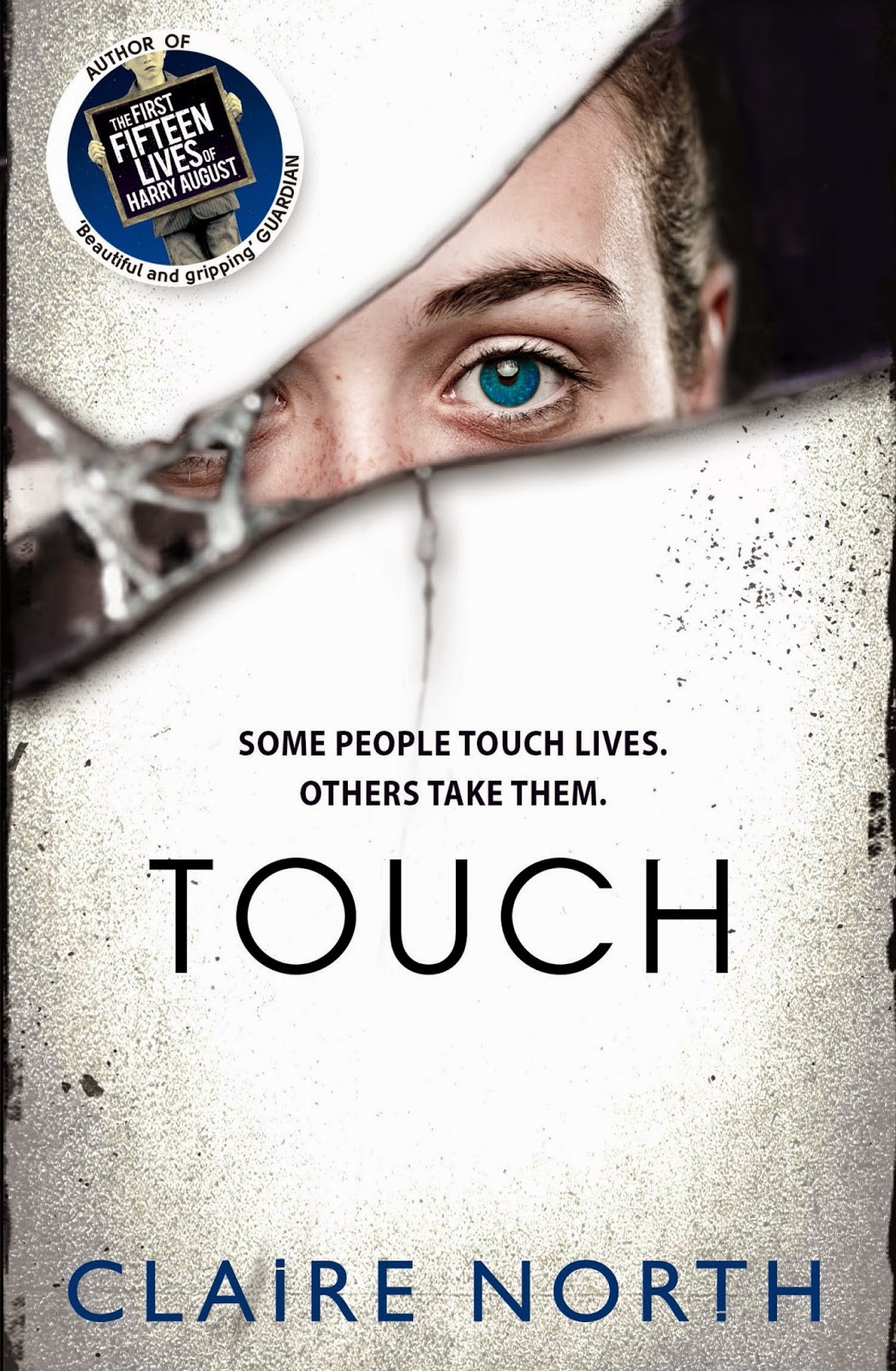
Book Review | Touch by Claire North


He tried to take my life. Instead I took his.

It was a long time ago. I remember it was dark, and I didn't see my killer until it was too late. As I died, my hand touched his. That's when the first switch took place.

Suddenly, I was looking through the eyes of my killer, and I was watching myself die.

Now switching is easy. I can jump from body to body, have any life, be anyone.

Some people touch lives. Others take them. I do both.

***

Fresh from the success of The First Fifteen Live of Harry August, Claire North—the second pseudonym (after Kate Griffin) of prose prodigy Catherine Webb—returns with Touch, a tremendously well-travelled science-fictional thriller that's as disturbing as its predecessor was delightful.

From word one we follow an ancient entity christened Kepler by its enemies; a continuous consciousness of some sort that at the moment of its first host's murder moved—much to its own amazement—into its murderer's mind, and took over his body to boot. Several so-called "skins" later, Kepler has a basic understanding of its situation; of its ability, in particular, to essentially possess a person—any person—with but a touch.

"I walk through people's lives and I steal what I find," Kepler confesses. "Their bodies, their time, their money, their friends, their lovers, their wives—I'll take it all, if I want to." (p.67)

Happily, our entity has attempted, over the centuries, to apply its power responsibly; to cause as little trauma as possible by sliding through the lives of others rather than trampling everything in its path; to recompense those who have played host to its essence, even. All things considered, Kepler seems to be a bit of a stand-up spirit... if spirit it is.

But of course it isn't the only being able to inhabit the bodies of bystanders, and some of the others have attracted the attention of an organisation dedicated to their destruction—an organisation that sends an assassin to kill Kepler in the frenetic first flush of Touch.

Monday, 7 April 2014

Book Review | The First Fifteen Lives of Harry August by Claire North


Harry August is on his deathbed. Again.

No matter what he does or the decisions he makes, when death comes, Harry always returns to where he began, a child with all the knowledge of a life he has already lived a dozen times before. Nothing ever changes.

Until now.

As Harry nears the end of his eleventh life, a little girl appears at his bedside. "I nearly missed you, Doctor August," she says. "I need to send a message. It has come down from child to adult, passed back through generations from a thousand years forward in time. The world is ending, and we cannot prevent it. So now it's up to you."

This is the story of what Harry does next, and what he did before, and how he tries to save a past he cannot change and a future he cannot allow.

***

You will die, one day. As will I. Our time will come, and we will go. As the most memorable character in Claire North's astonishing novel notes, that is "the fundamental rule of this universe. The very nature of life is that it must end." (p.235)

Many of us spend our days denying death, yes, but whether it is conscious knowledge or not, the inescapable fact that the worst will occur factors into our every decision. The paths we take, the choices we make—all are dictated by the finiteness of our futures. With just one life to live, our achievements are all the more meaningful. With no guarantee, really, that there's more than this, our mistakes have to matter.

But what if they didn't? What if death were not the end? What if there were... exceptions?

According to North, they're called "kalachakra," or "ouroborans," (p.41) and Harry August—whose first fifteen lives this dense text documents—is one of an exclusive few: an immortal among us, blessed—or cursed, depending on your perspective—to be born again... and again... and again.

Friday, 7 March 2014

Quoth the Scotsman | Claire North on The Theory of Everything

You'll have heard about Harry August: the title character of a nearly-here novel by someone calling herself Claire North. Furthermore, you may be aware that the first book to feature the fellow documents the highlights of his first fifteen lives—he's an immortal, after all, both blessed and cursed to live his life again and again until who knows when.


What you might not know is whether The First Fifteen Lives of Harry August is truly any good, or just the latest in a long line of debuts perpetually pitched as the next next big thing. Well. Consider this confirmation: The First Fifteen Lives of Harry August is an extraordinary novel, as the publicity has promised. I'll be reviewing it in full at a later date, but for today, a quick quote.

It takes the form of a discussion between our protagonist and his friend and fellow academic, and it touches on two topics I've been dealing with whilst teaching recently: the inadequacy of studying any one subject without others to temper our learning, as well as the question of academic success versus actual education. Here, Harry's helping Vincent figure out his final year thesis:
The turning of the stars in the heavens, the breaking of the atoms of existence, the bending of light in our sky, the rolling of electromagnetic waves through our very bodies...
"Yes yes yes." He flapped his hands. "That's all important! But ten thousand words of thesis is... well, it's nothing. And then there's this assumption that I should focus on one thing along, as if it's possible to comprehend the structure of the sun without truly understanding the nature of atomic behaviour!"
Here it was again, the familiar rant.
"We talk about a theory of everything," he spat, "as if it were a thing which will just be discovered overnight. As if a second Einstein will one day sit up in his bed and exclaim, "Mein Gott! Ich habe es gesehen!" and that's it, the universe comprehended. I find it offensive, genuinely offensive, to think that the solution is going to be found in numbers, or in atoms, or in great galactic forces—as if our petty academia could truly comprehend on a single side of A4 the structure of the universe. X = Y. we seem to say; one day there will be a theory of everything and then we can stop. We'll have won—all things will be known. Codswallop." 
"Codswallop?" 
"Codswallop and barney," he agreed firmly, "to paraphrase Dr Johnson." 
Perhaps, I suggested, the fate of the universe could briefly take second place to the thorny issue of graduating with honours? 
He blew loudly between his lips, a liquid sound of contempt. "That," he exclaimed, "is precisely what's wrong with academics." (p.190)
The First Fifteen Lives of Harry August will be published by Orbit on April 8th, and you really need to read it: it's as good as guaranteed to be of the best books of the year.