Showing posts with label ghost stories. Show all posts

Thursday, 19 October 2017

Book Review | Release by Patrick Ness


Adam Thorn doesn’t know it yet, but today will change his life.

Between his religious family, a deeply unpleasant ultimatum from his boss, and his own unrequited love for his sort-of ex, Enzo, it seems as though Adam’s life is falling apart. At least he has two people to keep him sane: his new boyfriend (he does love Linus, doesn’t he?) and his best friend, Angela.

But all day long, old memories and new heartaches come crashing together, throwing Adam’s life into chaos. The bindings of his world are coming untied one by one; yet in spite of everything he has to let go, he may also find freedom in the release.

***

Happy as I hope we all are, on the whole, I expect each and every one of us has lived through a few bad days too.

Now I don't mean those days when we have to deal with death or ill health or anything actively awful. I'm talking about those days that just suck a bunch; those days when nothing seems to go your way. Maybe it starts with a letter from the taxman and spirals up, up and away from there. Maybe the milk is spoiled so you can't have your morning coffee. Maybe traffic makes you late for work even though you left early. Whatever the particulars, these are the days when everything that can go wrong does go wrong, and damn your plans.

These days doesn't destroy us, because we're reasonably well adjusted human beings. Tomorrow's another day, we tell ourselves. It's not like the world is ending or anything. But it is in Patrick Ness' ninth novel. Like The Rest of Us Just Live Here and More Than This before it, Release is a smart and sensitive standalone story that mixes the mundane with the magical in order to underscore the extraordinary qualities of the ordinary. It's a brief book about a bad day as bold and as beautiful as any finely-honed tome about the rise of Rome.

The bad day I've been banging on about is had herein by a young man called Adam Thorn. Adam is a pretty typical kid. He's never done drugs or caught an STD or seen a psychiatrist or displeased the police. He probably did decently at school, and he's definitely been holding down an alright job at a warehouse run by an Evil International Mega-Conglomerate in the several years since. He doesn't deserve to be miserable, but he is—in large part because of his family.

They fuck us up, our families! They don't mean to, but they do, and Adam's family is no exception to that regrettable rule. His father's a pastor at The House Upon the Rock, his mother is Big Brian Thorn's number one one fan, and his older brother Marty does God's Work as well. Naturally, none of these things should stop them from caring for Adam like a good family would, except that he's gay, and with this, they are not okay. "There was always a wound, it seemed, kept freshly opened by a family who also kept saying they loved him."

Tuesday, 15 November 2016

Book Review | Thin Air by Michelle Paver


The Himalayas, 1935.

Kangchenjunga. Third-highest peak on earth. Greatest killer of them all.

Five Englishmen set off from Darjeeling, determined to conquer the sacred summit. But courage can only take them so far—and the mountain is not their only foe.

As the wind dies, the dread grows. Mountain sickness. The horrors of extreme altitude. A past that will not stay buried.

And sometimes, the truth does not set you free.

***

It was on the back of the award-winning, six-part Chronicles of Ancient Darkness that Michelle Paver put out Dark Matter. A ghost story inspired by her lifelong love of the Arctic, it attracted flattering comparisons to the work of such giants of the genre as M. R. James and Susan Hill, and became, before long, a bona fide bestseller.

That the author has now turned her hand to another tale in the same vise-like vein can hardly be seen as surprising; what can is the fact that it's taken her six years and another complete children's series, namely the Gods and Warriors novels. But given the strength of Thin Air, a short, stirring and altogether masterful narrative set on the sheer slopes of the world's third-highest hill, if it takes another decade for Paver to perfect its successor, that's a decade I'll be willing to wait.

It's 1935, and mountaineering has the nation by the nape. Our protagonist Stephen Pearce has always been a keen climber, but he certainly wasn't supposed to be conquering Kangchenjunga this spring. He was meant to be getting married and starting a family, but something about the life he could see stretched out ahead of him—and the death, yes—didn't feel quite right, so when his big brother Kits basically begged him to follow in the footsteps of Edmund Lyell on an expedition up one of the Himalaya's highest peaks, Stephen said yes.

Yet Kits' request wasn't exactly selfless. He needed a medic for the expedition to go ahead, and if securing one meant upending his younger sibling's entire existence, then that was a price Kits was only too happy to pay to win the day. As Stephen reasons:
I know my brother. A couple of years ago, someone came upon Irvine's ice axe on Everest's north-west ridge, and Kits sulked for weeks. Why wasn't he the one to find it and get all the glory? That's what he's after now: relics of the Lyell Expedition; and a chance to complete what the great man began, by being the first in the world to conquer an eight thousand-metre peak—with the added lustre of planting the Union Jack on the summit, and beating the bloody Germans. (p.19)
Brothers they may be, but Stephen and Kits haven't always—or even often—gotten on, and for all that they're on their best behaviour at the outset of the trek, as the weather closes in and things threaten to get grim, the tension between them fairly flares.

Thursday, 18 August 2016

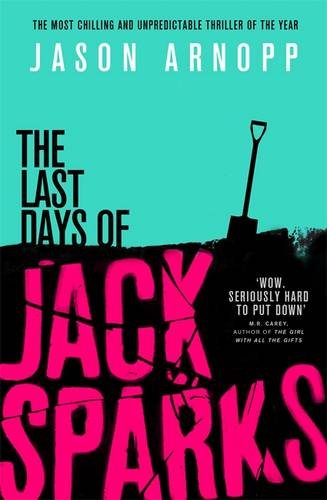
Book Review | The Last Days of Jack Sparks by Jason Arnopp


Jack Sparks died while writing this book.

It was no secret that journalist Jack Sparks had been researching the occult for his new book. No stranger to controversy, he'd already triggered a furious Twitter storm by mocking an exorcism he witnessed. Then there was that video: forty seconds of chilling footage that Jack repeatedly claimed was not of his making, yet was posted from his own YouTube account. 

Nobody knew what happened to Jack in the days that followed—until now.

***

If Hunter S. Thompson had written a Blair Witch tie-in, it might have looked a little something like this. A gonzo ghost story that trades in unreliable narration and drug-fuelled devastation, The Last Days of Jack Sparks marks the original fiction debut of music journalist and now novelist Jason Arnopp, and has as its central character a man who made his name writing for the NME before properly letting loose in a few bestselling books.

That's where the similarities between the author and the authored end, however. I have reason to believe that Jason Arnopp is a genuinely decent human being, whereas Jack Sparks is an egotistical twit who, for his first trick, travelled the length and breadth of Great Britain on a pogo stick, offending everyone he encountered equally. Since then, he's gobbled up gang culture and gotten close to a couple of Class A chemical concoctions, with similarly repugnant results.

Now, for his new novel, he's set his sights on a Halloween theme. Could ghosts really be real? Our intrepid reporter wants to know. So much so that Jack Sparks on the Supernatural will be his last book, because he died, quite violently, while writing it.

We learn this thanks to Jack Sparks' estranged brother Alastair, who footnotes and provides a foreword for the first draft of the found fiction that follows:
The decision to publish Jack Sparks on the Supernatural in its entirely uncensored form was in no way taken lightly, and I know how very difficult it is for the bereaved to read accounts of such horrendous events. Yet I also hope this book may yield some form of closure and put an end to unhelpful internet speculation—not least concerning the nature of my brother's death. (p.8)
Be warned, though, that Alastair's intentions might not be so wholly noble. "Believe me," he begs—but why should we? There's something defensive, dare I say desperate, about his abrupt introduction. And not long later, we learn that he and his brother weren't even on speaking terms towards the end of Jack's tenure. Might Alastair have an axe of his own to grind?

Jack indubitably does. He's a man on a mission at the outset of his ultimate effort: not to find evidence of things that go bump in the night, but to disprove every indication that they may. To wit, he sits in on an exorcism in Italy; laughs out loud as he live-tweets it, even. What he sees that day is hard to explain away, but Jack is determined to do so, or die trying.

Monday, 2 May 2016

Book Review | Hex by Thomas Olde Heuvelt


Welcome to Black Spring, the seemingly picturesque Hudson Valley town haunted by the Black Rock Witch, a seventeenth-century woman whose eyes and mouth are sewn shut. Blind and silenced, she walks the streets and enters homes at will. She stands next to children's beds for nights on end. So accustomed to her have the townsfolk become that they often forget she's there. Or what a threat she poses. Because if the stitches are ever cut open, the story goes, the whole town will die.

The curse must not be allowed to spread. The elders of Black Spring have used high-tech surveillance to quarantine the town. Frustrated with being kept in lockdown, the town's teenagers decide to break the strict regulations and go viral with the haunting. But, in so doing, they send the town spiraling into a dark nightmare.

***

An ancient, archetypal evil meets a miscellany of modern motfis—such as surveillance and social media—in HEX, the first of Dutch wunderkind Thomas Olde Heuvelt's five genre novels (of which this is the fifth) to be translated into the English language.

You may well have heard of the aforementioned author already; after all, he won the Hugo Award for Best Novelette in 2015, and was nominated for another unsettling short story, 'The Boy Who Cast No Shadow,' two years previously. HEX is long-form horror, however, and long-form horror is hard, not least because the unknowable, on the back of which so much such fiction is built, can only remain so for so long before folks get sick and tired of not knowing.

Yet in HEX, we know what would be unknowable in most horror novels from the get-go: the cause and the consequences of the ghost that has haunted the heart of the Hudson Valley for hundreds of years. We know her name and approximate age:
"It was in Black Spring that [Katherine van Wyler] was sentenced to death for witchcraft in 1664—although they didn't call it Black Spring back then; it was a Dutch trappers' colony known as New Beeck—and it's here in Black Spring that she's remained." (p.63)
It's even worse than that, though. This too we know; that before the noose was wrapped around her neck—as "an act of mercy," (p68) if you can credit it—Katherine was made to murder her own son in order to save her dearest daughter. Little wonder, then, that she's been making life difficult for the residents of Black Spring since; so difficult that an infrastructure unlike any other has had to be erected around her.

Wednesday, 10 February 2016

Book Review | Medusa's Web by Tim Powers


In the wake of their Aunt Amity's suicide, Scott and Madeline Madden are summoned to Caveat, the eerie, decaying mansion in the Hollywood hills in which they were raised. But their decadent and reclusive cousins, the malicious wheelchair-bound Claimayne and his sister, Ariel, do not welcome Scott and Madeline's return to the childhood home they once shared. While Scott desperately wants to go back to their shabby south of Sunset lives, he cannot pry his sister away from this old house that is a conduit for the supernatural. 

Decorated by bits salvaged from old hotels and movie sets, Caveat hides a dark family secret that stretches back to the golden days of Rudolph Valentino and the silent film stars. A collection of hypnotic abstract images inked on paper allows the Maddens to briefly fragment and flatten time—to transport themselves into the past and future in visions that are both puzzling and terrifying. 

As Madeline falls more completely under Caveat's spell, Scott must fight to protect her. But will he unravel the mystery of the Madden family's past and finally free them... or be pulled deeper into their deadly web?

***

Damn near a decade since his last standalone, two-time Philip K. Dick Award winner Tim Powers paints a characteristically trippy picture of modern Hollywood in Medusa's Web, a tense time-travel thriller about addiction and the fault lines that families straddle. 

The far-from-happy family at the heart of this narrative are the Maddens, under ancient Aunt Amity—a half-mad matriarch and erstwhile author who owns the deteriorating estate where the bulk of Powers' tale takes place:
Madeline had moved out of Caveat seven years ago, leaving her aunt with Ariel and Claimayne and the solitary writing of her endless unpublishable novels. Scott had left six years before that, to get married, though when that Louise woman left him he hadn't moved back in. (p.58)
Neither Madeline, an astrologer, nor Scott, an artist, had planned to come back to the moldering mansion they left so long ago, but Amity Madden's explosive suicide necessitates a reassessment. Her hastily-written last will stipulates that this house in the Hills is theirs to do what they want with if they can stomach spending a week within its walls—so home they go, much to Ariel and Claimayne's dismay.

Although Caveat has certainly seen better days, Ariel and Claimayne see it as their hard-earned inheritance. Understandably, then, they do everything in their power to drive Scott and Madeline away... until the same secret that tore the Maddens apart to start—a stash of so-called "spiders"—resurfaces, endangering everyone in the property in the process.

Friday, 6 November 2015

Book Review | Slade House by David Mitchell


Turn down Slade Alley—narrow, dank and easy to miss, even when you're looking for it. Find the small black iron door set into the right-hand wall. No handle, no keyhole, but at your touch it swings open. Enter the sunlit garden of an old house that doesn't quite make sense; too grand for the shabby neighbourhood, too large for the space it occupies.

A stranger greets you by name and invites you inside. At first, you won't want to leave. Later, you'll find that you can't.

This unnerving, taut and intricately woven tale by one of our most original and bewitching writers begins in 1979 and reaches its turbulent conclusion around Hallowe'en, 2015. Because every nine years, on the last Saturday of October, a 'guest' is summoned to Slade House. But why has that person been chosen, by whom and for what purpose?

The answers lie waiting in the long attic, at the top of the stairs...

***

Though there have ever been elements of the speculative in David Mitchell's fiction, his Man Booker Prize longlisted-last, released in 2014, was the first to fully embrace the form. Section by section, The Bone Clocks revealed itself to be "a soaring supernatural sextet" somewhat taken with time travel and very interested indeed in immortality. Unfortunately, the protracted finale of Mitchell's sixth made a middling meal of the same fantastical flourishes that had been so appealing when presented with more measure—an oversight I'm pleased to say he sets right in his laconic new novel.

Comprised of a collection of interlinked short stories, Slade House shares a world with The Bone Clocks—such that the Shaded Way has a pivotal role to play and Spot the Horologist is the game of the day—but where said setting was once an expansive canvas spattered with the stuff of science fiction, in this book it becomes the close-cropped backdrop of a hypnotic history of haunting.

For all that it has in common with The Bone ClocksSlade House's characters and narrative notions are its own—excepting, perhaps, the presence of little Nathan Bishop, the central character of the first section of this text: an extended version of the same short Mitchell shared by way of the "diabolical treble-strapped textual straitjacket" of Twitter in the lead up to the publication of its predecessor. 

Reiterated, 'The Right Sort' does not stop with Nathan lost in the gorgeous grounds of Slade House, which, like the text itself, are basically "a board game co-designed by M. C. Escher on a bender and Stephen King in a fever." (p.119) Instead, he ends up in the Victorian property proper, where the owners, Norah and Jonah, proceed to essentially sup his soul.

"It's not as if Norah and Jonah go 'Wooooooh' or drip ectoplasm or write scary messages in mirrors," (p.63) but they are, as it happens, as good as ghosts—or rather as bad.

Friday, 29 May 2015

Book Review | Day Four by Sarah Lotz


Four days into a five day singles cruise on the Gulf of Mexico, the ageing ship Beautiful Dreamer stops dead in the water. With no electricity and no cellular signals, the passengers and crew have no way to call for help. But everyone is certain that rescue teams will come looking for them soon. All they have to do is wait.

That is, until the toilets stop working and the food begins to run out. Then, when the body of a woman is discovered in her cabin, the passengers start to panic. There's a murderer on board the Beautiful Dreamer... and maybe something worse.

***

Got an appetite for good food? Hungry for some unforgettable fun?

If you answered yes to those questions, then Foveros Cruises is beside itself with excitement to invite you to spend a week on the sparkling seas aboard The Beautiful Dreamer—a once in a lifetime opportunity to get to know North America's number one psychic, Celine del Ray.

That's not all this holiday has to offer, either:
Soak up the sun during one of our many exciting excursions, where you can shop till your drop at our many concessions, snorkel in turquoise seas, horse-ride along beautiful beaches, and enjoy al fresco dining on our fabulous private island. 
Sounds like a fine way to spend a few days, doesn't it? Folks: don't be fooled. The Beautiful Dreamer might be a luxury liner, but Day Four describes a holiday from hell—and not just because of the bad buffet.

The first three days of the cruise are "relatively uneventful." (p.3) The ship makes a few stops in a few choice spots. The holidaymakers get to stretch their legs. They're well fed, and entertained in the interim. The WTF only hits the fan on day four, when a fire ravages the engine room, stranding The Beautiful Dreamer at sea.

The next thing the three thousand-some souls aboard know, the power goes out, taking access to the internet with it—and for some reason the radio also stops responding. Essentially, every thread connecting the ship to the world as we know it is suddenly severed.

Tuesday, 3 March 2015

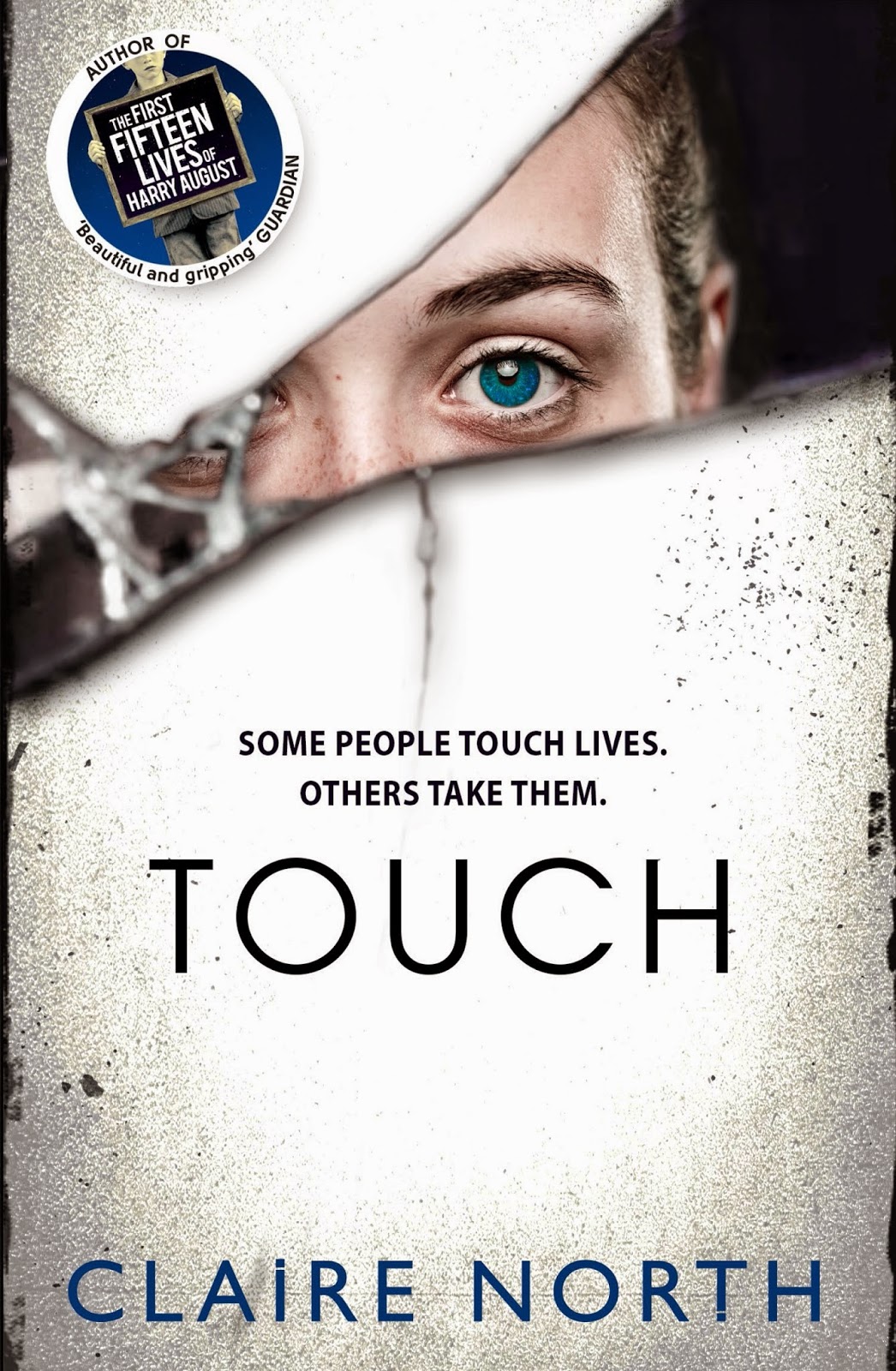
Book Review | Touch by Claire North


He tried to take my life. Instead I took his.

It was a long time ago. I remember it was dark, and I didn't see my killer until it was too late. As I died, my hand touched his. That's when the first switch took place.

Suddenly, I was looking through the eyes of my killer, and I was watching myself die.

Now switching is easy. I can jump from body to body, have any life, be anyone.

Some people touch lives. Others take them. I do both.

***

Fresh from the success of The First Fifteen Live of Harry August, Claire North—the second pseudonym (after Kate Griffin) of prose prodigy Catherine Webb—returns with Touch, a tremendously well-travelled science-fictional thriller that's as disturbing as its predecessor was delightful.

From word one we follow an ancient entity christened Kepler by its enemies; a continuous consciousness of some sort that at the moment of its first host's murder moved—much to its own amazement—into its murderer's mind, and took over his body to boot. Several so-called "skins" later, Kepler has a basic understanding of its situation; of its ability, in particular, to essentially possess a person—any person—with but a touch.

"I walk through people's lives and I steal what I find," Kepler confesses. "Their bodies, their time, their money, their friends, their lovers, their wives—I'll take it all, if I want to." (p.67)

Happily, our entity has attempted, over the centuries, to apply its power responsibly; to cause as little trauma as possible by sliding through the lives of others rather than trampling everything in its path; to recompense those who have played host to its essence, even. All things considered, Kepler seems to be a bit of a stand-up spirit... if spirit it is.

But of course it isn't the only being able to inhabit the bodies of bystanders, and some of the others have attracted the attention of an organisation dedicated to their destruction—an organisation that sends an assassin to kill Kepler in the frenetic first flush of Touch.

Thursday, 13 November 2014

Book Review | Wakening the Crow by Stephen Gregory


On a freezing night in January bookshop owner Oliver Gooch and his small daughter Chloe come across the crow, a raggedy skeletal wretch of a bird, which takes up a persistent refuge in their new converted church home.

Oliver took the money for the church from his daughter’s accident insurance. Chloe, once a rambunctious and defiant child, is now a silently smiling companion to Oliver; both a gift and curse as Oliver balances his guilt over her accident with his preference for this new, easy-to-manage child.

As the crow begins to infiltrate their lives it changes something in Oliver and Chloe. How is the crow connected to the boyhood tooth of Edgar Allan Poe, a mysterious gift to Oliver from which his bookshop draws its name, and with what purpose does it haunt the gloomy, fire-lit vestry of Poe’s Tooth Books?

***

Stephen Gregory pulls precisely none of his punches in Wakening the Crow, a darkly fantastic fiction about family which, like The Waking That Kills before it, is interested in the ties that bind us together largely because these lead to the lies that drive us apart.

Oliver Gooch is "a dabbler and a dilettante," someone who would "always procrastinate if there was an easier option," (p.95) and this past year, there has been. He and Rosie, his hard-working wife, have come into a substantial sum of money—enough, though the numbers go undisclosed, to purchase a church: an old Anglican in one of Nottingham's nicer suburbs.

"No, not the whole building," Gooch is quick to qualify. "As the congregation had dwindled to almost nothing, the commissioners had closed the church and sold it as two parcels. The body of the building was now a furniture warehouse. We'd bought the tower," to live in, and the vestry as well—a very special space our protagonist plans to turn into a bookshop. Specifically "a specialist outlet of strange and occult and arcane books. The shop I'd daydreamed foolishly about having." (p.27)

Now he's in a position to realise those same daydreams, you'd think he'd be happy, but how Gooch found himself here—the appalling cost of it—haunts him. Him and Rosie both. After all, they bought what they've got with blood money; with an insurance payout made after their daughter was brain-damaged in a car accident:
She wasn't the sly, defiant, occasionally foul-mouthed Chloe she'd been before. She couldn't speak. She couldn't read. She just smiled. She blinked and she smiled, in utter, blank, angelic silence. She was lovely, in the same way that a soft and harmless Labrador dog is lovely, but she was altered completely. (p.23)
For the better, in Gooch's book.

Monday, 27 October 2014

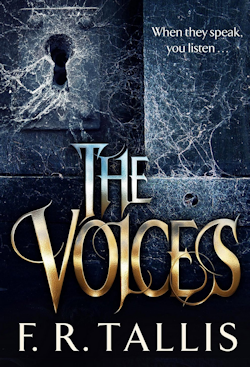
Book Review | The Voices by F. R. Tallis


In the scorching summer of 1976—the hottest since records began—Christopher Norton, his wife Laura and their young daughter Faye settle into their new home in north London. The faded glory of the Victorian house is the perfect place for Norton, a composer of film soundtracks, to build a recording studio of his own.

But soon in the long, oppressively hot nights, Laura begins to hear something through the crackle of the baby monitor. First, a knocking sound. Then come the voices...

***

Maybe you haven't heard of it—maybe you weren't born yet; maybe you're based elsewhere—but in Great Britain, the summer of 1976 went down in history. It was the hottest single season since records began some 400 years ago, and people in these parts weren't prepared. There were droughts. Deaths.

It was an indescribably violent time, all told. Hate crimes were a daily affair many commentators attributed to the incredible temperatures. "What a world to bring a child into," (p.1) as our couple comments on the first page of F. R. Tallis' haunting new novel. But that's exactly what Christopher and Laura Norton plan to do. Indeed, on the day they decide to spend their once-substantial savings on "a substantial Victorian edifice [...] concealed in a pocket of London's complex topography," (pp.1-2) their infant daughter is born. They name her Faye, meaning belief—which, though they have in her, they lack, alas, in one another.

A year later, the Nortons have settled into their new property nicely, but things between Faye's parents have gone to pot in short order, and a terror more malignant than the recent uptick in temperature is about to make its malevolent presence felt.

After The Sleep Room's success, it's a smart move on Tallis' part to focus in his new novel on another pseudo-scientific subject—in this instance Electronic Voice Phenomena. "It seemed a ludicrous idea, the dead communicating with the living through the medium of magnetic tape, but at the same time Christopher's mind was not entirely closed to extraordinary possibilities." (p.83) As an explanation for the voices he's been hearing recently—voices accidentally recorded in the course of composing the score for a forthcoming science fiction film—EVP isn't ideal, but it's the best of a bad lot... and rather that than face the fact that he might be losing his mind.

Friday, 3 October 2014

Book Review | The End of the Sentence by Maria Dahvana Headley & Kat Howard


It begins with a letter from a prisoner...

As he attempts to rebuild his life in rural Oregon after a tragic accident, Malcolm Mays finds himself corresponding with Dusha Chuchonnyhoof, a mysterious entity who claims to be the owner of Malcolm's house, jailed unjustly for 117 years. The prisoner demands that Malcolm perform a gory, bewildering task for him. As the clock ticks toward Dusha's release, Malcolm must attempt to find out whether he's assisting a murderer or an innocent. The End of the Sentence combines Kalapuya, Welsh, Scottish and Norse mythology, with a dark imagined history of the hidden corners of the American West.

Maria Dahvana Headley and Kat Howard have forged a fairytale of ghosts and guilt, literary horror blended with the visuals of Jean Cocteau, failed executions, shapeshifting goblins, and magical blacksmithery. In Chuchonnyhoof, they've created a new kind of Beast, longing, centuries later, for Beauty.

***

In the aftermath of a tragic accident that made a mess of his marriage, Malcolm Mays retreats to rural Oregon in an attempt to begin again, however he gets more than he bargained for when he moves into a foreclosed home in Ione.

In a sense he inherits its former occupant, a convicted criminal called Dusha Chuchonnyhoof who—having been unjustly jailed for two lifetimes and a day, he says—is preparing to reclaim his property. "The homeowner is only absent, you must understand. Not gone. The end of the sentence approaches [...] and when it comes, I will return." (p.15)

This much Malcolm is made aware of—this much and no more, for the moment—through the letters that mysteriously appear in and around the house. Letters sent, evidently, from the nearby penitentiary, bidding him welcome... but how can that be when he hasn't announced his presence to anyone? Other letters are delivered later: missives urging our man to prepare the place for Chuchonnyhoof's homecoming... despite the fact that the felon in question has been dead for half a century.

Malcolm has no intention of doing what the letters advise, but, as if sensing his resistance, Chuchonnyhoof—or else the degenerate purporting to be Chuchonnyhoof—promises to make it worth his while. How? By bringing his lost boy back from the beyond. "If you do as I tell you to do, he will return when I do. If you do not," warns one of the murderer's many messages, "he will remain where you left him." (p.38)

Monday, 29 September 2014

Book Review | Afterworlds by Scott Westerfeld


Darcy Patel has put college on hold to publish her teen novel, Afterworlds. With a contract in hand, she arrives in New York City with no apartment, no friends, and all the wrong clothes. But lucky for Darcy, she’s taken under the wings of other seasoned and fledgling writers who help her navigate the city and the world of writing and publishing. Over the course of a year, Darcy finishes her book, faces critique, and falls in love.

Woven into Darcy’s personal story is her novel, Afterworlds, a suspenseful thriller about a teen who slips into the “Afterworld” to survive a terrorist attack. The Afterworld is a place between the living and the dead, and where many unsolved—and terrifying—stories need to be reconciled. Like Darcy, Lizzie too falls in love... until a new threat resurfaces, and her special gifts may not be enough to protect those she cares about most.

***

As someone somewhen almost certainly said, the story is the thing... and it is, isn't it? Most readers read in order to know what happens next—to these characters or that narrative—rather than out of interest in much of anything outwith a given fiction; assuredly not the particular process of authors, though after Afterworlds, I've begun to wonder whether we mightn't be missing a trick.

A twofold story about storytelling, Scott Westerfeld's insightful new novel alternates between a pair of coming of age tales. In one, we meet Lizzie: a typical teenager, to begin with, who's too busy texting to notice the start of a terrorist attack:
I'd never heard an automatic weapon in real life before. It was somehow too loud for my ears to register, not so much a sound as the air ripping around me, a shudder I could feel in my bones and in the liquid of my eyes. I looked up from my phone and stared. 
The gunmen didn't look human. They wore horror movie masks, and smoke flowed around them as they swung their aim across the crowd. [...] I didn't hear the screams until the terrorists paused to reload. (pp.5-6)
Luckily, Lizzie comes to her senses eventually. As quietly as she can, she calls 911 as the bullets fly by. The operator on the other end of the telephone tells Lizzie her best bet is to play dead, and in lieu of a safer location, she does exactly that.

A touch too well, in truth, because she faints, and awakens in another world. There, in the land of the no longer living—a grayscale place where "the air [tastes] flat and metallic" (p.20)—she promptly falls for a foxy psychopomp:
These terrorists had tried to kill me but I'd gone to the land of the dead and now could see ghosts and apparently had acquired dangerous new powers and this boy, this boy had touched my fingertips—and they still tingled. (p.76)
In the aftermath of the attack, it beggars belief, a bit, that this boy is Lizzie's priority. Not the loss of so much life. Not her own nearness to nothing. Not even the realisation that she can move between worlds at will. Rather, Yamaraj, "a hot Vedic death god" (p.77) "modeled [...] on a Bollywood star" (p.121) by his faithless creator, debutant Darcy Patel.

Friday, 11 July 2014

Book Review | Touched by Joanna Briscoe


Rowena Crale and her family have moved from London. They now live in a small English village in a cottage which seems to be resisting all attempts at renovation. Walls ooze damp, stains come through layers of wallpaper, celings sag, and strange noises—voices—emanate from empty rooms.

As Rowena struggles with the upheaval of builders while trying to be a dutiful wife and a good mother to her young children, her life starts to disintegrate.

And then, one by one, her daughters go missing...

***

From the author of a selection of elegant bestsellers, not least the sensational Sleep With Me, comes a creepy period piece, positively drenched in dread, that documents an old-fashioned family’s decision to leave London for a crumbling cottage in the countryside.

For Rowena, mother and matriarch of the many and various Crales—including her dullard of a husband Douglas—the move is meant to demarcate a break from the bland patterns of the past, but from the first, the house seems set on rejecting its new tenants. A retaining wall can’t be broken through; a damp problem proves impossibly pervasive; and in the interim, “an impression she couldn’t pin down, that the house was already inhabited [...] overlaid with memories of all the years her mother-in-law had lived there,” (p11) eats away at Rowena.

It’ll be worth all the blood and sweat in the end, she tells herself. But that’s before her daughters start disappearing...
Numbers 2 and 3 The Farings were postcard cottages, age-softened and settled, with their deep-set windows and boxes of geraniums, their uneven floors and cool pantries, their small gardens tangles of mature flowers and shrubbery. The modern house in London had contained no soul, and little opportunity for her decorating dreams; The Farings, by contrast, possessed so much character, she found it hard to believe there weren’t other people there. That was why she was faintly nervy, she realised, imagining movement in other rooms, because it simply didn’t seem as though it was theirs yet. (p.29)
Initially, Rowena dismisses these feelings, insisting “it was her mind playing tricks, and she turned it off like a light switch,” (p.20) but they persist—and soon it seems one of her children is sensitive to them too. “This was Evangeline, who was dressed as a Victorian and had rain for hair. [...] She guttered in the others’ shining, blanked out by their shadows. Where the other Crales were clean with health and Jennifer was doll-beautiful, Evangeline was a grubby, transparent girl, dragging her feet and slipping away,” (p.6) quite literally latterly:
To explain the nature of Evangeline was difficult. Was she a backwards child? [...] Was she handicapped? A candidate for electroshock treatment? Evangeline did not fit easily into any category, and yet she was considered mentally subnormal by those who saw her slipping, murmuring, sliding through the village in her ghost frocks. The villagers had plenty to say to the police about Miss Evangeline Crale. (p.131)
But it’s as if she isn’t missed, in that no one other than Rowena really takes her disappearance seriously—and even she waits a few weeks before going to the police. It’s a whole other story when beautiful Jennifer follows in her inexplicable sister’s footsteps. Questions are asked and investigations urgently undertaken. The Pollards in particular are considered suspicious, but they’re practically friends of the family. They wouldn’t have hurt the girls, would they?

The trauma of all this turmoil is the ruination of Rowena. Her “dreams, already shattered, were irretrievable: it was the nightmare now that she fought.” (p.193) A nightmare that lives in The Farings with the remaining Crales...

Touched is a terrific little ghost story, to be sure—an exemplar of the short, smart shocks of horror Hammer-branded books have represented in recent years—but the narrative is not what makes it so special. Though it’s well handled on the whole, and very prettily written—Joanna Briscoe’s prose proved an unexpected pleasure—the twist the tale takes in its later stages is too transparently telegraphed to satisfy in the final summation, and there’s some unfortunate redundancy in the remainder.

Instead, what sets Touched apart are its central characters. Rowena is a brow-beaten broodmare—all too familiar a figure in Britain in the fifties and sixties—invested with such a sense of nervous energy that her eventual unravelling is essentially inevitable. Add to that unreliable protagonist a fantastic focal point for her frenzies in Evangeline, whose secret life—out of sight and out of mind—is superlatively rendered. 

Evangeline’s supposed disability is also deftly depicted, reflected as it is—if it is—by the harried or horrid reactions of others around her rather than her own entirely innocent idiosyncrasies:
Adults customarily shrank from her, ignored her, or addressed her like a simpleton. At her primary school, they had tied her to her chair to keep her in lessons, then tied her to another at lunch; but largely, she was allowed to disappear, and if people didn’t want her, such absences were her preference. (p.40)
It’s just a shame Evangeline is herself absent for such a large part of the narrative. Truth is, Touched is a touch less stimulating when she’s missing.

In a fascinating afterword, the author asserts that her “characters are all haunted by their pasts, their mistakes, their longings; pursued by guilt and desire so strong, it could infiltrate a life,” (p.242) and that’s clearly the case here, allowing anyone a way into Touched. To wit, this is an eminently accessible text, bolstered by a exquisitely composed story, but what makes it remarkable at the last is its juxtaposition of the genre’s foremost tropes—such as “houses in rebellion, secret rooms, figures glimpsed obliquely [and] unexplained smells” (ibid.)—with evils revealed to be markedly more mundane in nature.

***

Touched
by Joanna Briscoe

UK Publication: July 2014, Hammer Horror

Buy this book from
Amazon.co.uk / The Book Depository

Or get the Kindle edition

Recommended and Related Reading

Wednesday, 2 July 2014

Guest Post | "Ghost Writer" by Joanna Briscoe

My novels are all haunted, but I was the last to know it. 

Luckily, others were more astute, and I was asked by Arrow to write a novella for their Hammer imprint—a collaboration between Hammer Films and Random House publishers that has resulted in some of the most interesting short novels of the last few years. I loved Jeanette Winterson’s The Daylight Gate and Helen Dunmore’s The Great Coat, but when I was commissioned to write a novel with a supernatural aspect, I hadn’t read them, or any other adult ghost novel apart from The Turn of the Screw.

Or I thought I hadn’t. When I stop to think about some of my favourite literature—AS Byatt’s Possession; Toni Morrison’s Beloved; Rebecca; Jane Eyre—they are all pursued by ghosts in one way or another. And even more strangely, when I think about my own work, it is deeply haunted... While I was imagining howling apparitions in sheets, hauntings of a more subtle nature were staring me in the face. 


So in my first novel, Mothers and Other Lovers—which was in so many senses a classic rights-of-passage, semi-autobiographical first novel—I had plenty of ghosts to lay to rest! I think I had needed to look at childhood and my relationship with my mother, and how that had impacted on somewhat disastrous love life choices of that time... This is probably strictly the least haunted of my novels, but it was definitely about dealing with my demons. Several of them. Of course, straightforward autobiography rarely works as fiction, so it was a story, an invention, but I could never deny the true-to-life tale that had to get out.

My second, Skin, is the most shocking and in many ways worrying of my novels. It features a woman who is a victim of her own beauty and keeps having surgery to hold the years back. As each layer of her face is peeled away, more of her past is revealed. She herself is utterly haunted by her lost youth, and by her longing for one man who ultimately leaves her.

It’s that longing that really makes my novels haunted, I realise. I tend to write about obsessive, often dark and destructive yet highly addictive romantic or sexual desire, the longing itself more potent than the actual flawed relationship. In Sleep With Me, which was adapted by Andrew Davies as an ITV drama, the interloper, the unfathomable Sylvie, is frequently described as a ghost. In fact, the first line, which was used in the underground and train adverts, was "The day our child was conceived, someone else arrived. She was there as the cells fused, like a ghost."


The indications that I should write something more paranormal were screaming at me but still I didn’t notice! Reviewers even frequently described that novel as sinister, creepy, full of suspense, eerie, mesmerising and chilling... yet sometimes it still takes an outside eye to see what it is we should be doing.

My fourth novel, You, was all about a haunting of a different nature, though it was set in a large, creaking, thatched Devon house. In it, Cecilia is driven almost mad by the mistake she has made in the past in giving up a child for adoption. So haunted is she by it, she can almost think herself back into that time. In the meantime, the past is actually catching up with her in the form of that child, who has become a ghostly figure in her head but is actually all too real.

But this all took me to Touched, which is a finally novel that is decidedly and quite openly haunted! My first thought was a bright, bright—almost eerily bright—village green, and on that I saw a girl who dresses herself in Victorian clothes: shabby, faded, and decidedly odd. That was the starting point. Then I wondered about her mother, Rowena. Then I looked to her grandmother, and so the haunting began. In the meantime, Rowena, absolutely pursued by guilt, is developing her own very earthly passion for her intriguing neighbour, Gregory Dangerfield. Real life humans cause as many problems as the presences that haunt poor Rowena, while Rowena’s daughters have their own problems chasing them. And what is that face at the window, caught only in a split second film still? 


To me, with Touched, it was the perfection of the pretty village in which this family lives that was potentially eerie. And when they begin to attack the wall of their cottage to make a larger house, there is something not quite right going on, a sense of protest, of suffering. As ever, my characters are haunted by desire, longing, terrible guilt, and their past mistakes. But while they’re focusing on their own loves, lusts and shuddering regrets, less tangible apparitions gather in the margins. The spooks and spectres of the more plodding Victorian ghost stories don’t interest me, though there are some fine hauntings among them. It’s the presences that play while characters are looking elsewhere that get me: the glimpsed, the sensed, the loved. 

I think my ghosts have finally made their way out of the closet, and I look forward to sending them into the world, fully unformed.

***

Joanna Briscoe is the author of Mothers and Other Lovers, Skin, You and the highly acclaimed Sleep With Me, which was published in eleven countries and adapted for ITV Drama by Andrew Davies. She spent her very early years in 'the village of the damned,' Letchmore Heath in Hertfordshire, the location for the celebrated 1960 film based on John Wyndham's novel The Midwich Cuckooks—and the inspiration, too, for this Hammer novella.

You can find out more about Joanna on her website, www.joannabriscoe.com, or on Twitter @JoannaBriscoe. Stay tuned to The Speculative Scotsman to read my review of Touched as soon as is humanly.

Monday, 23 June 2014

Bargain Books | Graham Joyce, Stormwatcher

Though it's taken a bit of a backseat because of his illness, Graham Joyce updated his blog the other day with news about his current work in progress; thoughts on the shortlisting of The Year of the Ladybird for the August Derleth Award; a reminder, not unrelatedly, of The Ghost in the Electric Blue Suit's release date; and, of most interest to me at the moment, a pointer towards the e-book edition of his famously "lost" novel.

Wait, his what?


Well, that's what I thought. Over to the author to explain:
I call it lost because it was one of those that fell between one editor going and another coming in the UK, and was never properly published in the US either. It’s an important novel to me because I was trying to push the envelope of what I could do with that mix of magical or supernatural elements and a focus on domestic relationships, and trying hard not let the one value preside over the other. You’ll know I’m still working on that! It comes with an introduction in which I talk about what happens to a book when you lose your editor (fired, head-hunted, absconded, incarcerated or whatever); and about first trying to find a way of writing character-driven supernatural stories.
"A quietly supernatural thriller set in the Dordogne region of France in which a group of somewhat dysfunctional friends spend a two-week holiday in a lonely cottage," The Stormwatcher appears to have been written immediately after The Tooth Fairy—my first Graham Joyce novel, and a brilliant British Fantasy Award winner—before being published in 1997 "not in secret, but with the very opposite of a fanfare."

That's fair. I care, and I wasn't even aware of its existence.

In any event, The Stormwatcher has finally been made widely available... and about time too. You can—and you should, I'm sure—pick up a copy of the digital edition for your Kindle for a couple of quid. Go forth and ghost, folks!

Wednesday, 30 April 2014

Book Review | The Unquiet House by Alison Littlewood


Mire House is dreary, dark, cold and infested with midges. But when Emma Dean inherits it from a distant relation, she immediately feels a sense of belonging.

It isn't long before Charlie Mitchell, grandson of the original owner, appears claiming that he wants to seek out his family. But Emma suspects he's more interested in the house than his long-lost relations. 

And when she starts seeing ghostly figures, Emma begins to wonder: is Charlie trying to scare her away, or are there darker secrets lurking in the corners of Mire House?

***

Five months since her parents passed away, the bereaved, Emma Dean, inherits a house in West Fulford. "It was run down and drab and unkempt and unclean, but even so, something in it called to her. She could easily imagine this place filled with life, with parties, the distant laughter of children. [...] It was a shame—wrong, even—that somewhere so lovely should be locked up and abandoned." (p.10)

Pleased to have a project to occupy her thoughts, she sets about renovating the place, but though Emma means to make Mire House magnificent once more, it seems the house has other plans for its mawkish new occupant. Days into her stay she ends up locked in a closet in an ordeal that takes its toll on the whole of Alison Littlewood's sinister new novel.

It's only thanks to the intervention of Charlie—a distant relative who really should have inherited the house—that Emma sees the light of day again. But has he come to help her? Or are his designs rather darker?

Forty years before Emma's story, Frank Watts and his friends play a dangerous game on the property, tormenting its terrifying tenant: an old man who moved into Mire House many moons ago in the hope of having a family, but whose beloved wife died before she could give him children. Mr Owens has been on his own ever since—growing stranger by the day, so they say—to wit, when he catches Frank sneaking about his home, our boy expects a beating at the least. Instead, a bond of friendship forms between him and the formerly horrid householder... a bond that is tested when Frank's perpetually distressed mother gets wind of it.

Thursday, 26 December 2013

Book Review | The Silence of Ghosts by Jonathan Aycliffe


When the Blitz starts in London, Dominic Lancaster, injured out of service at the battle of Narvik, accompanies his 10 year old sister Octavia to the family house on the shores of Ullswater in the Lake District. Octavia is profoundly deaf but at night she can hear disturbing noises in the house. When questioned by Dominic as to what she can hear, she replies: "voices."

Two nights later she comes into his bedroom to tell him that the dead children in the house want them to leave. And then Octavia falls mysteriously ill... during her sickness she tells Dominic he must go to the attic. There, he releases an older, darker evil that threatens the lives of Olivia and himself.

***

When Dominic Lancaster goes to war as a gunner about the HMS Hotspur, it's a chance for him to show his family — who have dismissed him to date as a dreadful disappointment — that he may well be worthy of their legacy: a successful port importing business which Dominic stands to inherit after his father's passing.

Instead, he becomes one of the first casualties of the conflict when he loses his leg at the Battle of Narvik. His subsequent recovery is tough; tough enough that Dominic's parents dispatch him to Hallinhag House in the little village of Ullswater... ostensibly to give him a peaceful place to recuperate, but in truth, as Dominic determines, so that he isn't underfoot when the Blitz begins.

He's not alone in the Lancasters' holiday home. For one thing, his ten-year-old sister Octavia is with him. Profoundly deaf for the larger part of her little life, she's another distraction to be disdained at every stage by a pair of appalling parents, but somehow Hallinhag House seems to be improving her hearing. The sounds she starts to hear, however, are of nothing natural.
The house seems more than quiet. Downcast. Full of memories. No, that's wrong. It's full of forgettings. All the years that have gone, and I know so little of the men and women who spent time here, even though they were my ancestors. When I have been here before, the house has seemed filled with light; but that was always the summer and it is winter now. Perhaps the house has picked up on my mood, sensed by new vulnerability, and knows how useless I am. Can houses sense what we feel? Do they feed off all the emotions that have been experienced between their walls? Octavia says there are ghosts here. I admonish her, and I watch her when she comes to this room. She might be serious, but I doubt it. She has no names for these ghosts. Maybe they are silent, like her. (p.29)
Initially, Dominic has little time for such frivolousness, because he too has his sights set on getting better; on learning to walk once more, first and foremost. Assisting him in this is the district nurse, Rose, a beautiful young woman who treats him with care and kindness. It isn't long before Dominic falls for her, though there will be no flings in the future he foresees.

Friday, 20 December 2013

Book Review | Snowblind by Christopher Golden


Twelve years ago, the small town of Coventry, Massachusetts was in the grasp of a particularly brutal winter. And then came the Great Storm.

It hit hard. Not everyone saw the spring. Today the families, friends and lovers of the victims are still haunted by the ghosts of those they lost so suddenly. If only they could see them one more time, hold them close, tell them they love them.

It was the deadliest winter in living memory... until now.

When a new storm strikes, it doesn't just bring snow and ice, it brings the people of Coventry exactly what they've been wishing for. And the realisation their nightmare is only beginning.


***

Winter is upon us, and with it, inklings of Christmas.

There is no finer time, I find, for families and friends to get together, to share warmth and wine — mulled or otherwise — over stories of sleds and snowmen... all while a blanket of white settles softly upon the trees and streets outside.

But we all know that winter can be wicked as well; a season as cruel as it is cold. At its worst, winter, and the nightmarish things it brings, can kill. And in Snowblind by Christopher Golden, it does... or indeed they do.

"They were like wraiths, jagged, frozen bogeymen, and they whirled about on crushing gusts of wind." (pp.280-281) In the promising prologue of Golden's new novel — a prolonged piece set some years before the bulk of the book — these obscene creatures take eighteen souls young and old: a tragedy that tears apart the small Massachusetts community of Coventry.

A decade and change later, the survivors still struggle. And not just because they are haunted by hellish memories of that dark and stormy night:
Everything in Coventry — hell, the whole country — had gone downhill. The talking heads on TV said the economy was improving, but most of the guys he knew were still scared shitless that their jobs might evaporate out from underneath them. Either that or they were already unemployed. 
Doug himself was just barely hanging on. (p.55)

Monday, 16 December 2013

Book Review | The Woman in Black: Angel of Death by Martyn Waites


Autumn 1940, World War Two, the Blitz. Bombs are raining down, destroying the cities of Britain. In London, children are being removed from their families and taken to the country for safety.

Teacher Eve Parkins is in charge of one such group, and her destination is an empty and desolate house that appears to be sinking into the treacherous tidal marshes that surround it. Far from home and with no alternative, Eve and the children move in, but soon it becomes apparent that there is someone else in the house; someone who is far deadlier than any number of German bombs...

***

What a wonderful ghost story The Woman in Black was! Who, who has read the original 1983 novella, could possibly have forgotten the fate of Susan Hill's determined central character, the solicitor Arthur Kipps — not to mention his unfortunate family? Who, I ask you, slept soundly after having heard tell of the tragedy of Jennet Humfrye, the half-mad mother who saw her only son sucked into the murderous muck of the causeway connecting her home to the eerie village of Crythin Gifford? Who, in the end, could hold her haunting of Eel Marsh House against her?

Over the course of The Woman in Black: Angel of Death, I came to, I'm afraid. In this "fully authorised" sort-of-sequel, though it be blessedly brief, her "bleached-bone" features appear so frequently that she seemed little less chilling, not to mention sympathetic, than the wilting wallpaper which adorns the walls of the ancient estate where at the outset our hapless protagonist is dispatched.

Forty-odd years on from the events of the darkly fantastic classic this new book purports to take its cues from, the Blitz is in full swing. Eve Parkins, a trainee teacher, removes a class of children from the dangers of living in London — and from the comfort of their families, it follows — to a mouldering old mansion in the countryside where weird things start happening immediately.


Thursday, 5 December 2013

Book Review | The Waking That Kills by Stephen Gregory


The ghosts that haunt us are not always strangers...

When his elderly father suffers a stroke, Christopher Beale returns to England. He has no home, no other family. Adrift, he answers an advert for a live-in tutor for a teenage boy. The boy is Lawrence Lundy, who possesses the spirit of his father, a military pilot — missing, presumed dead. Unable to accept that his father is gone, Lawrence keeps his presence alive in the big old house and the overgrown garden. His mother, Juliet, keeps the boy at home, away from other children, away from the world; and in the suffocating heat of a long summer, she too is infected by the madness of her son.

Christopher becomes entangled in the strange household, enmeshed in the oddness of the boy and his fragile mother. Only by forcing the boy to release the spirit of his father can he find any escape from the haunting.

***

We may not know why, or when, or for what, but we will all, in our lives, lose someone we love.

Loss is not the whole of the story, of course. All too often, death itself is shocking, awful, to say nothing of the terrible tales that culminate there, but it's only when we let go — of the memory, the expectation, the guilt or need or even relief — it's only then than we begin to come to terms with the end.

Before The Waking That Kills is over, teacher Christopher Beale will have learned to let go of his father. Though his father is still alive at the start of this short novel — Stephen Gregory's first for five years — he is a sad shadow of the man he once was. A monumental mason by trade, which is to say someone who carves names and dates on graves, Christopher's father has had a stroke, and lives now in a nursing home in Grimsby, England; bewildered, bitter and impotent.

Christopher himself has been working in Borneo for seven years or so. It's a credit to his character that he hightails it home when he hears of his father's condition, ostensibly to be there for the man that made him, but he is, alas, distracted; trapped, perhaps, in an increasingly sinister scenario. "From the sweet, seductive, pitcher-plant entrapment of Borneo, to the Lincolnshire wolds" (p.146) he goes, to take a job tutoring a troubled teenager.

When he drives his father's hearse to Chalke House, however, where will live for the length of the sweltering summer that's just begun, Christopher finds that his status as a teacher is in truth a token. Instead, he is to be a friend to Lawrence Lundy first, and a father-figure afterwards, given the accidental death of his dad, whose memory Lawrence refuses to let lie.

He is a hard boy just to befriend, however. And it's clear from the first that he and his mother are keeping secrets from Christopher, though the truth will only out when he grows closer to both...