Tuesday, 2 May 2017

Book Review | Waking Gods by Sylvian Neuvel


As a child, Rose Franklin made an astonishing discovery: a giant metallic hand, buried deep within the earth. As an adult, she’s dedicated her brilliant scientific career to solving the mystery that began that fateful day: why was a titanic robot of unknown origin buried in pieces around the world? Years of investigation have produced intriguing answers—and even more perplexing questions. But the truth is closer than ever before when a second robot, more massive than the first, materializes and lashes out with deadly force.

Now humankind faces a nightmare invasion scenario made real, as more colossal machines touch down across the globe. But Rose and her team at the Earth Defense Corps refuse to surrender. They can turn the tide if they can unlock the last secrets of an advanced alien technology. The greatest weapon humanity wields is knowledge in a do-or-die battle to inherit the Earth... and maybe even the stars.

***

When she was a girl, Rose Franklin fell on a giant hand made of a metal mined, in the main, from meteorites. Determined to glean what it might mean, the government covered her discovery up and ordered its best and brightest minds to study this unlikely find. Where had the hand come from, how long had it been underground, and could you hit things with it? These were the interests of the military in particular, but decades later, they still couldn't say—not until Rose, now a leading figure in her field, headed up a second investigation.

In short order, she found that the hand was but a bit of a monolithic machine—a mech, I mean—the body parts of which had been buried around the world. After several international incidents, the rest of the robot was recovered, leaving Rose and her team to assemble Themis. Before long a pair of pilots were walking in it, astonishing the population of the planet in the process. But... well, why? What was it all for?

If Sleeping Gods left with you questions, know that there are answers to be had in the surprising second installment of The Themis Files. They come thick and fast, in fact.

In a sense, Sylvain Neuvel's entertaining debut related humanity's coming of age, and now that we're all grown up—now that we know we're not alone in the universe—Waking Gods wants to see how we'll behave in the face of an alien danger.
Thomas Henry Huxley [...] was a scientist in the early days of modern biology. He said: "The known is finite, the unknown infinite; intellectually we stand on an islet in the midst of an illimitable ocean of inexplicability. Our business in every generation is to recover a little more land." Almost a decade ago, when Themis was revealed to the world, we realised that ocean was a lot bigger than we thought, and what happened this morning in London has made our islet of certainty feel so small that we may wonder if we even have enough room to stand on. (pp.15-16)
What happened this morning in London was the mysterious appearance of a giant metal man, larger even than Rose's robot, that the media comes to call Kronos. Evidently, this isn't the alien invasion of our nightmares—indeed, Kronos doesn't say or do anything for days—and yet, after squabbling over how to react to the mech's admittedly threatening presence, the British Prime Minister bows to public pressure by ordering the army to impose a perimeter around Regent's Park. With tanks.

This may have been a mistake.

Tuesday, 18 April 2017

Book Review | The End of the Day by Claire North


At the end of the day, Death visits everyone. Right before that, Charlie does. Sometimes he is sent as a courtesy, sometimes as a warning. He never knows which.

You might meet him in a hospital, in a warzone, or at the scene of a traffic accident. Then again, you might meet him at the North Pole—he gets everywhere, our Charlie.

Would you shake him by the hand, take the gift he offers, or would you pay no attention to the words he says?

***

I've fallen for every one of Claire North's novels. The First Fifteen Lives of Harry August, Touch and The Sudden Appearance of Hope have between them broken my heart and expanded my mind. They've thrilled me and they've chilled me. By way of them I've been exposed to new places, new ideas—new ways of being, even. But if I had to level a single criticism against her thoughtful body of work, it would have to be directed at its measure, because whilst her texts have tackled a great many meaningful themes, not least the array of ways we determine identity, I've found North's literary positions a little non-committal.

That's not the case in The End of the Day. This is a book with something to say; something important, if I may. It's slow to start, and oddly episodic even when the plot has picked up; its characters come and go with next to no notice; it's difficult, and confusing, and contradictory—but that's what life is like, right? And the messy, maddening, magical gift of life we've all been given, that's what The End of the Day deals in: not death... although its principal perspective is on her payroll.

Like North's other novels, The End of the Day is a high concept travelogue of sorts, but this fiction's frequent flier is Charlie, and Charlie just got hired! He's to be the Harbinger of the foremost of the apocryphal horsemen, of which singular position Death gives this description:
The Harbinger is a mortal, a bridge between this world and the next. In the old days I used eagles, but people stopped paying attention to them after a while—just birds in he sky—[so] I switched to humans a few thousand years ago. One must move with the times. (pp.12-13)
North doesn't waste any time reinventing the wheel here. Death appears in any number of forms over the course of the story. Sometimes he's male and sometimes she isn't; from time to time she has a scythe; here and there, horns protrude from his lumpen skull. "In all other respects he was the figure she had known would come, the god of the underworld, exactly as the stories said he would be." (p.14)

Charlie, on the other hand, is just a puny human.

Tuesday, 11 April 2017

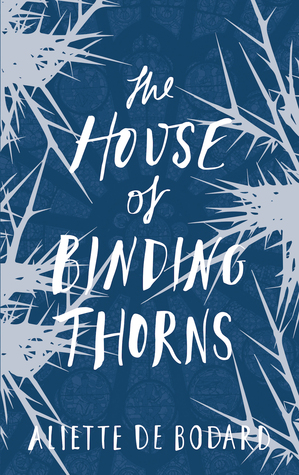
Book Review | The House of Binding Thorns by Aliette de Bodard


As the city rebuilds from the onslaught of sorcery that nearly destroyed it, the great Houses of Paris, ruled by Fallen angels, still contest one another for control over the capital.

House Silverspires was once the most powerful, but just as it sought to rise again, an ancient evil brought it low. Phillippe, an immortal who escaped the carnage, has a singular goal—to resurrect someone he lost. But the cost of such magic might be more than he can bear.

In House Hawthorn, Madeleine the alchemist has had her addiction to angel essence savagely broken. Struggling to live on, she is forced on a perilous diplomatic mission to the underwater dragon kingdom—and finds herself in the midst of intrigues that have already caused one previous emissary to mysteriously disappear....

As the Houses seek a peace more devastating than war, those caught between new fears and old hatreds must find strength—or fall prey to a magic that seeks to bind all to its will.

***

The second Dominion of the Fallen novel sees Aliette de Bodard return to the city of down-on-their-luck divinities she depicted so delicately in The House of Shattered Wings in the company of a cast of characters that were in the background of book one. In that sense it's a sequel, however The House of Binding Thorns stands as a striking example of a story that both stands alone and expands.

Welcome, then—or welcome back, perhaps—to the capital of France after the collapse. Some sixty years on from "the cataclysm that had devastated Paris, reducing monuments to blackened rubble, turning the Seine dark with the dangerous residues of spells, and leaving booby traps that still hadn't vanished," the angels who fell from heaven on that dark day have organised themselves into powerful houses, very much in the mode of the mafia. Indeed, de Bodard doubles down on that extended metaphor in The House of Binding Thorns, in that its narrative is driven by drug trafficking and an addict on the road to recovery is its principle perspective.

But the drug doing the damage in postwar Paris is no conventional concoction of chemicals. It is, instead, angel essence: the magic-amplifying fibre of the Fallen. It is "the promise of pleasure, of power," and power is what every mob boss wants, what every mob boss will do anything to get...

Asmodeus is just such a soul, as the head of House Hawthorn: a "brash statement of power" beside the "genteel, quiet, decaying thing" that is House Silverspires. "Silverspires had been Hawthorn's enemy," had kept it in check, "but the events of seven months ago"—so cannily chronicled in The House of Shattered Wings—"had left them bloodless and in ruins, barely capable of being a power in postwar Paris, much less a threat."

With Hawthorn high on its triumph, every other House is battening down the hatches. But though the ex-angel Asmodeus' organisation appears unequaled, in reality, it too is a ruin. "The House might look grand and magnificent, but it was like the rest of the city: barely hanging on to normality, struggling to maintain itself against decay." Mold and char and rot are rife in the Dominion of the Fallen novels, giving the series a certain sickening stench, as of something spoiled. That said, there are also heady hints of what was: a beautiful world, all orange blossom and eau de bergamot.

And as above, so below. Literally, in this instance, for under the River Seine, another kingdom cometh. "Legends had come to life in this city, in this place. Tales that had always been distant dreams," of angels, magic—and now dragons, or rather Rong.

Wednesday, 5 April 2017

Book Review | Luna: Wolf Moon by Ian McDonald


A Dragon is dead.

Corta Helio, one of the five family corporations that rule the Moon, has fallen. Its riches are divided up among its many enemies, its survivors scattered. Eighteen months have passed.

The remaining Helio children, Lucasinho and Luna, are under the protection of the powerful Asamoahs, while Robson, still reeling from witnessing his parent's violent deaths, is now a ward—virtually a hostage—of Mackenzie Metals. And the last appointed heir, Lucas, has vanished of the surface of the moon.

Only Lady Sun, dowager of Taiyang, suspects that Lucas Corta is not dead, and more to the point—that he is still a major player in the game. After all, Lucas always was the Schemer, and even in death, he would go to any lengths to take back everything and build a new Corta Helio, more powerful than before. But Corta Helio needs allies, and to find them, the fleeing son undertakes an audacious, impossible journey—to Earth.

In an unstable lunar environment, the shifting loyalties and political machinations of each family reach the zenith of their most fertile plots as outright war erupts.

***

It says a lot that I look back on Luna: New Moon lovingly rather than remembering how maddening and demanding a novel it was. Outside of his exemplary young adult efforts, Ian McDonald has rarely been easy to read, but I found the first stretch of said text tremendously testing. Yet for every ounce of effort I expended, Luna: New Moon repaid in spades, much as the Mackenzies do with their debts.

The Mackenzies are but one of the five faithless families at the heart of the second part of McDonald's narrative: a surprisingly accessible successor assuming you've finished the book it builds on. And build it does, on much of the hard work of the first: on the harsh mistress of the moon that is its desperate setting, and on the very much in motion story, which focuses on the clashing clans whose mandate is to somehow succeed on that satellite.

One thing Luna: Wolf Moon doesn't share with McDonald's last is its massive cast. It can't, considering the catastrophic fall of the Cortas—though to call what befell them a fall isn't quite right. The Cortas, "the lucky, flashy Cortas," were decimated, deliberately and decisively. Like the Starks of A Song of Ice and Fire, which fantasy saga this complex and often shocking science fiction series is obviously modelled on, they had their head literally lopped off.

And they didn't just lose their leader: they also lost their source of income, their sense of security and their seat of power. But though the Cortas are definitely down, they're not out. The better to recover some measure of strength, the survivors of the disaster at Joao de Deus have scattered.

Like Arya, little Luna looks too young to represent any kind of threat, but she'll come into her own quickly. Robson is stronger than Luna as of the offing, but having been adopted—or taken hostage—by the Mackenzies, he's something of a pawn, and thus this saga's Sansa. Lucasinho of the "good sex and better baked goods" can be Bran, because his part in the plot hasn't really been revealed; legal eagle Ariel is reminiscent of Robb Stark in that she still holds some sway over the system that underpins everything; whilst Wagner, the wolf who has channeled his bipolar disorder into a powerful pack mentality, is, of course, the Jon Snow of McDonald's story.

Some of these similarities are slight, sure, but some are so on the nose that they must be by design, and I struggle to begrudge that, given the incredible recognition George R. R. Martin has received in recent years. As an author, Ian McDonald is from my perspective no less deserving, and if he has to follow in a footstep or two to achieve even a measure of the success Martin has, then I say okay. The Cortas aren't carbon copies in any case; it's only their respective roles in the whole that have me meandering about in memory lane. Well, it's that, and a line that goes something like this: if you play the game of Luna, "you either live or the moon kills you."

Tuesday, 21 March 2017

Book Review | New York 2140 by Kim Stanley Robinson


As the sea levels rose, every street became a canal. Every skyscraper an island. For the residents of one apartment building in Madison Square, however, New York in the year 2140 is far from a drowned city.

There is the market trader, who finds opportunities where others find trouble. There is the detective, whose work will never disappear—along with the lawyers, of course.

There is the internet star, beloved by millions for her airship adventures, and the building's manager, quietly respected for his attention to detail. Then there are two boys who don't live there, but have no other home-- and who are more important to its future than anyone might imagine.

Lastly there are the coders, temporary residents on the roof, whose disappearance triggers a sequence of events that threatens the existence of all—and even the long-hidden foundations on which the city rests.

***

Not for the first time, and not, I can only hope, for the last, Kim Stanley Robinson takes aim at climate change in New York 2140, an immensely necessary novel as absorbing as it is sprawling about how that city among cities, so close to so many hearts, moves forward following floods that raise the seas fifty feet.

The Big Apple has been blighted. Uptown, being uptown both figuratively and literally, came through the crises brought on by humanity's hard-to-kick carbon habit relatively well, but downtown, everything is different. Submerged, the streets between buildings are cast now as canals. Nobody has a car anymore, but boats are mainstays on the waterways. Pedestrians must make do with jetties, or walk the dizzying bridges between those skyscrapers that haven't already collapsed after losing the ongoing fight to stay watertight.

Needless to say, New York as we know it is no more. But New Yorkers? Why, for good or for ill, they're New Yorkers still!
There is a certain stubbornness in a New Yorker, cliche though it is to say so, and actually many of them had been living in such shitholes before the floods that being immersed in the drink mattered little. Not a few experienced an upgrade in both material circumstances and quality of life. For sure rents went down, often to zero. So a lot of people stayed. 
Squatters. The dispossessed. The water rats. Denizens of the deep, citizens of the shallows. And a lot of them were interested in trying something different, including which authorities they gave their consent to be governed by. Hegemony had drowned, so in the years after the flooding there was a proliferation of cooperatives, neighbourhood associations, communes, squats [and such]. (p.209) 
Robinson's novel is arranged around a fitting for instance of this. The old Met Life tower on the drowned remains of Madison Square is home, now, to several thousand souls: a collective of individuals who all contribute to their cooperative's pot—be it financially or by bartering man-hours or goods for common use.

Among the many are Ralph Muttchopf and Jeff Rosen, a couple of old coders, or quants, who live in "a hotello on the open-walled farm floor [...] from which vantage point lower Manhattan lies flooded below them like a super-Venice, majestic, watery, superb. Their town." (p.6) But there are elements of their town that they deeply dislike, particularly the financial sector that has started gambling on what's become known as "the intertidal zone," (p.118) and down-on-their-luck as they are, with as little left to lose as you like, Mutt and Jeff do something they shouldn't: they hack the stock market.

Wednesday, 15 March 2017

Book Review | The Erstwhile by Brian Catling


In London and Germany, strange beings are reanimating themselves. They are the Erstwhile, the angels that failed to protect the Tree of Knowledge, and their reawakening will have major consequences.

In Africa, the colonial town of Essenwald has fallen into disarray because the timber workforce has disappeared into the Vorrh. Now a team of specialists are dispatched to find them. Led by Ishmael, the former cyclops, they enter the forest, but the Vorrh will not give them back so easily. To make matters worse, an ancient guardian of the forest has plans for Ishmael and his crew. 

Meanwhile a child of mixed race has been found abandoned in a remote cottage. Her origins are unknown, but she has powers beyond her own understanding. Conflict is coming, as the old and new, human and inhuman are set on a collision course. 

Once again blending the real and the imagined, The Erstwhile brings historical figures such as William Blake and places such as the Bedlam Asylum, as well as ingenious creations such as The Kin (a family of robots) together to create unforgettable novel of births and burials, excavations and disappearances.

***

More than four years on from The Vorrh, professor and performance artist Brian Catling is back with a book that explodes the exceptional premise of its predecessor at the same time as falling short of fulfilling its awesome promise.

The Erstwhile shifts the focus of the darkly fantastic fiction from the forest around which the first volume revolved to one of its many denizens. "No one quite knew what they were. But they had been given a name, which translated into 'of Before' or 'the Previous' and finally settled as "the Erstwhile.' Some said they were 'undead, angels, spirits embodied in flesh.' All that was known was they were as ancient as the forest itself." And the vast Vorrh, held close to the heart of Africa like an unspeakable secret, is at least as old as us. Indeed, "there is a deep belief that this land is sacred and may be the physical geographic location of the biblical Eden."

What business, then, does man have messing with it?

None, n'est-ce pas? But where there's wood, there's timber, and where there's timber, there's industry—a truism even in this alternate history. That industry animates the settlement of Essenwald, where the majority of the events of The Erstwhile occur. Truth be told, though, the Timber Guild has been having a tough time of it since the Vorrh started screwing with its various visitors:
The forest had a malign influence at its very core. Some said it was an unknown toxicology of plant and oxygen. Others said it was a disturbance in its magnetic resonance. A few said it was haunted and that its evil nature was responsible. In fact, nobody knew why prolonged exposure to the trees caused distressing symptoms of amnesia and mental disintegration. No matter what or who they tried, all was in vain. Nobody could work for more than two days in the Vorrh without contamination.
Nobody, that is, other than the Limboia. "They were hollow humans" whose lack of humanity left little for the forces of the forest to fuck with. And yet even the Limboia have been lost. As of the outset of The Erstwhile, they've been missing for some months, and without them, Essenwald's singular industry has stuttered to a costly stop. Alas and alack that the Powers That Be in that precarious place are prepared to do whatever it takes to get these beings back.