Wednesday, 10 May 2017

Book Review | Borne by Jeff VanderMeer


“Am I a person or a weapon?” Borne asks Rachel, in extremis.

“Yes, you are a person,” Rachel tells him. “But like a person, you can be a weapon, too.”

A ruined city of the future lives in fear of a despotic, gigantic flying bear, driven mad by the tortures inflicted on him by the Company, a mysterious biotech firm. A scavenger, Rachel, finds a creature entangled in his fur. She names it Borne.

At first, Borne looks like nothing at all―a green lump that might be a discard from the Company. But he reminds Rachel of her homeland, an island nation long lost to rising seas, and she prevents her lover, Wick, from rendering down Borne as raw genetic material for the special kind of drugs he sells.

But nothing is quite the way it seems: not the past, not the present, not the future. If Wick is hiding secrets, so is Rachel―and Borne most of all. What Rachel finds hidden deep within the Company will change everything and everyone. There, lost and forgotten things have lingered and grown. What they have grown into is mighty indeed.

***

Following his triumphant trek through Area X in the cerebral Southern Reach series, Jeff VanderMeer mounts a more modest yet no less affecting expedition into uncharted territory by way of Borne, a surprisingly beautiful book about a blob which behaves like a boy and the broken woman who takes him in.

Her name is Rachel, and when she was little, she "wanted to be a writer, or at least something other than a refugee. Not a trap-maker. Not a scavenger. Not a killer." (p.37) But we are what the world makes us, and no poxy author would have lasted long in the world in which this novel's narrator was raised:
Once, it was different. Once, people had homes and parents and went to schools. Cities existed within countries and those countries had leaders. Travel could be for adventure or recreation, not survival. But by the time I was grown up, the wider context was a sick joke. Incredible, how a slip could become a freefall and a freefall could become a hell where we lived on as ghosts in a haunted world. (p.37)
There is hope even in this haunted hellscape, however, and it takes a strange shape, as hope tends to: that of "a hybrid of sea anemone and squid: a sleek vase with rippling colours" (p.6) Rachel finds in the festering fur of a skyscraper-sized flying bear called Mord.

She brings the titular thing, Borne-to-be, back to the Balcony Cliffs, a broken-down apartment building where she lives and works with Wick, her sometime lover and a secretive biotech beetle dealer who pushes a memory-altering product "as terrible and beautiful and sad and sweet as life itself." (p.7) Out of the gate, Rachel intends to give her purplish prize to him to pick at—but something, the beginning of some instinct, stays her hand. Instead, she places it in her room, and tries to take care of it.

"This required some experimenting, in part because [she] had never taken care of anyone or anything before," (p.17) but equally because her amorphous mass is a complete mystery. Certainly Wick has never seen its like, and having worked once for the Company, he has seen everything there is to see. To wit, Rachel treats this colourful clump like a plant to start; reclassifies it as an animal after it starts to move around her room; and then, when it shocks her by talking, she takes to behaving around it as she would a baby boy. She talks to him; teaches him; comes, ultimately, to love him—and he her in turn.

Friday, 5 May 2017

Book Review | Waking Hell by Al Robertson


Leila Fenech is dead. And so is her brother Dieter. But what's really pissing her off is how he sold his afterlife as part of an insurance scam and left her to pick up the pieces. She wants him back so she can kick his backside from here to the Kuiper Belt.

Station is humanity's last outpost. But this battle-scarred asteroid isn't just for the living. It's also where the dead live on as fetches: digital memories and scraps of personality gathered together and given life. Of a sort.

Leila won't stop searching Station until she's found her brother's fetch—but the sinister Pressure Men are stalking her every move. Clearly Dieter's got himself mixed up in something a whole lot darker than just some scam.

Digging deeper, Leila discovers there's far more than her brother's afterlife at stake. Could it be that humanity's last outpost is on the brink of disaster? Is it too late for even the dead to save it?

***

On the back of one of the best debuts in recent memory, Al Robertson rounds up a brand new cast of characters for his second successive stop at Station. Absent "the dynamic duo" (p.173) that was Jack and Hugo—respectively "an accountant of the future [and] a psychotic virtual ventriloquist's dummy," in the words of the award-nominated author—Waking Hell isn't as compelling as Crashing Heaven, but between its excellently embellished setting and a narrative that boasts more momentum than most, there are moments when it comes close.

As of the outset, much has changed on Station, the battle-scarred asteroid where what's left of humanity lives under the purview of a pantheon of corporate gods:
Two and a half years before [...] Jack Forster, Hugo Fist and Andrea Hui had worked with the Totality to release the dead from semi-sentient slavery. But the Rebirth was just the start of a longer coming of age. It was one thing for ten thousand weaveselves to be reborn as fully self-aware continuations of ended lives—quite another for them to come to terms with that new start, both as individuals and as a group, and understand what to do with it. When Leila stepped out of the sea and into her new, post-mortal life, she became part of that conversation. (p.23)
The hero at the heart of Waking Hell has had to hoe a hard road in the years since her resurrection as a fetch. Initially, those like Leila Fenech were seen as sub-human, to be used and routinely abused by the living before being disposed of, like so much deleted data. The events of Crashing Heaven changed that; now, fetches finally have rights.

Still, there's resistance, including an organisation of individuals who damn near decimated the dead in an act of technological terrorism that'll stay with Leila to her last day. Luckily for her, she had her brother Dieter—a hacker with a particular fascination for the past—to lean on when the fanatics attacked:
When the Blood and Flesh plague shattered the deep structures of her memory, completely disordering her sense of herself, Dieter had helped her rebuild. He'd taken her out of the Coffin Drives' convalescence unit and back to his weavespace. Then he'd opened up his own memories of her life to her. They became a template, guiding her as she remade the structures of her past. He'd helped her heal when even the Fetch Counsellor had given up on her. 
Now he needed her just as much as she'd needed him. And she could only watch. (p.14)
She could only watch as he dies, infected from the inside out by an infernal artefact that feels like it fell straight out of Hellraiser—and by design, I dare say. Early on, at least, Waking Hell has a lot in common with a horror novel: it's all unsettling silences and gruesome goings-on, monsters and murders, and beyond these, thar be bees! Bees and some bloody ugly bugs. But for better or for worse, Robertson reverses gears too soon for these potentially interesting elements to have a dramatic impact on the narrative. What Waking Hell is is a solid science fiction sequel, despite the departure of its first act.

And its second, in a sense. This section is concerned with revenge, because while death is no longer the end in this milieu, Leila learns that for Dieter it will be. Essentially, he's been swindled into signing away the rights to his resurrection, ostensibly so that his sister will be looked after. And financially speaking, she is. Whoever the devil Dieter dealt with is, he's as good as his word. But rather than using the huge sum of money she inherits to live a right nice afterlife, Leila spends it in search of said devil's identity.

Then, with the help of a few friends—first and foremost a fraud investigator and an amnesiac janitor who aren't nearly as dreary as they seem—she sets out to bring the fight to the being that bastardised her beloved brother. Little does Leila realise that the being already has an army... an army it's planning to aim straight at Station. And as one of her new comrades says, "Of course you've got to look out for the people you love. [...] But if the whole of the rest of the world is in danger, you might have to start thinking a bit bigger." (p.147)

A bit bigger is actually a decent way of describing Waking Hell as a whole. It doesn't have the personality of Crashing Heaven—although its characters are a relatively rambunctious bunch, only the Caretaker entertains in the way Hugo Fist did, and I'm afraid he's far from front and centre—but it has scope and scale to spare. Nothing less than the fate of our race is at stake, and happily, there's more to humanity than the blasted asteroid Robertson's first novel focused on.

Leila's race to recover her brother—and, in so doing, save the day—gives us a window into this well-widened world, from the repellent reality underlying the weird and wonderful weavespaces people have created on Station to the scorched surface of the Earth humanity abandoned. And at the same time as casting the core conflict as increasingly crucial, the explosive expansion of Waking Hell's setting gives its narrative a frisson of the frenetic.

When I reviewed Crashing Heaven two years or so ago, I remarked that I hadn't a clue what the second of the Station books would look like. Given the devastating denouement of Robertson's dizzying debut, I knew it was destined to be different—but what those differences would be, I could only wait and see. That was enough to excite me. From here, however, it's much easier to conceive of an act three... and that's oddly disappointing.

An exploration of identity filtered through a revenge fantasy with a humble helping of horror, Waking Hell is fearsome, fast moving and fun—but it's also fairly straightforward, flat where the last book was full, and frankly much less memorable without Hugo Fist, who I really, really missed.

***

Waking Hell
by Al Robertson

UK Publication: October 2016, Gollancz
US Publication: April 2017, Gollancz

Buy this book from


Recommended and Related Reading

Tuesday, 2 May 2017

Book Review | Waking Gods by Sylvian Neuvel


As a child, Rose Franklin made an astonishing discovery: a giant metallic hand, buried deep within the earth. As an adult, she’s dedicated her brilliant scientific career to solving the mystery that began that fateful day: why was a titanic robot of unknown origin buried in pieces around the world? Years of investigation have produced intriguing answers—and even more perplexing questions. But the truth is closer than ever before when a second robot, more massive than the first, materializes and lashes out with deadly force.

Now humankind faces a nightmare invasion scenario made real, as more colossal machines touch down across the globe. But Rose and her team at the Earth Defense Corps refuse to surrender. They can turn the tide if they can unlock the last secrets of an advanced alien technology. The greatest weapon humanity wields is knowledge in a do-or-die battle to inherit the Earth... and maybe even the stars.

***

When she was a girl, Rose Franklin fell on a giant hand made of a metal mined, in the main, from meteorites. Determined to glean what it might mean, the government covered her discovery up and ordered its best and brightest minds to study this unlikely find. Where had the hand come from, how long had it been underground, and could you hit things with it? These were the interests of the military in particular, but decades later, they still couldn't say—not until Rose, now a leading figure in her field, headed up a second investigation.

In short order, she found that the hand was but a bit of a monolithic machine—a mech, I mean—the body parts of which had been buried around the world. After several international incidents, the rest of the robot was recovered, leaving Rose and her team to assemble Themis. Before long a pair of pilots were walking in it, astonishing the population of the planet in the process. But... well, why? What was it all for?

If Sleeping Gods left with you questions, know that there are answers to be had in the surprising second installment of The Themis Files. They come thick and fast, in fact.

In a sense, Sylvain Neuvel's entertaining debut related humanity's coming of age, and now that we're all grown up—now that we know we're not alone in the universe—Waking Gods wants to see how we'll behave in the face of an alien danger.
Thomas Henry Huxley [...] was a scientist in the early days of modern biology. He said: "The known is finite, the unknown infinite; intellectually we stand on an islet in the midst of an illimitable ocean of inexplicability. Our business in every generation is to recover a little more land." Almost a decade ago, when Themis was revealed to the world, we realised that ocean was a lot bigger than we thought, and what happened this morning in London has made our islet of certainty feel so small that we may wonder if we even have enough room to stand on. (pp.15-16)
What happened this morning in London was the mysterious appearance of a giant metal man, larger even than Rose's robot, that the media comes to call Kronos. Evidently, this isn't the alien invasion of our nightmares—indeed, Kronos doesn't say or do anything for days—and yet, after squabbling over how to react to the mech's admittedly threatening presence, the British Prime Minister bows to public pressure by ordering the army to impose a perimeter around Regent's Park. With tanks.

This may have been a mistake.

Tuesday, 18 April 2017

Book Review | The End of the Day by Claire North


At the end of the day, Death visits everyone. Right before that, Charlie does. Sometimes he is sent as a courtesy, sometimes as a warning. He never knows which.

You might meet him in a hospital, in a warzone, or at the scene of a traffic accident. Then again, you might meet him at the North Pole—he gets everywhere, our Charlie.

Would you shake him by the hand, take the gift he offers, or would you pay no attention to the words he says?

***

I've fallen for every one of Claire North's novels. The First Fifteen Lives of Harry August, Touch and The Sudden Appearance of Hope have between them broken my heart and expanded my mind. They've thrilled me and they've chilled me. By way of them I've been exposed to new places, new ideas—new ways of being, even. But if I had to level a single criticism against her thoughtful body of work, it would have to be directed at its measure, because whilst her texts have tackled a great many meaningful themes, not least the array of ways we determine identity, I've found North's literary positions a little non-committal.

That's not the case in The End of the Day. This is a book with something to say; something important, if I may. It's slow to start, and oddly episodic even when the plot has picked up; its characters come and go with next to no notice; it's difficult, and confusing, and contradictory—but that's what life is like, right? And the messy, maddening, magical gift of life we've all been given, that's what The End of the Day deals in: not death... although its principal perspective is on her payroll.

Like North's other novels, The End of the Day is a high concept travelogue of sorts, but this fiction's frequent flier is Charlie, and Charlie just got hired! He's to be the Harbinger of the foremost of the apocryphal horsemen, of which singular position Death gives this description:
The Harbinger is a mortal, a bridge between this world and the next. In the old days I used eagles, but people stopped paying attention to them after a while—just birds in he sky—[so] I switched to humans a few thousand years ago. One must move with the times. (pp.12-13)
North doesn't waste any time reinventing the wheel here. Death appears in any number of forms over the course of the story. Sometimes he's male and sometimes she isn't; from time to time she has a scythe; here and there, horns protrude from his lumpen skull. "In all other respects he was the figure she had known would come, the god of the underworld, exactly as the stories said he would be." (p.14)

Charlie, on the other hand, is just a puny human.

Tuesday, 11 April 2017

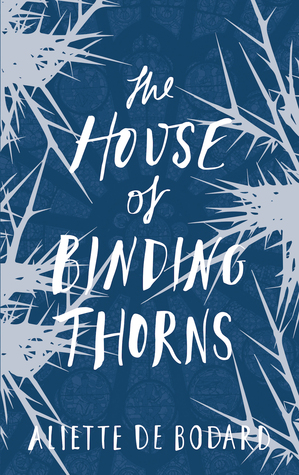
Book Review | The House of Binding Thorns by Aliette de Bodard


As the city rebuilds from the onslaught of sorcery that nearly destroyed it, the great Houses of Paris, ruled by Fallen angels, still contest one another for control over the capital.

House Silverspires was once the most powerful, but just as it sought to rise again, an ancient evil brought it low. Phillippe, an immortal who escaped the carnage, has a singular goal—to resurrect someone he lost. But the cost of such magic might be more than he can bear.

In House Hawthorn, Madeleine the alchemist has had her addiction to angel essence savagely broken. Struggling to live on, she is forced on a perilous diplomatic mission to the underwater dragon kingdom—and finds herself in the midst of intrigues that have already caused one previous emissary to mysteriously disappear....

As the Houses seek a peace more devastating than war, those caught between new fears and old hatreds must find strength—or fall prey to a magic that seeks to bind all to its will.

***

The second Dominion of the Fallen novel sees Aliette de Bodard return to the city of down-on-their-luck divinities she depicted so delicately in The House of Shattered Wings in the company of a cast of characters that were in the background of book one. In that sense it's a sequel, however The House of Binding Thorns stands as a striking example of a story that both stands alone and expands.

Welcome, then—or welcome back, perhaps—to the capital of France after the collapse. Some sixty years on from "the cataclysm that had devastated Paris, reducing monuments to blackened rubble, turning the Seine dark with the dangerous residues of spells, and leaving booby traps that still hadn't vanished," the angels who fell from heaven on that dark day have organised themselves into powerful houses, very much in the mode of the mafia. Indeed, de Bodard doubles down on that extended metaphor in The House of Binding Thorns, in that its narrative is driven by drug trafficking and an addict on the road to recovery is its principle perspective.

But the drug doing the damage in postwar Paris is no conventional concoction of chemicals. It is, instead, angel essence: the magic-amplifying fibre of the Fallen. It is "the promise of pleasure, of power," and power is what every mob boss wants, what every mob boss will do anything to get...

Asmodeus is just such a soul, as the head of House Hawthorn: a "brash statement of power" beside the "genteel, quiet, decaying thing" that is House Silverspires. "Silverspires had been Hawthorn's enemy," had kept it in check, "but the events of seven months ago"—so cannily chronicled in The House of Shattered Wings—"had left them bloodless and in ruins, barely capable of being a power in postwar Paris, much less a threat."

With Hawthorn high on its triumph, every other House is battening down the hatches. But though the ex-angel Asmodeus' organisation appears unequaled, in reality, it too is a ruin. "The House might look grand and magnificent, but it was like the rest of the city: barely hanging on to normality, struggling to maintain itself against decay." Mold and char and rot are rife in the Dominion of the Fallen novels, giving the series a certain sickening stench, as of something spoiled. That said, there are also heady hints of what was: a beautiful world, all orange blossom and eau de bergamot.

And as above, so below. Literally, in this instance, for under the River Seine, another kingdom cometh. "Legends had come to life in this city, in this place. Tales that had always been distant dreams," of angels, magic—and now dragons, or rather Rong.

Wednesday, 5 April 2017

Book Review | Luna: Wolf Moon by Ian McDonald


A Dragon is dead.

Corta Helio, one of the five family corporations that rule the Moon, has fallen. Its riches are divided up among its many enemies, its survivors scattered. Eighteen months have passed.

The remaining Helio children, Lucasinho and Luna, are under the protection of the powerful Asamoahs, while Robson, still reeling from witnessing his parent's violent deaths, is now a ward—virtually a hostage—of Mackenzie Metals. And the last appointed heir, Lucas, has vanished of the surface of the moon.

Only Lady Sun, dowager of Taiyang, suspects that Lucas Corta is not dead, and more to the point—that he is still a major player in the game. After all, Lucas always was the Schemer, and even in death, he would go to any lengths to take back everything and build a new Corta Helio, more powerful than before. But Corta Helio needs allies, and to find them, the fleeing son undertakes an audacious, impossible journey—to Earth.

In an unstable lunar environment, the shifting loyalties and political machinations of each family reach the zenith of their most fertile plots as outright war erupts.

***

It says a lot that I look back on Luna: New Moon lovingly rather than remembering how maddening and demanding a novel it was. Outside of his exemplary young adult efforts, Ian McDonald has rarely been easy to read, but I found the first stretch of said text tremendously testing. Yet for every ounce of effort I expended, Luna: New Moon repaid in spades, much as the Mackenzies do with their debts.

The Mackenzies are but one of the five faithless families at the heart of the second part of McDonald's narrative: a surprisingly accessible successor assuming you've finished the book it builds on. And build it does, on much of the hard work of the first: on the harsh mistress of the moon that is its desperate setting, and on the very much in motion story, which focuses on the clashing clans whose mandate is to somehow succeed on that satellite.

One thing Luna: Wolf Moon doesn't share with McDonald's last is its massive cast. It can't, considering the catastrophic fall of the Cortas—though to call what befell them a fall isn't quite right. The Cortas, "the lucky, flashy Cortas," were decimated, deliberately and decisively. Like the Starks of A Song of Ice and Fire, which fantasy saga this complex and often shocking science fiction series is obviously modelled on, they had their head literally lopped off.

And they didn't just lose their leader: they also lost their source of income, their sense of security and their seat of power. But though the Cortas are definitely down, they're not out. The better to recover some measure of strength, the survivors of the disaster at Joao de Deus have scattered.

Like Arya, little Luna looks too young to represent any kind of threat, but she'll come into her own quickly. Robson is stronger than Luna as of the offing, but having been adopted—or taken hostage—by the Mackenzies, he's something of a pawn, and thus this saga's Sansa. Lucasinho of the "good sex and better baked goods" can be Bran, because his part in the plot hasn't really been revealed; legal eagle Ariel is reminiscent of Robb Stark in that she still holds some sway over the system that underpins everything; whilst Wagner, the wolf who has channeled his bipolar disorder into a powerful pack mentality, is, of course, the Jon Snow of McDonald's story.

Some of these similarities are slight, sure, but some are so on the nose that they must be by design, and I struggle to begrudge that, given the incredible recognition George R. R. Martin has received in recent years. As an author, Ian McDonald is from my perspective no less deserving, and if he has to follow in a footstep or two to achieve even a measure of the success Martin has, then I say okay. The Cortas aren't carbon copies in any case; it's only their respective roles in the whole that have me meandering about in memory lane. Well, it's that, and a line that goes something like this: if you play the game of Luna, "you either live or the moon kills you."