Showing posts with label Russia. Show all posts

Wednesday, 23 April 2014

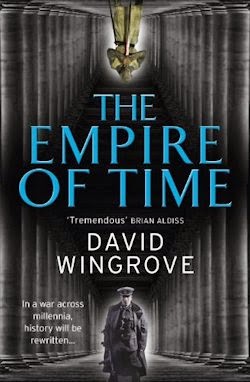
Book Review | The Empire of Time by David Wingrove


There is only the war.

Otto Behr is a German agent, fighting his Russian counterparts across three millennia, manipulating history for moments in time that can change everything.

Only the remnants of two great nations stand and for Otto, the war is life itself, the last hope for his people.

But in a world where realities shift and memory is never constant, nothing is certain, least of all the chance of a future with his Russian love...
***

It's 2999, and what do you know? The world is at war... or else what's left of it is.

Only "the remnants of two great nations" remain—Russia and Germany, refreshingly—and having lasted this long, and suffered so much over said centuries, neither side will accept anything less than the eradication of its eternal enemy. Thus, they fight. But with the Earth a nuclear blast-blackened shadow of its former self, the only battleground they have at hand is the past:
The thing is, we're both spread thin. I mean, three thousand years, and only a couple of hundred agents to police them. No wonder we miss things. But then, so do they. It's a game of chess—the most complex game imaginable—only the moves can be anything, and the board... 
The board is everywhere and any time. (p.16)
Our narrator Otto Behr is, at the outset, an agent engaged in an operation in the latter days of the Crusades when he's pulled out of the period to assist with a major manoeuvre in World War II era Germany. Here, another operative has been helping Hitler win the coming conflict at the same time as attempting to temper his more monstrous qualities. Sickening as it is, Seydlitz's plan is borderline brilliant, and abominably ambitious. It's "a direct assault upon the very heartland of Russia—and if this works..." (p.34) why, if this works, the long war will be all but won.

You might think that'd be that, but it's not, natch:
You see, nothing is ever straightforward in Time. If we both did the same old things, time and again, it would soon become predictable. And though the aim is to win—to eradicate the enemy—there is also a feeling, and I know I'm not alone in this, that the game is of itself a satisfaction, and a deep one at that. 
I like to outguess them, to prove myself not only quicker and tougher, but also smarter than they are. They outnumber us three to one and they are good [...] but we are better. We have to be simply to survive. (p.139)
Surviving what's to come will be all the harder, however, because Russian agents have been aware of Germany's great operation from day dot, and before it can come to something, they step in, seize Seydlitz, and use his DNA to infiltrate the future, too.

Friday, 15 April 2011

Book Review | Deathless by Catherynne M. Valente


Buy this book from


Koschei the Deathless is to Russian folklore what devils or wicked witches are to European culture: a menacing, evil figure; the villain of countless stories which have been passed on through story and text for generations. But Koschei has never before been seen through the eyes of Catherynne M. Valente, whose modernized and transformed take on the legend brings the action to modern times, spanning many of the great developments of Russian history in the twentieth century.


Deathless, however, is no dry, historical tome: it lights up like fire as the young Marya Morevna transforms from a clever child of the revolution, to Koschei’s beautiful bride, to his eventual undoing. Along the way there are Stalinist house elves, magical quests, secrecy and bureaucracy, and games of lust and power. All told, Deathless is a collision of magical history and actual history, of revolution and mythology, of love and death, which will bring Russian myth back to life in a stunning new incarnation.

***


Deathless is the latest from Catherynne M. Valente, and so, of course, it is a delight.


Having cast brilliant new light on One Thousand and One Nights in her two-volume opus The Orphan's Tales, and in The Habitation of the Blessed made a lurid and lyrical fantasy of the legends of 12th century Christian champion Prester John, Deathless sees Valente set her inimitable sights on Slavic folklore, with suitably stunning results. It begins:


"In a city by the sea which was once called St. Petersburg, then Petrograd, then Leningrad, then, much later, St. Petersburg again, there stood a long, thin house on a long, thin street. By a long, thin window, a child in a pale blue dress and pale green slippers waited for a bird to marry her." (p.15)


The child is Marya Morevna, here recast as a precocious young girl who whiles away her days dreaming of a husband, and better, brighter things. As well she should, for there are innumerable trials ahead: dark and troubling times for her city, for her family, and not least of all for Marya herself. However "the world is ordered in such a way that birds may be expected to turn into husbands at a moment's notice and no one may comment upon it at all," (p.23) so when "a great, hoary old black owl" (p.54) appears at the door of the long, thin house on the long, thin street as "a handsome young man in a handsome black coat, his dark hair curly and thick, flecked with silver, his mouth half-smiling, as if anticipating a terribly sweet thing," (p.55) and when that man asks after the hand of the girl who watches all from the long, thin window above, Marya's fate is sealed, and her dreams made real.


So it is that Marya comes to wed Koschei the Deathless, the Tsar of Life, who cannot die. "Fiendishly convenient things, wives. Better than cows. They'll love you for beating them, and work 'til they die." (p.113) Marya insists it will be different, for her... but perhaps the lady doth protest too much. So it is, in any event, that she comes to Buyan, Koschei's phantasmagorical kingdom beyond the sea, where the rivers run silver and buildings have skin. And so it is, one final time, that Marya meets Chairman Baba Yaga, Zemlehyed the leshy, Naganya the vintovnik who has a rifle scope for an eye, and the walking work of art that is Madame Lebedeva, whose make-up tends to match her cucumber soup.


I don't suppose Deathless is at 350 pages a particularly long novel, yet it seems an incredible length to prolong what is, at heart, a fairy tale, and Valente does so with such staunch authority and seeming ease as to stun. There is mystery and suspense in Deathless, wonder, awe and innocence; the form's every traditional demand is catered to, respectfully if not slavishly, and delicately refreshed whenever one trope or another appears in danger of tepidity. We stay in no one place for very long. The tone of Marya's tale darkens and lightens intermittently, as the years go by and, like a living being breathing, the Motherland rises and falls.


Valente finds particular success in her use of recurrence: in Deathless the rule of three is in full effect. Marya has three sisters, who marry three birds, who give her three gifts when she travels thrice nine kingdoms to escape Koschei's clutches and three friends who will never leave her otherwise. Beyond the reach of the three, there are moments - and moments aplenty - where prosaic phrases and sayings crop up once and again, to mean a different thing every time. Valente seems to mould the old anew with her every word, shifting metaphor and meaning and motif just so, so as to sustain a heady note usually so brief as to leave one wanting.


So too does Deathless leave one wanting, in the best possible sense. Dense and elusive, you will not likely find it an easy novel to read - rather the narrative is surreal and erotic and disturbing, often in the space of a single sentence - yet when you turn that last page, you will wish there was another, and another after that. Such is the joy of Catherynne M. Valente's fiction: her glorious use of language, her revelatory imagination, prose which will arrest you mid-breath. You could say Deathless wears a coat of many colours. It is a tapestry of new, old, borrowed and blue, and each fragment of the whole is as vibrant and integral as the last. Stunning stuff.

***

Deathless
by Catherynne M. Valente

US Publication: April 2011, Tor


Buy this book from

Tuesday, 18 January 2011

Book Review | There Once Lived a Woman Who Tried to Kill Her Neighbour's Baby by Ludmilla Petrushevskaya


Buy this book from


A woman finds herself filling a pit in the forest in the middle of the night; a family lock each other in their bedrooms to battle a strange plague; a wizard punishes two beautiful ballerinas by turning them into one hugely fat circus performer; a colonel is warned not to lift the veil from his dead wife’s face; and a distraught father brings his daughter back to life by eating human hearts in his dreams. In these blackly comic tales of revenge, disturbing deaths and haunting melancholy, Ludmilla Petrushevskaya blends miracles and madness in the darkest of modern fairy tales.

***


There Once Lived a Woman Who Tried to Kill Her Neighbour's Baby is the fabulously telling title of a collection of scary fairy tales by Ludmilla Petrushevskaya, "Russia's best known living writer." (p.ix)

I'd never heard of her.

But then, the story goes, there's good reason for that: for much of her writing life, Petrushevskaya was ostracised because "her stories about the lives of Russian women were too dark, too direct, and too forbidding. Even her fairy tales seemed to have an edge of despair to them." (p.viii) The Soviet Union was having none of it.

More fool them.

In time, of course, the Soviet Union collapsed, and having scraped the decades away writing scripts for television, radio and the stage, all of a sudden Petrushevskaya's off-kilter fiction was embraced by Russian readers, such that "her seventieth birthday in 2008 was a government-sponsored celebration on a national scale." (p.ix) There Once Lived a Woman Who Tried to Kill Her Neighbour's Baby is thus the first major translation of her work by an American publisher - so sayeth the great Wikipedia - and courtesy of Penguin Modern Classics, at long last we Brits have a chance to see for ourselves what all the fuss has been about.

Petrushevskaya is a sharp shock to the system indeed. A modern-day Grimm with none of the thematic whitewashing we've come expect from such stories as "There's Someone in the House," "The Black Coat" and "The New Robinson Crusoes: A Chronicle of the End of the Twentieth Century," Petrushevskaya is at her most disquieting when she sets her pointed sights on undermining the monotony of the everyday - as with the shut-in who becomes convinced there's an intruder in her flat in the first of those stories, and the family who are told the world will end if they leave their apartment in the second.

But this collection also serves to showcase another side of the Russian cause celebre: her scary fairy tales, as per that there subtitle. And in "The Father" and "The Cabbage-patch Mother," not to speak of several others, a glimmer of light cracks the dark, of love and hope and wonder amongst the bleakness of life as we know it.

There Once Lived a Woman Who Tried to Kill Her Neighbour's Baby is a lamentably short collection with which to begin what I can only hope becomes a long tradition of Petrushevskaya translations, each as precise as this, and yet it's long enough - I dare say a single story would be long enough - to bring to mind the likes of Tolstoy, Chekov, Beckett and Edgar Allen Poe. These are the sorts of names you throw around in company with Ludmilla Petrushevskaya, and There Once Lived a Woman Who Tried to Kill Her Neighbour's Baby will be argument enough as to why for any reader with a hankering for an entrancing bedtime story - or twenty.

Just don't expect to sleep soundly any time thereafter.

***

There Once Lived a Woman Who
Tried to Kill Her Neighbour's Baby
by Ludmilla Petrushevskaya


UK Publication: January 2011, Penguin
US Publication: September 2009, Penguin


Buy this book from

Thursday, 6 January 2011

Book Review | Thirteen Years Later by Jasper Kent


Buy this book from

"1825, Europe - and Russia - have been at peace for ten years. Bonaparte is long dead and the threat of invasion is no more. For Colonel Aleksei Ivanovich Danilov, life is peaceful. Not only have the French been defeated but so have the twelve monstrous creatures he once fought alongside, and then against, ten or more years ago. His duty is still to serve and to protect his tsar, Aleksandr the First, but now the enemy is human.

"However the Tsar knows that he can never be at peace. Of course, he is aware of the uprising fermenting within the Russian army--among his supposedly loyal officers. No, what troubles him is something that threatens to bring damnation down upon him, his family and his country. The Tsar has been reminded of a promise: a promise born of blood...a promise that was broken a hundred years before.

"Now the one who was betrayed by the Romanovs has returned to exact revenge for what has been denied him. And for Aleksei, knowing this chills his very soul. For it seems the vile pestilence that once threatened all he believed in and all he held dear has returned, thirteen years later..."

***


The trouble with Twelve was it was slow.


Forget the fact that the cover had a vampy dude on it. Forget that any bookseller or blogger who wrote up the first volume of this projected quintet talked about the very fellows, and that the blurb made quite plain the decidedly undead nature of Twelve's antagonists: it took fully 200 at-times wearisome pages for Jasper Kent to pull back the curtain on his ambitious narrative to admit that yes, the premise was essentially vampires do the Soviet Union.


Once that was out of the way, Twelve got good. It got fun, and exciting, and if its belaboured first act had proven a bit of a chore, it served at least to acquaint one with Aleksei Danilov and his merry men - an elite band of Russian soldiers who to turn the tide of battle against Napoleon's invasion force unwittingly enlist the assistance of the Oprichniki. Which is to say, a gang of vamps. However, as his squad were picked off one by one, Aleksei came to understand the nightmarish truth of these grimly effective mercenaries, and made it his mission to repel the forces of darkness from his beloved country's borders.


Thirteen Years Later, the Oprichniki are all dead - as are Aleksei's friends and fellow soldiers. Still balancing two love lives, with his young son Dmitry no longer so young and now another offspring to consider, Aleksei has spent a decade chasing ghosts, working in the erstwhile as a double agent on behalf of Tsar Aleksandr. But now a plot to supplant the Tsar is sketched out - somehow Aleksei must intercede - just as an impossible message arrives from a former squad mate still close to Aleksei's heart... and long presumed dead.


Thirteen Years Later is a longer book than its forebear, relating a narrative more ambitious still, and I had, truth be told, high hopes for it. The end of Twelve left me with the sense that what was to come would take the baton and run with it, forgoing the dreary beginning which was surely Twelve's weakest aspect. Sadly, I tend to think Kent's decision to kill off so many of book one's heroes and villains works against him come to book two; without that backbone, the author has all the same busywork to attend to. He must come up with a whole new cast, develop between them a cadaverous new conflict, and more besides what with the events of Twelve - as well as all that's happened in the intervening time between the then of that novel and the now of Thirteen Years Later - to recount.


I say "he must." I should really say Kent feels he must, for much of the time he spends bringing the reader up to speed on the Story So Far is a real drag. And Kent misspends a lot of time in that regard. Credit where it's due: rather than infodumping en masse he opts to parcel out those nuggets of knowledge he deems relevant to the events of Thirteen Years Later over the entire first half of this overbearing sequel, and though the attempt is an admirable one, it's woefully misguided. Kent is so set on making sure we have all the facts - and I do mean all the facts - that he sacrifices the sense of momentum which propelled the latter part of Twelve. As a result, Thirteen Years Later feels slow and stuttering by comparison, only gaining the impetus to move forward in the very late-game, and by then, it feels too little too late.


Which isn't to say I'll be giving up on this series. When Jasper Kent's on, he's on, and though his throwback storytelling technique might prove an acquired taste for some, it's one I share - and indeed delight in sharing when at last things heat up for Aleksei. It's just a shame it takes so bloody long for them to do so. They say it doesn't do to presume too much; I would add add to that, presuming too little can be equally problematic. Here's hoping lessons will have been learned come The Third Section.

***

Thirteen Years Later
by Jasper Kent

UK Publication: April 2010, Bantam
US Publication: February 2011, Pyr

Buy this book from
Amazon.co.uk / Amazon.com /
IndieBound / The Book Depository

Recommended and Related Reading

Tuesday, 4 January 2011

Book Review | Twelve by Jasper Kent


Buy this book from

"On 12th June 1812, Napoleon's Grande Armee forded the River Niemen and crossed the Rubicon - its invasion of Russia had begun.

"Charged with delaying the enemy's inexorable march on Moscow, a group of Russian officers summon the help of the oprichniki, a band of mercenaries from the outermost fringes of Christian Europe. As rumours of a plague travelling west from the Black Sea reach the Russians, the Oprichniki - twelve in number - arrive. Preferring to work alone, and at night, they prove brutally, shockingly effective against the French.

"But one amongst the Russians, Captain Aleksei Ivanovich Danilov, is unnerved by the mercenaries' ruthlessness, and as he comes to understand the true, horrific nature of these strangers, he wonders at the nightmare they've unleashed in their midst..."

***


Vampires, eh? After a long, dark night spent recovering their strength in the coffins they call home, the enfanged are everywhere these days. On the telly, in our books, at the cinema... if you're not a member of Team Eric or Team Jacob, what are you, exactly? Discerning, I'd say; I'm no fan of Stephanie Meyer. Nor, indeed, is Stephen King, who's on the record as asserting, somewhat comically, that "she can't write worth a darn." But then, however dubious its appeal, Twilight is far from the beginning and the end of this contemporary vampire vogue. There's The Vampire Diaries, too; 30 Days of Night and the Sookie Stackhouse books to speak of.

It's safe to say, I think, that never have vampires possessed such mainstream appeal as they do today. Whether we can thank more enlightened attitudes towards gender and sexuality or simply some attractive young actors for this upsurge in interest, there exists, in this era of widespread identity crisis, an undeniable attraction to the Transylvanian terrors Bram Stoker popularised so long ago. And if the likes of True Blood and Twilight represent vampire pop, Jasper Kent's gritty historical thriller Twelve stands to symbolise the opposite extreme of the movement: vampire punk, you might say. Or, perhaps more presciently, vampire grunge. Where the Sookie Stackhouse books are camp and sensual, Twelve is blunt and boisterous; it substitutes, too, the glittering cleanliness of Stephanie Meyer's single white vampires with blood, and dirt, and death.

Twelve is great, fun vampire fiction - some of the best I've read in ages. Certainly, I found it to be head and shoulders - and heart, har har - more mature and involving than any of the aforementioned series. Kent tells a relatively simple tale in this novel, the first of a reported quintet which will chronicle the life of Aleksei Ivanovich Danilov, the philandering Russian spy from whose perspective Twelve is told. Alongside three fellow friends and officers, Aleksei is charged with beating back the French invaders Bonaparte steers ever further into the motherland - but their small-scale sabotage is no match for the countless thousands of Napoleonic soldiers marching inexorably towards Moscow. All hope is not lost, however, for when Aleksei's commander Dmitry calls upon a band of twelve mercenaries to assist the saboteurs in their underhand endeavours, unbelievably, the crimson tide of battle begins, slowly but surely, to turn. But how can so few men possibly have such a dramatic effect on so many?

Well, because they're not men, of course; the twelve are voordalak - vampiric creatures sprung from the folklore of Eastern Europe - and the plague of blood and bodies they leave in their wake is testament to their superhuman capabilities. Tellingly, 200 pages of the narrative have passed before that revelation, and though there's plenty to keep you interested in the interim, even if by some happenstance you come to Twelve unaware of its dark vampiric heart, the jig is up long before Kent finally comes clean.

Treat the first half of the novel as an opportunity to get to know Aleksei and his companions, however, and it's a misjudgment easily overlooked. Maks, Dmitry and Domnikiia are well characterised throughout, lending depth and complexity to Aleksei through the development of their relationships with him. The vampires are less noteworthy, though given that there are twelve of them, it would perhaps be asking too much for each to come into their own. That said, as their numbers are whittled down, Iuda in particular rises quickly to the top of the metaphorical food chain. He is not so clear-cut an antagonist as Aleksei's opinion of him dictates, nor quite so complex a character as Kent would have us believe, but he is nevertheless an excellent foil for Twelve's recalcitrant protagonist.

Twelve has its faults, then, but Kent is a very fine storyteller, and the narrative he has crafted goes from strength to strength, leaving me in little doubt that if Thirteen Years Later picks up where this first volume leaves off - figuratively rather than literally - it will surely be a superlative reading experience. Already, Kent's characters are memorable, his setting stark and authentic, his old-school storyteller tone absolutely spot-on. Dirty, blunt and brutal, Twelve is the ideal antidote to the trite and tiresome likes of True Blood and Twilight - and things, I would wager, can only get better.

***

Twelve
by Jasper Kent

UK Publication: January 2009, Bantam
US Publication: September 2010, Pyr

Buy this book from
Amazon.co.uk / Amazon.com /
IndieBound / The Book Depository

Recommended and Related Reading