Showing posts with label haunted houses. Show all posts

Tuesday, 13 December 2016

Book Review | Five Stories High ed. by Jonathan Oliver


Irongrove Lodge—a building with history; the very bricks and grounds imbued with the stories of those who have walked these corridors, lived in these rooms. These are the tales of an extraordinary house, a place that straddles our world and whatever lies beyond; a place that some are desperate to discover, and others to flee. At one time an asylum, at another a care home, sometimes simply a home.

The residents of Irongrove Lodge will learn that this house will change them, that the stories told here never go away. Of all who enter, only some will leave.

Multi-award-winning editor Jonathan Oliver has brought together five extraordinary writers to open the doors, revealing ghosts both past and present in a collection as intriguing as it is terrifying. Along with a linking narrative, this collection features five novellas by Nina Allan, Tade Thompson, K. J. Parker, Robert Shearman and Sarah Lotz.

***

The latest in a lengthening line of excellent collections edited by Jonathan Oliver, Five Stories High finds several of speculative fiction's best and brightest riffing on the same literary instrument: the haunted house. Not just any old haunted house, either, but one—Irongrove Lodge—shared by every player:
The house, like its surroundings, seemed quietly respectable, the largest and most prominent among a number of Georgian properties in the vicinity, flanked on one side by a ruddy-faced Victorian terrace, on the other by a 1930s mansion block built from the familiar yellow-grey London stock. [...] I could not rid myself of the idea that the house had, in some peculiar way, itself created the ramshackle and disparate landscape that now surrounded it, drawn the cloak of modern London securely about itself, to conceal its true purpose.
The particulars of its true purpose differ dramatically depending on which of the five authors involved in Five Stories High you ask, but although Nina Allan, K. J. Parker, Tade Thompson, Robert Shearman and Sarah Lotz diverge on the details, all agree that Irongrove Lodge is a home most hellish.

The aforementioned anthology puts its best foot forward by way of Nina Allan's 'Maggots,' the longest of the five works of fiction featured, and the least traditional. Herein, the writer of The Race follows a boy who becomes convinced that one of his relatives has been replaced:
On the 23rd October 1992, my aunt, Claire Bounsell, nee Wilton, briefly went missing in York during a weekend anniversary trip with her husband David. She reappeared again just minutes later, apparently unharmed. My aunt and uncle came home to Knutsford and went on with their lives. The incident has been mainly forgotten, but the person living as Claire Bounsell is not my aunt. She looks like my aunt, she speaks like my aunt. She has my aunt's memories and to any outside observer it would be impossible to tell the difference between my aunt and her replacement. No one, including her husband, family and twin children, appears to have noticed that anything is wrong. And yet there is no doubt in my mind that my aunt has been replaced by an impostor.
Whether Willy's conviction that Claire isn't herself—that she is, in fact, no more than a maggot—is symptomatic of a sickness of sorts or not, it dogs our narrator for ages. It ruins his first real relationship; it makes a decade of Christmases difficult; and going forward, it's foundation of a fascination that hounds him from the family home into the workplace and leads him, at the last, to Irongrove Lodge, where he'll have answers, if he wants them—albeit at an awful cost.

Sensitive yet unsettling, Allan's superlative story of simulation, of someone pretending to be someone else, is seamlessly succeeded by K. J. Parker's 'Priest Hole,' in which a shapeshifter living in Irongrove Lodge does whatever he can to get by following the loss of the lady he loved.

Thursday, 15 October 2015

Book Review | Little Sister Death by William Gay


David Binder is a young, successful writer living in Chicago and suffering from writer’s block. He stares at the blank page, and the blank page stares back—until inspiration strikes in the form of a ghost story that captivated him as a child.

With his pregnant wife and young daughter in tow, he sets out to explore the myth of Virginia Beale, Faery Queen of the Haunted Dell. But as his investigation takes him deeper and deeper into the legacy of blood and violence that casts its shadow over the old Beale farm, Binder finds himself obsessed with a force that’s as wicked as it is seductive.

A stirring literary rendition of Tennessee’s famed Curse of the Bell Witch, Little Sister Death skilfully toes the line between Southern Gothic and horror, and further cements William Gay’s legacy as not only one of the South’s finest writers, but among the best that American literature has to offer.

***

As his friend Tom Franklin notes in the intimate introduction with which Little Sister Death begins, the late, great William Gay's lost horror novel "is the most metafictional thing [he] ever wrote—it's about a writer, obsessed with a haunting, who moves his family to the site" (p.xvii) of said unearthly events.

Gay, for his part, didn't go quite as far as that, but he had "long been fascinated with the Bell Witch phenomenon in Tennessee, and even had his own encounter with, perhaps, an echo of the Bell Witch herself." (pp.xvi-xvii) That true tale acts at a capstone on the unsettling story at the centre of Little Sister Death, but there's a goodly amount of truth, too, in the several hundred posthumously published pages preceding the author's authentic account of his own eerie experience.

Like William Gay, whose fearsome first novel won the 1989 James A. Michener Memorial Prize, the debut of Little Sister Death's central character David Binder is something of a success. Not necessarily commercially—it's no bestseller—but it wins enough awards to keep Binder and his kin in business.

Sadly, the critically acclaimed young author's second novel does not cement his literary legacy in the way Provinces of Night did in Gay's case. Instead, it's rejected, and rather than redrafting the manuscript, a briefly defeated Binder takes his agent's advice to "write a genre novel [...] something we can sell to the paperback house" (p.22) to heart. A trip to his local bookstore later, he has his subject: the Beale Haunting—Gay's thinly veiled rendition of the so-called Curse of the Bell Witch, which, for what it's worth, The Blair Witch Project is believed to have been based on.

Monday, 27 October 2014

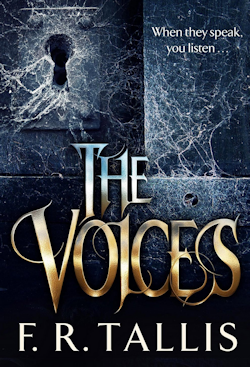
Book Review | The Voices by F. R. Tallis


In the scorching summer of 1976—the hottest since records began—Christopher Norton, his wife Laura and their young daughter Faye settle into their new home in north London. The faded glory of the Victorian house is the perfect place for Norton, a composer of film soundtracks, to build a recording studio of his own.

But soon in the long, oppressively hot nights, Laura begins to hear something through the crackle of the baby monitor. First, a knocking sound. Then come the voices...

***

Maybe you haven't heard of it—maybe you weren't born yet; maybe you're based elsewhere—but in Great Britain, the summer of 1976 went down in history. It was the hottest single season since records began some 400 years ago, and people in these parts weren't prepared. There were droughts. Deaths.

It was an indescribably violent time, all told. Hate crimes were a daily affair many commentators attributed to the incredible temperatures. "What a world to bring a child into," (p.1) as our couple comments on the first page of F. R. Tallis' haunting new novel. But that's exactly what Christopher and Laura Norton plan to do. Indeed, on the day they decide to spend their once-substantial savings on "a substantial Victorian edifice [...] concealed in a pocket of London's complex topography," (pp.1-2) their infant daughter is born. They name her Faye, meaning belief—which, though they have in her, they lack, alas, in one another.

A year later, the Nortons have settled into their new property nicely, but things between Faye's parents have gone to pot in short order, and a terror more malignant than the recent uptick in temperature is about to make its malevolent presence felt.

After The Sleep Room's success, it's a smart move on Tallis' part to focus in his new novel on another pseudo-scientific subject—in this instance Electronic Voice Phenomena. "It seemed a ludicrous idea, the dead communicating with the living through the medium of magnetic tape, but at the same time Christopher's mind was not entirely closed to extraordinary possibilities." (p.83) As an explanation for the voices he's been hearing recently—voices accidentally recorded in the course of composing the score for a forthcoming science fiction film—EVP isn't ideal, but it's the best of a bad lot... and rather that than face the fact that he might be losing his mind.

Friday, 3 October 2014

Book Review | The End of the Sentence by Maria Dahvana Headley & Kat Howard


It begins with a letter from a prisoner...

As he attempts to rebuild his life in rural Oregon after a tragic accident, Malcolm Mays finds himself corresponding with Dusha Chuchonnyhoof, a mysterious entity who claims to be the owner of Malcolm's house, jailed unjustly for 117 years. The prisoner demands that Malcolm perform a gory, bewildering task for him. As the clock ticks toward Dusha's release, Malcolm must attempt to find out whether he's assisting a murderer or an innocent. The End of the Sentence combines Kalapuya, Welsh, Scottish and Norse mythology, with a dark imagined history of the hidden corners of the American West.

Maria Dahvana Headley and Kat Howard have forged a fairytale of ghosts and guilt, literary horror blended with the visuals of Jean Cocteau, failed executions, shapeshifting goblins, and magical blacksmithery. In Chuchonnyhoof, they've created a new kind of Beast, longing, centuries later, for Beauty.

***

In the aftermath of a tragic accident that made a mess of his marriage, Malcolm Mays retreats to rural Oregon in an attempt to begin again, however he gets more than he bargained for when he moves into a foreclosed home in Ione.

In a sense he inherits its former occupant, a convicted criminal called Dusha Chuchonnyhoof who—having been unjustly jailed for two lifetimes and a day, he says—is preparing to reclaim his property. "The homeowner is only absent, you must understand. Not gone. The end of the sentence approaches [...] and when it comes, I will return." (p.15)

This much Malcolm is made aware of—this much and no more, for the moment—through the letters that mysteriously appear in and around the house. Letters sent, evidently, from the nearby penitentiary, bidding him welcome... but how can that be when he hasn't announced his presence to anyone? Other letters are delivered later: missives urging our man to prepare the place for Chuchonnyhoof's homecoming... despite the fact that the felon in question has been dead for half a century.

Malcolm has no intention of doing what the letters advise, but, as if sensing his resistance, Chuchonnyhoof—or else the degenerate purporting to be Chuchonnyhoof—promises to make it worth his while. How? By bringing his lost boy back from the beyond. "If you do as I tell you to do, he will return when I do. If you do not," warns one of the murderer's many messages, "he will remain where you left him." (p.38)

Friday, 11 July 2014

Book Review | Touched by Joanna Briscoe


Rowena Crale and her family have moved from London. They now live in a small English village in a cottage which seems to be resisting all attempts at renovation. Walls ooze damp, stains come through layers of wallpaper, celings sag, and strange noises—voices—emanate from empty rooms.

As Rowena struggles with the upheaval of builders while trying to be a dutiful wife and a good mother to her young children, her life starts to disintegrate.

And then, one by one, her daughters go missing...

***

From the author of a selection of elegant bestsellers, not least the sensational Sleep With Me, comes a creepy period piece, positively drenched in dread, that documents an old-fashioned family’s decision to leave London for a crumbling cottage in the countryside.

For Rowena, mother and matriarch of the many and various Crales—including her dullard of a husband Douglas—the move is meant to demarcate a break from the bland patterns of the past, but from the first, the house seems set on rejecting its new tenants. A retaining wall can’t be broken through; a damp problem proves impossibly pervasive; and in the interim, “an impression she couldn’t pin down, that the house was already inhabited [...] overlaid with memories of all the years her mother-in-law had lived there,” (p11) eats away at Rowena.

It’ll be worth all the blood and sweat in the end, she tells herself. But that’s before her daughters start disappearing...
Numbers 2 and 3 The Farings were postcard cottages, age-softened and settled, with their deep-set windows and boxes of geraniums, their uneven floors and cool pantries, their small gardens tangles of mature flowers and shrubbery. The modern house in London had contained no soul, and little opportunity for her decorating dreams; The Farings, by contrast, possessed so much character, she found it hard to believe there weren’t other people there. That was why she was faintly nervy, she realised, imagining movement in other rooms, because it simply didn’t seem as though it was theirs yet. (p.29)
Initially, Rowena dismisses these feelings, insisting “it was her mind playing tricks, and she turned it off like a light switch,” (p.20) but they persist—and soon it seems one of her children is sensitive to them too. “This was Evangeline, who was dressed as a Victorian and had rain for hair. [...] She guttered in the others’ shining, blanked out by their shadows. Where the other Crales were clean with health and Jennifer was doll-beautiful, Evangeline was a grubby, transparent girl, dragging her feet and slipping away,” (p.6) quite literally latterly:
To explain the nature of Evangeline was difficult. Was she a backwards child? [...] Was she handicapped? A candidate for electroshock treatment? Evangeline did not fit easily into any category, and yet she was considered mentally subnormal by those who saw her slipping, murmuring, sliding through the village in her ghost frocks. The villagers had plenty to say to the police about Miss Evangeline Crale. (p.131)
But it’s as if she isn’t missed, in that no one other than Rowena really takes her disappearance seriously—and even she waits a few weeks before going to the police. It’s a whole other story when beautiful Jennifer follows in her inexplicable sister’s footsteps. Questions are asked and investigations urgently undertaken. The Pollards in particular are considered suspicious, but they’re practically friends of the family. They wouldn’t have hurt the girls, would they?

The trauma of all this turmoil is the ruination of Rowena. Her “dreams, already shattered, were irretrievable: it was the nightmare now that she fought.” (p.193) A nightmare that lives in The Farings with the remaining Crales...

Touched is a terrific little ghost story, to be sure—an exemplar of the short, smart shocks of horror Hammer-branded books have represented in recent years—but the narrative is not what makes it so special. Though it’s well handled on the whole, and very prettily written—Joanna Briscoe’s prose proved an unexpected pleasure—the twist the tale takes in its later stages is too transparently telegraphed to satisfy in the final summation, and there’s some unfortunate redundancy in the remainder.

Instead, what sets Touched apart are its central characters. Rowena is a brow-beaten broodmare—all too familiar a figure in Britain in the fifties and sixties—invested with such a sense of nervous energy that her eventual unravelling is essentially inevitable. Add to that unreliable protagonist a fantastic focal point for her frenzies in Evangeline, whose secret life—out of sight and out of mind—is superlatively rendered. 

Evangeline’s supposed disability is also deftly depicted, reflected as it is—if it is—by the harried or horrid reactions of others around her rather than her own entirely innocent idiosyncrasies:
Adults customarily shrank from her, ignored her, or addressed her like a simpleton. At her primary school, they had tied her to her chair to keep her in lessons, then tied her to another at lunch; but largely, she was allowed to disappear, and if people didn’t want her, such absences were her preference. (p.40)
It’s just a shame Evangeline is herself absent for such a large part of the narrative. Truth is, Touched is a touch less stimulating when she’s missing.

In a fascinating afterword, the author asserts that her “characters are all haunted by their pasts, their mistakes, their longings; pursued by guilt and desire so strong, it could infiltrate a life,” (p.242) and that’s clearly the case here, allowing anyone a way into Touched. To wit, this is an eminently accessible text, bolstered by a exquisitely composed story, but what makes it remarkable at the last is its juxtaposition of the genre’s foremost tropes—such as “houses in rebellion, secret rooms, figures glimpsed obliquely [and] unexplained smells” (ibid.)—with evils revealed to be markedly more mundane in nature.

***

Touched
by Joanna Briscoe

UK Publication: July 2014, Hammer Horror

Buy this book from
Amazon.co.uk / The Book Depository

Or get the Kindle edition

Recommended and Related Reading

Thursday, 1 May 2014

Guest Post | "Haunted Homes" by Alison Littlewood

There are so many things that make haunted houses ideal for a good chilling tale. Home is where the heart is, they say; it’s also where family is, the things we love. It’s where we feel safe. Not so in the haunted house, where our refuge becomes a place of nightmare. Family, more likely than not, becomes a source of terror instead of love. Death walks the hallways and rattles at the doors, and we can become trapped by the very walls we build around ourselves.

In film, I’m a sucker for a good haunted house. All that sneaking around at night completely gets to me, possibly because it’s redolent of my own childhood fears of what might be hiding in the dark. And there are those cheap jump moments that are almost expected—the thing glimpsed in the mirror as the bathroom cabinet closes; the reflection in the window; and, of course, the dreaded cellar, that emblem of the subconscious, where who knows what might be lurking. Still, I’ll jump at all of them, in part precisely because I expect them.


In literature, it’s not really about the jump moment so much as a creeping sense of dread, of the things we don’t expect, the darkness lurking inside ourselves being reflected in the things around us. It’s about atmosphere, as evoked so beautifully in some of the classics of the genre—The Haunting of Hill House by Shirley Jackson, James Herbert’s Haunted or Susan Hill’s Woman in Black.

The written word also has the facility to place us on the inside, sharing the character’s thoughts but also their flawed perceptions and understanding. One of my favourite haunted house novels of recent times has just such a flawed protagonist. The eponymous Audrey, of Audrey’s Door by Sarah Langan, is struggling to emerge from a broken relationship and an upbringing with a mentally ill mother. She moves into the Breviary, an apartment building constructed by proponents of a movement called chaotic naturalism. When we discover that her ridiculously cheap apartment was recently a crime scene, we can feel the walls closing in before anything supernatural happens. Audrey, an architect, soon finds herself obsessed with doors, adding them to plans where no doors should be. When she is compelled to build a door in the middle of her apartment—leading to what?—the fear ramps up. It’s tense, clever and genuinely scary.

Another favourite of mine is Dark Matter by Michelle Paver [Ooh! I liked that one too—Ed]. Often, haunted houses are isolated, removed from sources of help and the normalising effect of other people. Here is an Arctic outpost rather than a house, but for the main character, Jack, it becomes his only home and refuge in the midst of a wilderness. Poor and disillusioned, he is recruited for the expedition by a group of men he sees as being a ‘cut above’, but problems beset the others until only Jack remains. The outpost becomes his home, one surrounded by snowy wastes and the endless dark. As it begins to seem he isn’t quite alone after all, we begin to wonder whether the haunting is a ghost or the effects of extreme isolation on Jack’s personality. The novel is set in the 1940s and is told in Jack’s diary entries, and it is his idiosyncratic voice that is a great part of the novel’s strength.

Short stories can be ideal for evoking an atmosphere, for encapsulating a moment in time or a distilled emotion, and as such they lend themselves well to the haunted house theme. House of Fear, edited by Jonathan Oliver, is an anthology of contemporary ghostly tales by practitioners like Stephen Volk, Adam Nevill, Robert Shearman, Sarah Pinborough, Christopher Priest, Tim Lebbon and many more. It’s a showcase, not just of some very fine authors, but of the huge range of approaches that can result from the theme: some traditional, some distinctly modern, others more surreal, while others question the concept of what it is that constitutes a haunting at all. The creativity on offer shows how far the concept of a haunted house can be reinvented and given fresh life; certainly, the tried and tested idea seems to be in no danger of dying out.

***

Alison Littlewood is the author of A Cold Season, published by Jo Fletcher Books, an imprint of Quercus. The novel was selected for the Richard and Judy Book Club, where it was described as “perfect reading for a dark winter’s night.” Her second novel, Path of Needles, is a dark blend of fairy tales and crime fiction, and her third, The Unquiet House, is a ghost story set in the Yorkshire countryside.

Alison’s short stories have been picked for The Best Horror of the Year and The Mammoth Book of Best New Horror anthologies, as well as The Best British Fantasy 2013 and The Mammoth Book of Best British Crime 10. Other publication credits include the anthologies Terror Tales of the Cotswolds, Where Are We Going? and Never Again. Alison lives in Yorkshire with her partner Fergus. Visit her at www.alisonlittlewood.co.uk.

Thursday, 26 December 2013

Book Review | The Silence of Ghosts by Jonathan Aycliffe


When the Blitz starts in London, Dominic Lancaster, injured out of service at the battle of Narvik, accompanies his 10 year old sister Octavia to the family house on the shores of Ullswater in the Lake District. Octavia is profoundly deaf but at night she can hear disturbing noises in the house. When questioned by Dominic as to what she can hear, she replies: "voices."

Two nights later she comes into his bedroom to tell him that the dead children in the house want them to leave. And then Octavia falls mysteriously ill... during her sickness she tells Dominic he must go to the attic. There, he releases an older, darker evil that threatens the lives of Olivia and himself.

***

When Dominic Lancaster goes to war as a gunner about the HMS Hotspur, it's a chance for him to show his family — who have dismissed him to date as a dreadful disappointment — that he may well be worthy of their legacy: a successful port importing business which Dominic stands to inherit after his father's passing.

Instead, he becomes one of the first casualties of the conflict when he loses his leg at the Battle of Narvik. His subsequent recovery is tough; tough enough that Dominic's parents dispatch him to Hallinhag House in the little village of Ullswater... ostensibly to give him a peaceful place to recuperate, but in truth, as Dominic determines, so that he isn't underfoot when the Blitz begins.

He's not alone in the Lancasters' holiday home. For one thing, his ten-year-old sister Octavia is with him. Profoundly deaf for the larger part of her little life, she's another distraction to be disdained at every stage by a pair of appalling parents, but somehow Hallinhag House seems to be improving her hearing. The sounds she starts to hear, however, are of nothing natural.
The house seems more than quiet. Downcast. Full of memories. No, that's wrong. It's full of forgettings. All the years that have gone, and I know so little of the men and women who spent time here, even though they were my ancestors. When I have been here before, the house has seemed filled with light; but that was always the summer and it is winter now. Perhaps the house has picked up on my mood, sensed by new vulnerability, and knows how useless I am. Can houses sense what we feel? Do they feed off all the emotions that have been experienced between their walls? Octavia says there are ghosts here. I admonish her, and I watch her when she comes to this room. She might be serious, but I doubt it. She has no names for these ghosts. Maybe they are silent, like her. (p.29)
Initially, Dominic has little time for such frivolousness, because he too has his sights set on getting better; on learning to walk once more, first and foremost. Assisting him in this is the district nurse, Rose, a beautiful young woman who treats him with care and kindness. It isn't long before Dominic falls for her, though there will be no flings in the future he foresees.

Thursday, 24 October 2013

Book Review | House of Small Shadows by Adam Nevill


Buy this book from
Amazon.co.uk / The Book Depository

Or get the Kindle edition

Catherine's last job ended badly. Corporate bullying at a top television production company saw her fired and forced to leave London, but she was determined to get her life back.


A new job and now things look much brighter. Especially when a challenging new project presents itself: to catalogue the late M. H. Mason's wildly eccentric cache of antique dolls and puppets. Rarest of all, she'll get to examine his elaborate displays of posed, costumed and preserved animals, depicting scenes from World War I.

When Mason's elderly niece invites her to stay at the Red House itself, where she maintains the collection, Catherine can't believe her luck... until his niece exposes her to the dark message behind her uncle's 'Art'. Catherine tries to concentrate on the job, but M. H. Mason's damaged visions raise dark shadows from her own past. Shadows she'd hoped had finally been erased. Soon the barriers between reality, sanity and memory start to merge. And some truths seem too terrible to be real...


***

Abandoned by her biological parents at an early age before being adopted into a family that questioned her sanity, Catherine has had it hard from the first, and her life doesn't appear to have gotten a great deal easier in recent years.

At school, it was plain that she didn't play well with others, nevertheless Catherine became close to Alice, another social outcast. Together, they found sanctuary of sorts in and around the grounds of a derelict special education centre, but in the summer of 1981, it all went horribly wrong: Alice vanished. Another victim of the Pied Piper of Ellyll, according to the local newspapers.

Her body was never recovered; indeed, no trace of Alice is ever discovered. But months later something like her spirit makes contact with Catherine, who in her innocence tells everyone about her otherworldly encounter... leading to a long period of appointments with child psychologists.

Time passes, and Catherine finally meets a man. Mike: the love of her life. He, however, breaks Catherine's heart, and so she leaves her troubled childhood behind to turn over a new leaf in London, where she works for a top television production company with an interest in documenting ancient estates. Then one dark day, just as she had dared to dream she'd managed to make a clean break, she crosses a colleague, Tara, who makes it her continuing mission to turn Catherine's life into a living hell.

Defeated, she returns to Ellyll with her tail between her legs, and suddenly, things start looking up. Catherine's offered a job cataloguing art and antiques for auction. Meanwhile she and Mike are reunited, and against all the odds, they make a go of it on take two.

Here, at last, is where House of Small Shadows starts. All of the above information we find out through protracted flashback, or reminiscences extended to such an extent that Adam Nevill's new novel nearly gives way under their weight. Catherine's implausible past does finally factor into the narrative, I'll give House of Small Shadows that, but cumulatively, it's indisputably convoluted, and far from the best foot for the author to put forward first.

Thankfully Nevill's rendering of the Red House, where most of the text takes place, is much more successful than his heavy-handed central character:
Her first impression was of a building enraged at being disturbed, rearing up at the sight of her between the gate posts. Twin chimney breasts, one per wing, mimicked arms flung upwards to claw the air. Roofs scaled in Welsh slate and spiked with iron crests at their peaks bristled like hackles. 
All of the lines of the building pointed to the heavens. Two steep gables and the arch of every window beseeched the sky, as though the great house was a small cathedral indignant at its exile in rural Herefordshire. And despite over a century of rustication among uncultivated fields, the colour of its Accrington brick remained an angry red. (pp.1-2)
A fantastic opening chapter wherein Catherine approaches this brilliantly sinister building left me longing to return to the Red House's grounds, but rather than that, Nevill has us travel back to repeat the previous week. When at last we catch up, our protagonist has been dispatched to poke around the property of the late M. H. Mason: a noted taxidermist in his time whose work fell out of favour as attitudes towards his ghastly art altered. Since his death decades ago, his niece, Edith, has cared for his estate:
Even a perfectly conserved Victorian drawing room filled with preserved animals could not upstage the visage of Edith Mason in the flesh. So much powder clung to the woman's ancient face that the skin papered to the bony features looked bleached, and her tiny eyes were made ghastly by their red rims. The lips about the teeth were non-existent and the nose was a blade, the light seemed to pass through the side as if it were pure cartilage. It was a difficult face to look at and Catherine struggled to do so. (p.39)
The Red House is redolent of all sorts of awfulness — as are its surviving inhabitants, Edith and Maude; the latter being a mute maid who slips Catherine a note after her first inspection, to the effect that she should never ever return.

It's spoiling nothing to say she does. But first, Nevill treats us to another chapter in the ongoing saga of Catherine's luckless life. With next to no explanation, Mike breaks up with her again, and she promptly falls into an intense depression, all alcohol and paranoia. Her only hope is to push through this bleary period and finish the work she's started at the Red House. To succeed in just this one way; that's all she wants. "Weirdness," in any event, "went with the territory. And this was her find, her moment. An opportunity. Not a trial that she could run away from like London and university and school and her hometown, and everyone that she ever encountered in any of those places." (p.186)

So she swallows her horror at the prospect and returns, against Maude's orders, to the Red House, resolving to complete a catalogue of M. H. Mason's disconcerting dolls and disgusting dead animals as quickly as possible. Whether she'll live to leave again is unclear...

For a book so rooted in its protagonist's past, at the first and at the last, it's a real shame House of Small Shadows revolves around such an unconvincing character. Catherine seems to have a single setting — hysterical — and though her horrid history is an influence in this, the unremitting misery and melodrama of her perspective distanced this reader rather than engendering my empathy. To make matters worse, she has next to no agency over the narrative. "Like a doll; something to be positioned by the insistent and capricious will of a nasty little girl," (p.99) she simply does as instructed, even when it's evident that the individuals instructing her mean her harm.

In recent years, Adam Nevill's novels have been a bastion of dark fantasy in the field of British genre fiction, and indeed, many of the ideas here are as insidious and effective as anything he's portrayed previously. The taxidermy will turn your stomach; the dolls are unspeakably unsettling; the Red House itself is an oppressive setting, and the lost old souls who call it home only add to that atmosphere. Take it from me: reading House of Small Shadows late in the evening is likely to lead to some serious nightmares.

As a narrative, then, there's a lot to recommend House of Small Shadows to horror aficionados. Character is where it all but falls apart, I fear. Your mileage may vary, but I had a tough time caring about Catherine, so though the novel's concepts and conflicts remained intellectually interesting to me right through to the satisfying, if unsurprising finale, and I admired in the meantime many aspects of the author's craft — including but not limited to his plot and premise — I wasn't emotionally involved in the experience at all, and that robbed my reading of House of Small Shadows of something indescribably vital.

***

House of Small Shadows
by Adam Nevill

UK Publication: October 2013, Pan

Buy this book from
Amazon.co.uk / The Book Depository

Or get the Kindle edition

Recommended and Related Reading

Thursday, 19 September 2013

Coming Attractions | The Unquiet House by Alison Littlewood

In early 2012, in the midst of a cold season of my own, I took a deep breath and immersed myself in Alison Littlewood's darkly fantastic first novel. In the review I wrote at the time, I concluded that it was "a powerful story about motherhood... about family, and the ties that bind us. Excepting a few missteps that it bears saying plague all and sundry authors in this genre [...] A Cold Season is a terrifically chilling tale. A sterling debut which bodes unspeakably well for its author and beyond."

By which I meant Jo Fletcher Books too: a brand new genre fiction-focussed imprint at the time. Now, nearly two years later, I'm pleased as can be to report that their forthcoming slate still looks great.

This week I was lucky enough to secure an early look at what's to come from JFB in 2014, and alongside The Galaxy Game by Karen Lord and Empress of the Sun by Ian McDonald, The Unquiet House — Alison Littlewood's next novel — was one of the highlights of a packed catalogue.

Here's the cover art:


And a brief blurb about the book to boot:
Mire House is dreary, dark, cold and infested with midges. But when Emma Dean inherits it from a distant relation, she immediately feels a sense of belonging. 
It isn’t long before Charlie Mitchell, grandson of the original owner, appears claiming that he wants to seek out his family. But Emma suspects he’s more interested in the house than his long-lost relations. 
And when she starts seeing ghostly figures, Emma begins to wonder: is Charlie trying to scare her away, or are there darker secrets lurking in the corners of Mire House?
That I never got around to reviewing Littlewood's second novel is a real regret, but I did indeed read it, and Path of Needles did nothing to diminish my appreciation of an abominably promising new horror author. Safe to say I won't make the same mistake when The Unquiet House is released in the UK next March.

Friday, 11 January 2013

Film Review | Sinister, dir. Scott Derrickson


Perhaps it's a lack of imagination on my part, but I cannot conceive of a trope more typical of the horror genre than the haunted house. In film and in literature, there exists a rich tradition of outwardly unblemished human habitats which the shadow of some ancient evil or recent violence has taken a secret shining to — and for good reason.

That darkness could impress itself upon a place, to play out again and again over the years on anyone who dares in their ignorance or their innocence to set foot in these sacred spaces... it's a powerful idea. One that we are immediately, even intimately familiar with, such that the haunted house requires only a slight suspension of disbelief on our part, and the most minute alterations to the classic narrative which invariably accompanies it can affect play in a major way.

Nowadays, however, we have haunted children, haunted hills, haunted histories and so on - hell, relatively recently I read and reviewed Michael Koryta's So Cold the River, which was about a haunted bottle of mineral water, if you can credit it - and with this expansion of horror's horizons, the archetypal haunted house has begun to look a little long in the tooth. I dare say there's life left in the old dog yet - see my high hopes for Adam Nevill's House of Small Shadows, coming Halloween 2013 - but give me a new idea over even an innovative spin on a predictable proposition any day of the week.


I don't know if Sinister represents a new idea, exactly - its core conceit, which is to say the haunted image (the haunted film, in fact) rather recalls Ringu - but at its best, it feels as fresh as it is ultimately familiar.

It's been a decade since true crime writer Ellison Oswalt had an actual hit on his hands, and with two point four children to support, he understands that there is but one last chance for literary lightning to strike twice. Failing that, a life of editing textbooks at best awaits. So motivated, our author, ably played by an edgy Ethan Hawke, uproots the Oswalts a final time. They move into a house which was recently the scene of a macabre multiple murder - the very uncanny hanging with which Sinister begins - though Ashley, Trevor and Tracy know little of this.

The weather seems to be with Ellison when, whilst unpacking, he comes across a box of home movies in the attic: Super 8 snuff films, after a fashion, documenting the deaths here in the Oswalt's new home — as well as a series of similarly sinister killings across the country. Sensing an extraordinary story, he opts to investigate them himself instead of alerting the proper authorities.

But when things begin to go bump in the night - when his son starts sleepwalking and his daughter takes to drawing pictures of the last tenants' little girl - Ellison realises that there may be more to these vile crimes than he had imagined, even in the darkest of his dreams.


Aside the miscasting of newcomer Juliet Rylance as Ellison's partner, who has little to do other than make ultimatums anyway, Sinister's actors are absolutely adequate. The kids aren't as central to the terror as you might suspect, given the genre, which is as well; it allows Hawke to shoulder most of the movie's most potent moments, and as aforementioned, he does so solidly. I hardly thought about his role in Dead Poets Society at all!

Meanwhile, behind the scenes, Scott Derrickson directs. A fledgling filmmaker most notable, I suppose, for The Exorcism of Emily Rose, he also remade The Day the Earth Stood Still as a thankless Keanu Reeves vehicle, and developed the fifth Hellraiser film, Inferno. I'll say that he equips himself better here than he ever has in the past... but then poor direction has rarely been the ruin of his previous pictures. 

Simply put, Sinister is blessed with a better script than the rest of Derrickson's efforts were, thanks to a screenplay co-written with C. Robert Cargill. If this unnerving experience is any sort of barometer for his impending debut - Dreams and Shadows, out in the US and the UK at the end of February - I expect smart, if not necessarily seamless modern horror.

The film is far from perfect, then, but I had a fair bit of fun with it. Neatly conceived, competently composed and respectably well executed, Sinister seems to me one of the strongest scary movies of recent years. You may interpret that phrase in any number of ways, so go knowing that it's more insidious than Insidious, and approximately ten times as interesting as The Possession.