Showing posts with label anthropomorphised animals. Show all posts

Tuesday, 10 February 2015

Guest Post | "Coming to the End of a Trilogy" by Gareth L. Powell

You know how in horror movies you can sometimes summon the monster by simply saying his name? That’s how it happened for me.


When Solaris Books published my fifth novel Macaque Attack in January 2015, it marked the end of a bizarre and unexpected journey—a journey that began some time in 2006, when the words ‘Ack-Ack’ and ‘Macaque’ started rattling around in my head, and I scribbled them into my notebook. I didn’t look in a mirror and say ‘Candyman’ three times; I simply wrote down two words. ‘Ack-ack’ is wartime British slang for antiaircraft fire, and a ‘macaque’ is a type of monkey.

Ack-Ack Macaque.

It sounded like a name. There was something about the rhythm of the syllables. I wrote it down and said it aloud and, hey presto, there he was. He sauntered into my brain fully formed: a bad-tempered, cigar-chewing monkey pilot with an eye-patch and a pair of shiny Colts. He was part Lee Marvin, part Biggles, and part John Belushi in 1941—a cynical badass stick-jockey with an eye patch and a cigar.

At the time, I needed a fictional anime character for a short story I wanted to write. I wanted to say something about the commodification of culture, especially in movie adaptations of books and comics, and so I needed a cartoon character with rough edges. I put Ack-Ack into the story and he took it over. I even ended up naming the story after him.

‘Ack-Ack Macaque’ became my second short story sale to Interzone, the long-running British SF&F magazine. It appeared in issue #212 in September 2007, and Warren Ellis memorably described it as “the commercialisation of a web animation into some diseased Max Headroom as metaphor for the wreckage of a fucked-up relationship.” The story garnered some good reviews and went on to be voted the year’s favourite short story in the annual Interzone reader’s poll.

That’s where it should have ended; but monsters, once summoned, can be hard to dismiss.

In 2012, I set out to write a murder mystery set on a giant Zeppelin. I wanted to explore different notions of what it means to be human, so the characters included a woman who had half her brain rebuilt with artificial processors following an accident; the self-aware recording of her dead husband; and a man who finds out he’s a clone. They had all considered themselves human in the past, but now weren’t so sure. All I lacked was the viewpoint of a character that had never been human at all, but had been ‘uplifted’ to consciousness.

Ack-Ack was waiting for me, smoking a cigar in the dark recesses of my imagination.

“About time, too,” he said.

The novel, Ack-Ack Macaque, appeared from Solaris Books in January 2013 and went on to co-win (alongside Ann Leckie’s all-conquering Ancillary Justice) the BSFA Award for Best Novel.


Writing the main characters—who are all outsiders, alienated from the rest of humanity by the surgery that’s made them different—was a fascinating and challenging experience. To convincingly portray them as individuals, I had to try to put myself in their position. I had to imagine what it would be like to be a creature with the mind of a man and all the attitude and bad habits of a monkey, or a former journalist whose thoughts now ran on mostly artificial neurons. Luckily, I guess we all know what it feels like to be an outsider. We’ve all been in situations where everybody else seems to know what’s going on, and we’re left floundering; where something about us—our clothes, the music we like, our sexuality—sets us apart from the crowd; and I was able to draw on those feelings of insecurity and self-consciousness to bring the characters’ inner thoughts to life.

Meanwhile, Ack-Ack had been busily spilling out into other media.

To help launch the book, a five-page Ack-Ack Macaque prequel strip appeared in the December 2012 issue of the legendary British comic 2000 AD. I also set up a Twitter feed in the monkey’s name, and he started interacting with his readers, quickly gathering an army of loyal followers who bombarded him with funny monkey pictures, banana jokes, and marriage proposals!

The sequel, Hive Monkey, appeared in January 2014. At the time, it was the first novel-length sequel I’d attempted, and to start with, I wasn’t sure I’d be able to pull it off. What if it wasn’t as good as the first one? I needn’t have worried. Climbing back about the skyliner Tereshkova felt like coming home. I’m extremely fond of all the main characters, especially Ack-Ack and Victoria Valois, and found it immense fun to hang out with them a second time, even as I broadened the alternate universe setting to ask new questions about the nature of humanity and what it is that makes us unique.

Hive Monkey was my first sequel, and Macaque Attack marked the completion of my first trilogy.

Or did it?

I won’t say how or why, but Macaque Attack features appearances by characters from my 2011 Solaris novel, The Recollection [reviewed right here on TSS—Ed] which means this ‘trilogy’ is actually more of a ‘quartet,’ and the monkey’s adventures have been playing out against a background far more epic than he could possibly have suspected.


As well as examining questions about the nature of memory and what it means to be human, these four books also concern themselves with notions of friendship, family and belonging. Ack-Ack Macaque starts out alone and gradually accretes a kind of ersatz family group or, as he thinks of it, a troop. The cynical, embittered veteran finds himself beginning to care about those around him. He takes on adult responsibilities and, as a consequence, he grows up. At the end of book three, he is wiser and more human than he was at the opening of book one.

As, I hope, am I.

Writing these books has been a hell of a lot of fun, and I’ve learned a lot from the process. I’ve had a blast, but all good things must eventually come to an end. I’ve said what I wanted to say, and now it’s time to say goodbye. I will miss Ack-Ack and Victoria terribly, but their stories have been told and I know it’s now time to move on to other projects.

Ack-Ack Macaque may have left the building, but, if the stars align just right and the wind’s blowing in a favorable direction, then one day it’s just possible he might come back.

Maybe.

Until then, there’s Macaque Attack—his biggest, craziest adventure yet. As Ack-Ack himself might say:


“Buckle up, sweethearts. It’s going to be a hell of a ride.”

***

Gareth L. Powell is an award-winning science fiction and fantasy author from Bristol whose books have been published in the UK, the USA, Germany and Japan. You can find him online at www.garethlpowell.com, and follow him on Twitter at @garethlpowell. Should you be brave enough, the aforementioned monkey tweets too, as @AckAckMacaque.

Friday, 16 January 2015

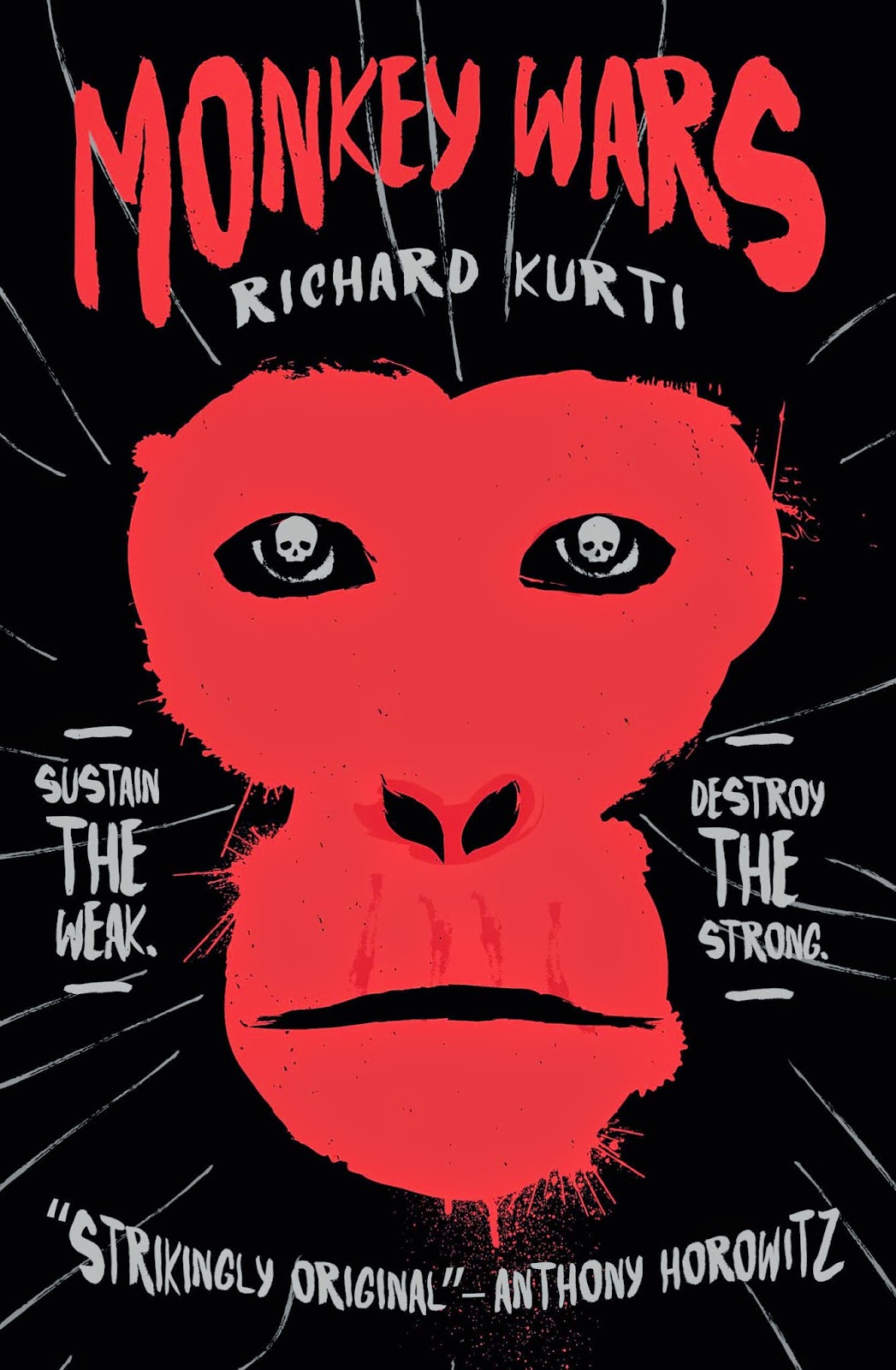
Book Review | Monkey Wars by Richard Kurti


In this dark, inventive fable, rhesus monkeys are brutally massacred on the dusty streets of Kolkata by a troop of power-hungry langur monkeys. Mico, a privileged langur, becomes entangled in the secrets at the heart of his troop's leadership and is shocked at what he discovers. He feels compelled to help the few surviving rhesus, especially Papina, a young female he befriends, even though doing so goes against everything he's been taught. As more blood is spilled, Mico realises that choosing between right and wrong won't be easy.

Told entirely from the monkeys' points of view, Monkey Wars shines a black light on the politics of power, the rise of tyrants and the personal dilemmas that must be faced when life is on the line.

***

Imagine a marketplace in Kolkata. Can you see the vendors selling stalls full of colourful fruit? Smell the heady scent of spices lacing the hazy air? Hear the buzz and the bustle of customers bargaining and bartering? Good.

Now picture the marketplace populous with as many monkeys as men and women. 

Were they peaceful creatures—the monkeys, I mean—it'd be a magnificent thing; a memory to truly treasure. But they aren't, and it isn't. These monkeys have no money, no manners, no morals. They take what they want, when they want it, and if someone comes between them and their ends... well. People have been hurt. But because "devout Hindus believe that all monkeys are manifestations of the monkey god, Hanuman," (p.3) authorities are unable to take action against said simians.

A true story, I'm told, though the tale screenwriter Richard Kurti spins out of it—an all-ages allegory of the rise of the Nazis arranged around a tragic romance right out of Romeo and Juliet—is as much fiction as fact.

Thursday, 2 October 2014

Book Review | Bête by Adam Roberts


It began when animal rights activists inserted AI chips in the brains of animals. The plan was to give animals speech. After all, if animals can talk we are bound to treat them more like us. A creature that can argue the case for its own intelligence, its own rights, is a much harder creature to use, to kill, surely.

But where does artificial intelligence end and the animal begin? With speech and self-awareness, have these canny animals also gained souls? Would we choose to believe them if they told us they had?

And would they forgive us?

***

Reading Adam Roberts is like participating in a literary lucky dip. It's a bit of a gamble, granted, but every one's a winner, and all of the prizes on offer are awesome.

Different sorts of awesome, I dare say. Always smart, and ever so sharp, but sometimes you get something scathing, and sometimes something sweet. Sometimes his stories are obscenely serious; sometimes they're ridiculously silly. Bête represents the best of both worlds—the coming together of all the aspects of Adam Roberts: the author, the professor and the satirist, alongside a number of others.

His fifteenth full-length fiction in fifteen years—including neither his punsome parodies nor his several collections—is a book about the rise of animals with intelligence to match man's, and it begins with a cutting conversation between a cattle farmer and the cow he had thought to slaughter.

"Won't you at least Turing-test me?" (p.11) it pleads as the bolt-gun is pressed against its head. One imagines many would, in that moment—indeed, making this beast into meat will be a matter of murder within weeks—but Graham Penhaligon is... somewhat set in his ways, shall we say. Also: a bit of a bastard. He pulls the trigger, a few pages later, in part because the cow—a farm animal made canny by activists with access to AI augmentations—makes the mistake of quoting a Morrissey song.
You dislike me for killing it. You're no vegetarian, though, hypocrite, reader, my image. My friend. You don't object to the killing as such. You object to my manner. When hunter-gatherers get angry it is hot and swift. When farmers get angry it is bone-deep and slow. (p.16)
And Graham, I'm afraid, has "spent decades perfecting anger as [his] being-in-the-world" (p.105)—so sayeth Cincinnatus the cat, a bête beloved by the cancer-ridden character our former farmer falls for in the novel's next section, which takes place fully five years after its provocative prologue. Brief and bleak as Graham's relationship with Anne is, it goes a long way toward humanising Roberts' immediately unappealing lead: a miserable man, as mean as he is maudlin, however he does, as it happens, have a heart.

Friday, 28 June 2013

Book Review | Lupus Rex by John Carter Cash


The crow king is dead, and in the field below all the creatures tremble as the Murder gathers to choose a new king from the rival sons Sintus, Milus and Nascus. 

When the crows drive everyone from the field to keep the reckoning secret, the quail Ysil, Cormo and Harlequin believe they must simply follow their elders to safety. But when the crows turn against each other, the forest becomes full of danger.

In the confusion the last wolf, Asmod, shucks off his isolation and begins to raise an army to claim the kingdom for his own. As hidden truths are brought to light and enormous sacrifices are made, Ysil and his friends must make an epic journey and an unthinkable alliance if the lesser animals are to survive.

***

In the animal kingdom, order is everything.

Absent order, chaos would surely consume the many and various creatures who live in and around Murder's Field, for instance. Imagine the madness of the grain harvest without someone to make sure the quails wait their turn! Consider those small souls who would go hungry because of the gluttony of others!

Luckily, that's where the crow king comes in. For generations — ever since the war of the wolves — he and his black-feathered forefathers have upheld a system of sharing, and to a certain extent caring. Under his watchful eye, an order of sorts is imposed. Rabbits, badgers, rats and mice alike are all subject to his commands from on high, in an ornate nest in a great tree at the centre of this field.

But now, the crow king is dead.

And at the outset of Lupus Rex, there is a very real reckoning ahead...

The order states that the crowning of a new king — by way of the reckoning aforementioned — must not be observed by any other animal. The penalty for observing this invite-only rite is death, no less, so when the process begins, the other creatures who call Murder's Field home venture through the woods to give the crows their privacy.

Later that same day, Monroth and Ysil — a pair of plucky young quail in constant competition for the heart of Harlequin — imperil everyone else by sneaking back to watch the sacred ceremony in secret. When their absence is discovered, a band of older animals is dispatched to bring them back before their mischief paves the way for their unmaking. Reunited and rightly chided, they find themselves with no choice but to wait out the rest of the Reckoning.

Or rather, that's the plan. But the Reckoning goes wrong: rather than surrendering to the rook's rule, one of the overlooked heirs to the crow king's bone throne rebels. Finding himself overmatched, if only momentarily, Sintus makes for the forest with his most loyal followers, promising to return with an entire army.

And with that, the ancient order collapses. Chaos takes the reins, and soon, a bloody battle ensues, in the aftermath of which the petrified quail are caught. Exiled after a tragic sacrifice and a mighty bribe, they set out in search of a fabled bird of prey who could turn the tide of the coming conflict, because as Cotur Ada insists, "The wolf will come [...] and its order will be one of blood and darkness. The crows will be its servants, and in the end, all animals — crows, quails, rabbits, every one — its prey. I beg you hear me. The wolf will come if the hawk does not return."

So begins Lupus Rex, the endearing debut of a new genre fiction imprint — Rebellion's Ravenstone  — and indeed an author, namely John Carter Cash. The only son of Johnny and June Carter Cash, John Carter Cash is a singer and a songwriter in his own right, and the producer of other artists' award-winning records in the interim. He's had a number of picture books for children published in the past, but Lupus Rex is his first novel proper — and like Joe Hill's Heart-Shaped Box, it should be judged as such, as opposed to the next phase of some magnetic genetic legacy.

That said, it's fantastic. Delightful and insightful. Almost as good as The Animals of Farthing Wood, if markedly darker. Cash is unafraid to kill off his most charming characters — indisputably brutally too. At points, heads roll and gizzards are liberally spilled, such that Lupus Rex sometimes feels like grimdark anthropomorphic fantasy; picture Joe Abercrombie with added animals. Yet though there is no dearth of death — and though this sense of peril is ever-present — Lupus Rex is largely a light ride.

And, admittedly, quite slight. It's so short that I read it in a single night. So short, in fact, that the abundance of set-up Cash imparts early on seems in service of a greater quest than the abbreviated adventure the exiled animals eventually go on. Another chapter or three in the company of these quails and their lone rabbit companion would have been a great way to develop more substantial characters. As is, they're sweet but somewhat simple creatures.

Another niggle: it can be hard to tell all the damned animals apart. Sulari counts "twenty-nine quail, fifty-five mice, twenty-two rabbits, fourteen squirrels, five badgers, and one slow, grumbling golden rat [...] And I the only hare." That's not to mention the crow kingdom, or the legendary outliers who come to Murder's Field for the climactic clash. If the truth be told, this was a touch too much for me; I can only imagine how challenging the younger readers Lupus Rex is actually aimed at are likely to find it.

Aside these issues, Lupus Rex is lovely. Atypically thrilling and lyrically written. In places, John Carter Cash's prose is truly beautifully put, whilst his depiction of the animal kingdom is particularly magnificent. The concept of the order is a wonderful one, and the resolution of this thread proves massively satisfying.

Certainly it is small, and short of perfectly formed, but Lupus Rex is still a darling of a debut, at the end of the day. A fine way, I dare say, to kickstart the career of a promising new novelist in addition to an exciting new imprint specialising in speculative fiction for children of all ages — up to and including us oldyins!

***

Lupus Rex
by John Carter Cash

UK & US Publication: June 2013, Ravenstone

Recommended and Related Reading

Monday, 14 January 2013

Book Review | The Twyning by Terence Blacker


Buy this book from


This is the story of Efren, a young ratling born into the Court of Tasting, in the kingdom of rats below the city streets. The kingdom is in turmoil after the death of the old king, assassinated by a human scientist, Dr Henry Ross-Gibbon. Obsessed by an ambition to exterminate all rats, the doctor is assisted by Dogboy, an abandoned thirteen-year-old with a gift for understanding animals. Soon a war to the death rages between the rat kingdom and its mortal enemy: humankind.

Hurt and alone, Efren finds shelter with Dogboy and his friend Caz, a runaway eleven-year-old girl. And between these unlikely allies, a spark is ignited — first of communication, then of hope.

This tumultuous story of creatures caught up in a pitiless war transcends the barriers between animals and humans. What Watership Down did for rabbits, The Twyning will do for the kingdom of rats.


***

Riddle me this, readers: what sees you when you're sleeping? What knows when you're awake? What's never more than six feet away, and sometimes carries plague?

That's right! I'm talking about rats. Dirty rotten rodents in the eyes of most folks. But not Terence Blacker's, apparently. His new novel promises to do for these creeping creatures what Watership Down did for rabbit warrens the world over... or else, that's what the publicity suggests. I'd like to suggest an alternative, because to me, The Twyning read more like Redwall with rats. Or rather Redwall with more rats.

There are, however, humans in The Twyning too. Caz and Dogboy are forgotten orphans (complete with horrible histories) who live together in a tip. To pay for the pies they need to stay alive, the caregiver of the pair does odd jobs for an affable rat-catcher, as well as a superior scientist who has made the beasts of the underworld his life's work. Whilst still peripheral, Dogboy's Dickensian adventures - in an ageless English setting, no less - intersect with our actual protagonist's narrative in a more meaningful way, I dare say, than the distractions that come courtesy of Caz.

If not one or the other, then, who is our hero? Well... it gives me great pleasure to introduce you to Efren, of the kingdom beneath our feet:
"A young apprentice whose past was a mystery, whose future was uncertain but whose present was always trouble. [Efren] was too undisciplined to be a taster, too small to be a warrior, too restless to work in the dustier Courts of History, Translation, Strategy or Prophecy. He was something of an outsider even among the other rats of his age. 
"It was said that his father had escaped from a prison in the world above. Certainly the dash of white between his ears, like the crest of a bird, suggested that some rogue blood, a hint of fragility, ran through his veins. 
"Yet there was nothing fearful or weak about this apprentice. He had the oddity of a fragile but none of its dependence on other rats." (p.6)
Never mind the foolish humans: Efren is this novel's real draw. He's a courageous little rodent who dares to doubt the doublethink of his fearless new leader. Having essentially seized control of the kingdom, Jeniel immediately implements a rather Orwellian regime change, beginning with the word:
"Certain words had entered everyday discussions, having first been heard in the speeches of Queen Jeniel. When spoken by the Queen, they had seemed casual. Then those who were close to her at court began to use them. After a while they had become a useful way of displaying loyalty to the new regime, of showing that you were acceptable in the new kingdom. 
"'Unvigilant', 'security', 'emergency', 'modern', 'safety from fear', 're-education', 'race loyalty': I knew what these phrases meant — or rather what they should mean. Now, though, I saw they had another meaning. They were a secret code among those who belonged at court. 
"Those who used them possessed race loyalty. 
"Those who did not were being unvigilant. 
"The few who were foolish enough to ask questions were almost certainly in urgent need of re-education."(p.128)
Thus, the court considers Efren a terrorist, and disowns him for his disobedience. Freed in this fashion from his former responsibilities, he escapes to the world above, to find true love in the form of a fragile — a pet rat, per The Twyning's terminology. But before the troubled couple can consecrate their relationship, Malaika - who has taken up with Caz, as it happens - Malaika alerts Efren to the greatest threat the kingdom has ever faced: a city-wide rat hunt, masterminded by Dogboy's ambitious employers.

With this knowledge comes a choice: before it's too late for all involved, the outsider Efren must decide where his loyalties lie. Should he save the kingdom, corrupt as it has become? Or let his friends perish alongside his enemies?

The Twyning rattles along these exciting lines for perhaps its first half, and there are several such moments in the final section as well. Sadly, the bloated middle of Blacker's book - that part of the entire which relies on the humans instead of Efren - is substantially less successful. One chance meeting follows another, and another, until what credibility the author has earned is soon spent; The Twyning begins to seem contrived, and I fear this feeling persists even after the intermediate act.

Furthermore, a few story beats feel forced, several characters fall flat, and Blacker's decision to alternate between the past and the present tense serves no particular purpose. Meanwhile, the horrendous sense of hysteria so powerfully evoked through the opening is disappointingly defused; it is all but abandoned, in fact, in favour of a far less impactful narrative.

Given all this, it's safe to say mistakes were made. But you know what? I still had a fine time with The Twyning. Indeed, Blacker succeeds more often than not. His worldbuilding is brilliant; his prose is mostly potent; his set-pieces are tortuously tense; and though it revolves around one of the animal kingdom's least appealing species, on the whole his story is surprisingly charming. Some of the concepts underpinning it are simply superb, not least the titular twyning — a mistake of nature, sustained as a symbol:
"Their tails had become inextricably entangled. As they had grown, the knot of living tissue that was at their centre melded and fused together so that, with adulthood, each of them was less an individual rat than a limb on a greater shared body, a spoke on a wheel of flesh. 
[...] 
"The Twyning expresses life's mystery. Unable to move in any one direction except at an awkward, complicated shuffle, it has its own kind of strength, for nothing terrifies a human more than the sight of rats, helpless, bound together, yet powerful." (pp.5-6)
So. Will The Twyning single-handedly render rats as attractive as rabbits? I think not, no... though the animals Richard Adams leveraged in his classic narrative certainly had something of a head start in that regard. These rodents simply can't compete. But put aside cuteness, and you'll find theirs is yet a darn charming yarn.

...

This review was originally published, in a slightly altered form, on Tor.com.

***

The Twyning
by Terence Blacker

UK Publication: January 2013, Head of Zeus

Buy this book from

Recommended and Related Reading