Showing posts with label trilogies. Show all posts

Thursday, 25 August 2016

Book Review | The Obelisk Gate by N. K. Jemisin


The season of endings grows darker, as civilisation fades into the long cold night.

Essun—once Damaya, once Syenite, now avenger—has found shelter, but not her daughter. Instead there is Alabaster Tenring, destroyer of the world, with a request. But if Essun does what he asks, it would seal the fate of the Stillness forever.

Far away, her daughter Nassun is growing in power—and her choices will break the world.

***

Middle volume syndrome sets in in the surprisingly circumspect sequel to one of the best and bravest books of 2015. Though the world remains remarkable, and the characters at the heart of the narrative are as rich and resonant as ever, The Obelisk Gate sacrifices The Fifth Season's substance and sense of momentum for a far slighter and slower story.

In the Stillness, a perpetually apocalyptic landscape which may or may not be our planet many generations hence, purpose is a pre-requisite. A use-caste, it's called. There are strongbacks and breeders and cutters and hunters, to name just a few, all of whom are defined by what they do; by what they can contribute to the communities, or comms, that they call home.

This is a hard world, however, replete with hard people. Season after Season—of widespread death by choking, boiling and breathlessness among other, equally unpleasant ends—has seen to that, so no comm will carry you if you're not prepared to pull your weight in some way. In the Stillness, there's just no place for waste.

No place for orogenes like our heroes, either. Able as they are to manipulate thermal and kinetic energy, orogenes, or roggas, have huge power, and with it, responsibility. That they could choose to behave irresponsibly, or behave in that fashion by accident, represents a risk most of the men and women of this world aren't willing to take. To wit, orogenes are either slaughtered as soon as they start exhibiting abilities, or sent to the Fulcrum, to be trained; some might say tamed.

Dear little Damaya, The Fifth Season's first perspective, was one such soul, summarily taken from her parents simply because she was different. At the Fulcrum, she was shaped—through pain and the promise of gain—into Syenite, said text's second perspective, but when, years later, she discovered the depths of the depravity underpinning this facility, she escaped, and again changed her name. As Essun, the third of The Fifth Season's three POVs, she met a man and had a family, all while hiding what she was, as well as what her children were... just as N. K. Jemisin hid the fact that her novel's seemingly separate narrators were one and the same.

That discovery packed a proper punch, but it's a known quantity now—as indeed is Essun's deception.

Tuesday, 23 February 2016

Book Review | Morning Star by Pierce Brown


I rise into darkness, away from the garden they watered with the blood of my friends. The Golden man who killed my wife lies dead beside me on the cold metal deck, life snuffed out by his own son’s hand.

Autumn wind whips my hair. The ship rumbles beneath. In the distance, friction flames shred the night with brilliant orange. The Telemanuses descending from orbit to rescue me. Better that they do not. Better to let the darkness have me and allow the vultures to squabble over my paralyzed body.

My enemy’s voices echo behind me. Towering demons with the faces of angels. The smallest of them bends. Stroking my head as he looks down at his dead father.

“This is always how the story would end,” he says to me. “Not with your screams. Not with your rage. But with your silence.”

***

Pierce Brown has several times cited Star Wars—specifically the original trilogy—as a influence of no small significance on the fan-favourite series Morning Star completes, and it's fair to say the pair share a double helix here and a structural strand there.

Like A New Hope before it, Red Rising introduced an almost recognisable galaxy ruled by an evil empire; an evil empire whose merciless machinations gave the saga's protagonist—here, the Helldiver Darrow—a very personal reason to rebel against said. It was a bloody good book, to be sure, but as nothing next to Golden Son, which scaled up the conflict and the cast of characters introduced in Red Rising marvelously, in much the same way The Empire Strikes Back improved in every conceivable sense on its predecessor. It also ended with a catastrophic cliffhanger... which we'll get back to.

In short, it shouldn't be such a surprise that the pattern which held true in books one and two of Brown's breakthrough also applies to the conclusion. For better or for worse, Morning Star is this trilogy's Return of the Jedi—though there are, thankfully, no Ewok equivalents in evidence.

The end begins with Darrow locked in a box.

Time, to wit, has lost all meaning to the Reaper, but he's been in this almost-but-not-quite-carbonite contraption for nearly a year. In the process the young man who freed Mars has lost much of his mind, and all of the carefully-carved body that helped him pass for a Gold in the colour-coordinated caste hierarchy of the sinister Society. He's so far gone, in fact, that he's seriously considering killing himself when a duo of deeply-embedded rebels finally spring him from the Jackal's base of operations.

Darrow may be back in play from this point on, but Brown is smart not to simply dismiss Golden Son's devastating denouement. The Reaper, returned, is no longer a leader. He has to be carved all over again, and retrained as if here were a new recruit to the cause. "Like a prisoner who spend his whole life digging through the wall, only to break through and find he's dug into another cell," (p.70) he feels beaten, defeated—which is understandable, because he was.

Tuesday, 10 February 2015

Guest Post | "Coming to the End of a Trilogy" by Gareth L. Powell

You know how in horror movies you can sometimes summon the monster by simply saying his name? That’s how it happened for me.


When Solaris Books published my fifth novel Macaque Attack in January 2015, it marked the end of a bizarre and unexpected journey—a journey that began some time in 2006, when the words ‘Ack-Ack’ and ‘Macaque’ started rattling around in my head, and I scribbled them into my notebook. I didn’t look in a mirror and say ‘Candyman’ three times; I simply wrote down two words. ‘Ack-ack’ is wartime British slang for antiaircraft fire, and a ‘macaque’ is a type of monkey.

Ack-Ack Macaque.

It sounded like a name. There was something about the rhythm of the syllables. I wrote it down and said it aloud and, hey presto, there he was. He sauntered into my brain fully formed: a bad-tempered, cigar-chewing monkey pilot with an eye-patch and a pair of shiny Colts. He was part Lee Marvin, part Biggles, and part John Belushi in 1941—a cynical badass stick-jockey with an eye patch and a cigar.

At the time, I needed a fictional anime character for a short story I wanted to write. I wanted to say something about the commodification of culture, especially in movie adaptations of books and comics, and so I needed a cartoon character with rough edges. I put Ack-Ack into the story and he took it over. I even ended up naming the story after him.

‘Ack-Ack Macaque’ became my second short story sale to Interzone, the long-running British SF&F magazine. It appeared in issue #212 in September 2007, and Warren Ellis memorably described it as “the commercialisation of a web animation into some diseased Max Headroom as metaphor for the wreckage of a fucked-up relationship.” The story garnered some good reviews and went on to be voted the year’s favourite short story in the annual Interzone reader’s poll.

That’s where it should have ended; but monsters, once summoned, can be hard to dismiss.

In 2012, I set out to write a murder mystery set on a giant Zeppelin. I wanted to explore different notions of what it means to be human, so the characters included a woman who had half her brain rebuilt with artificial processors following an accident; the self-aware recording of her dead husband; and a man who finds out he’s a clone. They had all considered themselves human in the past, but now weren’t so sure. All I lacked was the viewpoint of a character that had never been human at all, but had been ‘uplifted’ to consciousness.

Ack-Ack was waiting for me, smoking a cigar in the dark recesses of my imagination.

“About time, too,” he said.

The novel, Ack-Ack Macaque, appeared from Solaris Books in January 2013 and went on to co-win (alongside Ann Leckie’s all-conquering Ancillary Justice) the BSFA Award for Best Novel.


Writing the main characters—who are all outsiders, alienated from the rest of humanity by the surgery that’s made them different—was a fascinating and challenging experience. To convincingly portray them as individuals, I had to try to put myself in their position. I had to imagine what it would be like to be a creature with the mind of a man and all the attitude and bad habits of a monkey, or a former journalist whose thoughts now ran on mostly artificial neurons. Luckily, I guess we all know what it feels like to be an outsider. We’ve all been in situations where everybody else seems to know what’s going on, and we’re left floundering; where something about us—our clothes, the music we like, our sexuality—sets us apart from the crowd; and I was able to draw on those feelings of insecurity and self-consciousness to bring the characters’ inner thoughts to life.

Meanwhile, Ack-Ack had been busily spilling out into other media.

To help launch the book, a five-page Ack-Ack Macaque prequel strip appeared in the December 2012 issue of the legendary British comic 2000 AD. I also set up a Twitter feed in the monkey’s name, and he started interacting with his readers, quickly gathering an army of loyal followers who bombarded him with funny monkey pictures, banana jokes, and marriage proposals!

The sequel, Hive Monkey, appeared in January 2014. At the time, it was the first novel-length sequel I’d attempted, and to start with, I wasn’t sure I’d be able to pull it off. What if it wasn’t as good as the first one? I needn’t have worried. Climbing back about the skyliner Tereshkova felt like coming home. I’m extremely fond of all the main characters, especially Ack-Ack and Victoria Valois, and found it immense fun to hang out with them a second time, even as I broadened the alternate universe setting to ask new questions about the nature of humanity and what it is that makes us unique.

Hive Monkey was my first sequel, and Macaque Attack marked the completion of my first trilogy.

Or did it?

I won’t say how or why, but Macaque Attack features appearances by characters from my 2011 Solaris novel, The Recollection [reviewed right here on TSS—Ed] which means this ‘trilogy’ is actually more of a ‘quartet,’ and the monkey’s adventures have been playing out against a background far more epic than he could possibly have suspected.


As well as examining questions about the nature of memory and what it means to be human, these four books also concern themselves with notions of friendship, family and belonging. Ack-Ack Macaque starts out alone and gradually accretes a kind of ersatz family group or, as he thinks of it, a troop. The cynical, embittered veteran finds himself beginning to care about those around him. He takes on adult responsibilities and, as a consequence, he grows up. At the end of book three, he is wiser and more human than he was at the opening of book one.

As, I hope, am I.

Writing these books has been a hell of a lot of fun, and I’ve learned a lot from the process. I’ve had a blast, but all good things must eventually come to an end. I’ve said what I wanted to say, and now it’s time to say goodbye. I will miss Ack-Ack and Victoria terribly, but their stories have been told and I know it’s now time to move on to other projects.

Ack-Ack Macaque may have left the building, but, if the stars align just right and the wind’s blowing in a favorable direction, then one day it’s just possible he might come back.

Maybe.

Until then, there’s Macaque Attack—his biggest, craziest adventure yet. As Ack-Ack himself might say:


“Buckle up, sweethearts. It’s going to be a hell of a ride.”

***

Gareth L. Powell is an award-winning science fiction and fantasy author from Bristol whose books have been published in the UK, the USA, Germany and Japan. You can find him online at www.garethlpowell.com, and follow him on Twitter at @garethlpowell. Should you be brave enough, the aforementioned monkey tweets too, as @AckAckMacaque.

Tuesday, 14 October 2014

Book Review | TimeBomb by Scott K. Andrews


New York City, 2141: Yojana Patel throws herself off a skyscraper, but never hits the ground.

Cornwall, 1640: gentle young Dora Predennick, newly come to Sweetclover Hall to work, discovers a badly-burnt woman at the bottom of a flight of stairs. When she reaches out to comfort the dying woman, she's flung through time.

On a rainy night in present-day Cornwall: seventeen-year-old Kaz Cecka sneaks into the long-abandoned Sweetclover Hall, in search of a dry place to sleep. Instead he finds a frightened housemaid who believes Charles I is king and an angry girl who claims to come from the future.

Thrust into the centre of a war that spans millennia, Dora, Kaz and Jana must learn to harness powers they barely understand to escape not only villainous Lord Sweetclover but the forces of a fanatical army... all the while staying one step ahead of a mysterious woman known only as Quil.

***

Three teens from three times run rampant in 17th century Cornwall in the frenetic first volume of Scott K. Andrews' TimeBomb trilogy, a paradoxical romp which, whilst engaging and entertaining, promises a little more than it delivers.

To wit, TimeBomb begins quite brilliantly, with a fleeting glimpse of future New York: a sprawling city in which forty-storey superstructures are "dwarfed by the looming organic skytowns that twined sinuously up into the cloud base." (p.3) Here, we meet Yojana Patel, the determinedly independent daughter of... a powerful politician, I think?

We can't be certain because Andrews doesn't dally. In a matter of moments, rather than give her pursuers the satisfaction of catching her, Jana has thrown herself off the roof of a great skyscraper.

Death, in her day, is merely an inconvenience—she has a state-of-the-art board embedded in her head to that exact effect—but this particular passing doesn't happen as planned. Jana, in fact, never lands.
Instead, a second or two into her fall, she felt a tug upwards. Her first thought was that it was a freak gust of wind momentarily slowing her descent, but the tug increased. It felt as if the gravity that pulled her down was fighting an opposite force that wanted to pull her skywards. 
She opened her eyes and gasped. She was hovering in mid-air, surrounded by a halo of coruscating bright red sparks, like some kind of human firework. [...] Jana was so surprised by this that it took her a moment to realise that the world around her was darkening, as if a huge cloud was blocking out the sun. (pp.16-17)
In short, she goes into freefall—through time as opposed to space—before awakening, shaken, in the present day. Here, Jana joins forces with runaway called Kaz, who has been drawn almost inexorably towards Sweetclover Hall. As has Dora Predennick, a quiet Cornish lass from the past who, "in spite of all her natural meekness, humility and stay-at-home unadventurousness [...] was very formidable indeed when she was angry." (p.31) And having been forcibly transported over a time bridge, as she sees it, Dora's... pretty pissed.

Monday, 8 September 2014

Book Review | Acceptance by Jeff VanderMeer


It is winter in Area X. A new team embarks across the border on a mission to find a member of a previous expedition who may have been left behind. As they press deeper into the unknown—navigating new terrain and new challenges—the threat to the outside world becomes more daunting. 

In Acceptance, the last installment of Jeff VanderMeer’s Southern Reach trilogy, the mysteries of Area X may have been solved, but their consequences and implications are no less profound—or terrifying.

***

In the beginning was the Word, and the Word was... well. That'd be telling.

Because the Word was whatever you wanted it to be. The Word was possibility. The Word was promise. For in the Word was the beginning, to boot, and beginnings are simple. They're questions, essentially. It follows, then, that endings are answers. And it is far harder to answer questions satisfactorily than it is to ask 'em.

Acceptance is the end of the Southern Reach series, which began with Annihilation—with its countless cosmic questions. What is Area X? Where did it come from? Who—or what—created it? Not to mention: when? And why?

Readers are apt to approach Acceptance expecting answers, and they'll find a fair few, to be sure; Jeff VanderMeer does indeed complete the sinister circle of the Southern Reach series here. But when all is said and done, much of the mystery remains. Area X is, in the end, as unknowable as it was when we breached its impossible border at the very beginning of the trilogy. It has lost none of its promise. Possibilities still spring from its fantastical firmament. In the final summation, I can't conceive of a finale more fitting.

Tuesday, 26 August 2014

Book Review | The Incorruptibles by John Hornor Jacobs


In the contested and unexplored territories at the edge of the Empire, a boat is making its laborious way upstream. Riding along the banks are the mercenaries hired to protect it—from raiders, bandits and, most of all, the stretchers, elf-like natives who kill any intruders into their territory. The mercenaries know this is dangerous, deadly work. But it is what they do.

In the boat the drunk governor of the territories and his sons and daughters make merry. They believe that their status makes them untouchable. They are wrong. And with them is a mysterious, beautiful young woman, who is the key to peace between warring nations and survival for the Empire. When a callow mercenary saves the life of the Governor on an ill-fated hunting party, the two groups are thrown together.

For Fisk and Shoe—two tough, honourable mercenaries surrounded by corruption, who know they can always and only rely on each other—their young companion appears to be playing with fire. The nobles have the power, and crossing them is always risky.

And although love is a wonderful thing, sometimes the best decision is to walk away. Because no matter how untouchable or deadly you may be, the stretchers have other plans.

***

A grimdark fantasy about mercenaries protecting precious cargo as it's transported through treacherous territory, The Incorruptibles gives Red Country a run for its money, if not its funny, but what sets it apart from Joe Abercrombie's wild west diversion is its unexpected perspective.

Fisk and Shoe have been partners in crime for a lifetime. One is a pious man, the other "damned as surely as the sun rises." Why? Because "he loves the Hellfire. He loves his gun. He's a hard, unyielding man, with a long memory and impervious to regret. But there's kindness, too, under all that." (p.67) Sounds like an anti-hero to me!

Surprisingly, John Hornor Jacobs' new novel is more interested in the man of God—or rather Ia—than it is in the man of action I expected to find front and centre of the alt historical events The Incorruptibles documents.

Monday, 18 August 2014

Guest Post | "Om-Nom-Omnigenre" by Tom Pollock

"Oh really, how cool, you wrote a book?"

"Yes. Well, a trilogy actually."

"Oh cool, what genre is it?"

"YA. YA Urban Fantasy. YA Urban Fantasy Dystopia. YA Urban Fantasy Dystopia Post-Apocalypse."

"YA Urban...?"

"YA Urban Fantasy Dystopia Post-Apocalypse?"

"More or less."

At that point the conversation usually dries up. My interlocutor necks the rest of their wine, and suddenly remembers they have somewhere else important to be, but I swear it’s true. The Skyscraper Throne trilogy, my series about a teenaged graffiti artist and her poet best friend pulled into a world of runaway train ghosts, living reflections and crane fingered demolition gods, really is of all these genres, and maybe more.

Genre, you see, is a taxonomy, a periodic table for literature, but the truth is, almost all books are compounds, not individual elements. But while which genres to file a particular story under is ultimately up to the reader, it’s the writer who gets to choose the tropes they’ll use to judge it.

But how to choose? Tropes are just story elements—all that marks them out as special is the frequency with which we use them. For me, the first element in any story is the theme. Theme is just a fancy word for ‘what the story’s about,’ and my themes... they kind of snowballed.

The first thing I knew about the trilogy, you see, was that I wanted to tell a story about growing up, so YA made sense. The City’s Son was about two girls pulled into a magical world hidden beneath the skin of everyday London. This is an Urban Fantasy trope so tropey that it barely even registers—it’s practically definitional of the genre—but it’s also as neat a metaphor for one’s first, faltering steps into adulthood as I can think of: a world at once strange and familiar, exciting and frightening, that you’ve lived in every day of your life but never really seen until now.

In the second novel—The Glass Republic—our scarred protagonist is pulled into an aesthetic dictatorship, a parallel city inside reflections where the full measure of your worth is judged by your face, and the standards of beauty are set by a proud and ruthless Mirrorstocracy. Again, the core idea of a repressive regime is hardly original, but the resonance of a teen testing themselves against the rules and limits of their new world, and deciding how much they will shape those limits and how far they’ll allow them to shape them... for me that was the perfect second act.


And the final apocalyptic act? Bringing the world-that-is-London to the brink of destruction by an urban plague: streets running at 1000 degree fevers, windows and doors vanishing to leave citizens sealed up in brick, solid roads turning in an instant to a liquid so thin you can’t swim in it, just sink and let it fill your nostrils? 

All that is because when you’ve grown up—really grown up—you can never go home again.

Maybe that’s why I think of being grown-up (past tense) as a synonym for death.

Anyway, that’s how one series gets to be in (at least) four sub genres. So I’ll throw it over to you, dear internet friend, what’s your favourite genre: horror? Police procedural? Romance? And much more importantly—what do those genres say to you?

***

Inventor of monsters and hugger of bears, Tom Pollock writes fantasy, and writes about fantasy. Say hey to him on twitter @tomhpollock or by way of his website.

Friday, 15 August 2014

Book Review | Our Lady of the Streets by Tom Pollock


Ever since Beth Bradley found her way into a hidden London, the presence of its ruthless goddess, Mater Viae, has lurked in the background. Now Mater Viae has returned with deadly consequences. 

Streets are wracked by convulsions as muscles of wire and pipe go into spasm, bunching the city into a crippled new geography; pavements flare to thousand-degree fevers, incinerating pedestrians; and towers fall, their foundations decayed. 

As the city sickens, so does Beth—her essence now part of this secret London. But when it is revealed that Mater Viae's plans for dominion stretch far beyond the borders of the city, Beth must make a choice: flee, or sacrifice her city in order to save it.

***

There was always something special about Beth Bradley; something which went beyond her quick wit, her evident intelligence. Wasn't so long ago she was one among many—a badly-behaved teenager suffering through school, as exceptional individuals like Beth tend to—yet even then she was set apart by her street art; by graffiti which came to life because of her partnership with Pen, who'd append poetry to her pictures, turning still images into stories. Stories of the city.

Stories such as those Tom Pollock has told over the course of The Skyscraper Throne: an inventive and affecting urban fantasy saga which comes full circle with the release of Our Lady of the Streets. Be prepared to bid a bittersweet goodbye to Beth and her best friend, then... but not before they've had one last adventure together. An adventure as incredible as it is desperate; as tragical as it is magical.

Why? Because Beth Bradley is dying.

You could say she's city-sick. About to bow out because she has become London, and London is all but lost. Since the manifestation of Mater Viae's mirror image, the very streets have become fevered—a sweltering mass of metal and glass.

Most of the locals have legged it, luckily. But the infection is spreading. London is "an organic city," all of a sudden, "capable of growing hundreds of miles in only a few weeks—and bringing its sickness to everything it touches." Everything... and everyone.

Wednesday, 23 July 2014

Book Review | The Causal Angel by Hannu Rajaniemi


Alone on a timeless beach, Josephine Pellegrini find herself disappointed by the end of the world.

The sun is almost down, an orange flare just beyond the edge of the calm expanse of the sea. The globe of Earth hangs in the sky. There are dark tendrils chasing each other in the white and blue, spreading like spilled ink. Matjek Chen's Dragons, turning matter and energy and information into themselves. Soon they will burrow into the crust of the dying world.

And when the world has died? Josephine will turn her attention to the tools that have failed her. To the traitorous Mieli and to the thief who betrayer her: Jean le Flambeur.

With his infectious love of storytelling in all its forms, his rich characterisation and his unrivalled grasp of thrillingly bizarre cutting-edge science, Hannu Rajaniemi has swiftly set a new benchmark for SF in the 21st century. He has told the story of the many lives, and minds, of the gentleman rogue Jean le Flambeur.

Influenced as much by the fin de siecle novels of Maurice le Blanc as he is by the greats of SF, Rajaniemi has woven intricate, warm capers through dazzling science, extraordinary visions of a wild future, and deep conjectures on the nature of reality and story. And now it's time to learn the final fates of Jean, Mieli and all mankind...

***

The finale of the stellar science fiction saga that The Quantum Thief kicked off begins days after the devastating denouement of The Fractal Prince, with Jean le Flambeur, the trilogy's fin de siecle frontman, finally free, if crestfallen after the abject failure of his latest caper. His partner in crime, meanwhile, finds herself in terrible peril, in part because of the last act of her sentient spidership Perhonen:
When a Sobornost hunter attacked us, the ship tried to save Mieli by shooting her into space. I'm sure it seemed like a good idea at the time. [...] The problem is that Mieli served the Sobornost for two decades and carries a Founder gogol in her head. There are too many forces in the system that was access to that kind of information, especially now. For example, the Great Game Zoku, the zoku intelligence arm. They might be nice about it, but when they find her, they are going to peel her mind open like an orange. The pellegrinis, the vasilevs, the hsien-kus or the chens will be less polite. Let alone the mercenary company she infiltrated and betrayed on Earth. (pp.10-11)

The Causal Angel is as daunting a novel as this early excerpt suggests, requiring from its readers such deliberate committment that those who come to their fiction for fun—though there is some—would be best to leave this baby be. Accessible it ain't, I'm afraid. What it is is brilliant: far more focused than the books before it, and as fulfilling, finally, as it is difficult.

Friday, 23 May 2014

Book Review | Authority by Jeff VanderMeer


In the second volume of the Southern Reach trilogy, questions are answered, stakes are raised, and mysteries are deepened...

Following the disastrous twelfth expedition chronicled in Annihilation, Authority introduces John Rodriguez, the new head of the government agency responsible for the safeguarding of Area X. His first day is spent grappling with the fallout from the last expedition. Area X itself remains a mystery. But, as instructed by a higher authority known only as The Voice, the self-styled Control must battle to put his house in order.

From a series of interrogations, a cache of hidden notes and hours of profoundly troubling video footage, the mysteries of Area X begin to reveal themselves—and what they expose pushes Control to confront disturbing truths about both himself and the agency he’s promised to serve.

Undermined and under pressure to make sense of everything, Rodriguez retreats into his past in a labyrinthine search for answers. Yet the more he uncovers, the more he risks, for the secrets of the Southern Reach are more sinister than anyone could have known.

***

In Annihilation, the first of three novels in the Southern Reach series by Jeff VanderMeer, a party of unidentified individuals ventured into Area X, where they discovered—amongst other appalling alterations to that lost landscape—a tunnel, or a tower, and descended into its demented depths.

What they saw there, what they felt—the writhing writing, the lighthouse keeper creature, the impossible passage it protected—I don't expect to forget. Not now, not never. They have, however. They've forgotten the lot, not least how they ended up back in the land of the living:
Just like the members of the prior expedition, none of them had any recollection of how they had made their way back across the invisible border, out of Area X. None of them knew how they had evaded the blockades and fences and other impediments the military had thrown up around the border. None of them knew what had happened to the fourth member of their expedition—the psychologist, who had, in fact, also been the director of the Southern Reach and overridden all objections to lead them, incognito. (p.6)
In this way, as if the knowledge is insignificant—it isn't—the first of the unspeakable secrets behind the scenes of the Southern Reach series is revealed. Authority, of course, has many more in store. It's every inch as sinister and suggestive as its successful predecessor, in large part because of the dramatic departure it marks.

With the director of the eponymous organisation gone, if not forgotten—certainly not by her stalwart second in command, Grace, who in her heart of hearts believes her boss will be back, bringing a new understanding of the world in her wake—an interim leader is needed. Enter John Rodriguez, the "son of a woman who lived in a byzantine realm of secrets." (p.81)

That he calls himself Control after a malicious comment made by his gun-toting grandpa tells us all we need to know about this comprehensively confused fixer. Assuming his mission is to impose order upon this flailing organisation, he has his work cut out in any case, given that Grace sets herself against him from the first. She questions his suggestions, withholds essential information, accuses him of conduct unbecoming; she does everything she can do to undermine his authority, in short.

Wednesday, 23 April 2014

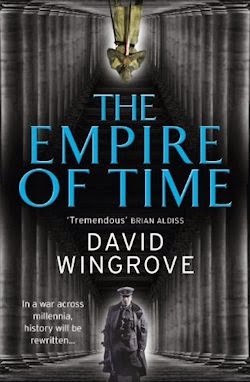
Book Review | The Empire of Time by David Wingrove


There is only the war.

Otto Behr is a German agent, fighting his Russian counterparts across three millennia, manipulating history for moments in time that can change everything.

Only the remnants of two great nations stand and for Otto, the war is life itself, the last hope for his people.

But in a world where realities shift and memory is never constant, nothing is certain, least of all the chance of a future with his Russian love...
***

It's 2999, and what do you know? The world is at war... or else what's left of it is.

Only "the remnants of two great nations" remain—Russia and Germany, refreshingly—and having lasted this long, and suffered so much over said centuries, neither side will accept anything less than the eradication of its eternal enemy. Thus, they fight. But with the Earth a nuclear blast-blackened shadow of its former self, the only battleground they have at hand is the past:
The thing is, we're both spread thin. I mean, three thousand years, and only a couple of hundred agents to police them. No wonder we miss things. But then, so do they. It's a game of chess—the most complex game imaginable—only the moves can be anything, and the board... 
The board is everywhere and any time. (p.16)
Our narrator Otto Behr is, at the outset, an agent engaged in an operation in the latter days of the Crusades when he's pulled out of the period to assist with a major manoeuvre in World War II era Germany. Here, another operative has been helping Hitler win the coming conflict at the same time as attempting to temper his more monstrous qualities. Sickening as it is, Seydlitz's plan is borderline brilliant, and abominably ambitious. It's "a direct assault upon the very heartland of Russia—and if this works..." (p.34) why, if this works, the long war will be all but won.

You might think that'd be that, but it's not, natch:
You see, nothing is ever straightforward in Time. If we both did the same old things, time and again, it would soon become predictable. And though the aim is to win—to eradicate the enemy—there is also a feeling, and I know I'm not alone in this, that the game is of itself a satisfaction, and a deep one at that. 
I like to outguess them, to prove myself not only quicker and tougher, but also smarter than they are. They outnumber us three to one and they are good [...] but we are better. We have to be simply to survive. (p.139)
Surviving what's to come will be all the harder, however, because Russian agents have been aware of Germany's great operation from day dot, and before it can come to something, they step in, seize Seydlitz, and use his DNA to infiltrate the future, too.

Thursday, 27 March 2014

Book Review | The Boy with the Porcelain Blade by Den Patrick


Lucien de Fontein has grown up different. One of the mysterious and misshapen Orfano who appear around the Kingdom of Landfall, he is a talented fighter yet constantly lonely, tormented by his deformity, and well aware that he is a mere pawn in a political game.

Ruled by an insane King and the venomous Majordomo, his is a world where corruption is commonplace, but it's only when Lucien discovers the plight of the "insane" women kept in the so-called Sanatoria that he realises how deeply rooted the day-to-day decay is.

***

To paraphrase A. A. Milne, creator of Winnie the Pooh—and Tigger too!—the things that make us different are the very things that make us us.

But when you're different—and who isn't?—fitting in is a difficult thing. It's far harder, however, for the likes of Lucien de Fontein, a young man who has no ears, I fear, and must display his most significant difference every day, come what may.

There are others like Lucien. Other Orfano, which is to say "witchlings [...] whose deformities were an open secret among the subjects of Demesne in spite of the Orfano's attempts to appear normal." (p.10) Lucien has long hair to hide the gory holes on his head, but no matter how hard he tries to fit in with his fellows, they reject him repeatedly. Evidently, "the life of an Orfano was a lonely one," (p.17) if not without its privileges:
"Years of schooling. Almost daily education in blade and biology, Classics and chemistry, philosophy and physics, art, and very rarely, assassination. He had been given the best of everything in Demesne as set down by the King's edict, even when he'd not wanted it, which had been often. Now he would be bereft of everything; all thanks to Giancarlo." (p.43)
Giancarlo is Lucien's Superiore, an instructor of sorts who can't stand the sight of our Orfano... who has gone out of his way to break him at every stage. So far, Lucien has held fast in the face of Giancarlo's cruelty, but everything comes to a head during his final Testing: the emboldening moment when he is to trade his paltry porcelain blade for real steel, and indeed the scene with which Den Patrick's debut begins. But the bastard master pushes his intemperate apprentice too far, and Lucien's response—to attack Giancarlo rather than the innocent he is to kill—leads to his exile from Demesne.

Tuesday, 4 March 2014

Book Review | Annihilation by Jeff VanderMeer


For thirty years, Area X, monitored by the secret agency known as the Southern Reach, has remained mysterious and remote behind its intangible border—an environmental disaster zone, though to all appearances an abundant wilderness. Eleven expeditions have been sent in to investigate; even for those that have made it out alive, there have been terrible consequences.

Annihilation is the story of the twelfth expedition and is told by its nameless biologist. Introverted but highly intelligent, the biologist brings her own secrets with her. She is accompanied by a psychologist, an anthropologist and a surveyor, their stated mission: to chart the land, take samples and expand the Southern Reach’s understanding of Area X.

But they soon find out that they are being manipulated by forces both strange and all too familiar. An unmapped tunnel is not as it first appears. An inexplicable moaning calls in the distance at dusk. And while each member of the expedition has surrendered to the authority of the Southern Reach, the power of Area X is far more difficult to resist.

***

A biologist, an anthropologist, a surveyor, and a psychologist venture into Area X.

Sounds like the setup for a joke, doesn't it? Well halt that thought, because Annihilation is no laughing matter. On the contrary: Jeff VanderMeer's first new novel since Finch is a nightmarish narrative about the fungus among us which trades in terror and tension rather than simple titters. It's the award-winning author's most accessible text yet... though there's a very real chance Annihilation will leave you with weird dreams for years.

So what the hell is Area X?
The government's version of events emphasised a localised environmental catastrophe stemming from experimental military research. This story leaked into the public sphere over a period of several months so that, like the proverbial frog in a hot pot, people found the news entering their consciousness gradually as part of the general daily noise of media oversaturation about ongoing ecological devastation. Within a year or two, it had become the province of conspiracy theorists and other fringe elements. (p.94)
But of course, there's more to the story.

At bottom, Area X is an anomaly; a treasure trove of the unknown. Our unnamed narrator—the biologist of the aforementioned four—describes "a pristine wilderness devoid of any human life," (pp.94-95) but this image, like many of the pictures she posits, is imperfect. After all, the Southern Reach has been overseeing trips into this treacherous territory for several decades. Annihilation, in fact, follows the fortunes of the twelfth such expedition to date... or so the agency tells its members.

They are women to a one, and they are represented throughout by their respective roles. "A name was a dangerous luxury here. Sacrifices didn't need names," (p.134) and that is exactly what they are—that is how some of them even see themselves—thus they are not people but purposes. Their mission: to map Area X. To explore and more in service of the Southern Reach's knowledge of the anomaly, though the agency may know more than it's willing to admit.

Friday, 31 January 2014

Book Review | Red Rising by Pierce Brown


Darrow is a Red: a member of the lowest caste in the colour-coded society of the future. Like his fellow Reds, he works all day, believing that he and his people are making the surface of Mars livable for future generations. Yet he spends his life willingly, knowing that his blood and sweat will one day result in a better world for his children.

But Darrow and his kind have been betrayed. Soon he discovers that humanity reached the surface generations ago. Vast cities and sprawling parks spread across the planet. Darrow — and Reds like him — are nothing more than slaves to a decadent ruling class.

Inspired by a longing for justice, and driven by the memory of lost love, Darrow sacrifices everything to infiltrate the legendary Institute, a proving ground for the dominant Gold caste, where the next generation of humanity’s overlords struggle for power. He will be forced to compete for his life and the very future of civilization against the best and most brutal of Society’s ruling class. There, he will stop at nothing to bring down his enemies... even if it means he has to become one of them to do so.

***

Incredibly, man has been fascinated with Mars for millennia. For more than four thousand years, we've wondered what might be out there, up there. Now we know: some rocks, some regolith, and the occasional frozen lake.

The drab reality of the red planet might pale in comparison to all the otherworldly wonders we've imagined in our science and science fiction, but that hasn't stopped us from dispatching exploratory probes and planning manned missions. More than that: we've considered colonising its canyons—overcoming the challenges of its harsh environment and making Mars a home away from home—though those days are a fair ways away, I'm afraid.

Part the first of an ambitious trilogy by Pierce Brown, Red Rising takes place in a future where these distant dreams have been realised... not that the Golds who live the high life here have elected to tell the Reds whose blood, sweat and tears made man's occupation of Mars viable. Rather, the Reds are perpetually mislead: they labour away in craters and caves under the impression that they will be rewarded for their hard work one day, when others come.

But others are already here. They have been for hundreds of years; hundreds of years during which generations of Reds have dug and danced and died none the wiser, including our protagonist Darrow's dad.

Thursday, 5 September 2013

Book Review | Your Brother's Blood by David Towsey


Buy this book from
Amazon.co.uk / The Book Depository

Or get the Kindle edition

Thomas is thirty-two. He comes from the small town of Barkley. He has a wife there, Sarah, and a child, Mary; good solid names from the Good Book. And he is on his way home from the war, where he has been serving as a conscripted soldier. 

Thomas is also dead - he is one of the Walkin'. 

And Barkley does not suffer the wicked to live.

***

To believe in something, utterly and unconditionally, even or especially when everything else we understand goes against it, is, I think, a powerful thing.

I often wish I had it in me, that capacity. But a leap is needed — a leap of faith into the great unknown — and I... I like to know where I'm going well before I get there.

The appeal, however, is clear, even to me. Belief begets a sense of purpose in a world that often strikes this critic as poorly plotted. Belief reveals meaning in the seemingly meaningless. Belief changes us; rearranges us; makes us more, ultimately, than we were, or would have been. But with great power comes great responsibility — as a great man mooted a great many years ago — and inasmuch as faith can be freeing, when wielded without kindness or compassion it can, of course, be a weapon as well.

In case you were wondering why I'm banging on about the sensitive subjects above: blame David Towsey's daring debut. Faith is the fire at the beating heart of Your Brother's Blood. It's what sets the small town of Barkley apart in a world that's fallen to fear and loathing. It's what keeps its people decent, centuries on from the dawn of the Walkin'...
Debate continues over the cause of Automated Man's fall from scientific grace. War would be an obvious cause. Regardless of man's level of sophistication, time has proven him to be an aggressive creature. We can only imagine what kind of weapons would have been at his disposal. 
Perhaps man outgrew this world and journeyed to the star? Leaving nothing but scraps — both human and otherwise — behind. Abandoned by science, those remaining lived as best they could, resulting in the societies of today. A neat [...] theory. 
Yet, despite finding no obvious flaw in this hypothesis, my personal preference leans towards another explanation: the resources that fuelled man's domination ran out. 
For all his subtleties, he was finite. It is the pattern of humanity: like the moon, their influence waxes and wanes. Mechaniks, magic, the power to fly, are all hollow trinkets; nothing can escape the pattern. (pp.vi-vii)
In Your Brother's Blood, humanity as you and I understand it is gone, and all but forgotten. Yet the world still turns — and there are still people peppered upon it, albeit not in such numbers. The last of us, for they are thus, have had to go back to basics. The bare necessities are they need, really: food, friendship, protection from the elements, a few rudimentary tools.

And faith. In Barkley especially — an insular community modelled after a man who believed the Walkin' were symptomatic of a second Fall — faith is pervasive. Everyone, but everyone, attends sermons on the Sabbath, to hear Pastor Gray preach about the evils of these others: a belief shared by many beyond Barkley. Here, however, the flock is taught to tar the first-born with the same destructive brush: "The gates of heaven are closed to the kin of those damned souls. They are left to walk the earth; abominations; fouls creatures of the night. Twisted husks: they fester instead of finding eternal joy." (p.7)

In recent years, this cruel and unusual commandment has been enough to keep the Walkin' from coming back to Barkley, yet at the outset of Your Brother's Blood, one man does exactly that. Poor Jared Peekman is promptly burned to death — again — as a mob bays for his blood. The same mob doesn't know how to handle the cold-blooded murder of Jared's seven year old son, whose throat Luke Morris, the Pastor's devoted disciple, simply slits.

Meanwhile, far from home, in a pit of half-burned bodies, Thomas McDermott comes back from the dead. He remembers the end, the bayonet buried to its hilt in his chest... yet here he is. No two ways about it: he's one of the Walkin' now. To wit, his darling daughter Mary may also bear the taint.

A Barkley man born and bred, Thomas's faith is desperately tested by this fate worse than death. "Would there ever be a punishment?" he wonders.
Was there anyone, the Good Lord or otherwise, to judge him and mete it out? Had he done anything wrong? He'd wanted an end to these questions, an end to the uncertainty. To spill [it all] out onto the orange soil at the bottom of the canyon. (pp.46-47)
In the end, Thomas can't bring himself the commit this mortal sin. Instead, he grapples with an impossible choice: to go west or escape into the east. He could return home to Barkley, though he's well aware of what awaits him there — of how his reappearance could endanger his wife and child — or traipse towards the secret Walkin' commune on Black Mountain.

He heads home, of course.

It, uh... doesn't end well.

This is hardly surprising. From word one on, Your Brother's Blood is harrowing, haunting and all too human. Towsey starts his book boldly, with a scorching sermon about the wickedness of the Walkin' presented in canny parallel with Thomas's repugnant reawakening — courtesy a tickling carri-clicky which burrows through him as he claws his way out of a mass grave. It's stomach-churning stuff, one sequence as much as the other. And these awful things are but the beginning.

To be clear, the Walkin' are zombies of a sort, but they aren't interested in brains; they're just dead men that move, have memories and want what they've always wanted. For Thomas, that's first and foremost the safety of Mary and Sarah, however if he's to spend his second life in hiding, he wants to see them one last time. So though his return to Barkley might be misguided, Thomas is so smartly characterised we sympathise entirely.

The supporting cast are more of a mixed bag than our profaned protagonist. Some obvious shorthand — I speak of a peeping Tom, primarily — marks the bad guys from the good. Amongst the latter camp, several seemingly central individuals serve no discernible purpose; a number are marginalised by the narrative; still others are left to languish in the last act. Your Brother's Blood doesn't chronicle an ensemble, either. It's a slight novel, and hardly action-packed.

Much of this, I'm moved to moot, is down to the fact that Your Brother's Blood is but the inaugural volume of The Walkin'. That's all well and good — though the rise of the saga is at times a tiresome trend, I could hardly call myself a genre fiction fan if I weren't willing to forgive the format. Indeed, I'll certainly be reading the next novel in this series, given that Your Brother's Blood affected me, in the main, in much the same way Alden Bell's melancholy debut did... which is to say immensely.

Be that as it may, the decision to close the book on book one when Towsey does left me feeling — I won't beat around the bush here — cheated. But only because I cared so much about Thomas and Mary and Sarah. Only because I had invested heavily in what is from the first a fascinating, emotionally enrapturing narrative, and immersed myself in the pitch-perfect, undead western setting of Your Brother's Blood.

I might be an unbeliever, but I have faith in David Towsey to tell the rest of this tale well. I only wish he'd had the good grace to follow through in more ways than the one he undoubtedly does in this book too. Nevertheless, Your Brother's Blood is a tremendously memorable debut, and a striking start to what promises to be a bloody biblical trilogy.

***

Your Brother's Blood
by David Towsey

UK Publication: August 2013, Jo Fletcher Books

Buy this book from
Ainmazon.co.uk / The Book Depository

Or get the Kindle edition

Recommended and Related Reading

Monday, 12 August 2013

Book Review | The Glass Republic by Tom Pollock


Buy this book from
Amazon.co.uk / The Book Depository

Or get the Kindle edition

Pen's life is all about secrets: the secret of the city's spirits, deities and monsters her best friend Beth discovered, living just beyond the notice of modern Londoners; the secret of how she got the intricate scars that disfigure her so cruelly - and the most closely guarded secret of all: Parva, her mirror-sister, forged from her reflections in a school bathroom mirror. Pen's reflected twin is the only girl who really understands her.

Then Parva is abducted and Pen makes a terrible bargain for the means to track her down. In London-Under-Glass, looks are currency, and Pen's scars make her a rare and valuable commodity. But some in the reflected city will do anything to keep Pen from the secret of what happened to the sister who shared her face.

***

As a people, we are plainly preoccupied with the picture of perfection; obsessed, essentially, by being beautiful. But image isn't everything, much as it may look that way in the day to day. As the protagonist of Tom Pollock's striking second novel suggests, "This thing — beauty? — it's arbitrary. People just make it up." Then again, as Pen's new partner in thought-crime counters, "Just 'cause something's made up, doesn't mean it's not real." (p.255)

All too true. So what's a poor, disfigured girl to do? A girl whose trust in another — her best friend Beth, no less — led to her being embraced by the barbed wire arms of The City's Son's big bad? Whose scars, even after extensive reconstructive surgery, are "a dozen mocking, mirroring mouths" (p.7) which mark Pen out as other amongst her fearful peers? Why, travel to an alternate dimension where our preconceived ideas about beauty have been completely reconceived; where she's celebrated, instead, as the most gorgeous girl in all the world!

Welcome, one and all, to The Glass Republic.

We'll get back to the inverted landscape of London-Under-Glass in time, but before that, let's recap. The Glass Republic begins a couple of months after the unhappy ending of Pollock's phenomenal first novel. Pen — aka Parva "Pencil" Khan — was a standout supporting character in said who was butchered come its cruel and unusual conclusion. To wit, I was keen to see what fate awaited her in book two of The Skyscraper Throne, however I hadn't expected her to take Beth Bradley's place as protagonist.

Beth isn't absent the narrative, exactly, though her role is rather reduced, in part because she must come to terms with what she's become: something hardly human, she feeds "on the city around her with every step [...] drawing power and information through the bare soles of her concrete-grey feet." (p.27) She carries an iron railing around as an extension of the urban environment she represents, and speaks to streetlight spirits without sound. Beth, then, figures into the fiction from time to time, but her intermittent chapters are largely devoted to foreshadowing; setting up certain secondary story threads Pollock plans, I presume, to pay off in the concluding volume of his terrific trilogy, namely next year's Our Lady of the Streets.

But we're getting ahead of ourselves again. The Glass Republic is for its part about Pen's plight, primarily. At the outset, she's trying to immerse herself in the mundane, the better to forget the incredible events she was caught up in some four months ago. To that end, she's returned to school, but to ingratiate herself amongst a new group of friends, she's asked to explain her mutilated face. She does so honestly — not that anybody believes her. Cue the smoothest recap I've read in recent memory:
I was kidnapped by a living coil of barbed wire — the servant of a demolition god whose fingers were cranes. I was its host, and it sent me to kill Beth Bradley, but she freed me from it instead. I held the monster down with my body while she cut it off with a sharpened park railing. (p.5)
Well, quite.

Predictably, things between Pen and her new schoolfriends go from tolerable to terrible in short order. Seeking solace from their spite, she turns to a reflection of herself... yet Parva is no mere mirror image. She's an esteemed member of the mirrorstocracy:
The girl on the other side of the glass had come from [Pen] — she was composed of all the infinite reflections of her that had been caught between the two mirrors — but that was when their coexistence had ended. 
Pen and Parva had diverged from that moment in time like beams of refracted light; now Parva had her own feelings, her own life, built up in the weeks since she'd first stepped into whatever lay outside the bathroom door in the reflection. She drank wine, ate meat and swore like a squaddie with haemorrhoids. Much to Pen's chagrined envy, she'd even managed to land herself a job, although she wouldn't say doing what. (p.22)
After an upsetting incident, Pen escapes to the bathroom where she and Parva like to put the world to rights, but on this occasion, all she sees behind the mirror is a bloody handprint. It's apparent that Parva's in trouble, so Pen resolves to seek out the Chemical Synod — the same oily entities who helped Beth discover herself — praying that they may know a way for her to travel to London-Under-Glass.

They do. They possess "a compound fit to change sseeing into doing, a tincture to transform a window to a door: a portal primer, if you will, or a doorway drug." But the price of this prize is a painful prospect; no less than "a complete ssset of memoriess of a child, rendered from the mindss of her parentsss — not copiesss, you undersstand, but originalss." (p.65) Without telling Beth anything, Pen acquiesces — after all, this is her quest, to undertake on her terms — and into the mirror city she goes.

I've been banging on about being burned out on London as the backdrop for fantastic happenings for long enough now that I confess I did not relish the thought of another narrative set in the city, but The Glass Republic sidesteps that category smartly.

The larger part of the action takes place in London-Under-Glass, which, like Parva, is different enough from its original that it is independently interesting. The mirror city has its own aesthetics — asymmetry is valued highly, which is why Pen's scars make her the apple of everyone's eye — not to mention its own politics and media and economy and so on. Everything, right down to the weather, is similar, yet bizarrely set apart. As Pen observes, "it was as though the London she knew had run in the rain." (p.110)
She recognised the art deco horses of the Unilever building over her, and the old power station that housed the Tate Modern on the opposite bank, but they were taller here, and their shapes rippled as they rose into the sky, their familiar outlines bent by strange accretions of brick and stone. 
They look exactly like they look reflected in the river at home, Pen marvelled. Here, that's how they actually are. (p.102) 
Pen, in the interim, is an absorbing protagonist. She's reticent and introverted where Beth was ballsy and confident. She goes her own way rather than simply mirroring the development of our previous hero, which is especially refreshing. That said, I was as taken with Espel: a fierce steeplejill-cum-companion who both helps and hinders Pen throughout The Glass Republic. I can safely say that she balances out Pencil Khan's more passive aspects nicely; explaining much more than that would be to give what is a great game away.

Meanwhile, Pollock's monsters are awesome. I enjoyed the "sewermander" (p.35) — a bottle-sized dragon — particularly, but not all of the author's creations are so wonderfully whimsical. Be warned that there are also "nightmare things squatting fatly on heavy haunches with back-bent teeth and empty eye sockets." (p.54) And that's just for starters.

A year or so ago, I described The City's Son as "a tour-de-force in sophisticated urban fantasy — beautifully wrought, tightly plotted and fantastically finessed." Somewhat shockingly, it was also Tom Pollock's first novel. If anything, his second is better. Certainly, the prose is punchier, and it was pretty impressive to begin with. Add to that an awesome secondary world and a masterfully expanded cast of characters, and it's easy to see why this author is one of speculative fiction's most promising new voices.

The Glass Republic is not your garden variety urban fantasy. Instead, it's a text very much concerned with appearances, and indeed, what lies beneath these. In that sense — and many others, yes — it's such an unfettered success that the concluding volume of The Skyscraper Throne saga can't come soon enough.

***

The Glass Republic
by Tom Pollock

UK Publication: August 2013, Jo Fletcher Books

Buy this book from
Amazon.co.uk / The Book Depository

Or get the Kindle edition

Recommended and Related Reading

Monday, 1 April 2013

Book Review | The Grim Company by Luke Scull


Buy this book from

The grey granite walls of Dorminia rise to three times the height of a man, surrounding the city on all sides save for the south, where the Broken Sea begins. The stone is three-foot thick at its weakest point and can withstand all but the heaviest assault. The Crimson Watch patrol the streets even as Salazar's Mindhawks patrol the skies.

The Grey City was not always so. But something has changed. Something has broken at its heart. Perhaps the wild magic of the dead Gods has corrupted Dorminia's Magelord, as it has the earth itself. Or perhaps this iron-fisted tyranny is the consequence of a lifetime of dark deeds...

Still, pockets of resistance remain. When two formidable Highlanders save the life of a young rebel, it proves the foundation for an unlikely fellowship. A fellowship united against tyranny, but composed of self-righteous outlaws, crippled turncoats and amoral mercenaries. A grim company. But with the world entering an Age of Ruin, this is not a time of heroes...

***

In literature, as in life, everything has its moment in the sun—though some moments are of course more equal than others. I dare say some last so long that they've been burned to a crisp well before they're over.

Consider, for instance, the unabashed action hero. I think it's safe to assert that the sun set on the Arnie archetype some time ago. These days, readers demand certain failings from their favourite fictional figures. Certain shades of grey to ground the good guys and the bad.

Thus, some stories are simply no longer told. Genres come and genres go—from popular consciousness, if not the fringes of the entire picture. I mean, I don't suppose we'll be waving goodbye to paranormal romance any time in the foreseeable future, but it doesn't have quite the hold it once did, does it? Similarly, though it pains me to say, the New Weird has gotten awfully old.

But you must be wondering what all this has to do with the debut of one Luke Scull. Well, consider what his phenomenal first novel is called: it can come as no surprise that The Grim Company is as grimdark as fantasy gets. And though grimdark fantasy has been all the rage in recent years, the writing is on the wall. The genre has been brought low, and rightly so, by some of its foremost proponents' reliance on rape and torture as torpid plot devices; cardinal sins that The Grim Company is not entirely innocent of either, though its author does evidence an awareness that such subjects are not substitutes for storytelling.

So the genre's moment may almost be over. Almost... but not quite. Notwithstanding the issues that have all but gutted a good thing, The Grim Company is a genuinely great debut: fun yet fearsome, gritty and gripping in equal measure. If it marks the last hurrah of grimdark fantasy—though I sincerely hope there's an alternative solution to the problems posed—at least the genre will go out on fine form.

The Grim Company begins with—wait for it—a magical tsunami:
"The Tyrant of Dorminia had dropped a billion tons of water on a living city and instantly created the biggest mass graveyard since the Godswar five centuries past. Forty thousand men, women and children had died in an instant. One second they were alive; the next they were gone. All those lives, extinguished with the same callous lack of regard a farmed might show for an ants' nest as he drowned it in boiling water. [...] That any man should have the audacity, much less the capacity, to enact such judgement on so many unknowing souls... why, it would be an affront to the gods, if the gods weren't already dead." (p.88)
The gods may be gone, yet there are those in this story—namely Magelords—with godlike powers. One such is the aforementioned tyrant: Salazar rules over Dorminia with an iron fist, and indeed an iron heart—literally—by way of his Supreme Augmentor, Barandas. Though well aware of his master's monstrous qualities, Barandas owes Salazar a debt, and his loyalty is such that one senses the Supreme Augmentor will serve said till the day he dies.

That day may come sooner than Barandas believes, because Salazar's ghastly attack on Shadowport has engendered as much anger as it has obedience, or failing that fear. For the Shards, a company of Dorminian idealists, it's the last sordid straw: his reign of terror must end. The rebellion, they resolve, begins here... here where, one way or the other, it will end as well.

It's not so straightforward, obviously. Is it ever? To wit, the Shards are shattered early on: Sasha and Vicard join forces with two Highlanders—Brodar Kayne and his right hand man, the mercenary Jerek—to sabotage the source of Salazar's supremacy; "magic was fading from the world," you see, "and as soon as the last divine corpse was sucked dry, there would be nothing left." (p.92) But the rebels' trip to the Rift quickly takes a disastrous turn, and as the body count embiggens, our company can only wonder why doing the right thing feels so wrong.

They need a hero, really. Alas, after a friendly dressing down results in a temper tantrum, the one and the only Davarus Cole is captured by Salazar's forces, pressed into service as part of a prison gang, then dispatched into dangerous territory to help replenish the Tyrant's supplies. In other words, he'll be aiding and abetting the enemy. Merely an inconvenience to a saviour-in-the-making such as he!
"His abilities and quick wits outstripped those of his peers by no small distance—and besides, hadn't Garrett always said he would one day be a great hero, like his real father? A man such as he met injustice head on, enchanted blade in hand and epic destiny propelling him forwards with a righteous fury no petty villain could withstand." (p.13)
So he likes to think, that is. Later, Sasha suggests an alternative interpretation: "He's the only person I know who can scrape through the most dangerous situations by the sheer power of his own bullshit." (p.200)

Off to the side of all this, there's Eremul the tragic half-mage, who wants Salazar's head on a platter, and the sultry sorceress Yllandris, who dreams of being a Queen. These peripheral perspectives give readers insight into the larger landscape of Luke Scull's series, and though they serve little other purpose in The Grim Company, they're sure to play a larger part in the tomes to come.

Thankfully, the primary points of view are absorbing from word one. Waiting for Cole to be taken down a peg or ten is terrific fun, and in the interim the author uses his clueless central character to comment on the fantasy heroes of yesteryear. Sharp as Scull's barbs are, there's nothing especially subtle about this satire, however it does demonstrate the value of what sets grimdark fantasy apart.

By that measure, Brodar Kayne is a rather more traditional character than poor, dear Davarus: a downtrodden old warrior very much after Joe Abercombie's heart. "I ain't what I used to be," he says at one stage, as he advances on three Highlanders younger and stronger than he. "Can't piss in a straight line, if at all. I got aches in places I didn't know could ache. But if there's one thing I still know how to do [...] it's killing. You never really lose the instinct for it." (p.104) Despite his familiarity, Kayne struck me as a marvellous man of action: strong yet uncertain, done in but not defeated, bitter but still this side of miserable, he is a weapon, albeit a blunt one—a maul rather than a delicate dagger—that the author wields well.

In truth, no-one does grimdark fantasy better than Joe Abercrombie, but by the dead, Luke Scull comes incredibly close. The Grim Company can't quite eclipse the likes of The Heroes, or Red Country; all told, though, this is a substantially more satisfying debut than The Blade Itself.

In large part that's thanks to an action-packed narrative, paced like a race. There's never dull moment in The Grim Company—even in the middle, where most stories sag. Here, there and everywhere there are extraordinary set-pieces: battles, by and large, but what battles they are! In the interim, there's murder, mystery and intrigue; a meaningful, if somewhat simplistic magic system; no shortage of snappy banter; and such smooth worldbuilding that I hardly noticed it happening. There's precious little time to take stock of all this—instead, depth and texture seems to simply spring from the story—but I didn't mind the immediacy of the overall experience one whit.

A confident debut, then? Definitely. It mightn't be particularly original, but it's bold. It's brutal. Shiver me timbers, The Grim Company is brilliant.

But—and you must have known there would be a but coming—Luke Scull inherits a few iffy elements amongst the many he emulates successfully. I don't believe that these spoil the novel, but cumulatively, they do somewhat take the edge off. Considering grimdark fantasy's fall from grace of late, that's a shame, and no mistake. Yet whether or not there's a place for this sort of fiction in the literary landscape of tomorrow, The Grim Company is a sterling exemplar of what the genre has to offer today.

***

The Grim Company
by Luke Scull

UK Publication: March 2013, Head of Zeus

Buy this book from

Recommended and Related Reading