Showing posts with label survival. Show all posts

Thursday, 23 November 2017

Book Review | Artemis by Andy Weir


Jazz Bashara is a criminal.

Well, sort of. Life on Artemis, the first and only city on the moon, is tough if you’re not a rich tourist or an eccentric billionaire. So smuggling in the occasional harmless bit of contraband barely counts, right? Not when you've got debts to pay and your job as a porter barely covers the rent.

Everything changes when Jazz sees the chance to commit the perfect crime, with a reward too lucrative to turn down. But pulling off the impossible is just the start of her problems, as she learns that she's stepped square into a conspiracy for control of Artemis itself—and that now, her only chance at survival lies in a gambit even riskier than the first.

***

It's been six years since Andy Weir became a self-publishing success story on the back of The Martian. A scientifically fastidious yet satisfying work of fiction that spoke of a stranded astronaut's struggle to survive on the ruthless red planet, it—and Ridley Scott's subsequent adaptation of said—made sci-fi fun for some; specifically for folks who had previously sneered at the genre for its seeming self-seriousness.

Those readers will be over the moon to hear that Artemis is, in its attention to technical detail and its prioritisation of play as the order of the day, The Martian's perfect partner, though more demanding fans of the form are likely to find it slight: derivative, dreadfully slow to start, and rather lacking in the heart department. But for better or for worse, Weir's new novel is in many ways more of the same problem-solving stuff that made him a household name.

In theory, at least, one of Artemis' most dramatic departures from The Martian is in its central character. Mark Watney was a Real America Hero: a white dude who did good. Jazz Bashara, on the other hand, is a young woman of Saudi Arabian descent who makes her living by breaking the law. This transparent flipping of scripts has little impact in practice, alas. While she might be a rule-breaker to begin with, Jazz is every inch the saviour before the book is through, just like her predecessor. And just as Watney was, for all intents and purposes, a man of Mars, Jazz, the hell with her heritage, is "a local gal. Grew up right here on the moon." The net effect of her gender, meanwhile, is that Weir seems to see it as a license to make altogether too many jokes about breasts and banging.

Needless to note, this is not sophisticated sci-fi. But to paraphrase Jazz, who likens the shining city the novel is named after to "a bunch of metallic boobs," Weir is clearly no poet—and he knows it. In truth, Artemis, "the first (and so far, only) city on the moon" does bear rather a resemblance. "It's made of five huge spheres called 'bubbles.' They're half underground, so Artemis looks exactly like old sci-fi books said a moon city should look: a bunch of domes. You just can't see the parts that are belowground."

It's in these nether regions that we find the story's hero-to-be. Jazz is "one of the little people" who eke out an existence in Artemis by doing the dirty jobs the "rich tourists and eccentric billionaires" that make up most of the city's population are unwilling to. As she herself has it in her distressingly on-the-nose narration, "you don't expect J. Worthalot Richbastard III to clean his own toilet, do you?"

Thursday, 12 October 2017

Book Review | Sea of Rust by C. Robert Cargill


Humanity is extinct. Wiped out in a global uprising by the very machines made to serve them. Now the world is controlled by One World Intelligences—vast mainframes that have assimilated the minds of millions of robots. But not all robots are willing to cede their individuality, and Brittle—a loner and scavenger, focused solely on survival—is one of the holdouts.

Critically damaged, Brittle has to hold it together long enough to find the essential rare parts to make repairs—but as a robot's CPU gradually deteriorates, all their old memories resurface. For Brittle, that means one haunting memory in particular...

***

C. Robert Cargill's first novel since the darkly delightful Dreams and Shadows duology is an intimate epic that plays outs like War for the Planet of the Apes with machines instead of monkeys. A soulful and stunningly accomplished work of science fiction set in a wasted world ruled by robots, Sea of Rust is a searching yet searing story of survival.

Sadly for our species at least, survival isn't in the cards. Sea of Rust takes place some time after the massacre of mankind, and as such, it has "a writhing mass of pseudo flesh and metal" (p.332) as its cast of characters. That includes our protagonist, Brittle: a Caregiver model manufactured to keep a widow company during the last days of the human race who has no-one but herself to care for now. But such is life in this devastated landscape:
The Sea of Rust [is] a two-hundred-mule stretch of desert located in what was once the Michigan and Ohio portion of the Rust Belt, now nothing more than a graveyard where machines go to die. It's a terrifying place for most, littered with rusting monoliths, shattered cities, and crumbling palaces of industry; where the first strike happened, where millions fried, burned from the inside out, their circuitry melted, useless, their drives wiped in the span of a breath. Here asphalt cracks in the sun; paint blisters off metal; sparse weeds sprout from the ruin. But nothing thrives. It's all just a wasteland now. (p.3)
A wasteland it may be, but Brittle—with most of the map memorised and emergency caches stashed away all over the place—braves it on a damn near daily basis. You see, the Sea of Rust is a lawless land, by and large, and to survive, you have to scavenge. To wit, Cargill's book begins with Brittle hot on the heels of a failing service bot who's here for the same reason as she: to replace his own broken bits and bobs. But Brittle's both wiser and wittier than Jimmy. She convinces him to shut down voluntarily, supposedly so that she can assess the damage to his dying drives. Then she scraps him for parts: an emulator, a sensor package and a battery. "All in all, it's a great haul." (p.16)

And that's Sea of Rust to a T, readers: it's dark, but it does has a heart, because in truth, Brittle could have just killed Jimmy. From a distance. Quickly. Instead, she took his impending death personally, and gave him hope before prying out his precious processor.

Tuesday, 16 May 2017

Book Review | The Boy on the Bridge by M. R. Carey


Once upon a time, in a land blighted by terror, there was a very clever boy.

The people thought the boy could save them, so they opened their gates and sent him out into the world.

To where the monsters lived...

***

Whether it's a character that captures us or a narrative that enraptures us, a situation that speaks to something unspoken or a conflict that builds on something broken—who can say, on this or any other day, what makes a book a bestseller? The quality of a given novel has next to nothing to do with its success on store shelves, that's for sure. Plenty of bad books have shifted millions, and many more deserving efforts have come and gone to no such notice. It's a blessing, then, when a truly wonderful work of fiction becomes a bestseller... but it can also be a burden.

The Girl With all the Gifts was probably the best zombie novel to have been released in recent years, and it sold hella well—well enough to spawn a movie that was also pretty swell. But while the next book to bear M. R. Carey's name was a dark delight in its own right, Fellside didn't catch on in the same way, I'm afraid.

To wit, I wasn't entirely surprised when I heard that Carey's new novel was a sidequel of sorts to The Girl With all the Gifts. I was, however, concerned; concerned that setting a second story in the same world that Melanie and Miss Justineau so wholly inhabited ran the risk of diminishing their devastating adventures. Happily, The Boy on the Bridge bears its burden brilliantly, and I can only hope it's as blessed by the book-buying public as its predecessor.

It is, admittedly, a little derivative. And I don't just mean that it tugs on many of the same heartstrings The Girl With all the Gifts did—though it does, ultimately: The Boy on the Bridge is an equally bleak book, and equally beautiful, too. But that's not it either. I'm talking about the plot, which is, at least initially, almost a mirror image of its predecessor's: it's an apocalyptic road story about the relationship between a teacher and her unusual student.

Wednesday, 10 May 2017

Book Review | Borne by Jeff VanderMeer


“Am I a person or a weapon?” Borne asks Rachel, in extremis.

“Yes, you are a person,” Rachel tells him. “But like a person, you can be a weapon, too.”

A ruined city of the future lives in fear of a despotic, gigantic flying bear, driven mad by the tortures inflicted on him by the Company, a mysterious biotech firm. A scavenger, Rachel, finds a creature entangled in his fur. She names it Borne.

At first, Borne looks like nothing at all―a green lump that might be a discard from the Company. But he reminds Rachel of her homeland, an island nation long lost to rising seas, and she prevents her lover, Wick, from rendering down Borne as raw genetic material for the special kind of drugs he sells.

But nothing is quite the way it seems: not the past, not the present, not the future. If Wick is hiding secrets, so is Rachel―and Borne most of all. What Rachel finds hidden deep within the Company will change everything and everyone. There, lost and forgotten things have lingered and grown. What they have grown into is mighty indeed.

***

Following his triumphant trek through Area X in the cerebral Southern Reach series, Jeff VanderMeer mounts a more modest yet no less affecting expedition into uncharted territory by way of Borne, a surprisingly beautiful book about a blob which behaves like a boy and the broken woman who takes him in.

Her name is Rachel, and when she was little, she "wanted to be a writer, or at least something other than a refugee. Not a trap-maker. Not a scavenger. Not a killer." (p.37) But we are what the world makes us, and no poxy author would have lasted long in the world in which this novel's narrator was raised:
Once, it was different. Once, people had homes and parents and went to schools. Cities existed within countries and those countries had leaders. Travel could be for adventure or recreation, not survival. But by the time I was grown up, the wider context was a sick joke. Incredible, how a slip could become a freefall and a freefall could become a hell where we lived on as ghosts in a haunted world. (p.37)
There is hope even in this haunted hellscape, however, and it takes a strange shape, as hope tends to: that of "a hybrid of sea anemone and squid: a sleek vase with rippling colours" (p.6) Rachel finds in the festering fur of a skyscraper-sized flying bear called Mord.

She brings the titular thing, Borne-to-be, back to the Balcony Cliffs, a broken-down apartment building where she lives and works with Wick, her sometime lover and a secretive biotech beetle dealer who pushes a memory-altering product "as terrible and beautiful and sad and sweet as life itself." (p.7) Out of the gate, Rachel intends to give her purplish prize to him to pick at—but something, the beginning of some instinct, stays her hand. Instead, she places it in her room, and tries to take care of it.

"This required some experimenting, in part because [she] had never taken care of anyone or anything before," (p.17) but equally because her amorphous mass is a complete mystery. Certainly Wick has never seen its like, and having worked once for the Company, he has seen everything there is to see. To wit, Rachel treats this colourful clump like a plant to start; reclassifies it as an animal after it starts to move around her room; and then, when it shocks her by talking, she takes to behaving around it as she would a baby boy. She talks to him; teaches him; comes, ultimately, to love him—and he her in turn.

Thursday, 19 January 2017

Book Review | Defender by G. X. Todd


In a world where long drinks are in short supply, a stranger listens to the voice in his head telling him to buy a lemonade from the girl sitting on a dusty road.

The moment locks them together.

Here and now it's dangerous to listen to your inner voice. Those who do, keep it quiet.

These voices have purpose.

And when Pilgrim meets Lacey, there is a reason. He just doesn't know it yet.

***

Long seen though they've been as the preserve of the precocious, or the last hope of the lonely, imaginary friends are ten-a-penny in Defender.

G. X. Todd's remarkably readable dystopian debut posits a planet Earth ravaged by unfathomable cataclysm. On the one hand, survivors are scant; on the other, theories about how it happened aren't. "To get it over and done with, he quickly ticked off the points on his fingers as he listed them. 'Biological attack, poisoning, after-effects of dementia vaccines, aliens, subliminal and/or psychological warfare, chemical agents in the water supply, the mystical forces of sea tides and the moon. And, my personal favourite, some kind of Rapture-type event.'" (p.101)

But the cause of this apocalypse isn't the point of Todd's text—the first of four in a series starting here. Instead, she's interested in the effect: namely the voices people started hearing in their heads. Defender's protagonist Pilgrim has one; he calls it, of all things, Voice. That said, he's a rarity these days, because most of the folks who ended up with imaginary friends are dead.

Whether they're symptomatic of a mass auditory hallucination or something more... well. "That's the million-dollar question," (p.254) one Todd isn't inclined to answer—at least, not in this novel—but it's safe today to say that these imaginary friends mightn't be entirely made up. Nor, indeed, are they terribly friendly. Many pushed the people who heard them into murder and suicide, hence the paltry population of Defender's North America. Pilgrim, for his part, has come to something of an understanding with the who-knows-what he hosts:
Any sense of peace he ever hoped to achieve would only be an illusion, for Voice was always with him and always would be. He was demon and angel and conscience wrapped up in one, and there was no escaping him. (p.10)
To wit, when Voice urges Pilgrim to offer the girl selling lemonade from a stand by the side of the road a ride, it's easier for our hero to hear her out than to start a subconscious squabble there'd be no stopping.

Lacey seems harmless enough in any event. Sixteen years old, she's been raised in blissful ignorance in a farm off the beaten track by her Gran, but now that her Gran is gone, the farm has fallen fallow, and she knows she needs to move on. What she wants is to get to her sister's in Vicksburg. It's been years since they saw one another, but Lacey believes her sister is a survivor; that together, they could turn their little lives into something worthwhile.

Taking on a passenger goes against everything that's kept Pilgrim alive—if not well—since everything went to hell, but for some mysterious reason, Voice won't take no for an answer, so Lacey packs a rucksack, sit in the pillion position, and off they pop.

That's how the adventures of Lacey and Pilgrim begin—and that might well be how they end as well, because unbeknownst to them, they're on a collision course with a monster of a man called Charles Dumont: a creepy country bumpkin who's tasked his gun-toting gang to round up any and all of the survivors they come across—especially those that have been "blessed" with imaginary friends.

Tuesday, 15 November 2016

Book Review | Thin Air by Michelle Paver


The Himalayas, 1935.

Kangchenjunga. Third-highest peak on earth. Greatest killer of them all.

Five Englishmen set off from Darjeeling, determined to conquer the sacred summit. But courage can only take them so far—and the mountain is not their only foe.

As the wind dies, the dread grows. Mountain sickness. The horrors of extreme altitude. A past that will not stay buried.

And sometimes, the truth does not set you free.

***

It was on the back of the award-winning, six-part Chronicles of Ancient Darkness that Michelle Paver put out Dark Matter. A ghost story inspired by her lifelong love of the Arctic, it attracted flattering comparisons to the work of such giants of the genre as M. R. James and Susan Hill, and became, before long, a bona fide bestseller.

That the author has now turned her hand to another tale in the same vise-like vein can hardly be seen as surprising; what can is the fact that it's taken her six years and another complete children's series, namely the Gods and Warriors novels. But given the strength of Thin Air, a short, stirring and altogether masterful narrative set on the sheer slopes of the world's third-highest hill, if it takes another decade for Paver to perfect its successor, that's a decade I'll be willing to wait.

It's 1935, and mountaineering has the nation by the nape. Our protagonist Stephen Pearce has always been a keen climber, but he certainly wasn't supposed to be conquering Kangchenjunga this spring. He was meant to be getting married and starting a family, but something about the life he could see stretched out ahead of him—and the death, yes—didn't feel quite right, so when his big brother Kits basically begged him to follow in the footsteps of Edmund Lyell on an expedition up one of the Himalaya's highest peaks, Stephen said yes.

Yet Kits' request wasn't exactly selfless. He needed a medic for the expedition to go ahead, and if securing one meant upending his younger sibling's entire existence, then that was a price Kits was only too happy to pay to win the day. As Stephen reasons:
I know my brother. A couple of years ago, someone came upon Irvine's ice axe on Everest's north-west ridge, and Kits sulked for weeks. Why wasn't he the one to find it and get all the glory? That's what he's after now: relics of the Lyell Expedition; and a chance to complete what the great man began, by being the first in the world to conquer an eight thousand-metre peak—with the added lustre of planting the Union Jack on the summit, and beating the bloody Germans. (p.19)
Brothers they may be, but Stephen and Kits haven't always—or even often—gotten on, and for all that they're on their best behaviour at the outset of the trek, as the weather closes in and things threaten to get grim, the tension between them fairly flares.

Tuesday, 4 October 2016

Book Review | Death's End by Cixin Liu


Half a century after the Doomsday Battle, the uneasy balance of Dark Forest Deterrence keeps the Trisolaran invaders at bay. Earth enjoys unprecedented prosperity due to the infusion of Trisolaran knowledge. With human science advancing and the Trisolarans adopting Earth culture, it seems that the two civilizations can co-exist peacefully as equals without the terrible threat of mutually assured annihilation. But peace has also made humanity complacent.

Cheng Xin, an aerospace engineer from the 21st century, awakens from hiber­nation in this new age. She brings knowledge of a long-forgotten program dating from the start of the Trisolar Crisis, and her presence may upset the delicate balance between two worlds. Will humanity reach for the stars or die in its cradle?

***

The translation and publication of Cixin Liu's Three-Body books has been a singular highlight of the science fiction scene in recent years. The Hugo Award-winning opening salvo of said saga took in physics, farming, philosophy and first contact, and that was just for starters. The world was wondrous, the science startling, and although the author's choice of "a man named 'humanity'" as that narrative's central character led to a slight lack of life, The Three-Body Problem promised profundity.

A year later, The Dark Forest delivered. Bolstered by "a complex protagonist, an engrossing, high-stakes story and a truly transcendent setting, The Dark Forest [was] by every measure a better book" than The Three-Body Problem. Not only did it account for its predecessor's every oversight, it also embiggened the Remembrance of Earth's Past trilogy brilliantly and explored a series of ideas that astonished even seasoned science fiction readers.

But "no banquet was eternal. Everything had an end. Everything." (p.27) And when something you care about does approach that point, all you can do is hope it ends well.

Death's End does.

Friday, 20 March 2015

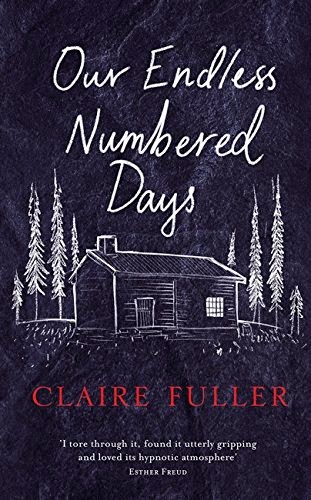
Book Review | Our Endless Numbered Days by Claire Fuller


1976: Peggy Hillcoat is eight. She spends her summer camping with her father, playing her beloved record of The Railway Children and listening to her mother's grand piano, but her pretty life is about to change.

Her survivalist father, who has been stockpiling provisions for the end which is surely coming soon, takes her from London to a cabin in a remote European forest. There he tells Peggy the rest of the world has disappeared.

Her life is reduced to a piano which makes music but no sound, a forest where all that grows is a means of survival, and a tiny wooden hut that is Everything.

***

Kids. They'll believe almost anything if the "truth" comes from someone they trust.

And why wouldn't they? The world is wide and full of wonders we expect our children to accept without question. In that sense, the thought that a big ol' bunny rabbit brings them chocolate eggs each Easter isn't much less credulous than the idea that a thing called gravity keeps them from flying into the sky.

But there's a big difference between a little white lie told with the best of intentions and the apocalyptic fiction Peggy Hillcoat's father passes off as a fact at the start of Claire Fuller's disarmingly dark, if indisputably beautiful debut.

A so-called survivalist who has till today remained rooted in relative reality—content to attend meetings with other Retreaters at the same time as stockpiling provisions to see himself, his wife Ute and their darling daughter through the imminent collapse of civilised society—Peggy's papa is pushed over the proverbial edge by a betrayal at the beginning of the book, so when Ute, a prestigious pianist, takes some time away from the family home to tour, her husband takes the opportunity to spirit their eight-year-old off on what he calls a holiday.

Poor, perceptive Peggy sees through this ruse, but what's a girl in the wilderness of the woods to do except forge on forward in her father's footsteps?
The holiday my father had promised wasn't a holiday. There were no beaches or sandcastles, no ice creams, no donkey rides; my father said we would rest when we got to die Hütte. The bushes at the sides of the path we walked along were nearly grown together, as if to say, this path is not for humans. My father was having none of it. (p.49)
Their destination, die Hütte, is a ramshackle cabin in the forests of rural France where Peggy's papa plans to put down roots. To that end, he tells her that the world beyond the hills on the horizon is gone, along with all the folks unfortunate enough to be on the other side of the Great Divide, including Ute—and innocent as she is, Peggy assumes his tall tale is true.

Monday, 30 June 2014

Book Review | Zodiac Station by Tom Harper


In the Arctic Ocean, the US Coast Guard icebreaker Terra Nova batters its way through the pack ice. There shouldn't be anyone near them for hundreds of miles. But then a lone skier, half-dead with cold, emerges out of the snow.

His name is Tom Anderson, and he is the only survivor of a disaster at Zodiac Station, a scientific research base deep in the Arctic Circle. He tells an incredible story of scientists and spies, of lust and greed, of jealousy, mayhem and murder. But his tale simply doesn't add up. Whose blood is smeared across his clothes? Why is there a bullet hole through the jacket he's wearing, and why is that jacket labelled with someone else's name?

It's clear that more was going on at Zodiac Station than Anderson is telling. And someone else may have survived the disaster, as well... someone who has killed before, and who is willing to kill again.


***

An uncanny account of the circumstances surrounding the murder of the members of a remote outpost near the North Pole, Tom Harper's taut new novel—a conspiracy-ridden riff on The Thing—is thrilling and quite literally chilling.
I suppose you know about Utgard. It's the last place in the world, the most northerly scrap of land on the planet. Easy to miss—so easy, in fact, that no one realised it was there until the twentieth century. Most of it's covered in ice, so much that the weight has actually pushed the land below sea level. Not that there's much sea, either: for ten months of the year it's frozen solid. The only notable population is polar bears, and a couple of dozen scientists at Zodiac Station. I wouldn't like to say who's hairier. (p.16)
Zodiac Station's story unfolds in several stages. In the framing tale we have Carl Franklin, Captain of the US Coast Guard cutter Terra Nova: "an ice-reinforced vessel capable of making a steady three knots through four-foot ice, of smashing her way to the North Pole if need be. She'd already been there twice in her short working life." (p.1) For now, the ship simply sits, as the cutter's complement of clever-clogs set about sciencing the pristine scenery.

Lucky for the geeks that they're guarded by men with weapons, as they aren't as alone as they think.

Monday, 16 June 2014

Book Review | Those Who Wish Me Dead by Michael Koryta


When Jace Wilson accidentally witnesses a brutal murder, his life is changed forever. An ordinary teenager growing up in Indiana, Jace is suddenly forced into the Witness Protection Program and given a new name and history. Taken in by a couple ho run a wilderness program for young boys, Jace finds himself hiking through the Montana mountains, tortured by his memories and by the fear that he'll never be safe again.

The killers, known as the Blackwell Brothers, are two of the most heinous criminals the country has ever known. Jace was the one person to catch them in the act, and he slipped through their fingers. Now they've tracked him down and are making their way across the country, ruthlessly slaughtering anyone who gets in their way.

***

Though he cut his teeth as a crime writer, ten years and the same number of novels into his creative career, Michael Kortya, more than any other author, appears poised to succeed or at the very least equal Stephen King.

Like the fiction of the modern-day Dickens, his work is eminently accessible, remarkably natural, cannily characterised, and it tends, as well, towards the speculative end of the spectrum. He's told spooky stories about haunted mineral water, wicked weather and whatnot, but the fantastic is not his only focus—again along the lines of the aforementioned master—and Koryta is no less capable when it comes to writing about the world we know, as Those Who Wish Me Dead demonstrates.

It's about a boy; a boy who witnesses a nightmarish murder after daring himself to dive into the water at the bottom of a quarry. Thanks to some quick thinking, Jace escapes the scene of the crime with his life that night, but the killers catch a glimpse of him—and just like that, the infamous Blackwell brothers are on his back. If they find him, he's finished, so his parents do the only thing they can do: they hide him. And what better place to squirrel away a well-to-do kid from the city than amongst a bunch of badly behaved boys in the mountains of Montana?

Friday, 21 February 2014

Book Review | The Troop by Nick Cutter


It begins like a campfire story: five boys and a grownup went into the woods...

It will end in madness and murder. And worse...

Once a year, scoutmaster Tim Riggs leads a troop of boys into the Canadian wilderness for a three-day camping trip—a tradition as comforting and reliable as a good ghost story and a roaring bonfire. But when an unexpected intruder stumbles upon their campsite—shockingly thin, disturbingly pale, and voraciously hungry—Tim and the boys are exposed to something far more frightening than any tale of terror. The human carrier of a bioengineered nightmare. An inexplicable horror that spreads faster than fear. A harrowing struggle for survival that will pit the troop against the elements, the infected... and one another.

Part Lord of the Flies, part 28 Days Later—and all-consuming—this tightly written, edge-of-your-seat thriller will take readers deep into the heart of darkness and close to the edge of sanity.

***

Imagine how different the world would look if a real diet pill existed; if losing weight was a simple sugar solution away. Think for a minute about how dramatically that would change the day to day. It'd be revolutionary, in truth. And it would make certain people very rich indeed.

Dr. Clive Edgerton, for one, isn't in it for the money. It's the science that interests him: the science, in this instance, of adapting a hydatid for use in human hosts. Awful as the thought is, a tapeworm which could be introduced to our systems with one pill and passed after another—once it had done its dirty work—would be a great breakthrough... one the determined doctor is on the very precipice of making.

He's ready, if you can credit it, to start testing Thestomax in earnest: a fascinating narrative strand that The Troop simply isn't interested in. Instead, Nick Cutter—"a pseudonym for an acclaimed [Canadian] author of novels and short stories," per the press release I received—dubs Edgerton "Dr. Death" and treats his quest as the premise for an absorbing, albeit appalling body horror novel that reads like The Lord of the Flies meets Mira Grant's Parasite.

Friday, 14 February 2014

Book Review | The Martian by Andy Weir


I'm stranded on Mars.

I have no way to communicate with Earth.

I'm in a Habitat designed to last 31 days.

If the Oxygenator breaks down, I'll suffocate. If the Water Reclaimer breaks down, I'll die of thirst. If the Hab breaches, I'll just kind of explode. If none of those things happen, I'll eventually run out of food and starve to death.

So yeah. I'm screwed.

***

We all have our dreams and desires.... or we all had them. How sad!

Andy Weir, at least, did something with his. Fascinated by space exploration from an early age, "like most kids growing up [he] wanted to be an astronaut. Instead, he wrote a book—The Martian—which he self published on Amazon in 2012."

By all accounts, it went down very well, in the wake of which overwhelmingly positive and in all probability profitable response, an assortment of proper publishers came a-calling. The result is a novel with problematic priorities that begs for the suggestions of a determined editor. That it is a gripping and largely satisfying text nevertheless speaks to how marvellous The Martian might have been.

The book is about no more and no less than a man left to die on Mars. Potty-mouthed botanist Mark Watney is far from the first fellow to travel to the red planet — as a crewmember of Ares 3 he's the fourteenth, in fact, to set foot on its soil — but he's certainly the first man to be stranded there, abandoned there. A series of unfortunate events just "six days into what should be the greatest two months of [his] life" (p.1) leave our hero alone in the absolute dark of the stars, and struggling to survive.

After a critical equipment failure and the evident death of one of their number, the other astronauts of Ares 3 have no choice but to hightail it home, unaware that Mark is still alive... however he won't be for long if Mars has its uncaring way. All our man has is two rovers, a prefab hab and a small container of potatoes, plus the promise of Ares 4's arrival in four years or so—assuming the tragedy of his apparent passing hasn't completely derailed NASA's provisional plans for the program.

He doesn't, however, have enough food to last him a single Martian year, far less four, and his existence, in the interim, is entirely dependent on disposable equipment: air regulators and water reclaimers meant to function for a few months at most. He has no conceivable way of communicating with anyone either, and even if he had, help is an impossibly long way away. Mark Watney is on his lonesome, ladies and gentlemen, and he has his work cut out, no doubt.

Tuesday, 24 September 2013

Book Review | Proxima by Stephen Baxter


The very far future: The Galaxy is a drifting wreck of black holes, neutron stars, chill white dwarfs. The age of star formation is long past. Yet there is life here, feeding off the energies of the stellar remnants, and there is mind, a tremendous Galaxy-spanning intelligence each of whose thoughts lasts a hundred thousand years. And this mind cradles memories of a long-gone age when a more compact universe was full of light...

The 27th century: Proxima Centauri, an undistinguished red dwarf star, is the nearest star to our sun — and (in this fiction), the nearest to host a world, Proxima IV, habitable by humans. But Proxima IV is unlike Earth in many ways. Huddling close to the warmth, orbiting in weeks, it keeps one face to its parent star at all times. The 'substellar point', with the star forever overhead, is a blasted desert, and the 'antistellar point' on the far side is under an ice cap in perpetual darkness. How would it be to live on such a world?

Needle ships fall from Proxima IV's sky. Yuri Jones, with 1000 others, is about to find out...

Proxima tells the amazing tale of how we colonise a harsh new eden, and the secret we find there that will change our role in the Universe for ever.

***

We have wondered how life began ever since we had the wherewithal to wonder, I warrant. Generation after generation, inquiring minds have asked exactly that: a question that has no absolute answer, so far. A question so complex that many expect we'll never figure it out, not for a fact.

Saying that, these days, we have a pretty decent theory. It's all conjecture, of course, but breakthrough after breakthrough made in recent years appear to agree that in all likelihood, life began by way of RNA, or ribonucleic acid: a self-replicating molecule composed of four building blocks of a sort, two of which scientists have already successfully synthesised using the same simple chemicals that existed on Earth at the time the first fabled spark was struck.

But what if somewhere far from here — fully four years at the speed of light from the solar system we call home — life began in a very different manner? What if the building blocks it was fashioned from were fundamentally different? Would life find a way anyway?

That's the question Stephen Baxter asks in his latest novel, Proxima, the first part of an absorbing and characteristically ambitious new duology about the colonisation of a vast exoplanet... and the answer? No less than a resounding yes.

Meet Yuri Eden: not our hero's real name, but it'll do. It'll have to.
Yuri had been born on Earth in the year 2067, nearly a hundred years ago, and, dozing in a cryo tank, had missed mankind's heroic expansion out into the solar system. It had been his fortune to wake up in a prison-like colony on what he had learned, gradually, was Mars. But now, after another compulsory sleep, this was different again. (p.9)
At the very outset of the text, Yuri assumes he's back on Earth. Does he have another thing coming! Unhappily, he's been awakened "aboard the prosaically named Ad Astra," (p.54) a prison ship of criminals in the process of being transported to an apparently habitable planet orbiting a far-distant star, the better to people it with UN citizens before China — this future's superpower — can do likewise.

Proxima, incidentally, is a real red dwarf, though Baxter admits in the afterword to having invented the other celestial bodies in its system for this fiction — including Per Ardua, the planet our protagonist and his fellow detainees are unceremoniously deposited on shortly. Initially, Yuri is "disoriented, bewildered — too mixed up [...] to be either fearful or excited about setting foot on this alien world. Maybe that would come later. Or not. After all, countless generations had dreamed of reaching Mars, and that had turned out to be a shithole." (p.59)

Cumulatively, the colonists number in the high hundreds, but they're soon separated into groups of no more than fourteen, and even these numbers are quickly whittled down. Abandoned incredible distances from one another without the slightest hint of supervision, the men amongst Yuri's makeshift community set about killing one another for "access" to the women. A foolproof plan, I'm sure...

Throughout this period of fear and upheaval, Yuri does his best to keep himself to himself — as does another press-ganged Per Arduan: Mardina, a crewmember of the Ad Astra who was cruelly thrown to the wolves, as it were, after a murder on the shuttle down to the surface left Yuri's group biologically unbalanced.

Years pass in this manner. Years in which it becomes clear that they really are on their own in an unchangeable alien landscape. Mardina won't wholly give up hope, but eventually, she and Yuri break away from the other incomers, and start thinking about the unthinkable... about putting down roots. Ahoy, existential crisis!
Inside his head, out of sight of any unseen cameras, unheard by any hidden microphones, there were days when Yuri felt overwhelmed by a kind of black depression. Maybe it was the static nature of this world, the sky, the landscape, the stubbornly unmoving sun. Nothing changed, unless you made it change. Sometimes he thought that all they were doing was no more meaningful than the marks he used to scribble on the walls of solitary-confinement cells in Eden. And when they died, he supposed, it would all just erode away, and there would be no trace they had ever existed, here on Per Ardua.
Ultimately, Yuri and Mardina do find reasons to keep on keeping on. I won't give them away, except to say that our protagonist becomes fascinated with the alien flora and fauna of Per Ardua:
Everything living was built out of stems here. Even the huge forest trees were stems grown large for the main trunk; even their leaves proved to be nothing but more stems, specialised, distorted in form, jointed together, supporting a kind of webbing. The stems themselves [...] were assembled from something like the cells that comprised terrestrial life. It was as if on Per Ardua complex life had developed by a subtly different route than on Earth. Rather than construct a complex organism direct from a multitude of cells, Arduan cells were first assembled into stems, and the life forms, from builders to trees to the big herbivores and carnivores of the plains and forest clearings, were all put together from the stems, as if fabricated from standard-issue components. (p.112)
A number of other narrative threads are in play in Proxima. We spend several tremendously memorable chapters in the company of Angelia 5941, "a disc spun of carbon sheets, a hundred metres across and just a hundredth of a millimetre thick. Yet she was fully aware, her consciousness sustained by currents and charge stores in the multilayered mesh of electrically conductive carbon of which she was composed." (p.65) Angelia put me in mind of 'Malak,' the Peter Watts short story in Engineering Infinity, and though Baxter doesn't go as far, his efforts to make this artificial perspective sympathetic are nevertheless effective.

Then there's Stephanie Kalinski, the daughter of the scientist who assembled Angelia, and her identical twin, Penny. Stephanie, however, doesn't believe in Penny. Before she ventured into an ancient Hatch discovered in the mantle of Mercury, she lived the life of an only child. Afterwards, it is as if her past has been rewired; as if history itself has shifted to fit around her inexplicable sister.

A fantastic concept, excellently executed, and it says a lot about Proxima that it's at best a secondary plot point. Its themes are perhaps heavy-handed — doors open, don't you know? — but Baxter's new novel is so gleefully full of ideas that it's easy, in the moment, to overlook its blunter beats. Said attitude extends to some awkward, and not entirely necessary infodumping, which the author inserts insouciantly into various conversations. I ever so wish he'd resisted this, though the more fantastical aspects of Proxima are mostly bolstered by their basis in scientific fact.

Narratively, the story of Yuri and Mardina journeying across this weird new world is very Dark Eden indeed, and as with Chris Beckett's Arthur C. Clarke Award-winning novel, the sense of wonder Baxter effects again and again in the course of exploring the unknown is emblematic of science fiction at its finest.

Sadly, one of the genre's weaker points comes through too, because all too often, Proxima is all head and no heart. It lacks, alas, an emotional core — though there's certainly room for one through Yuri. But Baxter has him play his cards so close to his chest that we never really feel like we know him. We may well come to care for him, but this is simply a by-product of spending so long in his company.

Be that as it may, the biggest problem with Proxima is dwarfed by the sheer impetus of its author's intellectual ambition, which extends to asking and answering pressing questions about humanity's past; up to and including the origin of the species, indeed. There's so very much going on, a veritable spree of ideas, and so many of these succeed beyond my wildest dreams — see the builders, the poles of Per Ardua, the kernels Stephanie studies, not to mention the gathering, Paul McAuley-esque conflict between the opposing forces of this future — that picking holes in this awesome novel seems particularly mean-spirited.

Make no mistake: Proxima is immensely entertaining and eminently accessible science fiction which builds towards a catastrophic, cold War of the Worlds conclusion that is both breathtaking and bone-chilling. For fans of the genre Stephen Baxter has brought so much to since the Xeelee Sequence, not reading it is not an option. Ultimately, Ultima can't come soon enough.

***

Proxima
by Stephen Baxter

UK & US Publication: September 2013, Gollancz

Buy this book from
Amazon.co.uk / Amazon.com
IndieBound / The Book Depository

Or get the Kindle edition

Recommended and Related Reading