Showing posts with label love stories. Show all posts

Thursday, 19 October 2017

Book Review | Release by Patrick Ness


Adam Thorn doesn’t know it yet, but today will change his life.

Between his religious family, a deeply unpleasant ultimatum from his boss, and his own unrequited love for his sort-of ex, Enzo, it seems as though Adam’s life is falling apart. At least he has two people to keep him sane: his new boyfriend (he does love Linus, doesn’t he?) and his best friend, Angela.

But all day long, old memories and new heartaches come crashing together, throwing Adam’s life into chaos. The bindings of his world are coming untied one by one; yet in spite of everything he has to let go, he may also find freedom in the release.

***

Happy as I hope we all are, on the whole, I expect each and every one of us has lived through a few bad days too.

Now I don't mean those days when we have to deal with death or ill health or anything actively awful. I'm talking about those days that just suck a bunch; those days when nothing seems to go your way. Maybe it starts with a letter from the taxman and spirals up, up and away from there. Maybe the milk is spoiled so you can't have your morning coffee. Maybe traffic makes you late for work even though you left early. Whatever the particulars, these are the days when everything that can go wrong does go wrong, and damn your plans.

These days doesn't destroy us, because we're reasonably well adjusted human beings. Tomorrow's another day, we tell ourselves. It's not like the world is ending or anything. But it is in Patrick Ness' ninth novel. Like The Rest of Us Just Live Here and More Than This before it, Release is a smart and sensitive standalone story that mixes the mundane with the magical in order to underscore the extraordinary qualities of the ordinary. It's a brief book about a bad day as bold and as beautiful as any finely-honed tome about the rise of Rome.

The bad day I've been banging on about is had herein by a young man called Adam Thorn. Adam is a pretty typical kid. He's never done drugs or caught an STD or seen a psychiatrist or displeased the police. He probably did decently at school, and he's definitely been holding down an alright job at a warehouse run by an Evil International Mega-Conglomerate in the several years since. He doesn't deserve to be miserable, but he is—in large part because of his family.

They fuck us up, our families! They don't mean to, but they do, and Adam's family is no exception to that regrettable rule. His father's a pastor at The House Upon the Rock, his mother is Big Brian Thorn's number one one fan, and his older brother Marty does God's Work as well. Naturally, none of these things should stop them from caring for Adam like a good family would, except that he's gay, and with this, they are not okay. "There was always a wound, it seemed, kept freshly opened by a family who also kept saying they loved him."

Monday, 29 May 2017

Book Review | Men Without Women by Haruki Murakami


"I find writing novels a challenge, writing stories a joy. If writing novels is like planting a forest, then writing short stories is more like planting a garden."

Across seven tales, Haruki Murakami brings his powers of observation to bear on the lives of men who, in their own ways, find themselves alone. Here are vanishing cats and smoky bars, lonely hearts and mysterious women, baseball and the Beatles, woven together to tell stories that speak to us all. 

Marked by the same wry humor that has defined his entire body of work, in this collection Murakami has crafted another contemporary classic.

***

"If writing novels is like planting a forest, then writing short stories is more like planting a garden," muses Haruki Murakami in the materials accompanying Men Without Women. He must, then, be something of a glutton for punishment, having immersed himself in metaphorical forestry for the decade and change since his last short story collection, Blind Willow, Sleeping Woman, allowed the World Fantasy Award-winning author to tend to his wending trellises.

Compared to the twenty four works of fiction featured in that last, Men Without Women is a strikingly slim volume, compiling only seven stories, six of which Murakami's legion of English-language fans may well have read already. And whilst I wish I could tell you their haunting quality makes up for their wanting quantity, so many of said struck me as uneventful retreads that I can only recommend this collection with a handful of caveats.

That being said, if you come to Murakami for the cats and the cars, the deep obeisance to The Beatles and the bars choked with smoke, then come! Men Without Women has all that jazz—and oh so many miserable men and mysterious women.
The day comes to you completely out of the blue, without the faintest of warnings or hints beforehand. No premonitions or foreboding, no knocks or clearing of throats. Turn a corner and you know you're already there. But by then there's no going back. Once you round that bend, that is the only world you can possibly inhabit. In that world you are called 'Men Without Women.' Always a relentlessly frigid plural.  
Only Men Without Women can comprehend how painful, how heartbreaking it is to become one. (p.224)
That's as may be, but if this collection is about anything, it's about communicating that pain, that heartbreak, to the reader.

Wednesday, 10 May 2017

Book Review | Borne by Jeff VanderMeer


“Am I a person or a weapon?” Borne asks Rachel, in extremis.

“Yes, you are a person,” Rachel tells him. “But like a person, you can be a weapon, too.”

A ruined city of the future lives in fear of a despotic, gigantic flying bear, driven mad by the tortures inflicted on him by the Company, a mysterious biotech firm. A scavenger, Rachel, finds a creature entangled in his fur. She names it Borne.

At first, Borne looks like nothing at all―a green lump that might be a discard from the Company. But he reminds Rachel of her homeland, an island nation long lost to rising seas, and she prevents her lover, Wick, from rendering down Borne as raw genetic material for the special kind of drugs he sells.

But nothing is quite the way it seems: not the past, not the present, not the future. If Wick is hiding secrets, so is Rachel―and Borne most of all. What Rachel finds hidden deep within the Company will change everything and everyone. There, lost and forgotten things have lingered and grown. What they have grown into is mighty indeed.

***

Following his triumphant trek through Area X in the cerebral Southern Reach series, Jeff VanderMeer mounts a more modest yet no less affecting expedition into uncharted territory by way of Borne, a surprisingly beautiful book about a blob which behaves like a boy and the broken woman who takes him in.

Her name is Rachel, and when she was little, she "wanted to be a writer, or at least something other than a refugee. Not a trap-maker. Not a scavenger. Not a killer." (p.37) But we are what the world makes us, and no poxy author would have lasted long in the world in which this novel's narrator was raised:
Once, it was different. Once, people had homes and parents and went to schools. Cities existed within countries and those countries had leaders. Travel could be for adventure or recreation, not survival. But by the time I was grown up, the wider context was a sick joke. Incredible, how a slip could become a freefall and a freefall could become a hell where we lived on as ghosts in a haunted world. (p.37)
There is hope even in this haunted hellscape, however, and it takes a strange shape, as hope tends to: that of "a hybrid of sea anemone and squid: a sleek vase with rippling colours" (p.6) Rachel finds in the festering fur of a skyscraper-sized flying bear called Mord.

She brings the titular thing, Borne-to-be, back to the Balcony Cliffs, a broken-down apartment building where she lives and works with Wick, her sometime lover and a secretive biotech beetle dealer who pushes a memory-altering product "as terrible and beautiful and sad and sweet as life itself." (p.7) Out of the gate, Rachel intends to give her purplish prize to him to pick at—but something, the beginning of some instinct, stays her hand. Instead, she places it in her room, and tries to take care of it.

"This required some experimenting, in part because [she] had never taken care of anyone or anything before," (p.17) but equally because her amorphous mass is a complete mystery. Certainly Wick has never seen its like, and having worked once for the Company, he has seen everything there is to see. To wit, Rachel treats this colourful clump like a plant to start; reclassifies it as an animal after it starts to move around her room; and then, when it shocks her by talking, she takes to behaving around it as she would a baby boy. She talks to him; teaches him; comes, ultimately, to love him—and he her in turn.

Tuesday, 18 April 2017

Book Review | The End of the Day by Claire North


At the end of the day, Death visits everyone. Right before that, Charlie does. Sometimes he is sent as a courtesy, sometimes as a warning. He never knows which.

You might meet him in a hospital, in a warzone, or at the scene of a traffic accident. Then again, you might meet him at the North Pole—he gets everywhere, our Charlie.

Would you shake him by the hand, take the gift he offers, or would you pay no attention to the words he says?

***

I've fallen for every one of Claire North's novels. The First Fifteen Lives of Harry August, Touch and The Sudden Appearance of Hope have between them broken my heart and expanded my mind. They've thrilled me and they've chilled me. By way of them I've been exposed to new places, new ideas—new ways of being, even. But if I had to level a single criticism against her thoughtful body of work, it would have to be directed at its measure, because whilst her texts have tackled a great many meaningful themes, not least the array of ways we determine identity, I've found North's literary positions a little non-committal.

That's not the case in The End of the Day. This is a book with something to say; something important, if I may. It's slow to start, and oddly episodic even when the plot has picked up; its characters come and go with next to no notice; it's difficult, and confusing, and contradictory—but that's what life is like, right? And the messy, maddening, magical gift of life we've all been given, that's what The End of the Day deals in: not death... although its principal perspective is on her payroll.

Like North's other novels, The End of the Day is a high concept travelogue of sorts, but this fiction's frequent flier is Charlie, and Charlie just got hired! He's to be the Harbinger of the foremost of the apocryphal horsemen, of which singular position Death gives this description:
The Harbinger is a mortal, a bridge between this world and the next. In the old days I used eagles, but people stopped paying attention to them after a while—just birds in he sky—[so] I switched to humans a few thousand years ago. One must move with the times. (pp.12-13)
North doesn't waste any time reinventing the wheel here. Death appears in any number of forms over the course of the story. Sometimes he's male and sometimes she isn't; from time to time she has a scythe; here and there, horns protrude from his lumpen skull. "In all other respects he was the figure she had known would come, the god of the underworld, exactly as the stories said he would be." (p.14)

Charlie, on the other hand, is just a puny human.

Thursday, 17 November 2016

Book Review | The Hidden People by Alison Littlewood


Pretty Lizzie Higgs is gone, burned to death on her own hearth—but was she really a changeling, as her husband insists? Albie Mirralls met his cousin only once, in 1851, within the grand glass arches of the Crystal Palace, but unable to countenance the rumours that surround her murder, he leaves his young wife in London and travels to Halfoak, a village steeped in superstition.

Albie begins to look into Lizzie's death, but in this place where the old tales hold sway and the hidden people supposedly roam, answers are slippery and further tragedy is just a step away...

***

In the beginning, a bang: a promising and potentially explosive prologue, or a scene that's suggestive of all the fun to come. That's a fine way for a story—especially a scary story—to start. But you've got to be smart. You don't want to give yourself nowhere to go by starting the show with the showstopper, and I dare say that's exactly what Alison Littlewood did with her debut.

Chilling and thrilling in equal measure, and at once creepy and weepy, A Cold Season was a hell of a hard act to follow, and although both Path of Needles and The Unquiet House were reasonably well received, nothing Littlewood has written since said has surpassed its macabre mastery. Certainly not last year's tedious sequel. Happily, her newest novel rights almost every one of A Cold Silence's throng of wrongs. I'd go farther than that, in fact; I'd assert that The Hidden People is the aforementioned author's most accomplished effort yet—if not necessarily her most accessible.

Albert Mirralls—Albie to his nearest and dearest—only met his lovely cousin once, at the Great Exhibition of 1851 that saw the unveiling of that transparent marvel, the Crystal Palace, but little Lizzie Higgs, with her sweet songs and her sure steps, made such an impression on our man in those moments that when he hears of her murder more than a decade later, he immediately leaves the life he's built behind in order to address her death.

In Halfoak, a superstitious village arranged around a great, twisted tree, Albie is told the whole of the sordid story his sophisticated father had only hinted at. Little Lizzie had gone on to marry James Higgs, a shoemaker, and though they had been happy in their house on the hill, their inability to bear children became the talk of the town in time. Higgs, for his part, had an unusual idea why: he thought his wonderful wife had been replaced by a changeling. As the local publican puts it:
"The good folk, as they call them—mainly from fear, I think—the quiet ones, the hidden people—they're fading, you see? [...] Their race is weak. And so they take changelings—human children, or women who can bear them, to strengthen their lines. And in their place they leave one of their own, worn-out and old, bewitched to look like the one they're meant to replace, though of course they do not thrive; they soon sicken or die. Or they leave a stock of wood, similarly enchanted, and with similar outcome. These changelings can be identified by their weaknesses, or some disfigurement, or by a sweet temper turning of a sudden into querulous and unnatural ways. They might refuse to speak or eat. A child might become a milksop or a squalling affliction. A good wife may be transformed into a shrew. There are many ways of telling." (p.89)
Tragically, the recent disappearance of a wooden broom and the entirely understandable turning of Lizzie's temper was all it took to convince Higgs that his wife was not the woman he married. To wit, he tried to drive the fairy from his home. He tried iron; he tried herbs; and, all else having failed, he tried fire. "And she was consumed by it." (p.13)

Friday, 11 November 2016

Book Review | A Closed and Common Orbit by Becky Chambers


Lovelace was once merely a ship's artificial intelligence. When she wakes up in an new body, following a total system shut-down and reboot, she has to start over in a synthetic body, in a world where her kind are illegal. She's never felt so alone.

But she's not alone, not really. Pepper, one of the engineers who risked life and limb to reinstall Lovelace, is determined to help her adjust to her new world. Because Pepper knows a thing or two about starting over.

Together, Pepper and Lovey will discover that, huge as the galaxy may be, it's anything but empty.

***

Life is a lot of things. It's intense and it's tedious; it's exhausting as often as it's exhilarating. Sometimes it's kind of delightful; sometimes it's quite, quite terrifying. "None of us have a rule book," as Pepper puts it. "None of us know what we're doing here." (p.317) But we each have our own ideas, don't we? We all have our aspirations, our particular purposes. Some of us want to start families. Some of us want to make successes of ourselves. Some of us want to see the world. Some of us want to pave the way for change.

Insofar as she ever wanted anything, Lovelace—the AI formerly installed on the spaceship which went The Long Way to a Small, Angry Planet in Becky Chambers' radiant debut—Lovelace wanted to make the humans in her hull happy. That's why she opted to be installed in a body kit:
At the time, it had seemed like the best course, the cleanest option. She had come into existence where another mind should have been. She wasn't what the Wayfarer crew was expecting, or hoping for. Her presence upset them, and that meant she had to go. That was why she'd left—not because she'd wanted to, not because she'd truly understood what it would mean, but because the crew was upset, and she was the reason for it. [...] She'd left because it was in her design to be accommodating, to put others first, to make everyone else comfortable, no matter what. (p.112)
But what of her comfort?

That's the question at the centre of A Closed and Common Orbit, the sensitive sequel of sorts to the novel that was nominated for any number of awards and accolades, including the Baileys Prize for Women's Fiction, the Tiptree Award, the Kitschies Golden Tentacle and the Arthur C. Clarke Award. I say "sequel of sorts" because Chambers' new book only features a few of The Long Way to a Small, Angry Planet's characters, and isn't in the least bit interested the fate of the Wayfarer. It is, in other words, entirely standalone—unlike so many of the struggling sequels that insist on this—although a passing familiarity with the larger canvas of said series is sure to prove a plus.

In any case, Lovelace. Just imagine, for a moment: if life, despite its heights, is still sometimes too much for us—we who have been here, trying and failing and feeling for years—then what must it be like for someone such as she, someone who has never even been called upon to pretend to be more than a program?

Friday, 29 July 2016

Book Review | The Race by Nina Allan


In a future scarred by fracking and ecological collapse, Jenna Hoolman's world is dominated by illegal smartdog racing: greyhounds genetically modified with human DNA. When her young niece goes missing that world implodes.

Christy’s life is dominated by fear of her brother, a man she knows capable of monstrous acts and suspects of hiding even darker ones. Desperate to learn the truth she contacts Alex, who has his own demons to fight. Last but not least there's Maree, a young woman undertaking a journey that will change her world forever.

The Race weaves multiple together story threads and realities to take us on a gripping and spellbinding journey.

***

If I were to start this article by stating that The Race is the best debut of the year to date, I'd be telling the truth, to be sure, but I'd be lying to you, too—and that's as apt a tack as any I could take to introduce a review of a book as deceptive and self-reflexive as said.

You see, it might be that I was more moved by Nina Allan's first novel than by any other released in recent months—emotionally and, yes, intellectually—but The Race was not released in recent months, not really: NewCon Press published an earlier edition in 2014, which, even absent the substantial and supremely satisfying expansion Allan has added for Titan Books' new and indubitably improved take two, went on to be nominated for the BSFA's Best Novel Award, the John W. Campbell Memorial Prize and the Kitschies' Red Tentacle. And although The Race is indeed Allan's first novel proper, it is, in a sense, a cycle of stories that share subjects and settings, not unlike several of the aforementioned author's earlier efforts, such as Stardust and The Silver Wind.

So it's not really a debut and it wasn't really released this year, which leaves just one of my first line's facts unfudged. Happily, The Race actually is amazing, and if you haven't read it already, don't let this second chance pass you by.

The Race is a book about longing, and belonging. It's a book about identity—how it's formed for us, and how we go on to fit it to ourselves or else ourselves to it. It's a book that teaches us the value of family; the damage those nearest and dearest to us can do, and the good things, too. It's a book that instructs us to take the measure of our previous experiences before moving fully into the future.

It's a book, for the first hundred pages and change, about Jenna Hoolman, who lives in a former gas town with what's left of her family; with her brother Del and his oddball daughter Lumey. Sapphire's glory days are long gone, alas. "It's what you might call an open secret that the entire economy of Sapphire as it is now is funded upon smartdog racing. Officially the sport is still illegal, but that's never stopped it from being huge." (p.11)

Smartdog racing is the practice of gambling on greyhounds that have been genetically engineered to have an lifelong link with their runners, which is what the men and women who train and care for these incredibly clever creatures are called. Some people believe they're mind readers, but not Jen's boyfriend Em:
"I think true telepathy—the kind you see in films—is probably a myth. But something approaching it, definitely. A kind of empathic sixth sense. The work that's been done with the smartdogs is just the start. All runners are natural empaths to an extent, we've known that for a long time. The implant is just a facilitator for their inborn talent. Children like Lumey though—children who don't need an implant at all to communicate—they're the next stage. A new race, almost. And yes [...] that would make her very valuable indeed." (pp.129-130)
Valuable enough to kidnap and hold to ransom, to truly devastating effect, not least because the only way Del knows how to raise the money to buy Lumey back from her captors is to wager a sizable sum on his smartdog, Limlasker, winning the Delawarr Triple. "What it came down to was this: Del was proposing to bet his daughter's life on a sodding dog race." (p.67) The race Allan's title refers to, right?

Well, you know... yes and no.

Thursday, 9 June 2016

Book Review | The Fireman by Joe Hill


No one knows exactly when it began or where it originated. A terrifying new plague is spreading like wildfire across the country, striking cities one by one: Boston, Detroit, Seattle. The doctors call it Draco Incendia Trychophyton. To everyone else it’s Dragonscale, a highly contagious, deadly spore that marks its hosts with beautiful black and gold marks across their bodies—before causing them to burst into flames. Millions are infected; blazes erupt everywhere. There is no antidote. No one is safe.

Harper Grayson, a compassionate, dedicated nurse as pragmatic as Mary Poppins, treated hundreds of infected patients before her hospital burned to the ground. Now she’s discovered the telltale gold-flecked marks on her skin. When the outbreak first began, she and her husband, Jakob, had made a pact: they would take matters into their own hands if they became infected. To Jakob’s dismay, Harper wants to live—at least until the unborn child she is carrying comes to term.


***

Unlike some, I have a soft spot for Heart-Shaped Box, and a lot of love for Horns, but even I'd agree that NOS4A2 is Joe Hill's strongest novel—not least, I believe, because it's also his longest. The larger than life-sized story it told and the complex characters explored over its engrossing course simply couldn't have come to be without the room to breathe its length allowed, so when I found out The Fireman was similarly thick, I was pleased.

And it's an awesome novel, naturally: an apocalyptic parable written from the perspective of an infectiously happy heroine every millimetre as meaty and memorable as Ms. Vic McQueen, and whose hellish ex gives Charles Talent Manx a run for his money. But for all that The Fireman kicks off brilliantly and ends tremendously well, the middle section of the text—an epic in and of itself—tends towards the plodding and the predictable.

It begins with the world burning.

It's been burning for months, as a matter of fact, but only "in filthy places no one wants to go," you know. So sayeth Harper Grayson's asshole of a husband. And it's true that the first recorded cases of Draco Incendia Trychophyto—a spore that marks its hosts with gorgeous golden growths before causing them to suddenly combust—it's true, at least according to the news, that the so-called 'Scale originated elsewhere.

Some say the Russians engineered it. Others insist on the involvement of ISIS, or, failing that, fundamentalists fixated on the book of Revelations. Truth be told, its source isn't so important, because the thing about fire is, it spreads—and with it, this incipient sickness. Before long, "fifteen million people are infected. Maine is like Mordor now," Harper has it: "a belt of ash and poison a hundred miles wide. Southern California is even worse. Last I heard, SoCal was on fire from Escondido to Santa Maria."

With "her silliness and her sense of play and her belief that the kindnesses you showed other added up to something," said school nurse is just about the sweetest human being there's ever been, so whilst her increasingly hysterical other half hides, Harper helps, however she can. Alas, lending a hand at the local hospital leads to her developing symptoms of the 'Scale herself—just hours after she learns she's pregnant.

Thursday, 2 June 2016

Book Review | The City of Mirrors by Justin Cronin


In life I was a scientist called Fanning...

...then, in a jungle in Bolivia, I died...

I died, and then I was brought back to life.

Prompted by a voice that lives in her blood, the fearsome warrior known as Alicia of Blades is drawn towards to one of the great cities of The Time Before. The ruined city of New York. Ruined but not empty. For this is the final refuge of Zero, the first and last of The Twelve. The one who must be destroyed if mankind is to have a future.

What she finds is not what she's expecting: a journey into the past, to find out how it all began, and an opponent at once deadlier and more human than she could ever have imagined.

***

The epic journey that began in The Passage finally comes full circle in The City of Mirrors, a proper doorstopper of a novel that satisfies somewhat in spite of its sheer size and a hell of a hammy bad guy.

I have such fond memories of the beginning of this trilogy, which paired an awesome and expansive apocalypse—one up there, in my estimation, with the end of the world in Swan Song and The Stand—with a truly heartbreaking tale of loss on the small scale. By the denouement of that book, I had no idea where the story as a whole was going to go, but I knew that I wanted to know. And then... well.

The Twelve wasn't terrible. It had a couple of a kick-ass action scenes, and some stirring slower moments that allowed Justin Cronin to explore the emotions of his vast cast of characters. But almost every other inch of that many-inched monolith of a novel felt like filler; texture at best and time-wasting at worst. In that respect, The City of Mirrors splits the difference. It doesn't meander as much as its messy predecessor did, but nor, on the back of such bloat, and with more of its own to add to the tally, can it recapture the magic of The Passage.

"Three years had passed since the liberation of the Homeland" (p.18) that ended The Twelve, and almost a hundred thousand souls now call the walled city of Kerrville, Texas home. Considering how catastrophic the survivors' situation seemed until recently, that's reason enough to be optimistic, never mind the fact that there hasn't been a single viral sighting since:
The age of the viral was over; humankind was finally on the upswing. A continent stood for the taking, and Kerrville was the place where this new age would begin. So why did it seem so meager to [Peter], so frail? Why, standing on the dam of an otherwise encouraging summer morning, did he feel this inward shiver of misgiving? (p.15)
Perhaps because Peter—the leader of the resistance that took down the Twelve viral progenitors, and in turn the millions of vampires they had sired—has lost his sense of purpose. Or perhaps because "people had begun to openly talk about moving outside the wall," (p.15) and he can't believe that the threat is actually at an end.

Thursday, 19 November 2015

Book Review | The Light That Gets Lost by Natasha Carthew


A small boy hiding in a cupboard witnesses something no child should ever see. He tries not to look but he still hears it. And when he comes out, there's no mistaking. His mum and dad have been killed. And though he's only small, he swears that he'll get revenge one day.


Years later, Trey goes to a strange camp that is meant to save troubled teenagers. It's packed with crazies, god-botherers, devoted felons and broken kids. Trey's been in and out of trouble ever since the day the bad thing happened, but he's not here for saving: this is where he'll find the man who did it. Revenge and healing, salvation and hell are a boiling, dangerous mix, and Trey finds himself drawn to a girl, a dream and the offer of friendship in the dark .

***

When you think about it, the business of living boils down to a string of decisions; seemingly insignificant decisions about little things, largely, like whether to take the left road or the right. Maybe one direction gets you to your destination without delay on this postulated day, and perhaps that matters, but taking the long way could lead, equally, to a chance meeting that leads to laughter that leads, at the last, to love.

What I mean to say is that, in a very real way, we're changed by our choices—made or broken or both. Take Tremain Pearce, the deeply damaged protagonist of Natasha Carthew's languid but ultimately uplifting latest. When a man murders his mother and father, and hurts his big brother Billy so seriously that he'll require round-the-clock care for the remainder of his days, Trey chooses to make the guy who got away with it pay: a decision that determines the lot of his lamentable life from that sickening instant on.
His short life, sketched and drawn wrong since memory began, had been rubbed down to this one moment in time; he was sitting at the brink of a place where there was no turning back and he was ready to jump. For Mum and Dad and Billy he was ready to leap into the unknown and all he knew of that unknown was it had one single solitary name and the name was revenge. (p.5)
In the name of revenge, then, Trey contrives a transfer from his foster family into the care of Camp Kernow, a faith-based prison facility which purports to teach difficult children a trade, where he has reason to believe the man who took his family from him has sought safety "in the cloth of God." (p.6)

Monday, 9 March 2015

Book Review | The Buried Giant by Kazuo Ishiguro


The Romans have long since departed, and Britain is steadily declining into ruin. But at least the wars that once ravaged the country have ceased.

The Buried Giant begins as a couple, Axl and Beatrice, set off across a troubled land of mist and rain in the hope of finding a son they have not seen for years. They expect to face many hazards—some strange and other-worldly—but they cannot yet foresee how their journey will reveal to them dark and forgotten corners of their love for one another.

Sometimes savage, often intensely moving, Kazuo Ishiguro's first novel in a decade is about lost memories, love, revenge and war.

***

Like The Unlikely Pilgrimage of Harold Fry and The Hundred-Year-Old Man who Climbed out of the Window and Disappeared, Kazuo Ishiguro's first new novel since Never Let Me Go a decade ago appears to be another of those elderly odysseys we've seen with such zeitgeist-like regularity recently—albeit one with the trappings, and the characters, of a classical fantasy.

There be dragons in this book, to be sure—alongside sprites, ogres, wizards and warriors—and you can practically taste the magic in the air of its Arthurian England. But never mind that, or the fact that its narrative is arranged around an epic quest, because The Buried Giant is at its best when it's about Axl and Beatrice, a loving couple who leave their humble home ostensibly to travel to a village a few days walk away. There, the pair hope to renew their relationship with their estranged son.

A simple enough thing, you might think, but the kicker—the tragedy, in truth—is that they don't really remember him. They don't really remember much of anything.

Perhaps that's par for the course, as Axl—rifling through the impressions of memories that have of late escaped him whilst he waits for his ailing wife to awaken—reflects in the first chapter:
He was after all an ageing man and prone to occasional confusion. And yet, this instance of the red-haired woman had been merely one of a steady run of such puzzling episodes. Frustratingly, he could not at this moment think of so many examples, but they had been numerous, of that there was no doubt. (p.10)
As it happens, Axl and Beatrice are far from the only souls, young or old, laid low by this seeping sickness. This sort of thing has been happening all across the kingdom. A plague of forgetfulness seems to have spread by way of the strange mist that's moved in, affecting almost everyone.

Everyone except Winstan, that is...

Tuesday, 3 March 2015

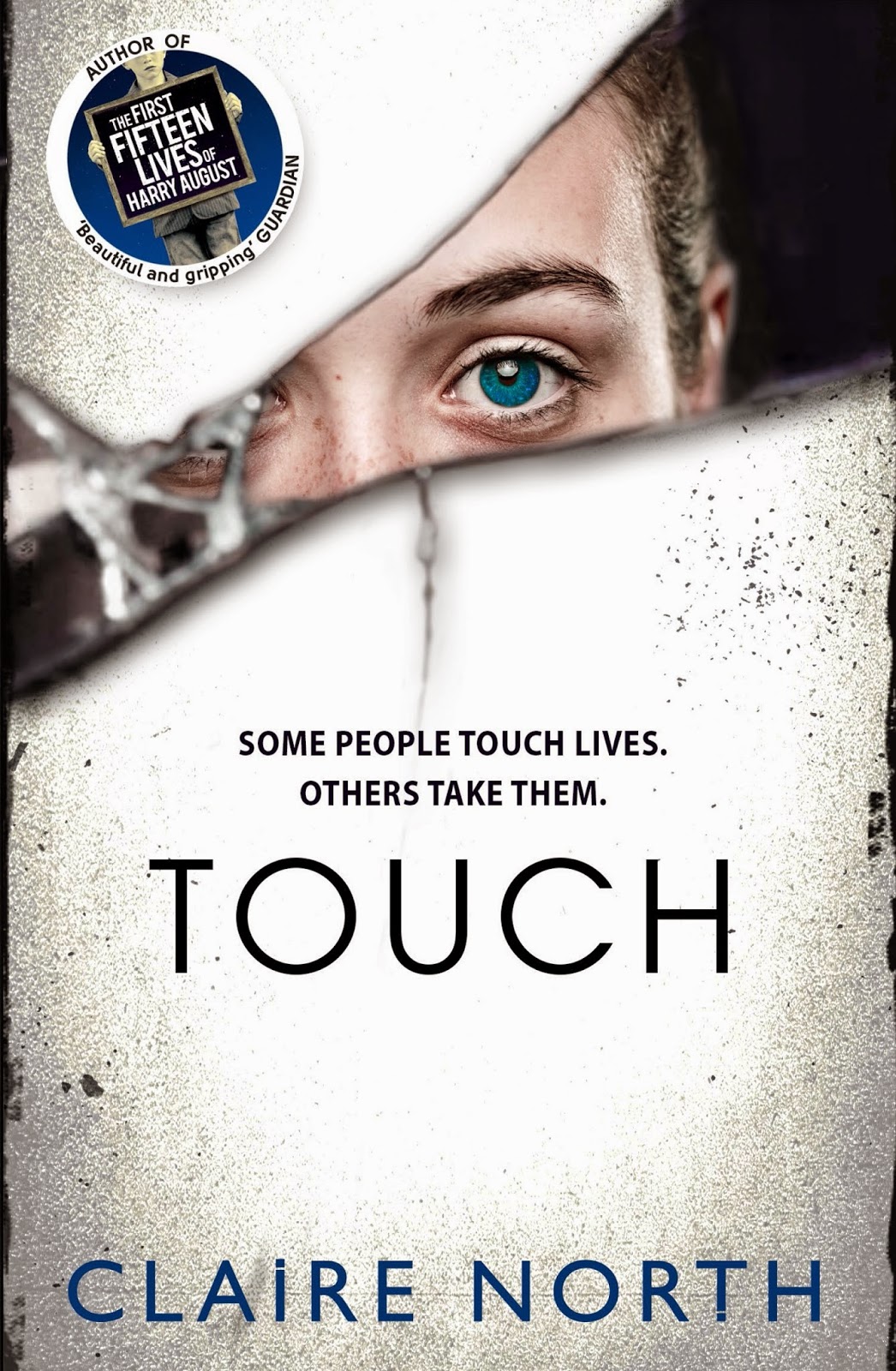
Book Review | Touch by Claire North


He tried to take my life. Instead I took his.

It was a long time ago. I remember it was dark, and I didn't see my killer until it was too late. As I died, my hand touched his. That's when the first switch took place.

Suddenly, I was looking through the eyes of my killer, and I was watching myself die.

Now switching is easy. I can jump from body to body, have any life, be anyone.

Some people touch lives. Others take them. I do both.

***

Fresh from the success of The First Fifteen Live of Harry August, Claire North—the second pseudonym (after Kate Griffin) of prose prodigy Catherine Webb—returns with Touch, a tremendously well-travelled science-fictional thriller that's as disturbing as its predecessor was delightful.

From word one we follow an ancient entity christened Kepler by its enemies; a continuous consciousness of some sort that at the moment of its first host's murder moved—much to its own amazement—into its murderer's mind, and took over his body to boot. Several so-called "skins" later, Kepler has a basic understanding of its situation; of its ability, in particular, to essentially possess a person—any person—with but a touch.

"I walk through people's lives and I steal what I find," Kepler confesses. "Their bodies, their time, their money, their friends, their lovers, their wives—I'll take it all, if I want to." (p.67)

Happily, our entity has attempted, over the centuries, to apply its power responsibly; to cause as little trauma as possible by sliding through the lives of others rather than trampling everything in its path; to recompense those who have played host to its essence, even. All things considered, Kepler seems to be a bit of a stand-up spirit... if spirit it is.

But of course it isn't the only being able to inhabit the bodies of bystanders, and some of the others have attracted the attention of an organisation dedicated to their destruction—an organisation that sends an assassin to kill Kepler in the frenetic first flush of Touch.

Friday, 27 February 2015

Book Review | The Death House by Sarah Pinborough


Toby's life was perfectly normal... until it was unravelled by something as simple as a blood test.

Taken from his family, Toby now lives in the Death House; an out-of-time existence far from the modern world, where he, and the others who live there, are studied by Matron and her team of nurses. They're looking for any sign of sickness. Any sign of their wards changing. Any sign that it's time to take them to the sanatorium.

And no one returns from the sanatorium.

Withdrawn from his house-mates and living in his memories of the past, Toby spends his days fighting his fear. But then a new arrival in the house shatters the fragile peace, and everything changes.

Because everybody dies. It's how you choose to live that counts.

***

A slim, sorrowful volume that splits the difference between The Fault in Our Stars and The Girl with All the Gifts, The Death House documents the last days of several students in a school full of Defectives: young people who have been taken from their parents and installed in an isolated location because of something bad in their blood. Something that'll kill them all before long.
It's school but not school. Like this whole place is life but not life. At least the teachers, who disappear off to their own wing once lessons are done, will get out of here. Sometimes I'll catch one watching us as we work as if we're animals in a zoo. I can never decide quite what the look is. Fascination or fear, or maybe a bit of both.
Maybe a bit of both is appropriate...

On the back of The Language of Dying, a life-affirming dark fantasy about the passing of a man with lung cancer, Sarah Pinborough opts not to detail the Defective gene here. That isn't to say there aren't certain suggestions—implications that when the time comes, the kids in question will turn into monsters of a sort; monsters some of them have seen in the movies the school screens each week. To wit, we can guess what happens next. We can guess that death is essentially a blessing on the affected.

The kids struggle to see it that way, because of course they do—they're kids. Boys and girls from eight to eighteen bundled into black vans and largely left to their own devices on an island where they make friends and enemies, fight and make light; where they do whatever they can do, in truth, to avoid facing the fate that awaits them.

Monday, 3 November 2014

Book Review | The Book of Strange New Things by Michel Faber


It begins with Peter, a devoted man of faith, as he is called to the mission of a lifetime, one that takes him galaxies away from his wife, Bea. Peter becomes immersed in the mysteries of an astonishing new environment, overseen by an enigmatic corporation known only as USIC. His work introduces him to a seemingly friendly native population struggling with a dangerous illness and hungry for Peter’s teachings—his Bible is their “book of strange new things.” But Peter is rattled when Bea’s letters from home become increasingly desperate: typhoons and earthquakes are devastating whole countries, and governments are crumbling. Bea’s faith, once the guiding light of their lives, begins to falter. 

Suddenly, a separation measured by an otherworldly distance, and defined both by one newly discovered world and another in a state of collapse, is threatened by an ever-widening gulf that is much less quantifiable. While Peter is reconciling the needs of his congregation with the desires of his strange employer, Bea is struggling for survival. Their trials lay bare a profound meditation on faith, love tested beyond endurance, and our responsibility to those closest to us.

***

Michel Faber's first novel since The Fire Gospel—a sterling send-up of The Da Vinci Code and its ilk—is a characteristically compelling exploration of faith which takes place "in a foreign solar system, trillions of miles from home," (p.47) on a wasteland planet populated by hooded beings with foetuses for faces.

So far, so science fiction. Factor in first contact, a spot of space travel, and an awful lot of apocalypse, and The Book of Strange New Things seems damn near destined to be speculative. Unfortunately for fans of the form, as the author warns early on, "there was nothing here to do justice to [that] fact." (p.47) Or, if not nothing, then very little aside the superficial.

Even in addition to the aforementioned trappings, honeydewed drinking water and a dizzying day/night cycle do not add up to much more than an unlikely lens through which to look at love: in the first between mere mortals, but above and beyond that, the love—and the love lost—between man and maker.

The Book of Strange New Things is beautiful, albeit brutal. Despairing to a degree, but also bullish about the future. Hope, however, is a fragile thing, as Faber's protagonist preaches at a point:
As fragile as a flower. Its fragility makes it easy to sneer at, by people who see life as a dark and difficult ordeal, people who get angry when something they can't believe in themselves gives comfort to others. They prefer to crush the flower underfoot, as if to say: See how weak this thing is, see how easily it can be destroyed. But, in truth, hope is one of the strongest things in the universe. Empires fall, civilisations vanish into dust, but hope always comes back, pushing up through the ashes, growing from seeds that are invisible and invincible. (p.315)
Indeed, Peter Leigh means to be one of these seeds; to share his hope—the faith that saved him from a life of drug abuse and destitution—with the natives of Oasis. He still struggles to believe the Powers That Be at USIC picked him of all people—him but not his wonderful wife Bea, who did deliver Peter from his dark past—to be an apostle upon another planet; to spread the Good News about God to the "indigenous inhabitants" (p.71) of this unknowable new world.

Friday, 22 August 2014

Book Review | Colorless Tsukuru Tazaki and His Years of Pilgrimage by Haruki Murakami


Tsukuru Tazaki had four best friends at school. By chance all of their names contained a colour. The two boys were called Akamatsu, meaning 'red pine', and Oumi, 'blue sea', while the girls' names were Shirane, 'white root', and Kurono, 'black field'. Tazaki was the only last name with no colour in it.

One day Tsukuru Tazaki's friends announced that they didn't want to see him, or talk to him, ever again.

Since that day Tsukuru has been floating through life, unable to form intimate connections with anyone. But then he meets Sara, who tells him that the time has come to find out what happened all those years ago.

***

"From July of his sophomore year in college until the following January, all Tsukuru Tazaki could think about was dying." (p.1)

So begins Haruki Murkami's first novel since the bloat of the book many expected to be his magnum opus. Happily, Colorless Tsukuru Tazaki and His Years of Pilgrimage is essentially the inverse of IQ84. It's short and sweet where that last was extended in its dejection; gently suggestive rather than frustratingly overbearing; and though the ending is a bit of bait and switch, it's one which feels fitting, unlike IQ84's dubious denouement.

If you were worried, as I was, that Murakami may have had his day, then rest assured: his new novel represents a timely reminder of the reasons you fell for his fiction in the first place.

As with almost every book to bear the international bestseller's brand, Colorless Tsukuru Tazaki and His Years of Pilgrimage immerses readers in the mindset of a single, emotionally crippled character; a man approaching middle age, in this case, whose major malfunction is made plain from the first page, as he reflects on his lowest moments:
There was an actual event that had led him to this place—this he knew all too well—but why should death have such a hold on him, enveloping him in its embrace for nearly half a year? Envelop—the word expressed it precisely. Like Jonah in the belly of the whale, Tsukuru had fallen into the bowels of death, one untold day after another, lost in a dark, stagnant void. (p.2)
But before this death, this darkness... life, and light. Light composed of the colours of his four best friends, with whom his life was intimately intertwined:
The two boys' last names were Akamatsu—which means 'red pine'—and Oumi—'blue sea'; the girls' family names were Shirane—'white root'—and Kurono—'black field'. Tazaki was the only last name that did not have a color in its meaning. From the very beginning this made his feel a little bit left out. (p.6) 
Not half as left out as he felt when, one day, they "announced that they did not want to see him, or talk with him, ever again. It was a sudden, decisive declaration, with no room for compromise. They gave no explanation, not a word, for this harsh pronouncement. And Tsukuru didn't dare ask." (p.3)

Colorless Tsukuru Tazaki and His Years of Pilgrimage takes place decades after this rejection.

Monday, 4 August 2014

Book Review | The Seventh Miss Hatfield by Anna Caltabiano


Rebecca, a 15-year-old American, isn't entirely happy with her life, comfortable though it is. Still, even she knows that she shouldn't talk to strangers. So when her mysterious neighbour Miss Hatfield asked her in for a chat and a drink, Rebecca wasn't entirely sure why she said yes. It was a decision that was to change everything.

For Miss Hatfield is immortal. And now, thanks to a drop of water from the Fountain of Youth, Rebecca is as well. But this gift might be more of a curse, and it comes with a price. Rebecca is beginning to lose her personality, to take on the aspects of her neighbour. She is becoming the next Miss Hatfield.

But before the process goes too far, Rebecca must travel back in time to turn-of-the-century New York and steal a painting, a picture which might provide a clue to the whereabouts of the source of immortality. A clue which must remain hidden from the world. In order to retrieve the painting, Rebecca must infiltrate a wealthy household, learn more about the head of the family, and find an opportunity to escape. Before her journey is through, she will also have—rather reluctantly—fallen in love. But how can she stay with the boy she cares for, when she must return to her own time before her time-travelling has a fatal effect on her body? And would she rather stay and die in love, or leave and live alone?

And who is the mysterious stranger who shadows her from place to place? A hunter for the secret of immortality... or someone who has already found it?

***

The Seventh Miss Hatfield is seventeen year old Anna Caltabiano's second novel: a scientific romance, after a fashion, and indeed, an extraordinary feat for someone so young. I can't in good conscience recommend it, however—much as I might like to champion the work of such a promising new author.

It's 1954, and Cynthia, a lonely little girl on the edge of adolescence, has become fascinated by her new neighbour: a strange lady who has spoken to no one in the weeks since she moved into the street. The better to get a glimpse of this antisocial character, Cynthia puts away her doll one day to take Miss Hatfield a package the postman abandoned when she refused to open her door. To her surprise and delight, she's invited in for a glass of freshly made lemonade. Her host, however, slips some mysterious liquid into her drink: a drop of water from a lake discovered in the distant past by Ponce de Leon which immediately makes her immortal.

"I'm rescuing you from your life," Rebecca Hatfield reasons. "I know you're miserable. I've watched you playing with your doll. You don't fit in with your friends or your family. You can't fit in because you aren't meant to—you're meant for something greater than a normal existence." (p.22) Something more like the lot of a time-travelling identity thief, if you can believe it, as that's exactly what Miss Hatfield asks Cynthia to do: to pop into the past, pretending to be someone else, so as to steal a prized painting.

Monday, 4 November 2013

Book Review | Marina by Carlos Ruiz Zafón


Buy this book from
Amazon.co.uk / The Book Depository

Or get the Kindle edition

In May 1980, 15-year-old Oscar Drai suddenly vanishes from his boarding school in the old quarter of Barcelona. For seven days and nights no one knows his whereabouts...

His story begins in the heart of old Barcelona, when he meets Marina and her father German Blau, a portrait painter. Marina takes Oscar to a cemetery to watch a macabre ritual that occurs on the fourth Sunday of each month. At 10 a.m. precisely a coach pulled by black horses appears. From it descends a woman dressed in black, her face shrouded, wearing gloves, holding a single rose. She walks over to a gravestone that bears no name, only the mysterious emblem of a black butterfly with open wings.

When Oscar and Marina decide to follow her they begin a journey that will take them to the heights of a forgotten, post-war Barcelona, a world of aristocrats and actresses, inventors and tycoons; and a dark secret that lies waiting in the mysterious labyrinth beneath the city streets.

***

Upon its original publication, The Shadow of the Wind was something of a sensation in Spain, and again times ten — thanks in no small part to Lucia Graves' great translation — when it was let loose in the West damn near a decade ago.

Sadly, the going's been ever so slow as regards new novels by Carlos Ruiz Zafón since. There was The Angel's Game in 2009 — a bit of a disappointment, if I'm honest — and in 2012, The Prisoner of Heaven: a worthy sequel to The Shadow of the Wind, if not necessarily an equal. Be that as it may, I can hardly wait to read the concluding volume of the Cemetery cycle... but I'm going to have to, aren't I?

In the meantime, there's been plenty to keep Zafón's army of fans happy, because between these releases, Lucia Graves has been working her way through the novels the master of post-modern melodrama made his name with in the nineties: a series of four young adult fantasies beginning with The Prince of Mist — a pleasant if forgettable blip of a book — and concluding, this year, with Marina.

Set in the late 1970s in beautiful, byzantine Barcelona — an enchanted city wherein "time and memory, history and fiction merged [...] like watercolours in the rain" (p.5) — Marina tells the tale of Oscar Drai's missing days. "Then a fifteen-year-old boy languishing in a boarding school named after some half-forgotten saint," (p.5) at the outset Oscar meets a secretive girl called Marina and her ailing father, Germán. They become fast friends... though, you know, only on the down low:
Without knowing quite why, I kept the friendship hidden. I hadn't told anyone about them, not even my friend JF. In just a few weeks Germán and Marina had become my secret life and in all honesty the only life I wished to live. I remember the time when Germán went to bed early, excusing himself as usual with the impeccably manners of an old-fashioned gentleman. I was left alone with Marina in the room with the portraits. She smiled enigmatically. (pp.70-71)
As it happens, she has a habit of doing that; that and many other mysterious things. She has a secret, you see — several, strictly speaking — and one day she clues Oscar in on the gothic plot Zafón's novel revolves around. It begins at the Sarria cemetery, one of Barcelona's best-hidden spots:
If you look for it on the map, you won't find it. If you ask locals or taxi drivers how to get there, they probably won't know, although they'll have heard all about it. And if, by chance, you try to look for it on your own, you're more likely than not to get lost. The lucky few who know the secret of its whereabouts suspect that this old graveyard is in fact an island lost in the ocean of the past, which appears and disappears at random. 
This was the setting to which Marina let me that Sunday in September, to reveal a mystery that intrigued me almost as much as she did. (p.29)
To be sure, I was taken in too, for from their vantage point, Oscar and Marina watch a hooded woman pray before a grave unmarked excepting a simple symbol: a black butterfly with open wings. Perplexed, our intrepid adventurers stick their noses in still further, and resolve to follow the hooded woman home. When she disappears into an overgrown greenhouse, they head in unhesitating — and that's where the innocent fun finishes, because deep in the greenhouse, Oscar and Marina find an entrance to a subterranean inner sanctum of sorts, where they discover an obscenely creepy collection of dolls along with a macabre photo album depicting "innocent souls imprisoned within bodies that were horribly deformed." (p.41)

Intriguing, indeed. Alas, the mystery doesn't last. Marina may be the finest of Zafón's four young adult fantasies —  it is certainly the most reminiscent of the territory the author went on to explore in the Cemetery cycle — but it, too, has significant issues. Foremost among them, by far, is this; the end result of which is, I'm sorry to say, some faux-Phantom of the Opera nonsense. To make matters worse, Marina's riddles are revealed piecemeal by way of a series of increasingly convoluted monologues, for instance the following:
"All the former members of the Velo-Granell executive board met their deaths, theoretically of natural causes. Heart attack was the doctor's diagnosis in most of the cases. One of them drown in his own swimming pool. The body was still holding a gun when they fished him out. For the rest the circumstances were similar. They'd been alone in their beds; it was always at midnight; and they were all found in process of dragging themselves across the floor... trying to flee from a death that left no trace. All except Benjamín Sentís." (p.158-159)
Markedly more satisfying than the central mystery of Marina are the relationships between Oscar and Marina, Marina and her father, even Marina's father and our able narrator. A piquant combination of sweetness and silliness and sadness elevates their early interactions above and beyond the norm. Unfortunately, these too take a backseat when the twisted riddle begins to unravel, though the very last chapters represent something of a saving grace.

Marina's primary problem is far from fundamental, but it does undoubtedly take the edge off a novel I was looking forward to recommending unreservedly as far as two thirds through. As is, Marina might be slightly more satisfying than Carlos Ruiz Zafon's other young adult fantasies — a largely lacklustre bunch — but in the final summation it falls short of the promise of its premise and an absolutely fantastic first act.

***

Marina
by Carlos Ruiz Zafón

UK Publication: September 2013, Weidenfeld & Nicolson

Buy this book from


Recommended and Related Reading