Showing posts with label classics. Show all posts

Wednesday, 2 July 2014

Guest Post | "Ghost Writer" by Joanna Briscoe

My novels are all haunted, but I was the last to know it. 

Luckily, others were more astute, and I was asked by Arrow to write a novella for their Hammer imprint—a collaboration between Hammer Films and Random House publishers that has resulted in some of the most interesting short novels of the last few years. I loved Jeanette Winterson’s The Daylight Gate and Helen Dunmore’s The Great Coat, but when I was commissioned to write a novel with a supernatural aspect, I hadn’t read them, or any other adult ghost novel apart from The Turn of the Screw.

Or I thought I hadn’t. When I stop to think about some of my favourite literature—AS Byatt’s Possession; Toni Morrison’s Beloved; Rebecca; Jane Eyre—they are all pursued by ghosts in one way or another. And even more strangely, when I think about my own work, it is deeply haunted... While I was imagining howling apparitions in sheets, hauntings of a more subtle nature were staring me in the face. 


So in my first novel, Mothers and Other Lovers—which was in so many senses a classic rights-of-passage, semi-autobiographical first novel—I had plenty of ghosts to lay to rest! I think I had needed to look at childhood and my relationship with my mother, and how that had impacted on somewhat disastrous love life choices of that time... This is probably strictly the least haunted of my novels, but it was definitely about dealing with my demons. Several of them. Of course, straightforward autobiography rarely works as fiction, so it was a story, an invention, but I could never deny the true-to-life tale that had to get out.

My second, Skin, is the most shocking and in many ways worrying of my novels. It features a woman who is a victim of her own beauty and keeps having surgery to hold the years back. As each layer of her face is peeled away, more of her past is revealed. She herself is utterly haunted by her lost youth, and by her longing for one man who ultimately leaves her.

It’s that longing that really makes my novels haunted, I realise. I tend to write about obsessive, often dark and destructive yet highly addictive romantic or sexual desire, the longing itself more potent than the actual flawed relationship. In Sleep With Me, which was adapted by Andrew Davies as an ITV drama, the interloper, the unfathomable Sylvie, is frequently described as a ghost. In fact, the first line, which was used in the underground and train adverts, was "The day our child was conceived, someone else arrived. She was there as the cells fused, like a ghost."


The indications that I should write something more paranormal were screaming at me but still I didn’t notice! Reviewers even frequently described that novel as sinister, creepy, full of suspense, eerie, mesmerising and chilling... yet sometimes it still takes an outside eye to see what it is we should be doing.

My fourth novel, You, was all about a haunting of a different nature, though it was set in a large, creaking, thatched Devon house. In it, Cecilia is driven almost mad by the mistake she has made in the past in giving up a child for adoption. So haunted is she by it, she can almost think herself back into that time. In the meantime, the past is actually catching up with her in the form of that child, who has become a ghostly figure in her head but is actually all too real.

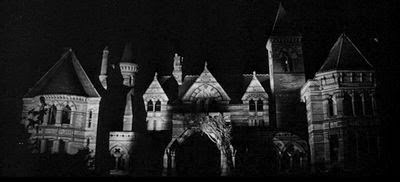
But this all took me to Touched, which is a finally novel that is decidedly and quite openly haunted! My first thought was a bright, bright—almost eerily bright—village green, and on that I saw a girl who dresses herself in Victorian clothes: shabby, faded, and decidedly odd. That was the starting point. Then I wondered about her mother, Rowena. Then I looked to her grandmother, and so the haunting began. In the meantime, Rowena, absolutely pursued by guilt, is developing her own very earthly passion for her intriguing neighbour, Gregory Dangerfield. Real life humans cause as many problems as the presences that haunt poor Rowena, while Rowena’s daughters have their own problems chasing them. And what is that face at the window, caught only in a split second film still? 


To me, with Touched, it was the perfection of the pretty village in which this family lives that was potentially eerie. And when they begin to attack the wall of their cottage to make a larger house, there is something not quite right going on, a sense of protest, of suffering. As ever, my characters are haunted by desire, longing, terrible guilt, and their past mistakes. But while they’re focusing on their own loves, lusts and shuddering regrets, less tangible apparitions gather in the margins. The spooks and spectres of the more plodding Victorian ghost stories don’t interest me, though there are some fine hauntings among them. It’s the presences that play while characters are looking elsewhere that get me: the glimpsed, the sensed, the loved. 

I think my ghosts have finally made their way out of the closet, and I look forward to sending them into the world, fully unformed.

***

Joanna Briscoe is the author of Mothers and Other Lovers, Skin, You and the highly acclaimed Sleep With Me, which was published in eleven countries and adapted for ITV Drama by Andrew Davies. She spent her very early years in 'the village of the damned,' Letchmore Heath in Hertfordshire, the location for the celebrated 1960 film based on John Wyndham's novel The Midwich Cuckooks—and the inspiration, too, for this Hammer novella.

You can find out more about Joanna on her website, www.joannabriscoe.com, or on Twitter @JoannaBriscoe. Stay tuned to The Speculative Scotsman to read my review of Touched as soon as is humanly.
Thursday, 1 May 2014

Guest Post | "Haunted Homes" by Alison Littlewood

There are so many things that make haunted houses ideal for a good chilling tale. Home is where the heart is, they say; it’s also where family is, the things we love. It’s where we feel safe. Not so in the haunted house, where our refuge becomes a place of nightmare. Family, more likely than not, becomes a source of terror instead of love. Death walks the hallways and rattles at the doors, and we can become trapped by the very walls we build around ourselves.

In film, I’m a sucker for a good haunted house. All that sneaking around at night completely gets to me, possibly because it’s redolent of my own childhood fears of what might be hiding in the dark. And there are those cheap jump moments that are almost expected—the thing glimpsed in the mirror as the bathroom cabinet closes; the reflection in the window; and, of course, the dreaded cellar, that emblem of the subconscious, where who knows what might be lurking. Still, I’ll jump at all of them, in part precisely because I expect them.


In literature, it’s not really about the jump moment so much as a creeping sense of dread, of the things we don’t expect, the darkness lurking inside ourselves being reflected in the things around us. It’s about atmosphere, as evoked so beautifully in some of the classics of the genre—The Haunting of Hill House by Shirley Jackson, James Herbert’s Haunted or Susan Hill’s Woman in Black.

The written word also has the facility to place us on the inside, sharing the character’s thoughts but also their flawed perceptions and understanding. One of my favourite haunted house novels of recent times has just such a flawed protagonist. The eponymous Audrey, of Audrey’s Door by Sarah Langan, is struggling to emerge from a broken relationship and an upbringing with a mentally ill mother. She moves into the Breviary, an apartment building constructed by proponents of a movement called chaotic naturalism. When we discover that her ridiculously cheap apartment was recently a crime scene, we can feel the walls closing in before anything supernatural happens. Audrey, an architect, soon finds herself obsessed with doors, adding them to plans where no doors should be. When she is compelled to build a door in the middle of her apartment—leading to what?—the fear ramps up. It’s tense, clever and genuinely scary.

Another favourite of mine is Dark Matter by Michelle Paver [Ooh! I liked that one too—Ed]. Often, haunted houses are isolated, removed from sources of help and the normalising effect of other people. Here is an Arctic outpost rather than a house, but for the main character, Jack, it becomes his only home and refuge in the midst of a wilderness. Poor and disillusioned, he is recruited for the expedition by a group of men he sees as being a ‘cut above’, but problems beset the others until only Jack remains. The outpost becomes his home, one surrounded by snowy wastes and the endless dark. As it begins to seem he isn’t quite alone after all, we begin to wonder whether the haunting is a ghost or the effects of extreme isolation on Jack’s personality. The novel is set in the 1940s and is told in Jack’s diary entries, and it is his idiosyncratic voice that is a great part of the novel’s strength.

Short stories can be ideal for evoking an atmosphere, for encapsulating a moment in time or a distilled emotion, and as such they lend themselves well to the haunted house theme. House of Fear, edited by Jonathan Oliver, is an anthology of contemporary ghostly tales by practitioners like Stephen Volk, Adam Nevill, Robert Shearman, Sarah Pinborough, Christopher Priest, Tim Lebbon and many more. It’s a showcase, not just of some very fine authors, but of the huge range of approaches that can result from the theme: some traditional, some distinctly modern, others more surreal, while others question the concept of what it is that constitutes a haunting at all. The creativity on offer shows how far the concept of a haunted house can be reinvented and given fresh life; certainly, the tried and tested idea seems to be in no danger of dying out.

***

Alison Littlewood is the author of A Cold Season, published by Jo Fletcher Books, an imprint of Quercus. The novel was selected for the Richard and Judy Book Club, where it was described as “perfect reading for a dark winter’s night.” Her second novel, Path of Needles, is a dark blend of fairy tales and crime fiction, and her third, The Unquiet House, is a ghost story set in the Yorkshire countryside.

Alison’s short stories have been picked for The Best Horror of the Year and The Mammoth Book of Best New Horror anthologies, as well as The Best British Fantasy 2013 and The Mammoth Book of Best British Crime 10. Other publication credits include the anthologies Terror Tales of the Cotswolds, Where Are We Going? and Never Again. Alison lives in Yorkshire with her partner Fergus. Visit her at www.alisonlittlewood.co.uk.

Monday, 11 February 2013

You Tell Me | The Scotsman in the High Castle

In case you hadn't heard, this morning brought news of an adaptation of a classic genre novel. Via Variety:
Syfy is adapting Philip K. Dick's book The Man in the High Castle into a four-part miniseries, with Ridley Scott attached to exec produce. 
Dick's novel, set in 1962, depicts a world where Nazi Germany and Japan were the victors in WWII and occupy the U.S. 
The X-Files vet Frank Spotnitz will serve as primary scribe and as exec producer. Scott will exec produce through his shingle Scott Free Prods., alongside Headline Pictures, Electric Shepherd Prods. and FremantleMedia Intl., which will also distribute the mini globally.
"Alternate history stories are part of an amazing and intricate genre of sci-fi," said Mark Stern, president of original content at Syfy and co-head of original content at Universal Cable Prods. "When done well, there's nothing better; and I can't think of better creative talent to bring Philip K. Dick's fascinating alternate-history thriller to life than Ridley Scott and Frank Spotnitz."
Well, I can.

Be that as it may, I'll probably watch Syfy's adaptation anyway. But the announcement puts me in a particular position: though I've had a copy on my shelves for many years indeed—in large part because I bought all the original SF Masterworks I could—I haven't read The Man in the High Castle, and with this miniseries on the near to far horizon, it's become a case of now or never.

Why is that?

As I've touched on here on The Speculative Scotsman, I value surprise very highly. So highly that, if I'm honest, whether Syfy's series is awful or awesome, I am entirely unlikely to invest precious time in a tale I've already been told.


Long story short, should I read The Man in the High Castle before Syfy's adaptation airs? Or should I make like nothing's changed?

Before you offer your opinions one way or the other, know that the only the only Philip K. Dick I can recall reading is Do Androids Dream of Electric Sheep? I was young at the time—perhaps too young—and I didn't entirely dig it; I only persisted because of my undying adoration of Blade Runner.

But maybe the time has come to re-evaluate my stance. Maybe I should read this book before Syfy's miniseries spoils the experience for me.

You tell me!

Thursday, 12 April 2012

Guest Post | Jason of Kamvision Reviews High Rise by J. G. Ballard

Ladies and gentlemen: welcome once again to The Speculative Scotsman! 

You may or may not know that I’m in America at the moment – if not, yes, it’s true... in fact I’m as far AFK as I’ve ever been before – but never ye fear! For in my absence, a few good men and women have volunteered to make the site their own, albeit only momentarily. They’re bloggers, by and large, but also friends; fine folks one and all that I’ve met on the internet (and occasionally off) in the course of keeping this shared space set aside for burbling about speculative fiction of all shapes and sizes. 

They all have blogs of their own, of course, and I’d urge you to seek them out. I care a lot about what goes on here on The Speculative Scotsman, so let me stress this one thing before I get to giving over the floor: the fact that I’m hosting the work of each of these excellent writers here speaks to my admiration and my respect for every last one among them. 

If you enjoy some or all of these terrific reviews and opinion pieces, do the decent thing and click through the links in the intro and outro of each. Follow a few of my favourite internet critics. :) 

So what do I have to entertain and inform you all today?

Only an incredible review of a brilliant book! An fond old favourite of mine as well, though I suppose I've never had call to mention it here on TSS before.

As to who wrote it... well, if you haven't been formerly introduced, then let me do the honours: everyone, meet Jason Baki, of Kamvision fame. Jason? Meet everyone. :)

I'm tragically short on time today, I'm afraid, so that's going to have to do it for me for the moment, folks, but here: read this review. And then this book.

And then? Well you immediately bookmark Jason's brilliant blog, don't you?

*** 


Buy this book from:

"When a class war erupts inside a luxurious apartment block, modern elevators become violent battlegrounds and cocktail parties degenerate into marauding attacks on 'enemy' floors. In this visionary tale, human society slips into violent reverse as once-peaceful residents, driven by primal urges, re-create a world ruled by the laws of the jungle."

***

JG Ballard’s often remarkably prescient dystopias, like those of George Orwell and Philip K. Dick have ensured his name is frequently cited among contemporary writers as an influence on their work. My own introduction to Ballard was a late one, I first read Crash shortly after seeing Paul Haggis’s film adaptation in 2004. Like many before, I was immediately struck by the visceral prose and his compelling insight into social dynamics. But in finally getting around to reading High-Rise, it wasn’t so much his fixation with the fragility of civil society that lured me, but rather it was the physical setting for the novel. I myself have spent the largest part of my life so far living at the top of a high-rise tower block, and now I am working on a novel of my own that is inspired in part by my experiences of this environment. So in coming to this work, I was particularly intrigued to see what Ballard had done with the physical space and how he imagined the design of a high-rise tower would impact on those who dwelled there. I have my own direct experience which informs my view, but I was certain Ballard would have some vivid insights of his own. Most certainly, he does.

The first notable feature about the actual physical building is that Ballard imagines it as a high-tech self contained world, complete with gymnasium, swimming pools, restaurant and shops. The second thing is that, as the above indicates, this is a luxury apartment peopled by those with good to high disposable incomes. This is most definitely not any old residential tower block located within an urban wasteland. 

It may not be inhabited by the urban poor, but the first indication of the physical influence of the building on the minds of its inhabitants is very much related to class. Ballard sees the tiered arrangement of the living space in a vertical environment as naturally predisposed to social hierarchy. A little over 50 pages into the novel he writes, “In effect the high-rise had already divided itself into the three classical social groups, its lower, middle and upper classes.” From this hierarchical arrangement stems the fundamental tensions between the residents that drive the narrative. In effect, from the outset the physical space imposes itself on the psychology of its residents, transforming educated, hitherto well-adjusted members of society, into rival clans driven by petty self interest. It’s a fascinating premise and one which instantly places the physical building itself at the centre of the action, which from my own perspective was exactly what I was hoping for. Much more than this, it allows for Ballard’s characteristic insight to run riot (along with most of the buildings occupants) as he explores the ramifications of social fragmentation. 

Ballard does, however, go a step further than just exploring divisions based on perceived social groupings. He also explores the impact of the space on the individual. Here, he suggests that the buildings self-sufficient design has an isolating effect. Many of the inhabitants withdraw from contact with the world outside the building except for work and later even from this. They begin to see themselves as separate not just from those occupying other floors within the building but even from those a few doors away. Ballard it seems is suggesting that apartment living and self-sufficiency are socially isolating. 

Now a great deal has already been written on the effect of architecture on human behaviour, and numerous reports have looked into the relationship between urban design and criminal activity. My own estate, heavily blighted by crime, was demolished and then entirely rebuilt as low-rise housing, due in no small part to the findings of such research. But in reading High-Rise I don’t think Ballard’s intention is solely to suggest that flawed urban design and modern physical living arrangements (the book was written in 1975) promote a breakdown of social cohesion. It seems to me that Ballard sees such divisions already in place across wider society irrespective of environment per se and constructs his high-rise as a microcosm. 

Why do I say this? Ballard makes reference throughout the book to the internal processes of his key characters and their relationship to the physical space in a manner that increasingly blurs the boundaries between their thoughts and their environment. There are three principal characters, Laing, Wilder, and Royal, who are each representative of one the primary hierarchical divisions mentioned earlier. Each of them comes to see themselves as somehow inseparable from their status within the building. Every little fissure and fragment in the block, serves only to reinforce this identity. Eventually the building no longer even functions effectively, yet the characters are so entrenched in their respective positions they scarcely notice what is happening around them. They choose to remain in the building, living in torrid conditions, largely by choice. So either they have massively internalised their environment or they are the architects of it. The narrative suggests both to a degree. In fact one of the key characters, Royal, a member of the upper tier of the social system, is actually an architect involved in the building’s design. But the social psychology that the novel explores in exaggerated form is indicative of widespread real world social hierarchies as exemplified by the class references. Surely Ballard isn’t suggested that class based hierarchies are primarily a product of urban design? Although he may be suggesting they are reinforced by such. Yet if we consider that all of the buildings occupants were initially drawn from similar comfortable social classes, in other words they were to a greater or lesser extent equals, then it seems to me the tiered living arrangements of the high-rise in the novel serves to illustrate the fragmentary effect of imposing hierarchies on those who would otherwise be equal. It is this that I think underpins the novels thematic focus much more than a simple critique of architectural form. Further evidence of this type of wider social commentary occurs later in the novel when a character from the upper tier seeks to use those in the middle tier to suppress those from the lower tier, “...Once we’ve gained a foothold there we can play these people off against those lower down – in short balkanize the centre section and then begin the colonization of the entire building…” A pretty good summation of divide and rule, I would say.

The novel also states on several occasions that those in the middle tier are naturally the most at home with life in the high-rise. The text describes how those dwelling in the central section of the building seem most content to isolate themselves, being both comfortable enough not to require too much from the outside and yet preoccupied with gaining access to the upper levels. I think Ballard’s intent here is fairly plain to see.

Back to my original interest in this novel, wondering how Ballard would use the physical space of a high-rise building, I found his approach fascinating. The high-rise described here isn’t just a physical entity: it’s also a psychological and psychosocial space. I have long been fascinated by the relationship between design, environment and psychology, perhaps because of my earliest influences. In High-Rise, Ballard demonstrates how these elements can combine to great effect within a novel. 

Away from these considerations, I found the book to be highly visual (it’s currently being filmed by Canadian Director, Vincenzo Natali), at times brutal, and possessed of an almost obsessive quality. The frequent comparisons to Lord of the Flies are not without merit. The narrative structure follows a form of ever increasing tension as the building descends into greater disarray, but with little variance. The female characters are also presented in a way that could be deconstructed along a number of interesting lines. The greatest strength of this novel by far is the expert twinning of theme to environment, which is then used to drive every aspect of the narrative - fine by me, because that’s what attracted me to it in the first place. High-Rise is an evocative novel, insightful if a little single-minded, but ultimately one which deserves its place as a classic of socially relevant hyper-real literature.

***

Everyone say thank you, Jason. 

Thank you, Jason!

Seriously: Kamvision is where it's at. Now go on and follow this fellow. :)

Tomorrow on The Speculative Scotsman, well... more awesomeness, obviously. More specifically, sex, courtesy of Staffer's Musings.

Thursday, 5 April 2012

Guest Post | Kristopher of The Sound and Fury Reviews We by Yevgeny Zamyatin

Today on The Speculative Scotsman, it's my absolute pleasure to play host to a terrific critique of a book I'll freely admit I hadn't heard of before the text of this guest post arrived in my inbox.

Alas, even with my Amazon Prime membership - what can I say? I'm a sucker for "free" postage - the copy of We I immediately ordered didn't arrive on time for me to bundle it off to the States. But hey, it'll be something to look forward to when I get back!

If you've ever visited the comments section here on TSS, you'll know his name: Kristopher A. Denby has been a mainstay around these here parts, with always something interesting to say. But did you know Kris also keeps an excellent occasional blog? And if not, why not?! 

The Sound and Fury of Kristopher A. Denby has been in my bookmarks for many, many years, and if it isn't already among your favourite haunts, well... you need only read on to see why it should be.

***


Buy this book from:

"The citizens of the One State live in a condition of 'mathematically infallible happiness'. D-503 decides to keep a diary of his days working for the collective good in this clean, blue city state where nature, privacy and individual liberty have been eradicated. But over the course of his journal D-503 suddenly finds himself caught up in unthinkable and illegal activities - love and rebellion.

"Banned on its publication in Russia in 1921, We is the first modern dystopian novel and a satire on state control that has once again become chillingly relevant."

***

I have a confession to make: I’d never heard of We or Yevgeny Zamyatin before the book was prescribed to me by a college professor. It’s best to get that out of the way straight off to avoid sounding know-it-allish while I attempt to persuade you to read this book. And make no mistake, you should read this book.

More likely than not, you are all considerably more sophisticated than I, and have covered the literary spectrum in your readings, dutifully paying equal attention to those noteworthy works which had spent the better part of a century (before we were all smitten with Glasnost) locked behind an iron curtain. On the off chance that you find yourself in my shoes, though, scratching your head in wonder at the notion that the Commies could have produced great sci-fi, then please, dear readers, allow me the chance to unburden you of your ignorance.

Written in 1921, a mere four years after the Russian Revolution, We tells the story of D-503, citizen of the One State and builder of the Integral, a great starship that will enable the totalitarian government of the One State to travel to the other planets in the solar system and subjugate their inhabitants “to the beneficial yoke of reason”. D-503 is a model subject, bending all of his thoughts and desires towards the goals of the One State. But when he encounters the strange, seductive female, I-330, his ordered world of numbers and degrees begins to unravel into chaos.

The plot should be familiar to any self respecting science fiction fan. We has inspired works great and terrible, big and small, from Orwell’s Nineteen Eighty-Four to Lucas’s THX 1138, and everything in between, including the films Logan’s Run, Gattaca and Equilibrium. But beyond being a particularly prescient work of speculative fiction, warning of the ills of governments run amok, the loss of the individual within the collective, and the cyclical nature of revolution, it is also simply a damned well written book.

Zamyatin’s prose is a thing of such striking beauty that the reader is compelled to linger over certain passages as one might linger in a museum in front of a particularly beautiful painting. D-503’s (by way of Zamyatin) antiseptic, mathematical descriptions of his world and the people who inhabit it are, at times, breathtaking, and imbued with such an original and innovative command of wordcraft that it’s easy to forget that you’re reading a book that was written nearly a century ago. [Okay, I'm in! - Niall]

And if the language of We shows little signs of wear, the themes contained within its pages show even less. Zamyatin’s criticism of the new Soviet government and its ham fisted attempts at social and economic equity are perhaps (oddly enough) just as relevant today as they were then.

Within the Green Wall of the One State, the buildings are made up of a clear glass-alloy that affords no privacy to any of its inhabitants, except on Sex Days when citizens are allotted 20 minutes to lower the blinds and, ahem… conduct business. The transparency of Zamyatin’s glass buildings, and the society contained within their walls, bear a striking resemblance to our own surveillance saturated society. With cameras on every street corner, in every ATM, every store, public building, and in every computer; our world, the world of 2012, is the symbolic equivalent to glass world of Zamyatin’s totalitarian One State. Even the One State’s march towards human perfection via the excision of the imagination is a dead ringer for Eugenics, which has managed to rear its ugly head again in recent years. 

We, though not as well known as its English successor, Nineteen Eighty-Four, is, nevertheless, just as important as the more well known work, and perhaps more beautiful and hopeful in its conclusion than Orwell’s famous dystopia. Regardless of what you look for in a book, however, be it keen social commentary or pure entertainment, this blast from the past, this classic titan amongst dystopian science fiction has got you covered. I highly recommend it.

Kirk out.

***

And how!

Five stars to this fantastic review, and here... doesn't the book sound cool too?

Thanks again, Kris, for putting this piece together for TSS. I owe you my left leg. Just let me know when you need it!

And readers? You know where he's at already. I bid you: go there, and be very merry. :) 

Meanwhile, back at the ranch, I'm returning to the blog tomorrow, for week two of Letters From America. So do stay tuned.

Friday, 23 March 2012

Book Review | Ender's Game by Orson Scott Card


Buy this book from

In order to develop a secure defense against a hostile alien race's next attack, government agencies breed child geniuses and train them as soldiers. A brilliant young boy, Andrew "Ender" Wiggin lives with his kind but distant parents, his sadistic brother Peter, and the person he loves more than anyone else, his sister Valentine. Peter and Valentine were candidates for the soldier-training program but didn't make the cut--young Ender is the Wiggin drafted to the orbiting Battle School for rigorous military training.

Ender's skills make him a leader in school and respected in the Battle Room, where children play at mock battles in zero gravity. Yet growing up in an artificial community of young soldiers, Ender suffers greatly from isolation, rivalry from his peers, pressure from the adult teachers, and an unsettling fear of the alien invaders. His psychological battles include loneliness, fear that he is becoming like the cruel brother he remembers, and fanning the flames of devotion to his beloved sister.

Is Ender the general Earth needs? But Ender is not the only result of the genetic experiments. The war with the Buggers has been raging for a hundred years, and the quest for the perfect general has been underway for almost as long. Ender's two older siblings are every bit as unusual as he is, but in very different ways. Between the three of them lie the abilities to remake a world. If the world survives, that is.

***

Isn't it funny, how classics come to be? How some consensus arises that this story, rather than that one, will live on? Will be as or more meaningful decades or even centuries hence as it seemed upon its release?

Ender's Game by Orson Scott Card is one such success story: a classic in both the critical and the commercial sense. You might think that last an insignificant point, moot in many ways, but glowing reviews do not necessarily beget stellar sales, and only rarely do questions of quality play a part in the bestseller charts. Ender's Game, however, has remained in print for nearly 30 years, shifted many millions of copies, and spawned untold prequels, sequels and side-stories. There's an ongoing comic, an authorised companion to the Enderverse, and a movie adaptation in the making; next summer's genre blockbuster, by all appearances.

Add to that - on the other end of the equation - the Hugo Award for Best Novel in 1985, the Nebula the next year, and a host of other prestigious proclamations of its general excellence. As one of its wiser characters asserts, "In all the world, the name of Ender is one to conjure with. The child-god, the miracle worker, with life and death in his hands." Ender's Game, then, is a known quantity of sorts. Or you would think it thus.

For my part, I came to Ender's Game with almost no knowledge of its plot... with not a notion about its characters, its conceptual concerns, its central narrative elements. All I brought to the table with me were my mixed memories of Card's last - namely The Lost Gate - and a rough recollection of the disturbing debacle over Hamlet's Father: ostensibly a retelling of the Shakespeare which went out of its way to expose, and I quote, "the dark secret of homosexual society." So perhaps not the most positive predisposition, but nevertheless, I expected Ender's Game to be tremendous. It's a classic, after all.

Now I'm in no position to dispute that, but were I... well I would, and I wouldn't. I'm in two minds, truth be told. Even now. I did enjoy Ender's Game. It's an interesting extrapolation of the prototypical super-soldier story, recast with innocent children in place of the usual convicted criminals or military guinea pigs. It asks some important questions about violence, retribution and responsibility. Its morals may be a bitter pill, but not an impossible one to swallow, and this is of course in keeping with the best sf.

Saying that, all the business in the battle room is basically space quidditch. Insipid stuff in other words. And then there's this, which I had to asterisk up just to get it into the system:
Alai cocked an eyebrow. 'Oh?'
'And Shen.'
'That slanty-eyed little butt-wiggler?'
Ender decided that Alai was joking. 'Hey, we can't all be n*ggers.'
Alai grinned. 'My great great grandpa would have sold him first.'
'Let's go get Bernard and Shen and freeze these bugger-lovers.'
The saving grace of Ender's Game is that the bigotry by the numbers above isn't in evidence altogether too often, but when it is, it's enough to make one wonder: is this really the sort of thing we want to expose generation after generation of potential science fiction fans to? Why do we hold up this, and not that, as representative of the best newcomers can expect?

Ender's Game is a product of its era in another sense as well. In terms of its ideas, however visionary they may have been in 1977, when the short story Ender's Game is based on was first published in Analog, they were surely less so in 1985, when the book proper was published, and less again when Card "updated" it in 1991, revising out some (but not all) of its political incorrectness. In the here and now, having had more than thirty years to mix with the stuff of contemporary sf, these ideas seem... tame. Stale, I dare say.

But that's the trouble with tribbles, isn't it? By today's standards, sure, Ender's Game feels for the larger part unremarkable, but to dismiss a classic because of the impact it's had is equally indecent. So I won't dispute the touchstone status of Card's supposed greatest... I'll only assert that the revelatory last act, around which every other element of Ender's Game is oriented, is astonishingly flat. I won't take the piss out of the twist - I didn't see it coming - but the unwieldy infodump which follows paints the pace of the tale to date in pedestrian shades, robbing this pivotal moment of much of its power.

On the one hand, I'm glad to have read Ender's Game at long last, and however dated it may be - and indeed, uneven - I enjoyed the experience enough that I might yet soldier on with one or another of the sequels, but never mind Orson Scott Card's recent fall from grace: I do not know that this dark parable is one for the ages in any case.

***

Ender's Game
by Orson Scott Card

UK Publication: December 2011, Orbit
US Publication: July 1994, Tor

Buy this book from

Recommended and Related Reading


Tuesday, 27 December 2011

Book Review | The Little Stranger by Sarah Waters


Buy this book from


In a dusty post-war summer in rural Warwickshire, a doctor is called to a patient at Hundreds Hall.

Home to the Ayres family for over two centuries, this handsome Georgian house, once grand and elaborate, is now in decline, its masonry crumbling, its gardens choked with weeds, the clock in its stable yard permanently fixed at twenty to nine.

But are the Ayreses haunted by something more sinister than a dying way of life? Little does Dr Faraday know how closely, and how terrifyingly, their story is about to become entwined with his. 

***

There are only a few things in life I love more than a good ghost story, especially once the chill of winter's set in.

Well it has - and how - so I went to work.

I'd be hard pressed now to think of a greater ghost story than The Little Stranger. Certainly nothing else written this century can hold a candle to it.

Speaking of candles, the surviving Ayreses have precious little else with which to light their way around Hundreds Hall - so hard-up have they become in the years since the war, and the untimely expiration of the former master of this once-great estate - so when night falls, life in this country house simply... stops.

Except there's something, isn't there? It beggars belief, but there must be. Something, or someone, that is in fact quite at home creaking around in the pitch dark and the thick damp of Hundreds' closed-off upper floors, when everyone else has taken to bed. And it's becoming bolder; more daring; more dangerous by the day.

Into this outwardly forbidding and inwardly escalating environment comes, on a seemingly routine call, bachelor-about-town Dr. Faraday.

"It was the purest chance that took me out there, for the Ayreses were registered with my partner, David Graham; but he was busy with an emergency case that day, so when the family sent out for a doctor the request was passed on to me. My heart began to sink almost the moment I let myself into the park. I remembered a long approach to the house through neat rhododendron and laurel, but the park was no so overgrown and untended, my small car had to fight its way down the drive. When I broke free of the bushes at last and found myself on a sweep of lumpy gravel with the Hall directly ahead of me, I put on the brake, and gaped in dismay. [...] What horrified me were the signs of decay. Sections of the lovely weathered edgings seemed to have fallen completely away, so that the house's uncertain Georgian outline was even more tentative than before. Ivy had spread, then patchily died, and hung like tangled rat's-tail hair. The steps leading up to the broad front door were cracked, with weeds growing lushly up through the seams." (p.5)


A working class fellow come good, if not as good as he might like, Dr. Faraday has thought fondly of Hundreds Hall his entire adult life, ever since attending a prize-giving ceremony at the estate where Faraday's dear departed mother was once a serving girl. Decades later, he returns to give aid to the Ayreses' own maid, but poor young Betty isn't ill, only spooked. You see, something in Hundreds has scared her half to death.

Whether it is real or merely imagined, our man will become intimately familiar with this ghastly phantasm the more time he spends attending the various Ayreses, and to Faraday's surprise, Caroline, Roderick, and their ailing mother are in need of a great deal of help -- help he's happy to give, initially. Ashamed of their fallen stature, not least their dilapidated estate, the Ayreses have lived in near-complete isolation for years, and in Faraday they finally find a line out into the town, and an audience for their stories, as old as time and as fine as antique wine. Helping them through the hard winter, he becomes quite the family friend... and ultimately, maybe more.

But all the while, there's something afoot. Something old, something new, something borrowed, something - invariably - blue. Something, in short, that seems to mean the family harm. As a supporting player suggests:

"Is that so surprising, with thing for that family so bleak? The subliminal mind has many dark, unhappy corners, after all. Imagine something loosening itself from one of those corners. Let's call it a -- a germ. And let's say the conditions prove right for that germ to develop -- to grow, like a child in the womb. What would this little stranger grow into? A sort of shadow-self, perhaps: a Caliban, a Mr. Hyde. A creature motivated by all the nasty impulses and hungers the consicous mind had hoped to keep hidden away: things like envy, and malice, and frustration." (p.380)


The Little Stranger is Sarah Waters' fifth novel, after Tipping the Velvet, Affinity, Fingersmith and The Night Watch, and it is, I think, by a large margin her finest. That said, I do have rather a fondness for speculative fiction - had you heard? - and though there have been certain dalliances in the past, this is the only of Waters' novels which could feasibly be described in such a way.

Note, though, that The Little Stranger did not begin as a ghost story - not according to the author, and to a certain extent I think this shows - and it does not necessarily end as one, either. Rather, the horrid goings-on at Hundreds Hall emerge from almost nowhere, from out of the woodwormed woodwork of this ruinous mansion as if they'd merely been biding their time, waiting for the right moment to strike.

And when the penny does drop, it does not feel forced, or at all false. The atmosphere of Hundreds Hall is such that if there hadn't been something secreted within its rotten reaches, I would have been sorely disappointed.

I was not.

There will be some who say The Little Stranger takes a long time to get where we know, or where we think we know it's going... but no. I'm sorry... but no. Because in advance of all that, there's cruel and unusual class conflict, excruciating romantic entanglement and occasional comedy. There's tension and suspense; meanwhile moments of unadulterated terror and terrible tragedy. Waters writes dialogue which peels clean off the page, and deposits it into the mouths and minds of such original, outspoken characters that they seem as alive (until they are not) as you or I.

Sarah Waters is an uncannily talented author, and whether or not this is her finest work, as I assert, it is in every sense - in terms of setting, character, narrative, and nuance - the equal of the very best ghost stories of yore.

These are not things I say lightly, but in this case I must say them, for I found The Little Stranger perfectly impossible to put down. It is the very definition of gripping... an absolute masterclass in ghostie goings-on. And marvelously, the author leaves the door open for multiple readings, and contradicting interpretations of what exactly has gone on in Hundreds Hall. 

The Little Stranger is The Turn of the Screw of our generation, and it is every bit as haunting, and as harrowing. With the festive season in full swing, and the hopeless cold to come, there is, I think, no better time to catch up on this creepy contemporary classic than now.


***

The Little Stranger
by Sarah Waters

UK Publication: May 2009, Virago Press
US Publication: April 2009, Riverhead Books

Buy this book from

Recommended and Related Reading


Monday, 7 November 2011

Bargain Books | The Name of the Win

Every now and again, particularly around Christmas - and like or lump it, Christmas is coming, by gum - a catalogue from The Book People arrives at TSS headquarters; a leftover from the bad old days when I would spend my every other penny on stories to keep me dreaming.

Saturday there brought the latest issue of the catalogue, and paging through it on the throne, as one does, I was not a little surprised to see a stonking deal I think you lot'll like.

So how about the Gollancz 50, folks? Maybe you remember hearing about them a few months ago? If not: what we're talking about here is ten fantasy and sf books selected from a shortlist of 50 to celebrate the speculative fiction imprint's 50th birthday. Modern classics hand-picked by readers just like us, or indeed, us, "all been beautifully repackaged in cool retro editions that follow the classic Gollancz yellow jacket style. They've got brand new introductions from outstanding top genre authors; Joe Abercrombie, Stephen Baxter, Stephen Deas, Peter F. Hamilton, Paul McAuley, Richard Morgan, Alastair Reynolds, Adam Roberts, Justina Robson and Chris Wooding."

You can read more about the Gollancz 50 here, if you're at all inclined.

Back then it was all I could do to stop myself buying spare copies of a bunch of books I already own. But now that The Book People are flogging a set of eight of the ten for less than a tenner? Resistance is futile.

Here's the selection on offer:


So all ten of the Gollancz 50 except for... well let me ask Jeeves. Dune and... The Time Machine. Which is a shame, but hey, I'll take what I can get. And at £8.99 for the set, I'll take the lot.

There's usually postage to pay on top, but almost any one of the vouchers listed here will get you free shipping, and/or some more money off. And I do believe they stack.

If not as a gift to yourself, then, consider this collection of genre classics old and new an ideal introduction to speculative fiction... as the perfect present for the uninitiated amongst your circle of family and friends.

I'm not even pimping an affiliate link here, incidentally. Just thought this was a hell of a bargain, and with the season of giving suddenly so very, very close, I'm all about being Santa's little helper.

I have the hat and everything.

Friday, 1 July 2011

Book Review | Who Goes There? by John W. Campbell


Buy this book from


An Antarctic research camp discovers and thaws the ancient, frozen body of a crash-landed alien. The creature revives with terrifying results, shape-shifting to assume the exact form of animal and man, alike. Paranoia ensues as a band of frightened men work to discern friend from foe, and destroy the menace before it challenges all of humanity! 

***


Was The Thing the first movie I ever bought on Blu-ray? I think it might just have been...


I'm an unabashed fan - what can I say? I must have seen John Carpenter's adaptation of Who Goes There? twenty times or more, all told - any excuse is a good excuse - and without fail, whenever in recent memory the credits have scrolled I've made a mental note to hunt out the tale upon which The Thing is based. Oh, and Howard Hawks' 1950s monstrosity The Thing From Another World. That too.


Yet till now, I never did...


...and I'm kind of wishing I never had, at all.


Because it's a pretty tepid novella. Even having made the usual allowances one must for fiction from another era, Who Goes There? seemed to me forgettable pulp - certainly not the "timeless genre classic" (p.10) Logan's Run author William F. Nolan describes in his punchy introduction. Its characters, of which there's something of an over-abundance, are to a one so thin as to appear transparent; and though the notional concept at its core, of an alien desperate to see its species survive after untold millennia frozen in a glacier, still hits home - particularly the shape-shifting and the subsequent paranoia Carpenter made so much of - Campbell seems leagues more interested in exploiting every last drop of the melodrama the premise entails, and haplessly documenting some talking heads talking nonsense.


Perhaps it wasn't always nonsense they were talking... perhaps it's dreadfully crass of me to assert as much. But even allowing for the foibles of such fiction in the late thirties, Who Goes There? is unequal to any variety of comparison with Carpenter's masterful adaptation. The bare bones of the story are there, at least, but the film fashions a body around those bones - developing the potential of certain threads of character and narrative Campbell seems profoundly uninterested in, and abandoning those others than simply do not work where the author of the original novella is content to present a picked-clean corpse.


Rocket Ride Books, however, have gone above and beyond with this edition of Who Goes There? Let's give the small press start-up credit where credit's been duly earned, because Campbell's novella is but one part of the classy package they've put together - and were it that alone, I might still recommend it, whatever its failings, as a curiosity to fans of either film version.


But the Rocket Ride reissue of Who Goes There? goes the extra mile, coming complete with the informative introduction aforementioned, and a whole other thing: the spec script William F. Nolan wrote for Universal Studios' consideration in the late 70s, when they were sniffing around the idea of another adaptation. So not the screen treatment John Carpenter used a few years later - that was from the pen of the late and lamented Bill Lancaster - but a third distinct take on Campbell's tale; an iteration more straightforwardly science fictional than either of the others, and wreathed in Americana. I'm glad, ultimately, that Nolan's script wasn't the basis of The Thing, but assuredly it makes for a fascinating what if?


For collectors, then, the value-packed Rocket Ride edition of Who Goes There? should make for a no-brainer of a buy. It'll be a harder sell to those with less interest in the cinematic lineage of John W. Campell's original story - poised to continue, against all odds, in a very promising prequel slated for later in 2011 - though those potential readers too would be well advised to look beyond the pulpy melodrama of Who Goes There? itself to the pitch-perfect extra features and deleted scenes of this bounteous re-release.

***

Who Goes There?
by John W. Campbell

UK and US Publication: April 2009, Rocket Ride Books


Buy this book from
Amazon.co.uk / Amazon.com
IndieBoundThe Book Depository

Recommended and Related Reading