Monday, 30 June 2014

Book Review | Zodiac Station by Tom Harper


In the Arctic Ocean, the US Coast Guard icebreaker Terra Nova batters its way through the pack ice. There shouldn't be anyone near them for hundreds of miles. But then a lone skier, half-dead with cold, emerges out of the snow.

His name is Tom Anderson, and he is the only survivor of a disaster at Zodiac Station, a scientific research base deep in the Arctic Circle. He tells an incredible story of scientists and spies, of lust and greed, of jealousy, mayhem and murder. But his tale simply doesn't add up. Whose blood is smeared across his clothes? Why is there a bullet hole through the jacket he's wearing, and why is that jacket labelled with someone else's name?

It's clear that more was going on at Zodiac Station than Anderson is telling. And someone else may have survived the disaster, as well... someone who has killed before, and who is willing to kill again.


***

An uncanny account of the circumstances surrounding the murder of the members of a remote outpost near the North Pole, Tom Harper's taut new novel—a conspiracy-ridden riff on The Thing—is thrilling and quite literally chilling.
I suppose you know about Utgard. It's the last place in the world, the most northerly scrap of land on the planet. Easy to miss—so easy, in fact, that no one realised it was there until the twentieth century. Most of it's covered in ice, so much that the weight has actually pushed the land below sea level. Not that there's much sea, either: for ten months of the year it's frozen solid. The only notable population is polar bears, and a couple of dozen scientists at Zodiac Station. I wouldn't like to say who's hairier. (p.16)
Zodiac Station's story unfolds in several stages. In the framing tale we have Carl Franklin, Captain of the US Coast Guard cutter Terra Nova: "an ice-reinforced vessel capable of making a steady three knots through four-foot ice, of smashing her way to the North Pole if need be. She'd already been there twice in her short working life." (p.1) For now, the ship simply sits, as the cutter's complement of clever-clogs set about sciencing the pristine scenery.

Lucky for the geeks that they're guarded by men with weapons, as they aren't as alone as they think.

Friday, 27 June 2014

Book Review | Reach for Infinity, ed. Jonathan Strahan


Anthologist extraordinaire Jonathan Strahan presents an extraordinary assemblage of hard science fiction stories in Reach for Infinity, the latest phase of a great undertaking that started with a simple idea six years ago and has gone from strength to strength since.

"The stories that went into that book, Engineering Infinity, were a diverse bunch," the estimable editor quite rightly reminds readers, and "that diversity, that lack of an attempt to force an editorial perspective on hard SF, was the book's strength." (p.11) So it was that Strahan set about expanding the purview of what he calls The Infinity Project, by way of "a book that gathered together stories of an achievable future, one where we had taken our first steps off our home world and into space, but hadn't yet left our solar system." (p.12)

In the conceptual stages, its successor was to tell "the story of how humanity might actually climb out of its own gravity well, if it could, and begin to make its way out onto the broader stage that could be seen in Edge of Infinity." (p.12) But as the short fiction started rolling in, Reach for Infinity "became a collection of stories about striving, reaching for that next elusive state in the development of each world created by the writers who took part." (p.12) Writers who represent an array of the greatest creators working in the industry today.

Tuesday, 24 June 2014

Book Review | The Way to Babylon by Paul Kearney


Michael Riven has fallen off a mountain. The author is broken in both body and mind, as the fall also claimed his wife and climbing partner Jenny. Readers are desperate to know what will happen next in the fantasy world Minginish, but neither writing, nor living, are of interest to the author as he lies in traction.

But there are others seeking the scribe out. Men—and someone who is not all human—have begun a quest to rescue their blighted homeland, and their road will take them between worlds. Michael Riven will return to his home in Scotland, and accompany a stranger into a place altogether more familiar and terrifying: Minginish itself, a real place stranger even than the world of his novels.

Michael must take up the companions of his stories—Bicker, Ratagan and Murtach—and find a way to mend the sundered world. He may even find that Jenny's existence did not end that day on the mountain.

***

The year of Paul Kearney continues with a reissue of the underrated author's second novel, and if The Way to Babylon can't quite hit the highs of his astounding debut, its expansive narrative nevertheless fondly recalls some of the finest in fantasy.

In the beginning, Michael Riven—the author of a successful fantasy saga himself—is miserable. Months after a tragic climbing accident, we find him broken in body and soul, and not a little bitter. Slowly but surely, he's coming into his own in a home, however he'll never be whole again, as the aforementioned catastrophe also claimed the love of his life: a ravishing lass from the Isle of Skye.

Fans are apparently clamouring for the conclusion of his unfinished trilogy, but our man's imagination is a mess at the moment. Indeed, he decides it's unlikely he'll ever return to writing. "There was something there, something black and futile, which stopped him every time his pen touched paper." Something... or someone.

See, "Jenny was in that world also, in every word he had ever written, as surely as if her picture smiled behind every sentence," and Riven isn't yet ready to be reminded. Instead, when he has most of his mobility back, he heads home, alone, to a broken-down bothy "where the mountains meet the sea." He's hardly settled in when a stranger appears in his porch; a rambler by the name of Bicker who invites Riven into the wilderness with him.

Riven can't resist, particularly given that Bicker's destination is Sgurr Dearg—the same sheer slope he and Jenny fell from. But his travelling companion has other plans. He leads an unwitting Riven through a portal into another plane that proves particularly familiar to our author. Incredibly, he seems to have stepped into the fantasy kingdom of his fiction—and that's when he realises who Bicker is.

"It was mad—crazy and insane. He was treading a non-existent world with a character from one of his own books." By all accounts his situation beggars belief, but Riven's incredulity can hardly withstand the real injuries he receives when a huge hound made of wood and wickedness attacks the party awaiting him and Bicker on the road to Ralath Rorim.

This is just the first of the recreated creatures he sees—beasts intent on ending him, no less—for Minginish is sickening. Since Jenny's death, chaos has overtaken the placid place written into existence by Riven:
You know the gogwolf—though that is the first one we have seen this far south. A bad omen. There are normal wolves also, but bolder than we have ever seen them before. And then there are things such as the grypesh, the rat-boars, and the Rime Giants and the ice worms. All these we have known to exist for a long time, but they stayed in their highland haunts and only hunters and wanderers encountered them, making for a good tale in the winter. But now they terrorise the very folk of the Dales and stalk the hills in between at will, cutting one village off from another; only the hardiest travel far these days, and then only at great need.
It becomes clear that Bicker believes Minginish is finished... unless Riven can come up with a way to save the day.

What follows is "a long story, spanning two worlds and riddled with the inexplicable," but of course "there's more to it than that." Too much more, to tell to truth. Though The Way to Babylon begins in the nursing home where Riven is recovering, this is but the first of a few false starts. A second is promised in the bothy; a third in Minginish; but the story only really gets going after a prolonged pause in Ralath Rorim.

The Way to Babylon's aimlessness is frustrating, as absorbing as these introductory acts are. It may be that they aid our understanding of the narrative's protagonist—a necessary evil given how churlish Riven is initially—but fully half of the whole is over before Kearney finally focuses. Suddenly, the text has direction. A quest takes shape. A goal is disclosed:
It was speeding up. Riven felt incredibly mortal, but at the same time there was a rising restlessness in him. He felt that time was slipping through his fingers. The Greshorns were calling him. And so was Sgurr Dearg. He only wished he knew why. Perhaps the Dwarves would tell him.
The Way to Babylon's second half is leaps and bounds better than its flailing first, in large part because we're almost helplessly propelled through this section as opposed to the previous puttering.

Pace, people. It's important.

Thankfully, the setting is never less than superlative; reason enough to keep reading even at the story's slowest. I'm probably a bit biased, having holidayed on them since I was a sprog, but the Western Isles off the coast of Scotland are one of my world's wonders, and Kearney does a cracking up job of nailing the way beauty and brutality go hand in hand on the Isle of Skye and its fantastical equivalent, Minginish.

On the one hand, "the world was wide and fair, hung over with a haze of sunlight and shimmering with warmth." But this "green and pleasant place, wrinkled with silver rivers" also takes in "great ragged masses of stone rearing up to the sky in twisting ridges and peaked, veined with snow, bare as gravestones." It's a genuine pleasure to see these special spots rendered so remarkably.

As are Kearney's characters. Riven's redemptive arc is inordinately rewarding; Bicker and his beery bodyguards—a blessedly bawdy bunch—keep things lively in the low moments; and Jinneth, a character Riven based on his late ladyfriend, presents a painful problem for our author to solve.

A Different Kingdom's untraditional structure was one of its strengths, in that its frame felt fitting. Here, however, it's a hindrance... but The Way to Babylon is well worth reading regardless of the fact that it puts its worst foot forward. Its setting is simply superb; its central characters are a class apart; and once Paul Kearney is done manhandling his narrative, the immersive quest we're left with is winning as well.

***

The Way to Babylon
by Paul Kearney

UK & US Publication: June 2014, Solaris

Buy this book from
Amazon.co.uk / Amazon.com
The Book Depository

Or get the Kindle edition

Recommended and Related Reading

Monday, 23 June 2014

Bargain Books | Graham Joyce, Stormwatcher

Though it's taken a bit of a backseat because of his illness, Graham Joyce updated his blog the other day with news about his current work in progress; thoughts on the shortlisting of The Year of the Ladybird for the August Derleth Award; a reminder, not unrelatedly, of The Ghost in the Electric Blue Suit's release date; and, of most interest to me at the moment, a pointer towards the e-book edition of his famously "lost" novel.

Wait, his what?


Well, that's what I thought. Over to the author to explain:
I call it lost because it was one of those that fell between one editor going and another coming in the UK, and was never properly published in the US either. It’s an important novel to me because I was trying to push the envelope of what I could do with that mix of magical or supernatural elements and a focus on domestic relationships, and trying hard not let the one value preside over the other. You’ll know I’m still working on that! It comes with an introduction in which I talk about what happens to a book when you lose your editor (fired, head-hunted, absconded, incarcerated or whatever); and about first trying to find a way of writing character-driven supernatural stories.
"A quietly supernatural thriller set in the Dordogne region of France in which a group of somewhat dysfunctional friends spend a two-week holiday in a lonely cottage," The Stormwatcher appears to have been written immediately after The Tooth Fairy—my first Graham Joyce novel, and a brilliant British Fantasy Award winner—before being published in 1997 "not in secret, but with the very opposite of a fanfare."

That's fair. I care, and I wasn't even aware of its existence.

In any event, The Stormwatcher has finally been made widely available... and about time too. You can—and you should, I'm sure—pick up a copy of the digital edition for your Kindle for a couple of quid. Go forth and ghost, folks!

Friday, 20 June 2014

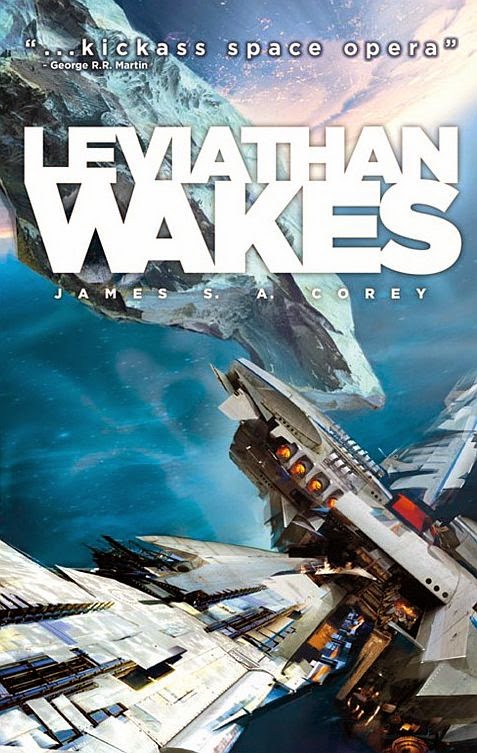
Book Review | Cibola Burn by James S. A. Corey


The gates have opened the way to a thousand new worlds and the rush to colonise has begun. Settlers looking for a new life stream out from humanity's home planets. Illus, the first human colony on this vast new frontier, is being born in blood and fire.

Independent settlers stand against the overwhelming power of a corporate colony ship with only their determination, courage and the skills learned in the long wars of home. Innocent scientists are slaughtered as they try to survey a new and alien world.


James Holden and the crew of his one small ship are sent to make peace in the midst of war and sense in the heart of chaos. But the more he looks at it, the more Holden thinks the mission was meant to fail.


And the whispers of a dead man remind him that the great galactic civilisation which once stood on this land is gone. And that something killed them.


***

In the aftermath of the announcement of SyFy's adaptation of The Expanse, interest in the series has reached fever pitch in recent weeks—interest which Cibola Burn is apt to satisfy. It's another solid installment of the ongoing blockbuster space opera, but the most focused narrative in the saga so far lacks, alas, the scope of the other stories James S. A. Corey has told, and character-wise, it's a mixed bag at best.

The embiggening of The Expanse intimated in Abaddon's Gate does seem set to continue in Cibola Burn, which begins several years since the revelation of the Ring: a great alien gate linking the Sol system to an expanse of space formerly far beyond people's reach. The OPA is holding it down at the moment, supposedly so that surveys into the area's safety can be conducted without disruption, but precious few forces have faith in its explanation, particularly given that a bunch of Belters have already settled the nearest habitable planet—the same planet that representatives of the UN have been commissioned to colonise.

That's where things start to fall apart.
The new sun was a faint dot of yellow-white light, not all that different from Sol when viewed from the Ring sitting just outside Uranus' orbit. It had five rocky inner planets, one massive gas giant, and a number of dwarf planets in orbits even farther out than the Ring. The fourth inner planet, sitting smack dab in the middle of the Goldilocks Zone, was Ilus. New Terra. Bering Survey Four. RCE charter 24771912-F23. Whatever you wanted to call it. 
All those names were too simple for what it really was: mankind's first home around an alien star. (pp.71-72)
But lest we forget our history lessons, where humanity goes, conflict follows, and it's no different on Ilus. There are tensions between the Belter settlers and the scientists and soldiers of RCE before the latter party have even arrived. Believing they're about to be evicted—as well they will be if Security Chief Murtry, a cold-blooded monster of a man, has his way—and remember: he represents Earth—a ragtag resistance arises amongst the planet's established inhabitants.

Basia, one of the three new perspectives presented in Cibola Burn, is a displaced family man ready to fight for what's right, however his actions are viewed by others as atrocities. Eventually, he comes to question them himself, particularly the part he plays in blowing up the first RCE shuttle to touch down on terra firma, killing half of its passengers in the process. In retaliation, the rest—massed by would-be martyr Murtry—slaughter some suspicious settlers.

In no time at all, Ilus is as a powder keg about to blow, and to make matters worse, everyone's watching. To wit, what happens here has to matter, so the various powers in play promise a mediator; someone so self-righteous and set in his ways that he may be able to defuse the spiralling situation somehow.
Everyone hates him equally, so we can argue he's impartial. He's got ties to you, Mars, me. He's a fucking awful choice for a diplomatic mission, so it makes him perfect. Brief him, tell him the UN will pay for his time at double the usual rates, and get him on New Terra as fast as possible before this thing gets fucked up any worse than it already is. (p.45)
This from the foul mouth of the fantastic Avasarala, who returns in Cibola Burn—alongside a few other familiar faces—albeit briefly. No prizes for guessing that she's referring, here, to our hero, Holden:
At the beginning of the war between Mars and the Belt, he had been the most important man in the solar system, and the celebrity, while it had waxed and waned over the years, had never gone away. James Holden was an icon. For some, he was the symbol of the triumph of the single ship over governments and corporations. For others, he was an agent of chaos who started wars and threatened stability in the name of ideological purity. But whatever people thought he meant, there was no question that he was important. He was the man who'd saved Earth from the protomolecule. He was the man who'd brought down Mao-Kwikowski. Who'd made first contact with the alien artifact and opened the gates that led to a thousand different worlds. (pp.132-133)
He didn't do it alone, of course, and as ever, accompanying Holden on the refitted Rocinante's trip to Ilus is its pilot, Alex; the XO, Naomi; the muscular mechanic Amos; and oh, Detective Miller's ghost:
Miller's ghost was an artifact of the alien technology that had created the gates and a dead man. It had been following Holden around for the two years since they'd deactivated the Ring Station. It spent its time demanding, asking, and cajoling Holden to go through the newly opened gates to begin its investigation on the planets beyond them. The fact that Miller could only appear to Holden when he was alone—and on a ship the size of the Rocinante, he was almost never alone—had kept him sane. (p.41)
The detective's spectre proves particularly pivotal in Cibola Burn's electrifying finale, such that it's surprising his presence is so underplayed in the remainder—and I'm afraid most of the narrative's returning characters are similarly short-changed. The crew of the Rocinante, up to and including Holden, are reduced to little more than roles—the better to pave the way, presumably, for the problematic new perspectives Corey is determined to develop.

Basia, at least, has an active part in the narrative, but in addition to him, we have Havelock—a sort of soldier of fortune on another of the ships in orbit around Ilus—and Elvi, a scientist who survives the shuttle crash at the start of the narrative, and sets about studying this strange, alien place. The need for these perspectives is revealed eventually, and there is indeed a need, but for the first half of the whole they serve no particular purpose.

Instead, Corey lumbers them with lacklustre subplots: Havelock trains up some surplus engineers in the ways of war—because there's nothing better for him to do, in truth—whilst Elvi nurses a crush on Holden that has her weak at the knees whenever they meet; a distraction which I dare say rubbed me the wrong way, though your mileage may vary.

Both characters come into their own around the midpoint of the novel, but largely because of all this needless narrative, Cibola Burn is singularly slow to start. The stinger is in the middle, when the previously peaceful planet comes alive, and everything goes in orbit goes to pot—and the action, when it happens, is spectacular. There are explosive set-pieces in space; and on Ilus itself, an unnatural catastrophe gives the colourless cast a kick up the arse. There is, to be clear, half of a hell of a novel here, with all the wit and wonder that's made The Expanse such a pleasure in the past, but the most remarkable aspect of the other half is all that is lacks.

Strange to think that Holden and his will be seen onscreen in all probability before the launch of the next novel, Nemesis Games. Safe bet I'll be there, in both cases, but not because of Cibola Burn, which is easily the weakest of Corey's space operas to date.

***

Cibola Burn
by James S. A. Corey

UK & US Publication: June 2014, Orbit

Buy this book from
Amazon.co.uk / Amazon.com
The Book Depository

Or get the Kindle edition

Recommended and Related Reading

Wednesday, 18 June 2014

The Scotsman Abroad | Rise of the Franchise

I don't know what it is about these things, but every time the fine folks at SF Signal ask me to take part in a Mind Meld, I end up banging on about Batman.


I guess I've got a decent excuse this afternoon. Here's the question James Aquilone posed to the panel:
DC reportedly has at least seven movies in development. Marvel has movies planned out to 2028. Star Wars kicks off a new trilogy next year and has at least two spinoffs already in development. Then there are the upcoming TV shows—Gotham, The Flash, Agent Carter, Daredevil... 
Is this too much of a good thing? Or a dream come true? Do you ever get sick of the constant movie news updates? What are your thoughts about the recent influx of shows and movies from these big franchises?
I took this open-ended question as an opportunity to talk about original ideas as opposed to established IP... albeit by way of franchise fatigue, finance, the overabundance of quality entertainment available to us today, and the forthcoming police procedural featuring baby Bruce:
Ideas are easy. If all it took to make a movie or greenlight a TV series was an awesome concept, we’d all be multimedia moguls, made of money—money we could pour into more original intellectual property, perhaps. But banking on original characters and shiny new narratives is, in the industry today, a dodgy bet at best. Better by far, financially, to latch on to an established franchise, which comes with interest built in; with a fanbase gagging to evangelise a few of their favourite things.
As I mentioned in the last Mind Mind I was asked to be a part of, I’m a longstanding Batman fan, so I’ll be watching Gotham in the autumn—for long enough, at least, to see if it’s for me. Would I if it lacked those connections? It’s not likely, no.
I love new experiences, in theory. In practice, alas, I’m more prepared to spend my minutes and my and my monies if I can try before I buy. So if there’s a problem, and I think there is, then I’m a part of it. I imagine most of us are. But we haven’t done anything wrong, really... or else, that’s what I tell myself.
Read the rest of my ramble right here, along with answers from a selection of other irregulars, including Douglas Cohen, Abby Goldsmith, Deanna Knippling, Derek Johnson, Lisa McCurrach, Melanie R. Meadors and Paul Cornell.