Showing posts with label digressions. Show all posts

Thursday, 18 December 2014

But I Digress | Baby's First Audiobook

Confession time, folks: I'd never listened to an audiobook from beginning to end till 2014. Till this autumn, even.

In my defence, I had tried at various points in the past... but the time I have to spend simply listening is limited. Plus I suck at it, utterly: I have restless hands, so to listen to something I have to be doing something else at the same time. The dishes, for instance. Or driving. 

But I only do so many dishes; I only drive so far.

And there are things I listen to as often as possible. I've been a podcast fan for many years, as long-time TSS readers will recall, so between the Bombcast, Idle Thumbs, Rocket Talk, and the Skiffy and Fanty Show, there's been, before now, more than enough to keep my ears occupied—and I haven't even mentioned BBC Radio 4! There's always something fascinating on there, so on those rare occasions when my podcast supply ran dry, I tended to tune into Woman's Hour or whatnot.

But my circumstances, of late, have changed. Since the Summer I've been commuting to and from work—whihc is an hour and change away—twice a week. Then, sometime in September, the radio in my car broke, and no-one that I've taken it to in subsequent months has been able to identify why.

I ran out of podcasts stored on my phone pretty much immediately, and whilst I did waste an age looking for a few new ones, I came to my senses eventually. I tried streaming some radio, too, but I have a silly small data allowance, and I realised this was going to cost me a small fortune. 

So I bought myself an audiobook. More Fool Me by Stephen Fry, and read by said. He hasn't come up often on The Speculative Scotsman at bottom because he isn't either of those things—speculative or Scottish—but I'm a huge fan of the man, and I'd enjoyed the bits of his autobiography he shared at his live book launch.

More Fool Me lasted me a couple of weeks, and though I had significant problems with it as an autobigraphy—it's repetitive, incomplete and unbelievably brief—to my surprise, I enjoyed the experience of hearing it hugely.

So I doubled down when, all too quickly, it was finished: I bought the audiobook of Words of Radiance by Brandon Sanderson, which I'd been meaning to read since its release.

It's proven to be a completely different experience from More Fool Me. In the first instance, one of the two speakers reads his chapters with such bombast that his voice has been hard to get past. Other problems: this audiobook is fifty-odd hours in full, with long-ass chapters and few suitable stopping points. As such, I frequently find myself flabberghasted by the narrative, picking up as I must in the middle of a chapter. 

I've gone from one extreme to the other, I fear, and so you see: baby's first audiobook may well be baby's last... unless you lend a helping hand.

What I want from an audiobook, it seems, is something accessible. Sometimes that dovetails with my tastes. Something not too long overall, and read without the intrusion that's ruined (the audiobook of) Words of Radiance for me.

Recommend a friend?

Thursday, 22 May 2014

But I Digress | Orbit Angers Fans

Orbit has been riding high recently. As an imprint of the Little, Brown Book Group, it was named publisher of the year at The Bookseller Awards, and a number of the novels it published in 2013 have been nominated for something of a smorgasbord of genre honours. Most notably, Ancillary Justice by Ann Leckie has won a slew of said already, including the Arthur C. Clarke Award and the British Science Fiction Association’s Award for Best Novel. It’s also up for a Locus, and a Hugo, too.


And here’s where the situation gets iffy. Last week, you see, Orbit released a statement saying that they wouldn’t be giving away thousands of copies of three of their books for free this year, and people on the internet got a little pissy.

But let’s start at the start, with the press release that explained the imprint’s decision to include in the Hugo Voters Packet extended extracts of the nominated novels—namely Parasite by Mira Grant, Ancillary Justice by Ann Leckie and Neptune’s Brood by Charles Stross—as opposed to electronic editions of the texts in their entirety:
We are of course very much in favour of initiatives that help readers to engage with important awards, and we are always looking for new ways to help readers discover new authors. However, in the case of the voter packets, authors and rights holders are increasingly feeling that if their work is not included in the packet it will be at a disadvantage in the awards. It’s difficult for anyone to know for certain whether this is the case, but either way we don’t feel that authors and rights holders should feel under pressure to make their work available for free. There are a lot of different attitudes to the idea of giving work away for free, but we hope most people would agree that writers and rights holders should be able to make their own choice, without feeling that their decision might have negative consequences.  
We would like to make it clear that this was our decision, and not one requested by any of our authors. It is a complex issue, with many different perspectives and opinions, and we believe that we are acting in the best interests of our authors while continuing to support the voter packet.
Orbit can’t have expected this "complex issue" to gather the negative momentum it has, however. More than fifty comments followed the blog post above, many of which we might politely describe as declarations of outrage. Boycotts have been plotted; Orbit has been called any number of names; and several of its employees have been singled out on social media.

Which is to say—and I hope we can agree here—the situation’s gotten rather out of hand, hasn’t it? Because whether or not Orbit’s decision to include excerpts rather than entire texts was the right one, at the end of the day, this is not how a community which we all wish the wider world would treat seriously behaves.

To be clear, I’m also disappointed in Orbit’s decision. It stinks of business. But it is what it is—a perspective reflected by the three authors implicated in the publisher’s policy, who put out the following open letter together:
It has become customary in recent years for authors of Hugo-nominated works to provide the members of the World Science Fiction convention who get to vote for the awards with electronic copies of their stories. The ball started rolling a few years ago when John Scalzi kindly took the initiative in preparing the first Hugo voters packet; since then it has become almost mandatory to distribute shortlisted works this way. 
Unfortunately, as professionally published authors, we can't do this without obtaining the consent of our publishers. We are bound by contracts that give our publishers the exclusive rights to distribute our books: so we sought their permission first. 
This year, Orbit—the publisher of Mira Grant's Parasite, Ann Leckie's Ancillary Justice, and Charles Stross' Neptune's Brood—have decided that for policy reasons they can't permit the shortlisted novels to be distributed for free in their entirety. Instead, substantial extracts from the books will be included in the Hugo Voters Packet. 
We feel your disappointment keenly and regret any misunderstandings that may have arisen about the availability of our work to Hugo voters, but we are bound by the terms of our publishing contracts. The decision to give away free copies of our novels is simply not ours to take. However, we are discussing the matter with other interested parties, and working towards finding a solution that will satisfy the needs of the WSFS voters and our publishers in future years. 
Finally, please do not pester our editors: the decision was taken above their level.
At the very least, let’s take that last statement seriously—and please, leave off the authors also.


So what now? Well, we’ll have to wait and see. The backlash has been bad enough that Orbit could conceivably admit their mistake and put aside a policy that is undoubtedly detrimental... though I dare say the damage is done.

And not just to Orbit’s image; the fact is that this negativity is apt to have an impact on the three awesome genre novels nominated in the first for a Hugo Award—and that’s not just right, readers. Agreed?

Thursday, 13 February 2014

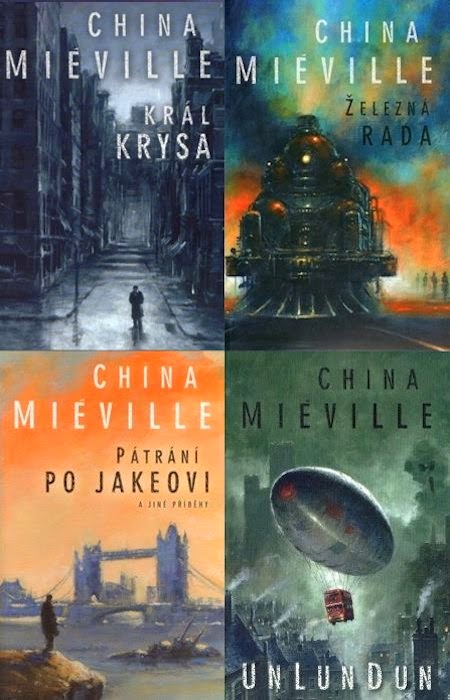
Cover Identity | Edward Miller's Mieville

As longtime readers of The Speculative Scotsman will be well aware, China Mieville is one of my very favourite authors, and The Scar is far and away my favourite of his exquisite fictions. But there was a time when I hadn't a clue that this book existed—that this was an author I'd be interested in.

I still remember the moment I became aware of both.

It was 2002. I was eighteen years old. Coraline was on the cusp of coming out and I'd gallavanted to Glasgow to hear Neil Gaiman read a bit of his new book. The event was held in Ottakars, as I recall. I miss Ottakars...

Anyway, whilst waiting in line to meet the man, I spent quite a bit of time admiring the Science Fiction & Fantasy section of the store. Mostly I could see spines, but a few of the books were faced out, the better to attract the attention of eejits like me.


My eye was drawn to a little book called Perdido Street Station in particular. The cover art was extraordinary, I thought. Weird and wonderful. That said, even then I knew not to judge a book by its cover, so I made a mental note to read a bit about the book when I could.

Weeks passed—months, even—before I took the plunge and bought a copy alongside what has become one of my most prized possessions: a first edition hardcover of The Scar. Both books had incredible covers by a man called Edward Miller (aka Les Edwards), and if I'm honest, I don't know that I'd have discovered China Mieville—certainly not so early on—were it not for his lavish art.

Tor have long since dispensed with Miller's services, I'm sorry to say, in favour of the icons that adorn the award-winning author's back catalogue today. But whilst researching some stories for this week's edition of the British Genre Fiction Focus, I came across a blog called Out There Books, and on that blog, a post about the Czech cover art of Mieville's ten texts to date. 

Evidently, Edward Miller has been keeping busy. Feast your eyes on these, readers!


A thousand thanks to Tom for alerting me to these Mieville-related paintings. They've made me a very happy man... albeit rather nostalgic.

Oh, the good old days, eh? 

Monday, 15 July 2013

But I Digress | Guilt by Amazon Association

I dare say everyone will be talking about the J. K. Rowling reveal today—I certainly will in Wednesday's edition of the British Genre Fiction Focus—but I wanted to take this time to talk about a topic that didn't quite make it into the column.

In a recent blog post for The Bookseller, you see, Keith Smith had a bit of a righteous rant about how certain authors—including Joanne Harris, Julia Donaldson, Alison Weir, Ian Rankin, Kate Morton and Patrick Ness—seemed to back Amazon and various other chain retailers despite having vouchsafed their support for smaller stores. For instance his:
“As someone who owns two independent bookshops I feel angry that these authors, unthinkingly or by design, have chosen to support Amazon, W H Smith or Waterstones without giving a fig for independent bookshops. Many of these are authors who, when asked, will say they couldn’t imagine life without their local bookshop. But words need to be matched by deeds if they are to make a difference.”
In principle, I agree with this part of Smith’s argument entirely—and so, it seems, do many of the authors he specifically took to task.

But Smith draws a hard line later in the originating article that I can’t quite get behind, by insisting that “the Booksellers Association should contact all authors immediately and ask them to stop supporting Amazon directly.”

Which strikes me, at least, as rather tyrannical. And a number of authors responded to Smith’s comments in kind. Alison Weir, for one:
“Linking to Amazon does not mean that I do not support independents. [...] The fact remains that publishers can shift large quantities of books through Amazon, W H Smith, Waterstones and the supermarkets, which are their main clients. Amazon also pays authors on their associates programme fees based on the number of books sold. Authors do have a living to make and Amazon can provide a great source of income which, sadly, independent book shops could not possibly meet. I understand the concerns of independent booksellers, and I think that there is a case to be made for Amazon to pay corporation tax, so that there would be fairer parity between its prices and those which independents with overheads have to charge. But accusing authors like me [...] of not 'giving a fig' for independents is not only ignorant but untrue; I think my deeds over the years give substance to my words."
Here’s Diana Kimpton, co-creator of the Pony-mad Princess picture books, speaking by way of The Bookseller again:
“I sympathise with small independent bookshops struggling through a recession, but authors are struggling too. Only a few get the high advances mentioned in the press. The rest earn much less, and many don't even get the equivalent of the minimum wage. As a result, the fact that the Amazon Associate scheme pays commission on sales resulting from links is very important. Because I have to split the royalty on my picture books with the illustrator, I actually earn more from the Amazon commission on a sale than I do from the publisher.”
Ultimately, I think Smith’s anger is a mite misplaced. Though it’s certainly the case that authors should be squarely behind independent booksellers, let’s face it: these days, most books are bought from the bigger names in the business, and to simply sever a supplementary source of income because Amazon and its ilk are, you know, completely evil, seems... well, selfish.

Let me be clear here. I sympathise with the plight of independent booksellers, but to ask for authors to support said stores solely goes against the real issue here: our right to choose where and from whom we buy our books. Why deny readers that? That they’re buying literature to begin with is, I think, the most important thing.

In one respect, then, Keith Smith is spot-on: authors should be seen to support choice.

But so should he, surely.

Friday, 5 July 2013

Trailer Trash | The Walking Dead Summer Special

Well, I know what I'm going to be doing this weekend.


You guys too?

400 Days is apparently a bridge between seasons one and two of Telltale's take on The Walking Dead. You'll recall that the phenomenal first season won any number of game of the year awards, including mine, and though this special standalone episode doesn't look to follow it directly, given the creative team's talent for character building — and for fashioning fascinating narrative out of a milieu which is, if we're honest, a lot like hundreds of others — I expect nothing less than excellence from 400 Days.

Incidentally, it occurs to me that the Microsoft Points card I bought to purchase this DLC with will probably be the last Microsoft Points card I ever have to buy. In part because the company are going with real money for marketplace transactions on the Xbox One, but largely because I'm still on Sony's side — never mind Microsoft's dramatic back-tracking after this year's E3. By then they'd made it crystal clear where there loyalties lay, which is to say, nowhere near me... or any other consumers, in truth.

I've pre-ordered a PS4, obviously. Knowing my proclivities, I'll probably cave and get an Xbox One eventually, but only once I'm sure Microsoft aren't planning to pull a fast one with DRM delivered via dashboard update or some similarly insidious bait-and-switch.

Either way, I won't miss Microsoft Points.

Tuesday, 14 May 2013

But I Digress | The Life and Death of Dial H

Regular readers will recall that I came back to comic books a couple of years ago, after entirely abandoning what had become a bad habit at best: a pull list of single issues that broke the bank each and every week, and hardly interested me beyond satisfying my not-so-secret completionist streak.

It was something I needed to do, in truth, but I realised, relatively recently, that I'd thrown the baby out with the bathwater; that I'd gotten shot of a bunch of good comics along with all the bad books that had driven me away from the form in the first place. So I resolved to give the whole rigmarole another go.

And I'm glad I did. I'm glad because I've read some stonking good comic books since I made the decision discussed above. Denise Mina and Andy Diggle have hooked me on Hellblazer; I'm midway through Y: The Last Man, and it's getting better and better; Global Frequency was a bunch of fun; American Vampire and The Unwritten are pretty brilliant; and I enjoy a bunch of the Batman books.


But as it happens, everyone isn't a winner, so of course I've read some utter rubbish in the interim. I won't name names.

In any case, Dial H. As a devout scholar of the school of Mieville, Dial H excited me immensely. I followed the news of its conception and development with baited breath. Though I tend to consume my comics as and when they're collected, I bought the first issue as soon as I could.

On reflection, that wasn't the best introduction to what is a rather byzantine book. Afterwards, I resolved to wait for the first trade, to give Dial H a proper second shot. Into You finally came out in April, and I had a bit of fun with it, I admit. But on the whole? I'd have to say no. Or else, not yet.

I'll read the next collection when it's published, I guess — I do like to see a thing through, and knowing Mieville the book will get better as it goes — but if I'm honest, yesterday's news, that Dial H had been cancelled, was rather a relief. I'm truly sorry that the audience wasn't interested in something so different and ambitious, but let's face it: Mieville didn't make it easy. I've read almost everything he's written, and even I had a hard time figuring out whether or not Dial H was decent.


On the one hand, it's a shame that Dial H didn't work out. On the other — the glass half full hand — this frees up the esteemed author to refocus on the prose fiction I fell for in the first place, because I don't think it's a coincidence that this is the first year since 2008 that he hasn't published a new novel.

So roll on news of whatever Mieville's been working on since the release of Railsea. I still hold out hope that he'll go back to Bas-Lag, but I'll take whatever I can get... up to and including the second Dial H trade. In my heart of hearts, however, I can't help but feel relieved rather than bereaved by this news.

Is that mean-spirited of me?

Have you ever been perversely pleased to see something end, and if so, when?

Thursday, 9 May 2013

But I Digress | The Limits of Cinema

It's been a while since I blogged about movies.

Truth be told, though, it's been a while since I saw anything particularly interesting.

When I was a much younger man, I'd watch a movie every night, almost without exception. Admittedly, a lot of the movies I watched during these grass-is-greener years were utter rubbish... but I knew that, even then. To an extent, I revelled in it, because I was also aware that I was living through a period of unequalled freedom; that it would be a long, long time before I had so many hours to spend on nothing of note.

That's very much the case these days, I'm afraid. 

When the opportunity to sit down with a film presents itself, the first thought that crosses my one track mind is: That's however many hours I could spend reading the next book in the review queue! And all too often, my nasty adult brain baulks at the prospect. Invariably, I end up doing something responsible instead. Mowing the lawn or preparing a class or rewriting a review.

I do realise that going to the cinema isn't in itself an irresponsible act, but I do feel like a negligent person when I follow my heart instead of my head. And perhaps that's played into my feelings about the occasional films I have seen this year. I thought Cloud Atlas would be awesome. It wasn't. Ambitious, absolutely, but really rather flat. Mama, meanwhile, is a singularly silly film.

I can't even remember what else there was.

These are films I would have watched quite happily when I was a smaller Scotsman. Enjoyed, even. Today, they feel like a waste. Of my time, which obviously there's less of than there was then.

I'm getting old, I guess.

On the other hand, I realise how self-fulfilling my attitude to movies at the moment is. If I won't give a film the time of day, then of course I won't see one that changes my mind. So for the last little while, I've been on the hunt for something extraordinary.

Today, I have likely candidate, the poster of which was recently released:


Fingers crossed it doesn't disappoint!

Not unrelatedly, I've just ordered a copy of Upstream ColorPrimer blew my mind back in the day, and though I don't expect that of this, something reminiscent is all I really need. A reminder that cinema can be as profound and affecting as the best written fiction.

Because it can, can't it?

Friday, 1 March 2013

But I Digress | On What Bookish Begot

Does the world need yet another website about books?


But before you lose interest entirely, it's actually quite clever. I told Bookish about my thing for China Mieville; it recommended I read Jeff VanderMeer. I fed it Tigana; Bookish responded with Tad Williams and Steven Erikson.


(Also Robin Hobb. Which makes me wonder if I should really be reading Robin Hobb. Thoughts?)

And all this while the engine's still in beta!

If the truth be told, though, I'm probably not in need of new books to read, and if I were, I'd really rather follow in the footsteps of a friend, or place my trust in one of the community's more reliable reviewers. But there are those, of course, without these fantastic facilities; without peers who share their interests, or absent access to (or tolerance for) certain social media.

And for those folks, Bookish could be brilliant.

If Twitter's any indication, however, news of the new resource has been met with a resounding meh. Why? I've heard the lack of user-generated content cited as a particularly singular reason why Bookish is irrelevant, or just utter rubbish. But even at this early stage, users can submit quotes, reviews, and I don't know what else.

Why the single-minded emphasis on user-generated content anyway? I appreciate the added value such integration represents at the best of times, but the cranky old man in me can't help but wonder, when are those? Where are those? In my experience of social media, opening the doors to all comers makes for a mixed bag of good and bad.

What's the problem with old-fashioned curated content anyway? Why does everything need to be about everyone?

Basically, why the hate for Bookish?


Does every medium have to be social to survive in this day and age? Let's face it: nothing is likely to supplant Facebook at this stage, so why risk ruining a good thing trying to put in hooks for users who won't care anyway?

But let's circle back to the first question I posed in this post: does the world need yet another website about books? Well no, of course not. But what's the harm in it, exactly? Indeed, when has the internet, and social media especially, ever been about need?

Thursday, 21 February 2013

But I Digress | Super Kindle 64


Who would have thunk it?

Well, everyone, obviously. Its existence was the worst kept secret in the gaming industry since... actually, I'm struggling to come up with an apposite example. This isn't an industry known for its grace or patience, after all; like a squabble in the schoolyard, if there's something going on, potential spectators are alerted as if by osmosis, or some telepathic process. Hence all the NDAs. And the elaborately coordinated PR campaigns.

But that's not what I want to talk about today. Rather than the announcement of the PS4 itself—which, for what it's worth, I'll buy if or else when the price is right—I want to use the immediate reaction to the would-be huge news as a jumping off point for discussion. Because the sentiment I heard, overwhelmingly, before, during and after Sony's shindig, was... so what?


Let me be clear: I disagree. I believe there's a real need for updated hardware. Try playing Far Cry 3 on a modern PC and you'll see what I mean. It's hard to go back, so I'm all for forward. But let's not kid around: there has never been a less significant jump between one generation and the next, nor a longer period between revisions than this one. What are we to understand from that if not the fact that the console cycle, as we know it, is coming to a close?

If you're wondering what all this could have to do with the publishing industry, simply consider the e-book reader, or the tablet that serves as such. Kindles and iPads are platforms built on technology too. And each time their hardware is revised, these devices grow ever closer to the endpoint the PS4 arguably represents. 

To make matters worse, there are new e-book readers every year—at least—so we're approaching the zenith of technology far quicker than the gaming industry did.

There will come a time, I put to you, when there will be no point in upgrading your Kindle or iPad. When our e-book readers will do everything we want them to do, and more, as well as we might like, and better. Beyond that, the only improvements will be superficial.


And I want to know what that device looks like. What's the ultimate feature set for e-book readers? And how very different could reading e-books possibly be from the experience we can have today?

Even then, what could possibly be better than the tactile pleasure of a physical edition, or the satisfaction of filing it away in your library?

Give me a foldable, flexible OLED screen that can read books to me out loud, with some sort of dynamic Last Time On the thing I've been reading functionality—for when I forget what's going on—and subscription-based access to a collaborative library of literature that isn't fragmented or just fucked in the way certain services are today. Maybe then I'll be moved to buy your device.

I don't ask for a lot, do I? :)

Wednesday, 6 February 2013

But I Digress | Niall no Kuni

It's hard to say whether or not the Japanese RPG has any place in the gaming industry today. 

In the nineties they were the in thing, and in the naughties they got bigger, better-looking, and somewhat more modern—albeit alongside every other genre that joined the HD generation. Yet despite massive investment and a fever pitch of interest, the JRPG simply couldn't keep up with the major new players in gaming, to the point that within weeks of its release, the last Final Fantasy vanished with nary a trace it had ever even existed. And let face it: there is no bigger name in the game than Final Fantasy.

Never one to learn its lesson, however, Square Enix is set to unleash a second sequel to Final Fantasy XIII this year. And who knows? Maybe the third time's the charm. But I doubt it. And speaking personally, I could care less. Not once but twice I got around 20 hours into Lightning's life, only to lose interest lest I lost the will to live entirely.


Granted, my interest in the genre had been flagging beforehand. And it's continued to do so since: the only JRPG I played in 2012 was Tales of Graces f, and again, I got about 20 hours in, looked at a FAQ to see how much more game I still had to play... and admitted defeat. I watched the end of the affair on YouTube. And I don't feel like I lost out on anything.

Be that as it may, I'm not quite ready to give up the ghost on the entire genre. I have at least one more attempt in me before I sign off once and for all: namely Ni no Kuni.

I've been holding out hope for this rare collaboration between Level 5 and Studio Ghibli (of Spirited Away fame—the very same!) since it was announced in 2008, and the copy I pre-ordered way back when finally arrived on Saturday. Despite having a hundred other things to do, I fed it to my PS3 immediately.

I'm 10 hours in already, and over the moon that I can say the time has flown by so far. So maybe Ni no Kuni is the game which makes the genre meaningful to me again. Or perhaps 10 hours from now I'll hit a wall that leaves me with no other option than to grind my life away, or give up on the JRPG after all. 

I so hope it doesn't come to that. I feel like I'd be killing a large part of the kid I once was, and I believe it's important to stay in touch—to a certain extent—with the things we loved when we were young.


I'll report back on my progress through Ni no Kuni even if I don't make much more. Why, if I finish the thing, and there's interest, I might even review it!

But for the moment, the floor is yours, folks. Do you think the JRPG has a place in the gaming landscape of today, or it is as long in the tooth as I suggested earlier? Does the prospect of Lightning's return in Final Fantasy XII-3 excite anyone at all?

And if any of you have been playing Ni no Kuni, I'd love to hear your thoughts on it. Do tell, too, if for whatever reason you've opted not to.

Monday, 28 January 2013

But I Digress | The Many-Coloured Covers, or, Me and Mrs May

Whilst assembling the first edition of the British Genre Fiction Focus for Tor.com, I found myself looking for something to read — a rare occasion indeed — and for various reasons, the recent reissue of The Many-Coloured Land caught my eye.

Now I've been vaguely aware of Julian May for all my adult life. Though my mum doesn't read much these days, when she did, The Saga of the Exiles was one of her favourite series. She still recalls it fondly.

But I always was one to go my own way. Even as a babe. So though I read A Wizard of Earthsea on her say-so, and adored it, and though the various other books she recommended me in my younger years were very probably responsible for my abiding speculative fiction fixation, The Many-Coloured Land lay unloved on its shelf in the study.

A couple of weeks ago, I finally righted my wrong. I read through The Many-Coloured Land in a couple of pretty serious sittings, and I see now that I should have done so years ago. But better late than never, eh?

It was nice to have a shared experience to discuss with my mum, for one. And she was a proper font of knowledge about the series when I asked her about it over the weekend.

To begin with, I didn't realise that Julian May was a woman. I don't think that fact would have altered the odds of me reading these novels then or now... all the same, I feel an utter idiot.

Whilst visiting, I also took a look at the much-loved copies of the quartet my mum has had since the early 80s. Here's a quick comparison of covers adorning those versus this recent reissue:


I know which artwork I'd rather have! Are you with me?

Then again, if The Saga of the Exiles hadn't been re-released — never mind the Game of Thrones-esque imagery — I doubt I'd have looked twice at it. As is, I'm greatly anticipating the next time I have a few days to spare, because I can't get started on The Golden Torc soon enough.

So. Lesson learned. Digression end.

Except to say: hey, are there any other massive Julian May fans out there?

Thursday, 29 November 2012

On Blogging | Graeme's Fantasy Book Review, I Salute You!

Blogs come and blogs go. The longer you do this thing, the clearer that sad fact appears. But the great and the good live on in our hearts and our minds, even after they're long gone. I often find myself thinking fondly of Floor-to-Ceiling Books, for instance, amongst myriad others.

But of all the blogs I've followed, and of all the friends I've made since becoming a part of this literary lark, good sir Graeme Flory and his absolutely fabulous Fantasy Book Review may have impressed the most lasting mark upon me — and The Speculative Scotsman as well. Never mind for the moment how prolific Graeme was as a blogger, how funny and insightful and kind in his writing and in real life: he taught zombies and honesty, and he taught them better than anyone else. 

So it's with sorrow in my otherwise impenetrable Scotch soul that I must inform you of the end of an era. Graeme's Fantasy Book Review closed its doors early yesterday... and I suddenly felt frightfully lonely.

Here's Graeme's explanation:
It's been a little while coming but it's time to bring this blog to a close. Obviously there are a whole load of reasons (none of them particularly interesting to you guys) but the bottom line is that I'm not really enjoying it anymore and that means that it's time to stop. That's not to say that I won't come back, in the future, and start something up again; just not here. I've got some ideas but I just want to stop and chill out for a while.
[...] 
It's been a amazing experience but you have to know when it's time to stop. It's time to stop :o)
In the final comments section, there's already been an outpouring of support for one of the very best bloggers there ever was, or ever will be. but if you haven't yet added your two cents to the discussion, I urge you: please do.

Luckily, we only have to say goodbye to a blog. Though I seem to have written an obituary - what can I say? I'm sad - Graeme himself is still well and truly with us, and I'd bet my last penny that we'll be hearing from him again... perhaps in some other capacity... and fingers firmly crossed, sooner rather than later.

In the meantime, you can harass the man on Twitter @graemesfantasyb.

In fact, could someone perhaps ask him who in holy hell will review all the zombie novels ever now?

Not it! :P

Monday, 26 November 2012

I Tube | An Act of Faith: Alan Moore and I

It's been some time since Alan Moore really, truly moved me.

Don't misunderstand me: I admire the man in many senses. He has a pretty brilliant beard, and his work ain't too shabby either. But when in readiness for the three Century singles I went back to the beginning of The League of Extraordinary Gentlemen, I got no further than The Black Dossier, which so bored me that I started skipping entire sections.

I can hardly express how utterly unlike me that is. For better or for worse, when I read something, I read it deliberately. I do not gloss; I don't know how to. But The Black Dossier's endless academic digressions drove me to distraction, so when I finally finished it, I was in no hurry to move on to the next volume. I haven't touched a single Century since, and it's been at least a year.

But now, between Moore's bravura introduction to The Vorrh - which I recently reviewed for Tor - and Antony Johnston's excellent adaptation of his screenplay Fashion Beast for Avatar Press, I find myself game for a touch more Moore. A quick Wiki says his next thing is The Moon and the Serpent Bumper Book of Magic, which sounds pretty terrific, but between now and whenever that graphic novel surfaces, he's written a short film.

Jimmy's End itself isn't out yet, but Act of Faith is. Intended to act as a curtain-raiser to the main event, in the great tradition Pixar brought back, it "unveils an isolated corner of the modern night, where carrion crows become the only comforters and it's a quarter to eternity."

I should stress that this description, lifted from the official site, is pure silliness. Instead, Act of Faith is a twisted 15 minute film about sex and suicide, starring a single actress and set in a single small space.

I'm going to say it's not safe for work. But if that's where you are at the moment, I'd urge you to save the link for later.

Otherwise, have at it immediately, please:


Well, what did you think?

Admittedly, the thing begins rather badly, but beyond the dodgy voice actor playing Faith's father, and the off-kilter camera angles, and the point about belief the short rather rams home, I enjoyed Act of Faith awfully.

Moore's script goes exactly where you expect it to, yet still it surprises; as the central character, Siobhan Hewlett is singularly riveting; overall, the atmosphere is fantastic, in no small part thanks to the soundtrack; and ultimately Mitch Jenkins' direction achieves the very voyeuristic feeling one imagines Moore was working towards. After a few minutes I simply submitted to this film, and Act of Faith's fuck you of a finale paid back my investment with interest.

I had mixed feelings about Alan Moore before this cunning curtain-raiser, but now I'm unbelievably keen to see Jimmy's End myself. I'll aim to alert you all as and when its creators make it available.

In the interim, it'd be great to hear from any other Alan Moore admirers out there. In fact, in my extended absence from the comic book form, I missed a great swathe of his work - other than Fashion Beast and a little of The League, I haven't read anything of his since the halcyon days of America's Best Comics - so I'd be interested to hear what, if anything, I'm missing.

Monday, 19 November 2012

But I Digress | Star Wars Into Darkness

If I see one more article purporting to contain exclusive news about the latest director, actor or other talent NOT involved in Star Wars: Episode VII, I swear I'm going to swear off the internet.


Admittedly I've never been a huge Star Wars fan. For me, it was Star Trek all the way. And though a love for one of the above doesn't necessarily preclude some fondness for the other, I tend to think these things are set in stone when one's stone is still soft — which is to say when you're young.

As a kid, in an odd intermingling of idiocy and innocence, I imagined the people who made Pepsi and Coca-Cola hated one another, and thus, the people who drank one soft drink had nothing to do with the enemy beverage. The same went for Snickers and Mars bars, fast food from McDonalds versus Burger King, and Star Wars vis-a-vis Star Trek.

I was a Coca-Cola kid. I also enjoyed Snickers, McDonalds and Star Trek. I dutifully avoided the other in each of these fields, with sometimes fundamentalist fervour, such that even now I have mixed feelings about Mars bars. Seriously, why no nuts?

In any event, then came the realisation that Star Wars fandom was essentially inextricable from the friends I found myself making, so I gave the original trilogy a shot. I gave it a couple, at that. But each time, I came out of the experience as cold as I'd gone in. The films seemed cartoonish to me. Simplistic, and sometimes silly. 

This is particularly rich coming from a Trekkie, isn't it? Believe you me, I'm well aware!

But back to the matter at hand: feeling my years even at age 11, I concluded that I should have sat down with Star Wars sooner. Because by the time I did, it was too late. I was new to double digits, but still too old for A New Hope.

I felt this way because Star Trek had my heart. There was just no room at the inn for another love. And I dare say it's still fully booked.

So the news of three more Star Wars movies leaves me... unmoved. I don't doubt that this is huge for some of you. But do we really need to blog about the infinite number of directors that don't plan to direct Episode VII? Each and every actor that may or may not return to reprise their roles?

No.

Tell you what, though. Star Trek Into Darkness looks fantastic. :D


I was going to see The Hobbit at the cinema this Christmas one way or the other, but the recent news that the IMAX print of it comes complete with nine minutes of the Star Trek sequel, has me reconsidering my mixed feelings about movies on those massive screens.

So where do you folks fall? Are you die-hard Star Wars fans, or Trekkies like yours truly? More to my meanderings, is there anyone out there who'll swear by both series?

Friday, 26 October 2012

Video Game Review | Resident Evil 6, dev. Capcom


Rarely do reviewers agree on a great deal, particularly in foundling fields such as game journalism, and yet critics from competing sites - typically so desperate to distinguish themselves - have conspired to rip Resident Evil 6 to shreds.

Well, it ain't right. And I'm telling teacher.

Giant Bomb, a resource near and dear to my heart, is one of the biggest bullies: "Resident Evil 6 is a big-budget disaster on the order of the Star Wars prequels, a sprawling production that clearly required so many individual talents to bring it into being, you can't help but wonder how the end result could have turned out so bad."

At least Destructoid's reviewer quantifies his problems: "Listlessly wallowing in the depthless waters of homogeneity, Resident Evil 6 is a coward of a game, afraid to make its own individual mark in the industry and cravenly subscribing itself to every overplayed trope in the book."

Joystiq, meanwhile, are rather more reasoned — and they get bonus points for using appropriate imagery! "Everyone would do well to study its anatomy, to learn what happens to a series stuck somewhere between a new life and an old body."

Get it? Because of zombies? Oh, what wit!

But beyond the wit... bullshit. Because Resident Evil 6 is overwhelmingly alright. It certainly won't be winning any Game of the Year awards, but why would that be the yardstick against which we measure this sprawling sequel? Why not its immediate predecessor? Why not its closest competition? Why not the stale new Silent Hill, or the forthcoming installment of Call of Duty?


Come to that, why compare it with anything? Resident Evil 6 is what it is. And what it is structurally ambitious, narratively novel, graphically gorgeous and extraordinary aurally. It may be mundane mechanically - as throwback and old-fashioned as ever this series has been, despite the efforts of its developer - but it isn't broken, and the notion that it should have been overhauled to feel more modern (which is to say more like every other goddamn game on the market) is counter-intuitive coming from a community that demands diversification on a daily basis.

In any case, Capcom have gone to incredible lengths to make fans of this multifarious franchise happy. In an era when six hour single-player games have become the new normal, it's surprising - shocking almost - that Resident Evil 6 clocks in approximately five times as long. Less so when you realise it's essentially four games in one. In the first, you're Leon, returning from Resident Evil 4 in a campaign that feels a lot like that game's. The second campaign casts you as Chris, Resident Evil 5's protagonist, and it plays similarly: it's more shooter than survival horror.

But the third and the fourth campaigns return to that very territory: the former recalls Resident Evil 3: Nemesis - you're being chased by an unstoppable monster the whole time - and the latter, starring I couldn't possibly tell you who, feels like it's sprung fully formed out of Resident Evil 2, what with the secret player character and all the puzzles she-who-must-not-be-named has got to solve.


Resident Evil 6 is an odd sort of hodgepodge, on the whole: a guided tour through the make-up of the entire series to date, or a forlorn love letter to itself. In that sense, it reminded me - of all things - of Final Fantasy IX. What makes it cohesive, if anything does, is the structure of the story: characters continuously come together as four narratives neatly interweave, and each time the player experiences something a second time it's from a whole other angle, with more or different information.

Admittedly, the controls are iffy. The Quick Time Events around every corner are overbearing. The puzzles are plodding and the shooting is largely unsatisfying. The dialogue is obvious and the tone of the story is all over the place. Resident Evil 6 has a lot of problems... but so did all the other games in the series, and praise was lavished upon these.

So what gives?

Patience, I presume. Critics don't have a great deal of it on good days, and around this time of year, when there are huge new releases to play through and review each and every week, it's obviously in very short supply. But to dismiss this game on those grounds is dishonest. Resident Evil 6 may not be particularly great, but it's not bad either - not like certain ostensibly objective perspectives have suggested - and if you ask me, you've got to give Capcom credit for trying so damned hard.

Monday, 15 October 2012

But I Digress | Reading Rituals

Well, that's it, isn't it? Summer's over.

And winter, of course, is coming. I've felt the frost already, and if you squint into the slate-grey skies, you can nearly see the snow. Hell, if the supermarkets are to be believed, it's a fine time to start thinking about Christmas.

But let's not get quite so far ahead of ourselves!

Let's lament the end of the summer before we start celebrating the beginning of winter.

'Twas a mean season for me, I suppose. I had hoped to take a few weeks away from work over the holidays, but other factors intruded: a death in the family, changing obligations, sudden monetary troubles and so on. All the while the kiddies kept coming in, so I kept showing up to the education centre I teach English at.

As it stands, the plan is to steal off somewhere warm as soon as humanly possible - more on that as the story develops - but I'm running on empty at the moment. Have been since I got back from America in March: coming back from a life-changing experience only to have life kick in immediately will do that, I know now.

It hasn't, however, been doom and gloom all day and night in my little corner of Scotland. The rare sunny days we've had hereabouts have been a huge highlight, because earlier in 2012, I got myself a hobby: I decided the time had come to turn the rampant wilderness I called my back yard into a proper goddamn garden.

Well, it isn't perfect yet - and I don't imagine I'll be able to do much more with it till next spring - but six months of back-breaking, at times bloody labour later, I've got a lawn, a rock garden, and a pretty paved path between the two. A pretty paved path that proved the perfect place to drop a pair of camping chairs and improvise a table.

I have many happy memories of afternoons in my brand new garden this summer. Yes, the weather could have been better, but often enough there was some sun, and whenever there was, I took out my book, and I read.

And I read and I read and I read!

This became rather a habit. A ritual, if you will — which brings me to my point.

Now that I can't go out there, under pain of mild frostbite or a simple soaking, I've had to say goodbye to the garden for the time being. That I can live with. What I've having more trouble overcoming is the loss of the spot I spoke of, where I spent, shall we say, some serious time reading.

I'm a creature of habit, I confess. Most of what I read, I read in bed, immediately before nodding off. I did this all through the summer, in addition to which I had a couple of hours every couple of days with my book in the back yard. Absent that, it's back to burning the midnight oil until some replacement pattern arises, so my reading, recently, has dropped off dramatically.

How I miss my afternoons in the garden! :(

On the bright side, this got me thinking. Am I just an oddity, or do we all have specific spots where we get the bulk of our bookworming done? Places where we can go, or things that we do, to get away from it all, you know?

With so many other things competing for our attention, reading for a protracted period - for me at least - isn't easy these days. Without my camping chair in the garden, I'm having trouble getting through more than a book a week.

So I want to know: what are your reading rituals?

Inspire me, people, please!

Monday, 8 October 2012

But I Digress | Honouring Dishonored

Little people remain the largest market for video games, so you'd think the summer holidays would be packed full of new releases to make the most of a captive audience of kiddies.

But no. This is not the case now, nor has it ever been — more's the pity. Instead, every summer, the industry suffers from what amounts to a drought. Nothing of note happens for a number of months. Summer is the season throughout which I wonder whether it's worth keeping up my subscription to LoveFilm; I replay games as rarely as I reread books, which is to say almost never, so I tend to rent rather than buy outright.

Invariably, though, there's an array of older releases to catch up on that make the holidays tolerable, and to a certain extent gamers have become conditioned to this period of listlessness. We look to downloadable titles for quick fixes. We go back to Battlefield 3 or some other multiplayer game, or revisit a few single-player favourites.

But mostly... we wait. We wait for the flood of new releases unleashed every autumn. And as of today, I think it's safe to say we're almost underwater.


I mean, crikey, I'm already behind! I've been keeping busy with Darksiders 2, Mark of the Ninja and Tales of Graces f, but I've already got copies of Borderlands 2 and the new Resident Evil in my queue, both of which look to be exhausting, 30+ hour affairs.

And there's so much more to look forward to! In the next six weeks alone, Halo 4, Assassin's Creed 3, X-COM: Enemy Unknown, Criterion's Need for Speed: Most Wanted, Far Cry 3 and Hitman: Absolution are all set to be released. Beyond that, the list goes on, and on, and on.

And on.

It doesn't, for instance, include the game I'm most excited to play this autumn. No prizes for guessing that I'm talking - and about time too - about Dishonored.


In case you're wondering why, let me clarify. Dishonored represents something none of the autumn's other contenders can: it's an original IP. A new experience. And there have been precious few of these in recent years. To purloin a semi-famous phrase, everything is a remix — a remake, a re-imagining, a straight sequel or a sequel to a sidequel. Or something.

On which note, go watch these videos. You simply must see and hear Kirby Ferguson's thesis.

To wit, Dishonored too takes its inspiration from any number of previous games. The project leads have been variously involved in Deus Ex, Half-Life 2 and the Thief series. In Dishonored they're evolving several of the systems they created in the first place; unifying a diverse spread of mechanics into a single, story-driven specimen.

In itself, all this is enough to make me moist.


But you know what really excites me about Dishonored? Well, I've been watching the developer diaries, and original IP it may be, but I'm getting a right Bioshock vibe from the footage — and I've adored no game this generation as much as I did and I do Irrational's last. From the propaganda posters to the way the player's powers can be combined in different ways in different situations: thus the way is paved for some experiential uniqueness, at least.

It's not a lot to go on, no, but if I'm right, we might well be talking about Dishonored again in a couple of months, when it comes time to pick our favourite games of the year.

It's coming out tomorrow for PC, PS3 and Xbox 360 in North America, and on Friday in European territories and the UK. I'll be waiting; indeed, antici... pating. Will you?

Wednesday, 26 September 2012

Opinionated Speculations | Snob vs. Blog

So I had this whole other post all but good to go, then Mr Mark Charan Newton - author of The Legends of the Red Sun and The Lucan Drakenfeld Mysteries, which I'm awfully excited about - twittered a link to an article from The Guardian. The headline sorta says it all:

BOOK BLOGGERS ARE HARMING LITERATURE,
WARNS BOOKER PRIZE HEAD JUDGE

So proclaimeth Peter Stothard, lamenting the end of an era in his eyes. Specifically the era of literary criticism... because of bloggers. Because we're idiots and amateurs all!

This is nonsense, obviously. Then again, as one such charlatan, I would say that, wouldn't I?

If you haven't already, off you pop: read Alison Flood's interview in its entirety here — and give the comments a gloss if you have the time to. That's where the actual debate is taking place, after all... though it seems to me somewhat one-sided.


That said, it's easy to see why so many are railing against Stothard's comments. Essentially, his argument is that literary critics are in a sense superhuman; in their knowledge and understanding, in their wit and insight, literary critics, according to Stothard, stand apart and indeed above the opinion of the uninformed, unedited and one presumes unwashed that you and I number amongst. In this way the chair of the Booker Prize momentarily lowers himself to give us the bath we clearly dearly need.

Normal people, in other words, don't know what's good for them. Only literary critics do. Thus we should all shut up.

What whole-hogwash!

Or is it?

This may prove an unpopular opinion, but beneath Stothard's snobbery, I wonder if there isn't a glimmer of sense in his sentiments. Because there is a difference between bloggers and literary critics, isn't there? I don't believe it's half so simple as this old blowhard would have it - that one presents an argument whilst all the other has is an opinion - yet there is a split somewhere, surely.

I mean... take me. You all know I write for a fair few sites outside of The Speculative Scotsman, including Strange Horizons and The Science Fiction Foundation, but I certainly don't consider myself a literary critic, and I sincerely doubt many other bloggers would describe themselves thus.

Though please, feel free to disagree.

So there is, least as I see it, a difference. It's hardly killing literature, as per Stothard's discriminatory silliness, but it is changing it. Unrecognisably in certain respects.


For instance, folks tend to attribute Fifty Shades of Grey's mega-success to the phenomenon of self-publishing, but let's not kid ourselves: without word of mouth - without many millions of us contributing to that word of mouth, by blogging amongst other things - it would have come to nothing. In this case, literary critics can't be blamed. They had next to nothing to do with it.

And perhaps that's emblematic of what's really bothering Stothard. Because in ages past, literary critics did dominate. And now they do not. Now they're made to share the limelight with mere mortals.

How awful!

Wednesday, 25 July 2012

But I Digress | The I in IMAX

I used to go to the movies all the time — at least once a month, if not every couple of weeks, to see what I could see.

This year, I've been to the cinema all of... two times. I saw Cabin in the Woods, and I saw Prometheus. I enjoyed both experiences immensely... though I think I would have been fine waiting to rent a copy of the former film.


And why is that, I wonder? What did the movies mean to me that they don't any more?

I suppose it's something to do with the inherent spectacle of cinema. The experience of being taken in by a film. But then, I didn't always have a sweet series six Samsung to watch movies on at home, nor the surround sound setup that I take for granted today. Either that's what's changed, or I have.

Though I suspect the whole truth is that it's a bit of both.

Because I certainly don't like opening nights. These days, there's nothing quite as likely to spoil a trip to the pictures for me than the sweaty, noisy, nacho-slathered mass of fellow film-goers that one can hardly avoid on opening nights. The inappropriate sniggering. The conversations you can't help but overhear during quiet moments.

The farts!

So on those increasingly rare occasions when I feel like I need to see something at the cinema - because I'll have to wait four more months if I opt not to - I'll wait at least a week. Often longer. And in that time, any number of things can happen to put me off: I can read one too many negative reviews, or be spoiled by some sadistic soul, or outside of all that, obligations have a habit of coming up right when I wish they wouldn't.

Which is why I still haven't seen The Avengers. Or The Hunger Games. Despite having planned to take both films in at the pictures.

I won't - and I haven't - let that happen with The Dark Knight Rises. Batman Begins might have been a bit mince - fun in a silly sort of way - but The Dark Knight was and is one of my very favourite films ever, and I have faith in Chris Nolan to conclude this trilogy more meaningfully than in the movie it began with.

Long story short, I've been avoiding potential spoilers all week. I haven't, as yet, read a single review. And I think it's safe to say that by now, the farters have come and gone.

Or at least, that's the dream.

But the dream, for me, has taken on a different form than it has in the past, because given how significant spectacle is in terms of my interest in cinema, and the fact that there isn't another film I can imagine myself being this excited to see due for a period of years, for the first time in my life, I've booked tickets to the IMAX. To see The Dark Knight Rises.


And do you know, I don't even know what IMAX is!

My best guess? It's big cinema. And I'm expecting big things from this film. So it sort of follows.

But I really have no idea what to expect otherwise, and there are truly few things as thrilling to a jaded old man like myself as that. To wit: woo!

I'll report back on my inaugural IMAX experience in the comments a little later, or else in my review of The Dark Knight Rises. In advance of that, though, what about you guys? I want to know.

Do you, for instance, go to the cinema as often as you used to do? If not, why not? What's changed?

Meanwhile, who's seen something at the IMAX? Did it add anything to the essential experience, in your opinion, or ruin the movie for you?

We'll talk again shortly!

Thursday, 7 June 2012

But I Digress | The Recommendation Engine

Some days, it's hard to be a blogger.

Some days - all your best laid plans be damned - real-life commitments rear an ugly hydra of heads to demand you attend to this thing or that thing, when all you really want to do, if the truth be told, is burble about books like a good, old-fashioned fanboy.

Alas: some days, there simply isn't an hour to set aside, and on those days - especially when there's a certain something you really want to say, or praise - the feeling of guilt, that people will be coming and going with nothing to show for it, can be... if not crippling, then certainly painfully frustrating.

But believe it or not, today's blog is about why, equally, it's awesome to be a blogger. It's about one of the reasons that arise from time to time to remind exactly you why you love doing this thing. Specifically, today's blog about a tweet I received from a reader - namely Celyn Armstrong - with a link to his Goodreads review of Kings of Morning by Paul Kearney.


You'll recall, first of all, that I really rather enjoyed Kings of Morning — indeed the entirety of The Macht Saga. Well, Celyn did too. After having read my reviews, he bought into the trilogy beginning with The Ten Thousand, and evidently didn't look back, going so far as to set down his adulation for all to see.

I only wish this sort of thing happened more often, because for a few, fine moments, it makes you feel like it's all been worthwhile. Which isn't to say it isn't otherwise... only that the rewards, and they are many and various, are rarely so naked. Maybe this is the megalomaniac in me - in all probability it is - but hearing from Celyn the other day made me feel like I'd changed the world a little baby bit. Influenced an influencer, who can help spread the good word in turn.

This, I think, is how we make our presence felt most meaningfully. This is what we leave behind, if we leave anything at all.

So please, I implore you: if you read a brilliant book or watch an awesome movie, or whatever... if you experience something superb, or perhaps something especially terrible, because a blogger has recommended you do so — and no, I don't just mean me here... then please and thank you too: take a second, and say.

You might just make someone's day. :)