Showing posts with label China Mieville. Show all posts

Thursday, 13 February 2014

Cover Identity | Edward Miller's Mieville

As longtime readers of The Speculative Scotsman will be well aware, China Mieville is one of my very favourite authors, and The Scar is far and away my favourite of his exquisite fictions. But there was a time when I hadn't a clue that this book existed—that this was an author I'd be interested in.

I still remember the moment I became aware of both.

It was 2002. I was eighteen years old. Coraline was on the cusp of coming out and I'd gallavanted to Glasgow to hear Neil Gaiman read a bit of his new book. The event was held in Ottakars, as I recall. I miss Ottakars...

Anyway, whilst waiting in line to meet the man, I spent quite a bit of time admiring the Science Fiction & Fantasy section of the store. Mostly I could see spines, but a few of the books were faced out, the better to attract the attention of eejits like me.


My eye was drawn to a little book called Perdido Street Station in particular. The cover art was extraordinary, I thought. Weird and wonderful. That said, even then I knew not to judge a book by its cover, so I made a mental note to read a bit about the book when I could.

Weeks passed—months, even—before I took the plunge and bought a copy alongside what has become one of my most prized possessions: a first edition hardcover of The Scar. Both books had incredible covers by a man called Edward Miller (aka Les Edwards), and if I'm honest, I don't know that I'd have discovered China Mieville—certainly not so early on—were it not for his lavish art.

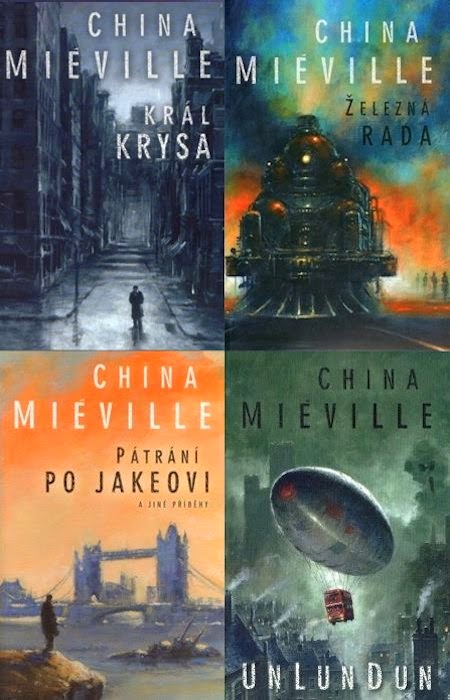
Tor have long since dispensed with Miller's services, I'm sorry to say, in favour of the icons that adorn the award-winning author's back catalogue today. But whilst researching some stories for this week's edition of the British Genre Fiction Focus, I came across a blog called Out There Books, and on that blog, a post about the Czech cover art of Mieville's ten texts to date. 

Evidently, Edward Miller has been keeping busy. Feast your eyes on these, readers!


A thousand thanks to Tom for alerting me to these Mieville-related paintings. They've made me a very happy man... albeit rather nostalgic.

Oh, the good old days, eh? 

Tuesday, 14 May 2013

But I Digress | The Life and Death of Dial H

Regular readers will recall that I came back to comic books a couple of years ago, after entirely abandoning what had become a bad habit at best: a pull list of single issues that broke the bank each and every week, and hardly interested me beyond satisfying my not-so-secret completionist streak.

It was something I needed to do, in truth, but I realised, relatively recently, that I'd thrown the baby out with the bathwater; that I'd gotten shot of a bunch of good comics along with all the bad books that had driven me away from the form in the first place. So I resolved to give the whole rigmarole another go.

And I'm glad I did. I'm glad because I've read some stonking good comic books since I made the decision discussed above. Denise Mina and Andy Diggle have hooked me on Hellblazer; I'm midway through Y: The Last Man, and it's getting better and better; Global Frequency was a bunch of fun; American Vampire and The Unwritten are pretty brilliant; and I enjoy a bunch of the Batman books.


But as it happens, everyone isn't a winner, so of course I've read some utter rubbish in the interim. I won't name names.

In any case, Dial H. As a devout scholar of the school of Mieville, Dial H excited me immensely. I followed the news of its conception and development with baited breath. Though I tend to consume my comics as and when they're collected, I bought the first issue as soon as I could.

On reflection, that wasn't the best introduction to what is a rather byzantine book. Afterwards, I resolved to wait for the first trade, to give Dial H a proper second shot. Into You finally came out in April, and I had a bit of fun with it, I admit. But on the whole? I'd have to say no. Or else, not yet.

I'll read the next collection when it's published, I guess — I do like to see a thing through, and knowing Mieville the book will get better as it goes — but if I'm honest, yesterday's news, that Dial H had been cancelled, was rather a relief. I'm truly sorry that the audience wasn't interested in something so different and ambitious, but let's face it: Mieville didn't make it easy. I've read almost everything he's written, and even I had a hard time figuring out whether or not Dial H was decent.


On the one hand, it's a shame that Dial H didn't work out. On the other — the glass half full hand — this frees up the esteemed author to refocus on the prose fiction I fell for in the first place, because I don't think it's a coincidence that this is the first year since 2008 that he hasn't published a new novel.

So roll on news of whatever Mieville's been working on since the release of Railsea. I still hold out hope that he'll go back to Bas-Lag, but I'll take whatever I can get... up to and including the second Dial H trade. In my heart of hearts, however, I can't help but feel relieved rather than bereaved by this news.

Is that mean-spirited of me?

Have you ever been perversely pleased to see something end, and if so, when?

Tuesday, 19 March 2013

Short Story Review | Three Moments of an Explosion by China Mieville

The presence of 'Three Moments of an Explosion' on the BSFA's shortlist for the Best Short Story of 2012 may strike some as strange, but consider that this brief piece comes from China Mieville, author of the Association’s choice of Best Novel in 2010, The City & The City, and a shoe-in for subsequent awards if ever there was one.

And it is, despite its succinctness, a searing short, packing more panache in 500 words than most stories ten times its length can conjure. Also more ampersands, per the perplexing example the serial nominee set in Railsea recently.

'Three Moments of an Explosion' starts with... well, what else but a bang? But this is an explosion of ideas inasmuch as actual matter:

The demolition is sponsored by Burger King. Everyone is used, now, to rotvertising, the spelling of company names & reproduction of hip product logos in the mottle & decay of subtly gene-tweaked decomposition—Apple paying for the breakdown of apples, the bitten-fruit sigil becoming visible on mouldy cores. Explosion marketing is new. Stuff the right nanos into squibs & missiles so the blasts of war machines inscribe BAE & Raytheon’s names in fire on the sky above the cities those companies ignite.
All too plausible, isn’t it?

Here, however, China Mieville makes do with a rather more modest illustration of the press push outlined above: instead of some oil-rich nation state, the titular explosion is of “an old warehouse, too unsafe to let stand,” brought to you by BK.


Have it Your Way, eh?

That said, this too comes at a cost—indeed, you might measure the collateral damage in lives—because in the story’s dense second paragraph China Mieville moves from the moment before the explosion to the moment of it, pulling back from one big idea to reveal another. Herein we hear of three demolition-trippers who have taken “tachyon-buggered MDMA” to be excepted, temporarily, from time. Thus, in these stolen seconds the trio mount a frenzied survey of the structure... as it crumbles.

This is extreme squatting. The boisterous, love-filled crew jog through their overlapping stillness together & bundle towards the building. Three make it inside before they slip back into chronology. Theirs are big doses & they have hours—subjectively—to explore the innards of the edifice as it hangs, slumping, its floors now pitched & interrupted mid-eradication, its corridors clogged with the dust of the hesitating explosion.
Come the third and final paragraph of 'Three Moments of an Explosion,' time has passed—this, then, is the moment after—but if you’ll pardon my Metallica, the memory remains. I’ll let you find out how on your own.

As I’ve touched on I don't know how many times here on The Speculative Scotsman, China Mieville is one of my very favourite writers. His Bas-Lag books in particular proved pivotal during my younger years, and ever since The Scar I’ve had a special place in my heart for his weird and wonderful worlds. Also his way with words; his wicked wit; and his specific stylistic signature—ampersands & all, of late.

In terms of character I confess he tends to be less successful, but 'Three Moments of an Explosion' showcases none by name, smartly sidestepping that potential pitfall. Furthermore, the verbosity which characterises China Mieville at his least appealing is also absent, for there are no wasted phrases in this shockingly short story. Every sentence, one senses, serves a purpose.

'Three Moments of an Explosion' may appear to be minor Mieville, but its brevity behoves us to look more closely. Read it once, read it twice, read it thrice. You’ll unpick the puzzle soon enough, and the solution is sublime.

***

'Three Moments of an Explosion' by China Mieville was published in Rejectmentalist Manifesto in September 2012. You can read it for free here.

Monday, 30 April 2012

Coming Attractions | Railsea by China Mieville

So here's something to get excited about.


Railsea is almost here!

Specifically speaking, it's not more than a month out, wherever in the world you are... that is assuming you're either in the UK or the United States, where Railsea will be released on May 24th and May 15th respectively.

In the unlikely event that you're wondering what Railsea is - why it's only the new novel by our man Mieville! - here's a bit of blurbage to whet your appetite:

On board the moletrain Medes, Sham Yes ap Soorap watches in awe as he witnesses his first moldywarpe hunt: the giant mole bursting from the earth, the harpoonists targeting their prey, the battle resulting in one’s death and the other’s glory. But no matter how spectacular it is, Sham can’t shake the sense that there is more to life than traveling the endless rails of the railsea – even if his captain can think only of the hunt for the ivory-coloured mole she’s been chasing since it took her arm all those years ago.
When they come across a wrecked train, at first it’s a welcome distraction. But what Sham finds in the derelict — a series of pictures hinting at something, somewhere, that should be impossible — leads to considerably more than he’d bargained for.

Soon he’s hunted on all sides, by pirates, trainsfolk, monsters and salvage-scrabblers. And it might not be just Sham’s life that’s about to change. It could be the whole of the railsea...

Doesn't that sound superb?

Railsea is YA, as I understand it, and while that mightn't be the most optimistic of omens - the consensus seems to be that Mieville's only other YA effort, Un Lun Dun, is his weakest work to date, and truth be told I don't know that I'd disagree - but while that mightn't be the most optimistic of omens, as I was saying, I'm still hella hopeful. Mieville's been on a winning streak ever since that Gaiman-esque digression, and last year's Embassytown stands among his best books yet.

Add to that: this tantalising new novel looks to touch on the selfsame subject matter as Iron Council, and I dare say it may have a whiff of The Scar about it as well. That's already a damn sight more Bas-Lag than I'd expected. And the more Bas-Lag the better, yes?

Not to speak too soon, but I haven't had an advance copy of Railsea yet myself, so we're all in the same boat this time. Or else the same, uh... train.

*ahem*

In any case, besides my enthusiasm for anything and everything Mieville, the material reason I opted to blog about Railsea today was this excerpt, published on Tor.com late last week. It features the prologue and the full first chapter of the book, and needless to say, it floated my goat.

So off you go, folks! Read it. Weep that there isn't more. Meanwhile we'll compare our notes a little later...

Thursday, 9 February 2012

You Tell Me | Double Fine Crowdfunding Fun


While I was asleep last night, the highly-held developers behind Psychonauts and Brutal Legend announced that they were seeking funding for an original point-and-click adventure, a la Monkey Island and Day of the Tentacle, both of which Double Fine mastermind Tim Schafer had a huge hand in creating way back when.

They were aiming to raise $400,000 to bankroll the project. Through Kickstarter, of all things.

This of course came on the heels of a flurry of tweets yesterday between Schafer and Minecraft millionaire Notch, who had suggested he give Double Fine a bunch of money to make a sequel to Psychonauts. Very kind of him it was as well; I'd love to play one.

In any event, when I awoke this morning, I'd no sooner read the news and clicked through to the Kickstarter site to see how much money had been pledged in my absence than the project met, and then immediately exceeded, its $400,000 goal.

I went in for $20 anyway. And clearly I wasn't the only one, because at the time of this writing, there's already an additional $130k in Double Fine's point-and-click coffers, and the number keeps going up. Go us!

So I was saying: this is awesome. Agreed?

But it got me thinking, as awesome things often do, and my thinkings were along these lines: if genre readers could come together like these gamers have, in their tens of thousands to support of an author or a specific series instead of a studio like Double Fine, and a project like this forthcoming point-and-click, what would we want to spend our hard-earned on?

You tell me, ladies and gentleman: what's the sequel that you've always longed to read, if only it existed? What book would you put up a bit of your own money to see written?

For myself, I'd give, say... £100 if it'd help convince China Mieville to go back to Bas-Lag.

I love that series like no other, and as incredible as Mieville's original fiction has been since Iron Council - and it has been, make no mistake - every time a new book is announced, and I realise it's not about Bas-Lag, which I long to go back to, a little part of me laments.

That'd be my pick, in any event.

Bear in mind that this is a strictly theoretical question - I am certainly not about to kick-start a Kickstarter on China Mieville's behalf - so let's not stress about the real world impediments that might put a dampener on our imaginations. Never mind that a given author might not be interested in returning to such and such a world however much money we wave in his or her face. Never mind viability or profitability or any of those fun-sucking factors.

Saying that, no amount of money is going to bring a dead writer back to life, so let's not go beyond the pale here. If you've always wanted to read a fourth Lord of the Rings novel, sure, say so... but who would you want to write it?

Like the thing says: you tell me!

Saturday, 9 July 2011

The Scotsman Abroad | Embassyzone


My second review for The Zone SF went up a couple of weeks ago.

I've been hugely remiss in not directing your generous attention towards the piece sooner, especially given how much I'm wont to go on about China Mieville hereabouts, but... well. Shall we say there were are few technical difficulties and leave it at that?

In any case, I agonised over this review for rather longer than I've delayed pointing it out. Which is to say, it was a hard thing to write. Putting words to one's feeling can be a trial at the best of times, and my feelings as regards Embassytown were, as expected, complex.


But then, is anything ever simple when it comes to Mr Mieville? I sincerely believe the man could make a masterpiece out of a molehill. And the ideas behind Embassytown are certainly more mountainous than molehillish:

If I may be so bold, let's get this show on the road with a quote, from a book I bet we've all read a bit of: "In the beginning was the Word, and the Word was with God, and the Word was God. He was with God in the beginning. Through Him all things were made; without Him, nothing was made that has been made. In him was life, and that life was the light of men. The light shines in the darkness, but the darkness has not understood it." So the great story goes. Or rather, so goes one translation of one chapter of one version of the story, according to this one guy, John, apparently.
These verses of the gospel of John refer back to the Psalms, to the oft-told tale of the Earth's and our creation as Christian theologians care to tell it. They are preface, introduction and summation, all in one. A proto-Saussure of sorts, in the verses aforementioned and at length in those that follow, the disciple John speaks to the unspeakable illumination of language, to create and name and declaim - as does Embassytown...
Embassytown, for its part, does not begin with such gargantuan ambition - though it ends, if you'll allow me this last little heresy, every bit the equal of the fourth and final gospel in terms of its revelatory import. Instead, it opens on a party: a glittering, gossiping, grandstanding Arrival Ball held to welcome to Embassytown a new Ambassador. His name - their name - is EzRa - and he, and they, will change everything.

Read on over at The Zone SF for more happy heresy, and stand aghast - or not - as I suggest China Mieville may be the closest author to Godhood that we have in these hallowed realms of speculative fiction. :)

Now the wait begins for Mieville's next novel... about which I haven't heard a single skinless sausage. Any of you better-informed sorts have any ideas what we might expect, and when?

Thursday, 19 May 2011

Cover Identity | Chong Takes Embassytown

As per the Subterranean Press site, the cover art has been released for the limited edition of Embassytown the exclusive publishers aforementioned will be putting out - apparently before the Autumn's upon us. And good Google, is it a sight for sore eyes or what?

Oh, for a high-res image of this lavish wraparound...


I expect a fair few of you will recognise the work as that of one Vincent Chong. Brownie points to you all.

For myself, the small print puts me out of contention: after all, not so very long ago I reviewed a rare art book which brought together some of Chong's most striking work to date. That piece is here, if you please. But though Altered Visions made for a truly impressive portfolio - "a modest but gorgeous collection of the work of one of the most promising new artists to have arrived on the scene in recent memory," I called it - you know what? I tend to think the man's gone from strength to strength since.

Is this his best piece yet? Well... personally speaking, I wouldn't say so, no. But near as dammit.

And that might just be me, because the yellows and browns and blues of the imagery above make for a distinctly different colour palette than that I'd imagined of Embassytown and its alien surrounds. At a push, I'd have to say I pictured deep reds and purples, slick and viscous rather than weather-worn. This seems a touch too Modern Warfare for my tastes.

But all the same, it's a beautiful image.

Beautiful enough I might just have to invest in a third copy of this incredible novel... which, now that I think of it, I should have an extensive review of - in which I make the case for China Mieville as a God of genre literature - ready for you all to read sometime within the next week.

***

Friday, 22 April 2011

Short Fiction Corner | A Very Mieville Morning

Don't look now, but it's only new China Mieville!

And no, I don't even mean Embassytown. Though that's what I've been reading these past few night, at long goddamn last. And it is... exquisite. But no, that's not the new China Mieville I mean.

Here. This morning The Guardian posted an exclusive short story by the man, the muscle, the mind behind The City and The City: at a glance 'Covehithe' seems to be about a risen rigging platform - though don't hold me to that. I've only read the first section for the minute but of course, it's superb. Of course it is: for Pete's sake, it's new China Mieville.

Away yes go and read it, then. Catching up on the blogs can wait today. :)

Friday, 4 February 2011

Book Review | Echo City by Tim Lebbon

Buy this book from


Surrounded by a vast, poisonous desert, Echo City is built upon the graveyard of its own past. Most inhabitants believe that their city and its subterranean Echoes are the whole of the world, but there are a few dissenters. Peer Nadawa is a political exile, forced to live with criminals in a ruinous slum. Gorham, once her lover, leads a ragtag band of rebels against the ruling theocracy. Nophel, a servant of that theocracy, dreams of revenge from his perch atop the city’s tallest spire. And beneath the city, a woman called Nadielle conducts macabre experiments in genetic manipulation using a science indistinguishable from sorcery. They believe there is something more beyond the endless desert... but what?

It is only when a stranger arrives from out of the wastes that things begin to change. Frail and amnesiac, he holds the key to a new beginning for Echo City — or perhaps to its end, for he is not the only new arrival. From the depths beneath Echo City, something ancient and deadly is rising. Now Peer, Gorham, Nophel, and Nadielle must test the limits of love and loyalty, courage and compassion, as they struggle to save a city collapsing under the weight of its own history.


***


This could be my least favourite China Mieville novel.

Talk about damning with faint praise... rather, I mean to praise with faint damning. From Bram Stoker and four-time British Fantasy Award-winner Tim Lebbon, your erstwhile go-to guy for Hellboy novelisationsEcho City is an accomplished fusion of fantasy fiction and the horror genre set in a city surrounded by poisonous desert fit to kill anyone who dares traverse it. The slowly roasting bones of all those who have tried little the barren sprawl, a dire warning to any fool enough to think themselves an exception: for centuries, no-one has left Echo City, and none have come.


Except this one guy.


Peer sees Rufus out in the wastes one day, a "shadow [shifting] far our in the desert - a slightly solid shape amid the unremitting downpour," (p.22) and with his shocking arrival, everything she has known begins to come undone. Of course, the city is all she's known; a Babylonian tower of epic proportions, scraping the skies, Echo City has been built - by necessity - upon itself, upon its own past. And "the past is a living place. The deeper you go, the further into history you travel. The city doesn't deal with history. It builds over its past, encloses it, shuts it off, and while tradition might persist, the real histories are soon forgotten. It's the present that matters to Echo City, while the past echoes below it, in some cases still alive." (p.212)


Rufus, however, despondent and conveniently amnesiac when we're first introduced, is emblematic not of the past, or even the present, but of a future in which Peer's dreams and nightmares are realised as one. For Peer is a Watcher: one of a clandestine cult of doomsayers who believe that the end is nigh-ish, and better to be prepared for it than not. Thinking themselves "the sensible minority in a city of unreason," (p.194) when Rufus falls into their collective lap they take his arrival as a sign that the end is even nigh-er than they'd thought.


Needless to say, Watchers are not the only fruit of the society sprung from this impossible, isolated wreck of a city. There are also the Garthans, a secretive race of proto-humans who dwell in the Echoes beneath to whom Rufus is a sort of albino Jesus, reborn that he might lead them into Honoured Darkness. And sure enough the Marcellans - the fundamentalist ruling class of Echo City - would love a slice of the pie. So begins a fraught race against time which takes Peer and Rufus deep into the crumbling foundations of the city, where the inevitable happens: together or otherwise, they must confront the past in order to have any hope of a future.


And I'm going on about China Mieville... why? Well, because of the chopped, for one thing: "three-legged whores... soldiers with blade limbs [and] builders with four arms" (p.296) or else out-and-out monstrosities made for murder from cultures in the artificial wombs of the Bakers, genetic wizards to whom Nadielle is the latest in a millennia-long lineage. And it is Nadielle, rather than Rufus, that Lebbon casts as the pivot around which this hellbound narrative turns. Her creatures roam the length and breadth of Echo City, stalking the streets and rises of every Canton; and before her, and her creatures, it was her "mother" - for Nadielle was herself unnaturally selected, the better to inherit her creator's secret science - and her mother's creatures. And so on, for "the Baker's line is long." (p.193) Longer, perhaps, than any other in the City's stifled history.


To his credit, Lebbon takes more of an interest in the creator of the chopped than the chopped themselves, while in the Bas-Lag books the Remade were the subject of Mieville's inspired speculations - the Remade, in favour of the Remaker. And never one to dwell on any one thing for any length of time, Mieville had no sooner conjured his iteration of the concept in question than done away with it, loping off toward pastures new. So there's certainly room for another take on... let's call it Man, Manipulated.


Lebbon is far from bereft of invention in that regard. Echo City boasts an assortment of truly inspired grotesques: most notably the Bellows, Giger-esque organs which pump Peer and her companions from Canton to Canton through the city's insides, and the Scopes, four twisted specimens - one of each of the compass' cardinal points - which answer the question What if binoculars were people too? leaving you wishing you hadn't asked after such lunacy in the first place.


Yet if you've read The Scar, or Iron Council, from the very outset of Echo City - a perversely visceral prologue wherein one horror births another, and within that other lies still another - there's something decidedly over-familiar about Lebbon's latest; about the chopped, something not a little been there, done that. Moreover, to have them play such a vital role in the narrative only foregrounds the problem, such as it is.


From there, other similarities between Echo City and the Bas-Lag books in particular - but also Kraken - extend outwards. The Cantons of Echo City are not dissimilar to the districts of New Crobuzon; so too has Mieville mined, multiple times, the revolutionary tension between bureaucracy and the misbegotten, which Lebbon frames as the Watchers versus the Marcellans - though there's not, in the end, a lot to these dissidents, besides which the Marcellans hardly seem a credible threat; we only meet the one, really, and even he's not who he seems. Then there's the stifling atmosphere, the weight of history and tradition, and the monsters. Did I mention the monsters already?


Echo City feels at times uncomfortably derivative - it would be a kindness to describe it as wearing its inspiration on its sleeve - but perhaps it is only in the comparison to such a master craftsman as the aforementioned award-devourer that Lebbon seems a second fiddle. And truth be told, the literature of the fantastic is so often content to play pointless jiggery-pokery with a few exhausted plot elements and call it a day that in some senses it's refreshing to see Lebbon at least has something worthwhile to say about such ho-hum tropes. He brings something new to the table, too: for the setting is itself a startling locale, and a good proportion of the story revolves around an ambitious, if occasionally belief-beggaring explication of Echo City and its long lost origins. It's no New Crubuzon, no... but then, nor was New Crubuzon after only a single volume.


It's hard to imagine Lebbon returning to Echo City, given the shattering events of the last act of his latest, but on the strength of its fascinating locale alone - and certainly Echo City has its other strengths: Lebbon's prose is a pleasure, and so too his seamless hybridisation of horror and dark fantasy - were there to be another novel set in the same world, I'd gladly go back for a second helping.


That is, so long as he swears not to mention the two-muffed woman (p.26) again. Talk about horror!

***

Echo City
by Tim Lebbon

UK Publication: July 2011, Orbit
US Publication: October 2010, Spectra


Buy this book from

Thursday, 30 September 2010

eee! Indeed

Could this surprise development herald a new direction for the great China Mieville?


No. Probably not. But how about that?

Wait, does no-one else see it? For goodness sake, the man used an exclamation point!

If nothing else, take this sociopath-friendly post as sage advice: you really should have the man's profoundly little-known Rejectmentalist Manifesto bookmarked by now. Don't expect China to spill the beans about Embassytown or give up the good stuff, such as when he's heading back to Bas-Lag; expect, instead, the unexpected, because that's precisely what you'll get. Now then.

eee!

:D

Tuesday, 10 August 2010

Go! Go! Joe Abercrombie Excerpt

Now I don't make a habit of posting blurbs and cover art and excerpts. These things, they have their place on the blogosphere - I wouldn't question it - but by and large, those places aren't here. If you want all that jazz to factor into your daily reading, the aforementioned Aidan's got you covered, with class, concise commentary et al.

Which isn't to say I don't ever repost publicity materials: only that it takes a special case for me to make an exception. For the record, China Mieville and Brandon Sanderson (more on whom soon) are the only authors whose excerpts I've pimped out via intravenous TSS. Two excerpts in six-and-some months... not bad going.

Well, make that three. Yesterday, in their newsletter, Gollancz released an exclusive excerpt from The Heroes - Joe Abercrombie's still-a-ways-out next novel, due in the new year - to subscribers. And with everyone's favourite Uncle nodding permission from the comfy chair I set up for him in the corner, I'm reproducing it here for those of you who don't subscribe to the monthly email loveliness. Which you almost certainly should. In fact, let me introduce you to a link to ease the very thing.

Anyway. The excerpt:


Splattering Brain Matter Starting January 2011

I haven't been able to read it myself yet - my pesky computer keeps choking on the URL - but, and this should come as no surprise to (love you) longtime readers, I'm something of an Abercrombie devotee. Though I was a touch disappointed by the unrelenting and often rather rote violence of Best Served Cold - the full review is here - The First Law trilogy represented a refreshingly frank and realistic new direction for fantasy at the time of its publication. I did it, too, something of a disservice, stopping and starting throughout despite having the whole saga to hand; by the time I came to read it in full, the style of storytelling Abercrombie pioneered had already been imitated ad infinitum. Despite that, I have a great deal of respect for the author, and high hopes for The Heroes, which is set to go back to the well in terms of setting and a couple of returning characters.

Here's the blurb, in case you haven't perused it yet:


"War: where the blood and dirt of the battlefield hide the dark deeds committed in the name of glory. The Heroes is about violence and ambition, gruesome deaths and betrayals; and the brutal truth that no plan survives contact with enemy. The characters are the stars, as ever, and the message is dark: when it comes to war, there are no heroes...

Meet the heroes.

Curnden Craw: a ruthless fighter who wants nothing more than to see his crew survive.

Prince Calder: a liar and a coward, he will regain his crown by any means necessary.

Bremer dan Gorst: a master swordsman, a failed bodyguard, his honor will be restored - in the blood of his enemies.

Over three days, their fates will be sealed."


Roll on January, right?

Meantime, I'm going to see if I can't get that excerpt working for myself...

Friday, 11 June 2010

Book Review: City of Ruin by Mark Charan Newton


Buy this book from

"Villiren: a city of sin that is being torn apart from the inside. Hybrid creatures shamble through shadows and barely human gangs fight turf wars for control of the streets.

"Amidst this chaos, Commander Brynd Lathraea, commander of the Night Guard, must plan the defence of Viliren against a race that has broken through from some other realm and already slaughtered hundreds of thousands of the Empire's people.

"When a Night Guard soldier goes missing, Brynd requests help from the recently arrived Inquisitor Jeryd. He discovers this is not the only disapearance the streets of Villiren. It seems that a serial killer of the most horrific kind is on the loose, taking hundreds of people from their own homes. A killer that cannot possibly be human.

"The entire population of Villiren must unite to face an impossible surge of violent and unnatural enemies or the city will fall. But how can anyone save a city that is already a ruin?"

***

For centuries, the traditional greeting between strangers and passing acquaintances across the length and breadth of the Boreal archipelago has been a respectful utterance of "Sele of Jamur," but the time of the Jamur empire has passed, and it did not go quietly into the good night. The Emperor is dead - long live the new Emperor, Urtica, a power-hungry former councilor whose machinations have driven the rightful heirs into exile; a door has opened to another world from which pour countless legions of alien creatures with dark designs on the denizens of a city already on brought to its knees by crime and corruption. Brynd Lathraea, Commander of the Night Guard, arrives in Villiren to organise a last-ditch defense against an impossible force only to find its populace unmoved by their impending extinction, while Inquisitor Rumex Jeryd, another newcomer, finds himself caught up in a disturbing serial murder investigation. But because people don't know what to say to one another, who to trust, no-one's saying anything, and the bodies start to pile up. It is a time of unrest, a time of war... and the end has only just begun.

Nearly a year to the day since Nights of Villjamur, rising star Mark Charan Newton returns to the world he painted so memorably in the first book of The Legends of the Red Sun with a sequel which outdoes that breakthrough fantasy in almost every sense. And that's saying something. We're talking about a book which attracted great acclaim from all comers here; an author whose fledgling efforts have seen him compared with a who's-who of genre greats. An unfortunately contrived last act somewhat dampened my own enthusiasm for Nights of Villjamur: an overabundance of convenient twists and characters acting against the internal logic Newton had established for them meant that I came away from it thinking... good, yes, absolutely - but truly great? Not quite.

Nevertheless, you have to allow for a little awkwardness in the opening acts of such grand sagas as The Legends of the Red Sun promises to be, and whatever its failings, Nights of Villjamur hinted at some incredible things to come. City of Ruin, I'm pleased to say, delivers on near enough every one of its predecessor's promises. Its characters act in character for the duration; their dialogue is snappier and significantly smoother; the action is bigger, better and more satisfying by all accounts; and the grand scheme of this ambitious quintet is revealed at last, to tremendous effect.

The first lesson City of Ruin teaches readers is to expect the unexpected. Though far from its only flourish, the titular setting of Nights of Villjamur was surely its greatest strength: a grand and subversive imperial capital alive with spectacle and intrigue. Having constructed such a fantastic canvas for the epic movements of The Legends of the Red Sun to take place upon, you might presume Newton would return to Villjamur in City of Ruin, yet the action herein takes place in another location entirely: a seething city on the very fringes of the Empire's grasp where gangs rule the roost. In and of itself, Villiren is not quite the equal of Villjamur, but the author broadens his focus still further to take in the larger landscape of the Boreal archipelago, and together with the crumbling city, the world is a more vibrant and fascinating place than before. Indeed, it is a dying earth, a motif only alluded to in Nights of Villjamur which pushes through the crowded irens and bustling frontlines to the fore in book two.

You get the distinct sense, in fact, that Newton has let loose his imagination in City of Ruin. From a cave-monster made of coins to a floating island a la Hayao Miyazaki through a great behemoth on the battlefield amalgamated from fallen bodies, the set-pieces here seem weirder and more wonderful than any in book one of The Legends of the Red Sun. Newton has spoken of how his creative wings were clipped during the composition of Nights of Villjamur, and commercially speaking I suppose the restraint makes a certain amount of sense. Herein, however, having achieved that mainstream success, he spreads them far and wide, and it's a joy to behold. City of Ruin is darker, harder and more dramatic than its predecessor. Those issues Newton had to tiptoe around before he addresses head-on this time, and it's a breath of fresh air to see a genre that so often shies away from the genuinely relevant questions of our age in favour of counterpoints abstracted by imagination deal with the likes of homophobia, domestic abuse, corruption and poverty.

City of Ruin is a big book of big ideas and big issues. It's fun and it's frank, difficult yet easy to swallow. It takes all the good of Nights of Villjamur and makes it great, whilst relegating the majority of that novel's problems to the farthest margins. There's still little clunk from time to time - a "dead corpse" is the worst expository offender, and a few allusions to the work of Jack Vance and China Mieville are so blunt as to take you out of the experience - but overwhelmingly, book two of The Legends of the Red Sun is a roundly more rewarding and polished endeavour than its predecessor. City of Ruin stands as a sterling example of modern epic fantasy with a twist of the new old weird that realises the incredible potential of Mark Charan Newton's earlier work with style, panache and glorious imagination.

***

City of Ruin
by Mark Charan Newton
June 2010, Tor UK

Buy this book from
Amazon.co.uk / Amazon.com /
IndieBound / The Book Depository

Recommended and Related Reading

Wednesday, 9 June 2010

Guest Post by Mark Charan Newton: Six Influences on the Legends of the Red Sun Series

Six months isn't such a long time at all, really. It's the halfway point between birthdays; it's the time it takes for Winter to turn into Summer, for the snow to become sun; it's how often you go on holiday, if you're anything like me. But let me tell you. In internet years - they're like dog years, only more nebulous - The Speculative Scotsman is positively claiming its pension. Sometimes it feels like I've been at this for ever, and so it's a pleasure, from time to time, to hand over the reigns to someone else. I don't do it terribly often - I'm not at all good at letting go, even temporarily - but this one time, in aid of the ongoing celebrations here on the blog, I'm making an exception.

Without further ado, then, it gives me great pleasure to welcome the one and the only Mark Charan Newton to TSS. Mayhap you've heard of him?

But enough of my burbling. Over to you, Mark...

***
 
One of the things I'm conscious of, as a writer, is to leave a trail of clues littered through my books so that people can see where I've been inspired by other writers. It's important to acknowledge these things. So, textual clues aside, here are six books which helped shape the construction of my own books, to varying degrees.
 
1) The Alexandria Quartet by Lawrence Durrell. Now any such lists invite pretentious selections, but invoking this metaphysical classic of the 1950s isn't me trying to appear clever - I learned a very important lesson about what book sequences can do from reading Durrell's stylish masterpiece. Each book in the series undermines the previous novel, and minor characters suddenly become the focal point, giving the reader a completely different understanding on what went before. It was a revelation, and made me instantly consider such subtle tricks in my own books.

2) The Scar by China Miéville. I've harped on about this book in many places and interviews, but suffice to say I wouldn't be writing today if I my imagination had not been inspired by this book. Reading this was the first time I realised what fantasy fiction could achieve in scope and ambition. I remain somewhat disappointed by the lack of true weird wow-factor in the genre (though it does exist with writers such as Erikson or Gaiman, for example). It strikes me as if some writers are reluctant to put much radical fantasy in their fantasy fiction, which I admit is my own personal taste - I don't have any agenda here. Because of my perceived shortage of such weirdness at the time, I thought I'd have a go at writing my own book. So I did.

3) The Master and Margarita by Mikhail Bulgakov. In City of Ruin readers will meet a new character called Voland. Bulgakov's mesmerising political satire contains a character called Woland, which was, in turn, linked to Goethe's Faust (the knight Voland - a demon), and so I wanted that satanic force to appear again, but in my new guise (though I've made a few connections apparent). I won't go into too much detail, since I'll leak spoilers everywhere. But if people want a unique spin on good and evil (and a thousand other themes) then you could do worse than take a trip through Bulgakov's Moscow.

4) The Book of the New Sun by Gene Wolfe. It's the definitive dying earth book, and outclasses Jack Vance's series for depth and imagery (though certainly not for madness). Whilst I can understand why readers would be frustrated with Wolfe's prose, I found this to be a beautiful book with so many layers, and it really captured the mood of how I viewed my own series. It informs much of how I view the dying earth sub-genre. I mean, you only have to look at the similar series title to see I'm conscious of this literary debt.

5) The Wallander crime series by Henning Mankell. My guilty pleasure is that I'm a huge fan of the detective Wallander, and Mankell's bleak Swedish crime series has been endlessly good fun for me when I wanted something a little less intensive to read. They're not mere entertainment though – they're very clever. In later books, Wallander constantly finds himself up against a certain political or social frustration, and I very much wanted to replicate such matters in my own books. Fantasy books don't have to just be entertainment (that should be a minimum) - if you want to talk about a theme or an issue, then where's the shame in that?

6) The Book of Imaginary Beings by Jorge Luis Borges. Mythology informs much of my work - in fact, as the series unfolds, it will become apparent just how much the world depends on mythology. And there's no way to deny that I love a good monster – who doesn't? Borges's bestiary is a wonderful A to Z of, well, monsters, creatures from different cultures and mythologies – and specifically in my case, the garuda came from this resource. If you want one book where you can quickly look up a beastie to put in your own writing, then this is it.

Friday, 30 April 2010

A Hat Trick for Mr Mieville

Day before yesterday, The City and the City, that exquisite hybrid of crime fiction and conceptual speculation, became only the fifth novel - after Take Back Plenty, The Sparrow, Christopher Priest's The Separation and Air by Geoff Ryman - to win both the BSFA and the Arthur C. Clarke award.

Not only that: China Mieville became the very first author to have won that latter acclaim three times. They honoured him in 2001 for Perdido Street Station, the beginning of the Bas-Lag trilogy, then again in 2005 for its rather underrated conclusion, Iron Council. And now, well... the gent's gone and done it again.

Three cheers are in order, I think. One for each of his Clarke trophies! Wait, is there even a trophy? Never mind. As Niall Harrison observes over on Torque Control, it's a judgment "which instantly looks like one of those decisions that couldn't have gone any other way," though let's be honest here: the six novels on the 2010 shortlist represented an incredible and diverse collection of speculative fiction, each and every one of which was in its own way award-caliber fodder.

But there's no questioning the wisdom of the Clarke panel's decision. Not to toot my own horn here, but as I Tweeted shortly before the ceremonies began, The City and the City is a book deserving of every inch of the praise and acclaim that's been heaped on it, and of all the candidates - of the four I've read, I should say - far and away the most extraordinary. Would that I had a review to link to, but I'm the blog wasn't even a wicked twinkle in my eye when Mieville's last novel hit bookstore shelves, so let's just say it was my favourite book of 2009 and leave it at that.

So. Huge congrats to China, first and foremost, but also to Julie Crisp, Chloe Healy, and all at Macmillan and Tor UK for their well deserved triumph.

But I'm not just posting to pat everyone involved on the back. Some kind soul thought to record the author's short acceptance speech, and as per usual, China, in the space of three mere minutes, manages to be illuminating, funny and touching. Here:


I very nearly teared up there at the end. Would that China's dear mum, for whom he wrote The City and the City - and indeed the novel is dedicated to her memory - had been around to see her son so honoured. I've no doubt she'd have been the proudest parent in all of London. And as those of us who've had the pleasure of China's latest novel know, London is the world.

But transcripted for your convenience, here are a few of the most prescient points China raised in his speech:


"Earlier this year, in response to a critique of the Booker prize, for ignoring some of the most exceptional literature out there - by one of the shortlistees; by Kim Stanley Robinson - the judge, the academic and writer John Mullan explained that the reason he didn't consider science fiction was because science fiction is bought by a special kind of person who has special weird things they go to and meet each other.

"He totally means us! I know it's very very cheap to rally the crown against a pantomime villain - but I never said I was expensive...

"One of the many reasons - I know we whine about this incessantly - one of the many reasons that I think that this is such a shame, this kind of contumely, is because as anyone who's been online knows and has looked around at the debate around this prize and science fiction prizes in general knows that by contrast science fiction readers are among the most critical, the most - they combine an extraordinary generosity with an extraordinarily rigorous critique in a way that I never see among many other readers. You know, the seriousness, the systemacicity, the fascination, the rigour with which the readers of this extraordinary field read is a constant amazement to me, and constantly something I'm very proud of.

"I think, at its best, they are the greatest readers and the greatest fiction out there, and I'm very very grateful to those readers for being open to a little bit of crime in their speculation. And just to conclude, I'd also say I'm extremely grateful to readers of crime for being open to a little speculation with their murder. It's meant a great deal to me to be read outside those traditional areas."


You've got to love a guy who can slip "contumely" into everyday speech with a perfectly straight face. I'm exactly the type to pride myself on knowing the meaning of all sorts of obscure words, and even I had to look that one up!

But to my point. I wonder, are we really "the greatest readers" of fiction? No man's above lip-service, I suppose, especially when honoured as China was on Wednesday night, but he honestly doesn't seem the type to be stroking our egos just because we really rather like his books. Certainly we are critical; sometimes overly so, I'd say. And speaking for myself, I know I'm capable of very generous praise when a book truly calls out to me - as Kraken did last week, for instance (review here).

And yet, China had barely finished giving his very gracious acceptance speech, calling us all lovely things, thanking us for our acceptance of him, in turn, for "being open to a little bit of crime in [our] speculation" and lo and behold, a debate calling into question the very openness China was speaking of was raging across the blogosphere. Was The City and the City really science fiction anyway, the instigators asked?

To which question I would answer, after a not inconsiderable amount of thought: pshaw. I don't often take idle talk personally, but this particular thing, this bothered me. How incredibly discriminatory, to consider - even for a moment - the dismissal out of hand of a novel that unquestionably does touch on speculative concepts simply because it also incorporates elements of another genre. Not only that; it's a slippery slope. Should science fiction that has within its pages allusions of intimacy be thus deigned romance? I mean, really.

It's time likes these that I'm reminded of how utterly reductive the notion of genre is.

More on which subject soon...

In the meantime, let this be an open forum for celebration of China's landmark triumph, and perhaps further discussion of the notion of our worth as critics of speculative fiction. Lest we forget the question on everyone's lips: to those of you who've read the Clarke award-winner, do you think its incorporation of tropes more typical of other genres should somehow have excluded it from consideration?

I'll totally fight anyone who says so... ;)