Showing posts with label zombies. Show all posts

Tuesday, 16 May 2017

Book Review | The Boy on the Bridge by M. R. Carey


Once upon a time, in a land blighted by terror, there was a very clever boy.

The people thought the boy could save them, so they opened their gates and sent him out into the world.

To where the monsters lived...

***

Whether it's a character that captures us or a narrative that enraptures us, a situation that speaks to something unspoken or a conflict that builds on something broken—who can say, on this or any other day, what makes a book a bestseller? The quality of a given novel has next to nothing to do with its success on store shelves, that's for sure. Plenty of bad books have shifted millions, and many more deserving efforts have come and gone to no such notice. It's a blessing, then, when a truly wonderful work of fiction becomes a bestseller... but it can also be a burden.

The Girl With all the Gifts was probably the best zombie novel to have been released in recent years, and it sold hella well—well enough to spawn a movie that was also pretty swell. But while the next book to bear M. R. Carey's name was a dark delight in its own right, Fellside didn't catch on in the same way, I'm afraid.

To wit, I wasn't entirely surprised when I heard that Carey's new novel was a sidequel of sorts to The Girl With all the Gifts. I was, however, concerned; concerned that setting a second story in the same world that Melanie and Miss Justineau so wholly inhabited ran the risk of diminishing their devastating adventures. Happily, The Boy on the Bridge bears its burden brilliantly, and I can only hope it's as blessed by the book-buying public as its predecessor.

It is, admittedly, a little derivative. And I don't just mean that it tugs on many of the same heartstrings The Girl With all the Gifts did—though it does, ultimately: The Boy on the Bridge is an equally bleak book, and equally beautiful, too. But that's not it either. I'm talking about the plot, which is, at least initially, almost a mirror image of its predecessor's: it's an apocalyptic road story about the relationship between a teacher and her unusual student.

Friday, 27 February 2015

Book Review | The Death House by Sarah Pinborough


Toby's life was perfectly normal... until it was unravelled by something as simple as a blood test.

Taken from his family, Toby now lives in the Death House; an out-of-time existence far from the modern world, where he, and the others who live there, are studied by Matron and her team of nurses. They're looking for any sign of sickness. Any sign of their wards changing. Any sign that it's time to take them to the sanatorium.

And no one returns from the sanatorium.

Withdrawn from his house-mates and living in his memories of the past, Toby spends his days fighting his fear. But then a new arrival in the house shatters the fragile peace, and everything changes.

Because everybody dies. It's how you choose to live that counts.

***

A slim, sorrowful volume that splits the difference between The Fault in Our Stars and The Girl with All the Gifts, The Death House documents the last days of several students in a school full of Defectives: young people who have been taken from their parents and installed in an isolated location because of something bad in their blood. Something that'll kill them all before long.
It's school but not school. Like this whole place is life but not life. At least the teachers, who disappear off to their own wing once lessons are done, will get out of here. Sometimes I'll catch one watching us as we work as if we're animals in a zoo. I can never decide quite what the look is. Fascination or fear, or maybe a bit of both.
Maybe a bit of both is appropriate...

On the back of The Language of Dying, a life-affirming dark fantasy about the passing of a man with lung cancer, Sarah Pinborough opts not to detail the Defective gene here. That isn't to say there aren't certain suggestions—implications that when the time comes, the kids in question will turn into monsters of a sort; monsters some of them have seen in the movies the school screens each week. To wit, we can guess what happens next. We can guess that death is essentially a blessing on the affected.

The kids struggle to see it that way, because of course they do—they're kids. Boys and girls from eight to eighteen bundled into black vans and largely left to their own devices on an island where they make friends and enemies, fight and make light; where they do whatever they can do, in truth, to avoid facing the fate that awaits them.

Friday, 28 November 2014

Book Review | Symbiont by Mira Grant


The SymboGen-designed parasites were created to relieve humanity of disease and sickness. But the implants in the majority of the world's population began attacking their hosts, turning them into a ravenous horde.

Panic spreads as these predators begin to take over the streets. In the chaos, Sal and her companions must discover how the parasites are taking over their hosts, what their eventual goal is—and how they can be stopped.

***

On the back of the unsightly excitement of Parasite, something like rigor sets in as the second half of what was a duology turns into the middle volume of a tolerance-testing trilogy. Symbiont isn't a bad book by any means—it's accessible, action-packed, and its premise remains appallingly plausible—but absent the ambiguity that made its predecessor so unsettling, it's  lamentable for its length and lack of direction.

The first part of Parasitology chronicled the apocalyptic consequences of SymboGen's latest and greatest innovation: the ubiquitous Intestinal Bodyguard—a magic pill meant to protect against allergy, illness and infection—was a worm which, in time, turned; a symbiotic organism supposed to support its host yet set, instead, on supplanting said. Before long, of course, this conflict of interests turned the population of San Francisco and its suburbs into zombies of a sort—sleepwalkers, as Mira Grant would have it.

The transition went differently for a few folks, though. After a catastrophic car crash, and at the cost of her every memory, Sally Mitchell's parasite saved her life... or so she thought.

Monday, 14 July 2014

Book Review | The Garden of Darkness by Gillian Murray Kendall


Their families dead from the pandemic SitkaAZ13, known as “Pest,” 15-year-old cheerleader Clare and 13-year-old chess club member Jem, an unlikely pair, are thrown together and realize that, if either of them wishes to reach adulthood, they must find a cure. A shadowy adult broadcasting on the radio to all orphaned children promises just that—to cure children once they grow into Pest, then to feed them and to care for them.

Or does this adult have something else in mind? 

Against a hostile landscape of rotting cities and of a countryside infected by corpses and roamed by voracious diseased survivors, Jem and Clare make their bid for life and, with their group of fellow child-travelers growing, embark on a journey to find the cure. They are hampered by the knowledge that everything in this new child-led world has become suspect—adults, alliances, trust, hope. But perhaps friendship has its own kind of healing power. 

***

A teenage take on The Walking Dead blissfully free from that franchise's most mercenary elements, The Garden of Darkness is an astonishingly good debut about a cheerleader and a chess club member's struggle to survive absent adults in a landscape ravaged by the Pest pandemic.

Though they went to school together way back when, the odd couple we quickly come to care about only really meet a matter of months after Pest lays waste to the world as we know it, killing all the afflicted adults and sentencing every single survivor to death at the onset of adolescence:
Clare knew she was infected with Pest—the rash was enough to prove that. She knew that she was going to die of it, too. Eventually. She might even have a couple of years left, but, according to the scientists, she wasn't going to live to adulthood. [...] In its own weird way, Clare thought the link between Pest and adolescence sounded logical. Adolescence had always been a bag of goodies: complexion problems, mood swings, unrequited love and now, Pest. (p.17)

Tuesday, 25 March 2014

Guest Post | "The Perfect Blade for Every Battle" by Sebastien de Castell

It’s a dangerous world out there, and if you’re not careful you could soon find yourself on the wrong end of an opponent’s knife, a zombie’s tooth, or a werewolf’s claws. If you’re reading this, then I’m assuming three things: first, you’re in terrible danger. Second, you have, for some reason, kept a copy of this article in your pocket. Third, you’re standing outside the only 24-hour sword shop in town. Oh sure, you might think that these are ridiculous and statistically unlikely assumptions to make, but then why are you still reading this article? Really. Go away. That’s right—run off back home to your microwave dinner and Desperate Housewives marathon. The rest of us have blood to shed. 

Still here? Right, then, well done you. Now you need to get inside that 24-hour sword shop and quickly pick out the right weapon for the battle ahead. To maximize your chances of drinking to your enemy’s demise (and minimising the odds of your skull being used as a tankard when they drink to yours), follow the handy guide below to match your current duelling dilemma with the right weapon for the job. 

Scenario 1 - It’s the Zombie Apocalypse

I put this one first as, based on popular media, it's apparently the most likely danger you’ll face this year. Cheer up, though, last year’s edition would have required you to prepare to face off with hundred year-old emo vampires whose only weaknesses are sparkling prettily in sunlight and occasionally brooding to death. 

Right, back to the zombies. What we need here is a good cleaving weapon. You might think a nice double-bladed battle-axe is the way to go, but the truth is, they’re actually pretty hard to wield accurately. Also, if you miss, it’s hard to bring it back around in time for a second try before your ex-neighbour chomps into your face and infects you with the deadly zombie virus (not to mention some pretty serious halitosis.) This will severely curtail any hopes of attracting a member of the opposite sex. 

Now, some of you are probably hoping I’ll tell you that The Walking Dead has it all wrong (well, they do about the crossbow thing but that’s another story) but when it comes to zombie fighting, Michonne has this thing figured out: get yourself a good katana. 

The katana is a traditionally made Japanese sword and one of the finest bladed weapons ever devised. It’s designed for slicing and delivers devastatingly sharp cuts against flesh, sinew, and bone. Can it really decapitate a zombie in one blow? Absolutely. The Japanese used to test katanas by cutting through dead bodies (evidently practicing for the inevitable zombie apocalypse to come.) Regrettably, it’s useless against Godzilla, which makes me wonder if the Japanese were really all that prescient, after all. 

Bonus Tip: While you’re at the store, grab yourself a bokken. This wooden practice weapon is roughly the same size and shape as a katana, but if you sharpen the end just a bit you’ll be ready in case Edward Cullen ever loses his cool and comes for you with his fangs bared. In fact, if you see Edward or any other Twilight vampires you should probably stab them through the heart even if they don’t seem threatening. Just in case, you know? 

Scenario 2 - Road Warrior Dystopia

Zombies? What a preposterous idea. We all know the future belongs to roving bands of ex-punk rock bassists ravaging the countryside in search of... well, it’s not entirely clear what they’re in search of, but they’re planning to kick your ass. So grab a blade and start cleaving black leather biker gangs. 

Your weapon of choice? The European bastard sword. This classic Medieval and early Renaissance monster is the jack-of-all trades you need to deliver judicious quantities of mayhem to all kinds of maniacally grinning mohawk monsters. Some hyena-faced lackey smirking at you while flipping his switch-blade in the air? Good—you’ve got more than enough reach to take him out. Armoured skateboarder is coming at you with a baseball bat? The bastard sword has the strength to parry that blow before you smite the post-apocalyptic Tony Hawk wannabe into the ground. 

Oh, and in case you’re thinking that broadswords were too heavy, they historically weighed between 2.5-3 pounds which was very close to sixteenth century rapiers. Bastard swords could also be wielded with two hands, making them easier to handle. Also, you get to say bastard a lot. Bastard. 

Scenario 3 - Real Life Duel

I know what you’re thinking: what if undead creatures with no biologically explainable capacity for movement and brain-eating don’t spontaneously rise up in oddly convenient urban centres around the country? What if completely foreseeable oil depletion fails to result in a world where everyone paradoxically drives around in gas-guzzling trucks? Alright, then, let’s prepare for something believable: a duel to the death with a fellow human over a question of honour. 


Yes, the classic duel at dawn. The cause? Likely some unintentional slight caused by a poor choice of words that triggers a light slap with a soft white glove. Your options? A simple apology or a deadly and prolonged fight resulting in death for one of you, murder charges for the other, and misery for both your families.

Right, duel it is then. 

You might be thinking rapier here, and if you were living in the 15th or 16th century I would agree with you. But the rapier is still a fairly heavy weapon to handle and that affects its speed. What you want here is a small sword. Yes, I realize the name "small sword" doesn’t inspire you with testosterone-filled confidence, but the small sword was fast—crazy fast—and the point was sharper than any blade that came before it. The only one thing that matters in a real swordfight is putting the pointy end into the other guy first. That’s why, by the late 17th century, the small sword had all but eliminated the rapier as the duelling weapon of choice. It’s also light enough to carry with you at all times and is surprisingly convenient for cooking hotdogs around the campfire. 

Scenario 4 - Crime of Passion


Troubles at home? Starting to suspect your spouse may be stepping out on you with someone from the accounting department? Where others might pause and consider thoughtful dialogue with their significant other, you refuse to waste time with ego-crushing self-reflection and expensive couples counselling. Instead, you’ve decided to commit the sort of love crime usually reserved for melodramatic classics of the French cinema. 

If murderous revenge is on your mind, then there’s only one weapon that will do the job the way it needs to be done: the N-Force Vendetta Double Sword. Yes, the N-Force has it all: big and bold enough to compensate for any masculine insecurities you may be experiencing, and with two separate blades you can offer one to your nemesis as a chance to defend themselves, or, heck, why not use one blade for your enemy and one for your spouse? Best of all, if you do a little research online you’ll quickly learn why the N-Force Vendetta Double Sword is the perfect blade if it turns out you haven’t stumbled upon the love of your life cheating on you with your best friend but instead have discovered them planning a particularly thoughtful birthday party for you. 

Hopefully these handy tips will get you through your next night of bloody battle, but if your sword fighting needs go beyond these every-day scenarios—if, for example, your king has been murdered and it turns out that every noble is a tyrant and every knight a thug—can I respectfully suggest you get yourself a copy of Traitor’s Blade and let Falcio, Kest, and Brasti be your guides on negotiating life’s little challenges?

Tuesday, 18 March 2014

Book Review | Black Moon by Kenneth Calhoun


"A black moon had risen, a sphere of sleeplessness that pulled at the tides of blood-and invisible explanation for the madness welling inside."

The world has stopped sleeping. Restless nights have grown into days of panic, delirium and, eventually, desperation. But few and far between, sleepers can still be found—a gift they quickly learn to hide. For those still with the ability to dream are about to enter a waking nightmare.

Matt Biggs is one of the few sleepers. His wife Carolyn however, no stranger to insomnia, is on the very brink of exhaustion. After six restless days and nights, Biggs wakes to find her gone. He stumbles out of the house in search of her to find a world awash with pandemonium, a rapidly collapsing reality. Sleep, it seems, is now the rarest and most precious commodity. Money can't buy it, no drug can touch it, and there are those who would kill to have it.

***

Black Moon is a book which wants to confuse you, and in that sense, it's a soaring success.

The thought behind its apocalypse is appallingly plausible: a plague of infectious insomnia has wounded the world, laying almost the lot of us low in the process. Without sleep, the larger part of the population is losing it. Unable "to distinguish fact from fiction," (p.3) to tell dreams apart from reality, the inflicted become zombies, of a sort. Thankfully they're absent that habitual hankering for brains, but "the murderous rage they feel when seeing others sleep" (p.44) has already led to indescribable violence on a scale that beggars belief.

It falls to the few who remain relatively rational to figure out what in God's name is going on:
Many in the scientific community were focusing on a known disease—fatal familial insomnia—the idea being that this was some kind of mutated strain of the already mutated variation called sporadic familial insomnia. Whereas FFI was believed to be hereditary and limited to less than forty families in the world, and took up to two years to kill the afflicted, this new iteration seemed to be some kind of unstoppable upgrade. Accelerated, resistant, moving through the four stages of demise at three times the speed. 
But this was just the leading theory. No real connection had been made, and the medical community remained confronted by its greatest fear: a mystery. (p.35)
A mystery that is very probably unsolvable, given the worsening condition of those looking into it.

Black Moon isn't a long novel. Nevertheless Kenneth Calhoun proffers three diverse perspectives rather than allowing readers to settle into a single just-so story. Of these, we hear from the easiest to like, namely Lila—a little girl sent her away for "her own safety" (p.78) who feels betrayed by her parents—the least. A shame: hers is certainly a familiar figure in apocalyptic fiction, but she's sweet and real and resonant in a way that the other pair of protagonists can't match.

Tuesday, 28 January 2014

Book Review | The Girl With All the Gifts by M. J. Carey


Melanie is a very special girl. Dr Caldwell calls her "our little genius."

Every morning, Melanie waits in her cell to be collected for class. When they come for her, Sergeant keeps his gun pointing at her while two of his people strap her into the wheelchair. She thinks they don't like her. She jokes that she won't bite, but they don't laugh.

Melanie loves school. She loves learning about spelling and sums and the world outside the classroom and the children's cells. She tells her favourite teacher all the things she'll do when she grows up. Melanie doesn't know why this makes Miss Justineau look sad.

***

There's been a bunch of buzz about this book in the six months since its announcement. Aside a hearty helping of hyperbole, however, we've had next to nothing to go on: only an unsettling excerpt about a girl who loves "learning about spelling and sums and the world outside the classroom" evidently being kept in captivity; and the fact that M. J. Carey is an ever-so-slight pseudonym for the author of the five Felix Castor novels and any number of awesome comics, not least Lucifer and more recently The Unwritten.

So what is The Girl With All the Gifts?

Well... I'm not going to tell you yet. But I was curious, to be sure. With Orbit asserting that The Girl With All the Gifts will be its "biggest cross-over launch ever," I expected loads more from the marketing department; a blogosphere blitz featuring lengthy excerpts and the like. Instead, the crux of the campaign to date has been an assurance that this book would be worth the wait. And it is. From the magnificent moment when what was actually going on dawned on me right through to the bleak but beautiful conclusion Carey has crafted, The Girl With all the Gifts is terrific. 

If you were wondering whether or not to bother with it, know now that there's no question. Buy a copy and avoid the internet at all costs. Don't even read the rest of this review!

Monday, 9 September 2013

Guest Post | "Faith in Fiction" by David Towsey

Today it's my pleasure to host a guest post from David Towsey, whose "bloody biblical" debut I reviewed late last week. I spoke quite openly about my faith, or lack thereof, in that article, and indeed, I came away keen to know more about the author's approach to the touchy subject above.

I knew it'd be a big ask, but belief is as powerful a pivot-point as it is provocative, so I cast caution to the wind and touched base with David to see if he'd be interested in discussing his particular perspective. He took the subject seriously from word one, and came back to me with the guest post below.

What follows, then, are the thoughts of "an enthusiastic novice" on faith, and how it factors into fiction.

***

When Niall asked me to write a guest post about my faith and how it informed Your Brother's Blood, I was at first reluctant. To be honest, I was terrified. I imagined my blundering sentences being examined and then torn apart in great detail, counter-posts exclaiming what a terrible person I must be, and worse. Religion is a difficult subject; it's a lot of things to a lot of different people and that can make it very hard to talk and write about. It's part of the trifecta of topics that in my house were not suitable for discussion at the dinner table. 

As a writer, I'm acutely aware that when I involve religion in my work I'm going to be creating problems for some readers. But as Your Brother's Blood isn't on sale in the UK as I'm writing this post, it is obviously hard to gauge reader-response. Perhaps readers will be more inclined to focus on the zombie-esque characters than the treatment of Christianity, but I understand both may raise questions. Questions like: how did my faith inform my debut novel Your Brother's Blood?

The short answer is: it didn't. And that's because I don't have a faith. I am a kind of lethargic atheist. I grew up in a non-religious household. I did attend a Church of England primary school. For assemblies we would file into the church that was next to the school. I can remember very little except the songs. 'Dance, dance, wherever you may be...' That was a favourite. As was the one that said the word 'naked'. [I find myself singing 'He's Got the Whole World in His Hands' with alarming regularity - Niall] Some of the teachings must have sunk into my subconscious. But that's my subconscious, and I prefer to leave that alone.

Lethargic and tolerant atheism. I don't begrudge anyone their faith. In fact, I'm slightly envious of it. Part of me would very much like to be a strong believer in one of the major world religions. From the outside looking in there seems to be a great degree of security and support in faith. But I just don't feel the faith, and I don't think that's the kind of thing you can fake. There are times when I struggle to understand some of the acts that are done in the name of various religions. My failure to understand can sometimes lead to angry words or feelings, but this is not unique to religion. People do things I don't comprehend all the time.

So if I'm an atheist, why write a book that involves a future vision of Christianity? Firstly, the Bible fascinates me. I tried to read it once, cover-to-cover. I found it impossible and am in awe of anyone who has. But I approach the Bible as a writer. That is worth emphasising. I am not looking for spiritual guidance. My fascination comes from the amazing stories and characters in the text. More so, there are some fantastic turns-of-phrase. For me, it's a great resource. And I am a child of the digital age. Instead of having a paper copy of the Bible on my desk, I have www.biblegateway.com bookmarked. Completely searchable, with many different versions of the Bible available, I spend hours on this site. Search the word 'flower' and there are thirty-four results. Brilliant. You can view the passages in context, or see the whole chapter, in just a single click.

Secondly, I believe that, in a challenging world like that of Your Brother's Blood, there would be many people who turned to religion for answers. This is something people have done for millennia – some might even argue it is the whole reason for organised religion. Answers for all the big questions, but also answers on how to live day-to-day. Over the course of the Walkin' Trilogy, I show how different people and communities handle the issue of the Walkin' – a kind of undead population. Your Brother's Blood focuses heavily on the town of Barkley that is fairly hard-line in its belief systems. I don't condemn Barkley for its beliefs. Despite the fact that if there is a villain in the novel then they are from Barkley, the same is true of the hero of the book. The difference is in the individual – something I think is true of all world religions and their believers.

Lastly, there is what I like to think of as the 'writers in space' argument. I write in the SF/F genre – I'll let you decide which Your Brother's Blood is – and that means approaching subjects that are unknown to me as an author. If friends of mine can write about space travel without being an astronaut, it seems odd to shy away from writing about religion as an atheist. Both demand a level of research. Both expose a writer to criticism from greater or more learned minds. It's no doubt obvious at this stage that I'm no Bible scholar. At best I'm an enthusiastic novice. At worst... 

[SPOILER] The Bible features heavily in all three of the Walkin' Trilogy books. It is an important part of the McDermott family. Some characters are happier about that than others. I like to think I treat the subject even-handedly. But I probably don't. If the books contribute to a debate on how writers approach or utilise religion then I don't think that's a bad thing. I'd like to be part of that conversation.

***

Thank you, David, for addressing my question so seriously and sincerely. Despite your doubts, I'm sure everyone here will agree that it's been a real pleasure having you on The Speculative Scotsman.

Thursday, 5 September 2013

Book Review | Your Brother's Blood by David Towsey


Buy this book from
Amazon.co.uk / The Book Depository

Or get the Kindle edition

Thomas is thirty-two. He comes from the small town of Barkley. He has a wife there, Sarah, and a child, Mary; good solid names from the Good Book. And he is on his way home from the war, where he has been serving as a conscripted soldier. 

Thomas is also dead - he is one of the Walkin'. 

And Barkley does not suffer the wicked to live.

***

To believe in something, utterly and unconditionally, even or especially when everything else we understand goes against it, is, I think, a powerful thing.

I often wish I had it in me, that capacity. But a leap is needed — a leap of faith into the great unknown — and I... I like to know where I'm going well before I get there.

The appeal, however, is clear, even to me. Belief begets a sense of purpose in a world that often strikes this critic as poorly plotted. Belief reveals meaning in the seemingly meaningless. Belief changes us; rearranges us; makes us more, ultimately, than we were, or would have been. But with great power comes great responsibility — as a great man mooted a great many years ago — and inasmuch as faith can be freeing, when wielded without kindness or compassion it can, of course, be a weapon as well.

In case you were wondering why I'm banging on about the sensitive subjects above: blame David Towsey's daring debut. Faith is the fire at the beating heart of Your Brother's Blood. It's what sets the small town of Barkley apart in a world that's fallen to fear and loathing. It's what keeps its people decent, centuries on from the dawn of the Walkin'...
Debate continues over the cause of Automated Man's fall from scientific grace. War would be an obvious cause. Regardless of man's level of sophistication, time has proven him to be an aggressive creature. We can only imagine what kind of weapons would have been at his disposal. 
Perhaps man outgrew this world and journeyed to the star? Leaving nothing but scraps — both human and otherwise — behind. Abandoned by science, those remaining lived as best they could, resulting in the societies of today. A neat [...] theory. 
Yet, despite finding no obvious flaw in this hypothesis, my personal preference leans towards another explanation: the resources that fuelled man's domination ran out. 
For all his subtleties, he was finite. It is the pattern of humanity: like the moon, their influence waxes and wanes. Mechaniks, magic, the power to fly, are all hollow trinkets; nothing can escape the pattern. (pp.vi-vii)
In Your Brother's Blood, humanity as you and I understand it is gone, and all but forgotten. Yet the world still turns — and there are still people peppered upon it, albeit not in such numbers. The last of us, for they are thus, have had to go back to basics. The bare necessities are they need, really: food, friendship, protection from the elements, a few rudimentary tools.

And faith. In Barkley especially — an insular community modelled after a man who believed the Walkin' were symptomatic of a second Fall — faith is pervasive. Everyone, but everyone, attends sermons on the Sabbath, to hear Pastor Gray preach about the evils of these others: a belief shared by many beyond Barkley. Here, however, the flock is taught to tar the first-born with the same destructive brush: "The gates of heaven are closed to the kin of those damned souls. They are left to walk the earth; abominations; fouls creatures of the night. Twisted husks: they fester instead of finding eternal joy." (p.7)

In recent years, this cruel and unusual commandment has been enough to keep the Walkin' from coming back to Barkley, yet at the outset of Your Brother's Blood, one man does exactly that. Poor Jared Peekman is promptly burned to death — again — as a mob bays for his blood. The same mob doesn't know how to handle the cold-blooded murder of Jared's seven year old son, whose throat Luke Morris, the Pastor's devoted disciple, simply slits.

Meanwhile, far from home, in a pit of half-burned bodies, Thomas McDermott comes back from the dead. He remembers the end, the bayonet buried to its hilt in his chest... yet here he is. No two ways about it: he's one of the Walkin' now. To wit, his darling daughter Mary may also bear the taint.

A Barkley man born and bred, Thomas's faith is desperately tested by this fate worse than death. "Would there ever be a punishment?" he wonders.
Was there anyone, the Good Lord or otherwise, to judge him and mete it out? Had he done anything wrong? He'd wanted an end to these questions, an end to the uncertainty. To spill [it all] out onto the orange soil at the bottom of the canyon. (pp.46-47)
In the end, Thomas can't bring himself the commit this mortal sin. Instead, he grapples with an impossible choice: to go west or escape into the east. He could return home to Barkley, though he's well aware of what awaits him there — of how his reappearance could endanger his wife and child — or traipse towards the secret Walkin' commune on Black Mountain.

He heads home, of course.

It, uh... doesn't end well.

This is hardly surprising. From word one on, Your Brother's Blood is harrowing, haunting and all too human. Towsey starts his book boldly, with a scorching sermon about the wickedness of the Walkin' presented in canny parallel with Thomas's repugnant reawakening — courtesy a tickling carri-clicky which burrows through him as he claws his way out of a mass grave. It's stomach-churning stuff, one sequence as much as the other. And these awful things are but the beginning.

To be clear, the Walkin' are zombies of a sort, but they aren't interested in brains; they're just dead men that move, have memories and want what they've always wanted. For Thomas, that's first and foremost the safety of Mary and Sarah, however if he's to spend his second life in hiding, he wants to see them one last time. So though his return to Barkley might be misguided, Thomas is so smartly characterised we sympathise entirely.

The supporting cast are more of a mixed bag than our profaned protagonist. Some obvious shorthand — I speak of a peeping Tom, primarily — marks the bad guys from the good. Amongst the latter camp, several seemingly central individuals serve no discernible purpose; a number are marginalised by the narrative; still others are left to languish in the last act. Your Brother's Blood doesn't chronicle an ensemble, either. It's a slight novel, and hardly action-packed.

Much of this, I'm moved to moot, is down to the fact that Your Brother's Blood is but the inaugural volume of The Walkin'. That's all well and good — though the rise of the saga is at times a tiresome trend, I could hardly call myself a genre fiction fan if I weren't willing to forgive the format. Indeed, I'll certainly be reading the next novel in this series, given that Your Brother's Blood affected me, in the main, in much the same way Alden Bell's melancholy debut did... which is to say immensely.

Be that as it may, the decision to close the book on book one when Towsey does left me feeling — I won't beat around the bush here — cheated. But only because I cared so much about Thomas and Mary and Sarah. Only because I had invested heavily in what is from the first a fascinating, emotionally enrapturing narrative, and immersed myself in the pitch-perfect, undead western setting of Your Brother's Blood.

I might be an unbeliever, but I have faith in David Towsey to tell the rest of this tale well. I only wish he'd had the good grace to follow through in more ways than the one he undoubtedly does in this book too. Nevertheless, Your Brother's Blood is a tremendously memorable debut, and a striking start to what promises to be a bloody biblical trilogy.

***

Your Brother's Blood
by David Towsey

UK Publication: August 2013, Jo Fletcher Books

Buy this book from
Ainmazon.co.uk / The Book Depository

Or get the Kindle edition

Recommended and Related Reading

Thursday, 1 August 2013

Book Review | Three by Jay Posey


The world has collapsed, and there are no heroes any more.

But when a lone gunman reluctantly accepts the mantel of protector to a young boy and his dying mother against the forces that pursue them, such a man may yet arise.

File Under: Science Fiction [Three For All | Apocalyptic Wasteland | A Journey Home | Fear the Weir]

***


Imagine a meeting of the minds behind the Fallout franchise and The Dark Tower saga. That's Three: a desperate western about obsession, regret and redemption set in the sandblasted wilderness of a world that's gone to hell in a handbasket. Not that we know when, or why... just that it has.

Nor does the author spend a great deal of time establishing the central character his debut is named after. However heroic, Three, we see, is frustratingly stoic: a bounty-hunter with an unspeakable secret. But in a very real sense, his silence is his strength, while what we don't know about the wasteland serves to make our journey through it that much more thrilling.

Some readers are likely to find this apparent lack of motivation and explanation unsatisfying, but Three isn't actually absent worldbuilding or character development at all; it just happens to happen in the background. Thus, there are few, if any infodumps, and the protagonist does not often monologue on his origins. Instead, we put the pieces of the puzzle together ourselves. We use our own imaginations to fill in the blanks.

Participation, then, is a prerequisite. Best to leave Three be, really, if you aren't prepared to play the game Jay Posey makes of it. But if you are? Then allow me an industry in-joke: it may just blow you away.

Let's back up a bit for a minute.

Three, when we meet, has come to town to cash in a bounty, but the agent who's supposed to pay him doesn't have enough Hard on hand to cover the outstanding amount, so he's made to wait.

Waiting, I'm afraid, isn't one of our man's many strengths:
"It was like this when he didn't have a job; something to find, someone to bring in. The restlessness was setting in, the need to move. To hunt. It was the third day in the same town. Might as well have been a month. There were benefits to being a freelancer, but down time wasn't one of them." (p.20)
That's where Cass and Wren come in: a Quint addict on the run from a special someone and her supernaturally sensitive son. Three doesn't take much interest when he first lays eyes on the pitiable pair, but their paths just keep on crossing. Soon enough he ends up saving them from certain death—all in a day's work, eh?—then, when he realises that they won't last long without his help, he reluctantly accepts the mantle of temporary protector.

And so the ragtag trio take to the wasteland... where there be Weir, I fear: a hive of cyber-zombies, in short, with burning blue orbs for eyes and the uncanny ability to track their targets' digital signatures. This is a particular problem in world where everyone (well, almost everyone) has come to rely on implants which connect them to the cloud.

By the by, there's more to Cass and Wren than meets the eye. Though he has no control over it, the little fella has a unique ability, and between her spiralling habit and her disgruntled former employers—a band of brutal brainhackers—Cass's past is catching up with her fast. Had Three known what a handful they'd be between them, things would have been different, undoubtedly, however "he was responsible for them now. And in a sudden flash he felt, without question, they were the mistake that would cost him his life. [But] he wasn't sure it was a mistake at all." (p.162)

And that's pretty much the plot. Again: not a lot, but enough—just—to get us going. Indeed, Three represents a real roller-coaster if we're willing to play our parts. To engage with the world and the characters and the narrative in the same sort of way we may in a video game.

Tellingly, Jay Posey has been involved in that very industry since 1998. Currently, he's a Senior Narrative Designer at Red Storm Entertainment, the creators of two Tom Clancy-branded franchises—I give you Ghost Recon and Rainbow Six—and if these series haven't been especially progressive in terms of the tales they've told, they've made for great rides regardless. As sandboxes for incredible set-pieces and immersive gameplay experiences rather than solely stories, they've done the trick, I think.

This ethos—of encouraging the player to participate in the construction of each aspect of the entire—also applies to our role as readers of Three. I for one was perfectly pleased to do a little of the heavy lifting, because Posey makes discovery fun, and keeps things interesting in the interim.

Not to lean too heavily on the video game angle, but I delighted in identifying scenes from Three via that vocabulary. There are stealth sections, then, in between all the brawling; minibosses at the end of each act; collectibles and sidequests; moments that reminded me of objective-based multiplayer modes like capture and hold.

I could go on, but suffice it to say that Three is an unmistakable gamey debut. But this is no bad thing—and no surprise considering Jay Posey's professional pedigree. The premise is certainly nothing new, and at the outset, the characters are rather unremarkable, but the author's distinctive approach to storytelling superimposes a firstly fascinating and finally satisfying dimension upon what could very easily have been a bland book.

As is, it isn't. On the contrary, I had all the fun reading Three. Honestly, all of it.

***

Three
by Jay Posey

UK Publication: August 2013, Angry Robot
US Publication: July 2013, Angry Robot

Buy this book from
Amazon.co.uk / Amazon.com
IndieBound / The Book Depository

Recommended and Related Reading


Monday, 10 December 2012

Book Review | Exit Kingdom by Alden Bell


Buy this book from
In a world where the undead outnumber the living, Moses Todd roams the post-apocalyptic plains of America. His reprobate brother, Abraham - his only companion - has known little else. Together, they journey because they have to; because they have nowhere to go, and no one to answer to other than themselves.

Travelling the bloody wastelands of this ruined world, Moses is looking for a kernel of truth, and a reason to keep going. And a chance encounter presents him with the Vestal Amata, a beguiling and mysterious woman who may hold the key to salvation. But he is not the only one seeking the Vestal. For the Vestal has a gift: a gift that might help save what is left of humanity. And it may take everything he has to free her from the clutches of those who most desire her.

***

Two years ago, The Reapers Are the Angels took the horror novel by storm. A literary rendition of the traditional zombie apocalypse more interested in exploring questions of innocence and obligation than, say, the pursuit of brains, it announced the arrival of an awesomely promising author, whose haunting voice I could not wait to encounter again, and gave the genre its most memorable character in recent memory.

The good news is, Alden Bell's back, and his painstaking prose is as evocative as ever it was. Add to that the following fact: herein he returns to the wonderfully wasted world of his Philip K. Dick and Shirley Jackson Award-nominated 2010 novel.

But Exit Kingdom is a prequel rather than the expected sequel, taking place over a period of weeks some years before the heart-rending events of The Reapers Are the Angels, and its sole perspective is similarly surprising: after all, Moses Todd seemed a merciless monster in Bell's remarkable last. Complete with the motive and the means, he spent the larger part of it anticipating the opportunity to murder our enterprising young heroine, whose absence in Exit Kingdom feels like a hole in the heart.

Bell does attempt to replace Temple - if not the character then her role in the whole - and whilst he meets with some success in this sense, it's far harder to invest in the Vestal. Amata is "a madwoman gone tricksy in the manners of the earth, the gorgeous get of a blighted world, so perfect in her lying everything," (p.205) thus the reader never knows where to stand as regards her. Of course Temple was tricksy too, yet the Vestal's deviance is still less direct. We all know the story of the boy who cried wolf; here, it appears, we have the wolf who cried woman.

Moses - a killer with a code - intuits as much the very moment he meets her. After a close encounter with a madman's pet terrors at a derelict airport, he and his brutish brother Abraham - also returning from the pages of The Reapers Are the Angels - stop off at a Mission, and the author has already established our man as after exactly that: some reason to keep on keeping on. To wit, in this "architecture of order," (p.43) he finds his heart's desire via Amata, whose blood tells a strange tale. The dead simply aren't interested in her, for the selfsame reason everyone else is, so when a monk asks Moses to shepherd the Vestal to a promised land of sorts - a citadel in Colorado which still stands strong against the undead menace - he accepts the quest without question.

He's wary of her from the first, however, and Amata's various escape attempts do nothing to dissuade this distrust. Nevertheless, she and Moses do become close over the course of their pseudo-religious pilgrimage. They share certain experiences on the road to potential redemption, not least Exit Kingdom's stark centrepiece. Crossing a frozen-over lake in the far north, they catch sight of something beneath their feet:
"The ice is clear, and caught under it, like some kind of horrible fish in an aquarium, is the face of a dead man gazing up at them. His body has gone soft and bloated from being underwater for so long, his eyes milky, his flesh gone pale, nibbled at by fishes, his skin peeled off and floating around him like a nest of seaweed. They could have thought him just straight dead if it weren't for the fact that his eyes are blinking up at them sluggishly. As they watch, the dead man raises a hand to them, his movements slow, made almost ghostly by the freezing water in which he is entombed. He places his palm against the undersurface of the ice.
"Moses knows it to be a grasp of hunger, but because the dead man doesn't seem to be able to bend his stiffened fingers,the outspread palm looks like a gesture of greeting or welcome. The eyes continue to blink, slowly. 
"It is pathetic and awful, the slug trapped underwater and undrownable — like a man staring up at them from the very mouth of the void, waving his goodbye as he descends, floating down peaceful into the great black." (pp.146-7)
As well as bringing Moses and Amata together for a time, this striking sequence also serves to illustrate Bell's atmospheric intent. Patiently paced and moody in its every movement, Exit Kingdom is a sombre, soul-searching story. There's sporadic action, I grant you - gathered around the outset and the denouement, or rather the novel's rise and fall - and it's remarkably well executed, at that.

But mostly, Exit Kingdom is about stillness... and silence. "Now the world has slowed down, there is no hurry. You watch the snowflakes fall lazily on the their way, and you are reminded of your own floating, your own speedless descent through life." (p.128) And so the undead are essentially unthreatening. The world may have gone to hell in a hurry, but now - decades on from whatever caused the zombies - now it turns in its own time. Even the explosive set-pieces are more measured than such scenes tend to be.

These occasional outbursts are engaging enough, but Exit Kingdom is unquestionably at its most affecting "in the noiseless interstices between action," (p.306) as Bell himself suggests in the interview appending this brief prequel. Moses, meanwhile, is a powerful presence — truly a narrative force of nature. And though the Vestal Amata is certainly no Temple - and though that lack leaves us, alas, with a less meaningful text than its elegant predecessor - she has her own unique appeal.

As has Exit Kingdom.

...

This review was originally published, in a slightly altered form, on Tor.com.

***

Exit Kingdom
by Alden Bell

UK Publication: November 2012, Tor

Buy this book from

Recommended and Related Reading

Thursday, 29 November 2012

On Blogging | Graeme's Fantasy Book Review, I Salute You!

Blogs come and blogs go. The longer you do this thing, the clearer that sad fact appears. But the great and the good live on in our hearts and our minds, even after they're long gone. I often find myself thinking fondly of Floor-to-Ceiling Books, for instance, amongst myriad others.

But of all the blogs I've followed, and of all the friends I've made since becoming a part of this literary lark, good sir Graeme Flory and his absolutely fabulous Fantasy Book Review may have impressed the most lasting mark upon me — and The Speculative Scotsman as well. Never mind for the moment how prolific Graeme was as a blogger, how funny and insightful and kind in his writing and in real life: he taught zombies and honesty, and he taught them better than anyone else. 

So it's with sorrow in my otherwise impenetrable Scotch soul that I must inform you of the end of an era. Graeme's Fantasy Book Review closed its doors early yesterday... and I suddenly felt frightfully lonely.

Here's Graeme's explanation:
It's been a little while coming but it's time to bring this blog to a close. Obviously there are a whole load of reasons (none of them particularly interesting to you guys) but the bottom line is that I'm not really enjoying it anymore and that means that it's time to stop. That's not to say that I won't come back, in the future, and start something up again; just not here. I've got some ideas but I just want to stop and chill out for a while.
[...] 
It's been a amazing experience but you have to know when it's time to stop. It's time to stop :o)
In the final comments section, there's already been an outpouring of support for one of the very best bloggers there ever was, or ever will be. but if you haven't yet added your two cents to the discussion, I urge you: please do.

Luckily, we only have to say goodbye to a blog. Though I seem to have written an obituary - what can I say? I'm sad - Graeme himself is still well and truly with us, and I'd bet my last penny that we'll be hearing from him again... perhaps in some other capacity... and fingers firmly crossed, sooner rather than later.

In the meantime, you can harass the man on Twitter @graemesfantasyb.

In fact, could someone perhaps ask him who in holy hell will review all the zombie novels ever now?

Not it! :P

Friday, 26 October 2012

Video Game Review | Resident Evil 6, dev. Capcom


Rarely do reviewers agree on a great deal, particularly in foundling fields such as game journalism, and yet critics from competing sites - typically so desperate to distinguish themselves - have conspired to rip Resident Evil 6 to shreds.

Well, it ain't right. And I'm telling teacher.

Giant Bomb, a resource near and dear to my heart, is one of the biggest bullies: "Resident Evil 6 is a big-budget disaster on the order of the Star Wars prequels, a sprawling production that clearly required so many individual talents to bring it into being, you can't help but wonder how the end result could have turned out so bad."

At least Destructoid's reviewer quantifies his problems: "Listlessly wallowing in the depthless waters of homogeneity, Resident Evil 6 is a coward of a game, afraid to make its own individual mark in the industry and cravenly subscribing itself to every overplayed trope in the book."

Joystiq, meanwhile, are rather more reasoned — and they get bonus points for using appropriate imagery! "Everyone would do well to study its anatomy, to learn what happens to a series stuck somewhere between a new life and an old body."

Get it? Because of zombies? Oh, what wit!

But beyond the wit... bullshit. Because Resident Evil 6 is overwhelmingly alright. It certainly won't be winning any Game of the Year awards, but why would that be the yardstick against which we measure this sprawling sequel? Why not its immediate predecessor? Why not its closest competition? Why not the stale new Silent Hill, or the forthcoming installment of Call of Duty?


Come to that, why compare it with anything? Resident Evil 6 is what it is. And what it is structurally ambitious, narratively novel, graphically gorgeous and extraordinary aurally. It may be mundane mechanically - as throwback and old-fashioned as ever this series has been, despite the efforts of its developer - but it isn't broken, and the notion that it should have been overhauled to feel more modern (which is to say more like every other goddamn game on the market) is counter-intuitive coming from a community that demands diversification on a daily basis.

In any case, Capcom have gone to incredible lengths to make fans of this multifarious franchise happy. In an era when six hour single-player games have become the new normal, it's surprising - shocking almost - that Resident Evil 6 clocks in approximately five times as long. Less so when you realise it's essentially four games in one. In the first, you're Leon, returning from Resident Evil 4 in a campaign that feels a lot like that game's. The second campaign casts you as Chris, Resident Evil 5's protagonist, and it plays similarly: it's more shooter than survival horror.

But the third and the fourth campaigns return to that very territory: the former recalls Resident Evil 3: Nemesis - you're being chased by an unstoppable monster the whole time - and the latter, starring I couldn't possibly tell you who, feels like it's sprung fully formed out of Resident Evil 2, what with the secret player character and all the puzzles she-who-must-not-be-named has got to solve.


Resident Evil 6 is an odd sort of hodgepodge, on the whole: a guided tour through the make-up of the entire series to date, or a forlorn love letter to itself. In that sense, it reminded me - of all things - of Final Fantasy IX. What makes it cohesive, if anything does, is the structure of the story: characters continuously come together as four narratives neatly interweave, and each time the player experiences something a second time it's from a whole other angle, with more or different information.

Admittedly, the controls are iffy. The Quick Time Events around every corner are overbearing. The puzzles are plodding and the shooting is largely unsatisfying. The dialogue is obvious and the tone of the story is all over the place. Resident Evil 6 has a lot of problems... but so did all the other games in the series, and praise was lavished upon these.

So what gives?

Patience, I presume. Critics don't have a great deal of it on good days, and around this time of year, when there are huge new releases to play through and review each and every week, it's obviously in very short supply. But to dismiss this game on those grounds is dishonest. Resident Evil 6 may not be particularly great, but it's not bad either - not like certain ostensibly objective perspectives have suggested - and if you ask me, you've got to give Capcom credit for trying so damned hard.

Friday, 11 May 2012

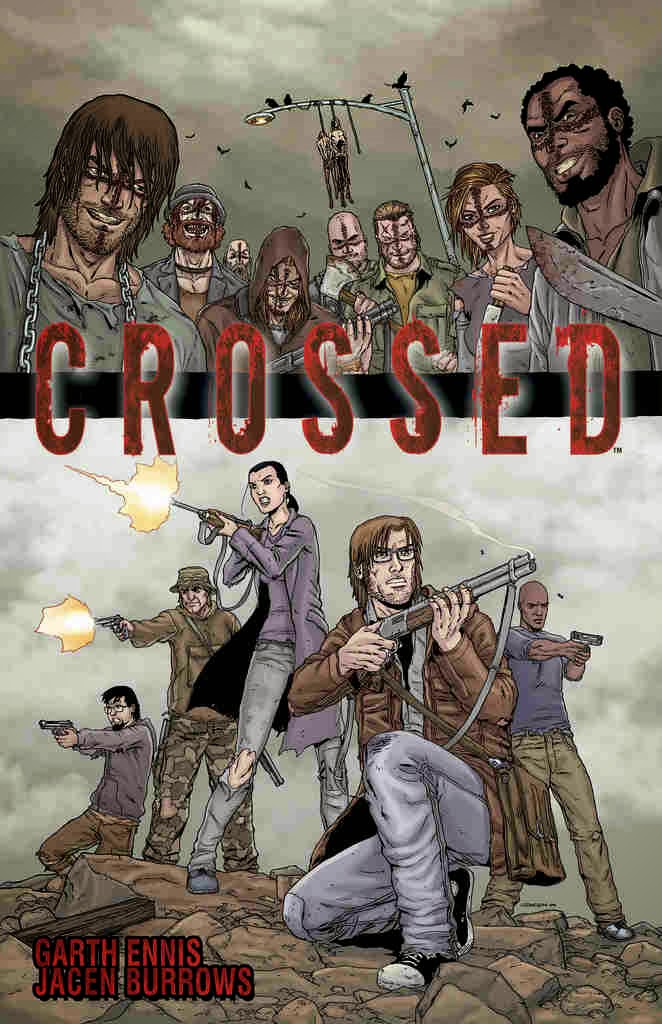
Comic Book Review | Crossed Vol. 1

Preacher was great, wasn't it?
And Preacher co-creator Garth Ennis has written some other stuff that I've enjoyed... though "enjoyed" might be a poor way to put it. Let's say "been gripped by." Or better yet, "been unable to look away from," like the scene of some horrific crime you just can't help but gawp at. I refer to his initial run on Punisher, of course, and nominally to Hitman too, which was published concurrently with Preacher, in the best years of Garth Ennis' career.

But it's been a decade since these three series ended, and most everything of Ennis' I've read in the intervening period has either soured me or simply sickened me. Here's looking at you, Chronicles of Wormwood... and War Story... oh, and The Boys. Particularly that latter; a more disgusting book than The Boys I do not know, nor would I want to. Then again I could only stand to read the first six issues. Maybe it gets better?

In any case, if there was even a miniscule part of me that still believed Garth Ennis was a halfway decent writer, then Crossed has killed it dead. Killed it dead and fucked it in the eye-socket with the severed horse's organ this first volume's antagonist - Horsecock, none other - carries around in lieu of a more socially acceptable weapon. Because Garth Ennis is at the helm. And that's what Garth Ennis does, these days.


Amongst the other highlights: the murder of a man because he's being a bit annoying; panel after panel of excruciatingly graphic depictions of randy zombies raping men, women and children alike; and most appalling of all, the calculated execution of an entire class of primary school kids, supposedly to save them from the horrors of surviving a Crossed apocalypse. I mean, fair enough: it's not pretty. But maybe it's prettier than a bullet in the brain, fired at close-range by someone who's supposed to be taking care of you.

But then, the alternative's not nearly as shocking, is it? And that's what Garth Ennis has made his name trading in: disgust and discomfort. The repugnant and the perverse. Indeed, there's really not a lot else to the first collection of Crossed. It's The Walking Dead with stumpfucking and - in stark contrast with the ensemble Robert Kirkman has gathered together with such tender loving care for his transmedia success story - a cast of characters even the most affectionate individual would have a hard time giving a crap about. I mean, Ennis clearly doesn't, and I've forgotten all their names already. Even the Wikipedia page could care less what this motley lot are called.

Meanwhile the world of Crossed is as ugly as the survivors who run willy-nilly around it, though it bears saying that it's rendered exceptionally well. Indeed, Jacen Burrows, whose pencils I've come across before - paired with the words and the worlds of far better writers than Ennis, including Alan Moore and Warren Ellis - is easily the best thing about this book. Ably supported by Juanmar, whose muted colour palette is only interrupted when blood follows, as invariably it does, Burrows' clinically clean lines leave little to the imagination, which is perfectly in step with Ennis' very direct script. You could describe them as dispassionate, perhaps, but then they'd have to be in service of scenes such as these.


To think a four time Eisner Award-winning author has fallen to this. It's enough to make one wonder whether Hitman and Punisher and Preacher were just happy accidents.

I don't doubt Crossed will have its fans, including people who sincerely believe Survival of the Dead represents the peak of George A. Romero's career of achievements, and those folks who love SAW VI above all other SAWs, say. The easily pleased, in other words, and that's putting it politely: a measure of restraint that may never again appear in the same sentence as the words Garth and Ennis.

In any event, if they want Crossed, then by the dead, they can have it. It's mean and it's nasty and it has no heart. It's cruel and unusual, and singularly spiteful to boot. Crossed is practically cancerous, so it might come as something of a surprise to you that I have every intention of reading the next volume. Maybe it's morbid curiosity, but I should say there's nothing inherently wrong with the premise behind this series in and of itself, and given Garth Ennis' absence, Family Values - written by Stray Bullets creator David Lapham - might just be alright. It certainly couldn't be any worse than this nauseating drivel.

Thursday, 23 February 2012

Film Review | Take Shelter, dir. Jeff Nichols


There's a storm coming. And not just any old whip of wind and water: the storm. The perfect storm. An unfathomable maelstrom of gale and tornado, thunder and lightning, with its unseeing sights set on home sweet home. For one family, it could mean the end of everything.

There's a storm coming. Curtis knows it. He knows he knows it. He's seen it, even... in dreams; smelt it and felt it in harrowing nightmares he's been having night after night, during which he loses everyone he loves. He envisions his beautiful wife Samantha lost to the storm, and then, worst of all, he watches it take his dear deaf daughter Hannah. And then he wakes.

Curtis will do anything and everything in his power to protect his family from the storm, but what storm is that, exactly? No-one else can even bring themselves to consider that there might be something coming, so when Curtis begins to build an expensive storm shelter in the back yard - risking his job, his home and the health insurance that's going to pay for the expensive surgery Hannah needs in the process - people start talking, and not in a nice way. Tongues wag, and soon the community rounds on Curtis, sure that he's lost his mind... like his mother, who was institutionalised in her 30s with a diagnosis of schizophrenia.


This, Curtis realises, is a very real possibility. But he's still having the dreams, and they're as real as anything else in the quiet life he leads. He can't simply ignore them, can he? What if they're a warning he doesn't heed, and his wife and daughter are the price he'll have to pay for his arrogance?

Take Shelter could be a little sharper off the starting mark, sure, but I beg you: batten down the hatches and bear with it, because in every other respect it's an incredibly thoughtful thriller. Tense, gripping, and intelligent, Take Shelter is as much a meditation on mental illness as it is a film about survival. It is about a family holding onto one another for dear life as dear life takes them for an almighty ride, which they might not all see the end of.

A palpable and powerful sense that something's not quite right pervades Take Shelter from the first. Exactly what it is that's amiss takes a little long too come clear, as aforementioned, but from the moment Curtis starts to unravel on through to Take Shelter's unforgettable final frame, writer/director Jeff Nichols is in impeccable control of his narrative, and his characters. The story is spun slowly, but just so, meanwhile the husband and wife at its deceptively silent heart come into their own - whether towards or at odds with one another - to tremendous effect.


On a not unrelated note: both of the leads turn in truly bravura performances. As a man out of step with his sanity, whose mind and body have begun to rebel against him, Michael Shannon is intense, unselfconscious and brilliantly unreadable. You won't be able to look away as Curtis comes apart, nor indeed as Samantha calmly and then frantically tries to keep the fraying ends of her husband in some semblance of order. Jessica Chastain, for her part, spends perhaps a disproportionate amount of time preparing food, but her character's support of her husband through these hardships is the emotional core of the role. Her patience, her anxieties and her attempts to understand Curtis' break are not easy things to convey, but Chastain internalises her struggles incredibly. She's a perfect foil for an ideal character actor.

Without these powerful performances, Take Shelter would only have been a fraction of the film it is, but the leads are not the only reason it soars so. Writer/director Jeff Nichols cut his teeth on 2007's terrific Shotgun Stories - another Michael Shannon-starrer - and he carries over more than that movie's smouldering main man. His script is spare, and sure-footed; he has refined the relentlessness of his first film into a more manageable sense of the tense; and though Take Shelter's pacing is not without its own issues, it's certainly an improvement over the infrequent unevenness of Shotgun Stories. Jeff Nichols, I think, is a filmmaker to watch like a hawk.

Take Shelter would have been worthy of applause for its ineffably sensitive treatment of mental illness alone, but that idea of restraint, of the unspoken things we think, also parlays into the stunning central characters, and the gathering narrative. In the end, there's so much more to this movie than a man and some worrisome weather. That the Academy opted to overlook Take Shelter and its breathtaking array of talent so that the likes of War Horse and George Clooney could have a nomination is absolutely damning, to all involved in this latest shameful oversight.

Thursday, 27 October 2011

Video Game Review | Dead Island, dev. Techland


No-one really gave a shank about Dead Island till that tremendous trailer.

The game, for all its immediate promise when Deep Silver announced it in 2006 - of a massive, first-person perspective open world a la The Elder Scrolls IV: Oblivion, but with zombies, and the stink of survival horror - Dead Island had been long thought lost to that dead zone known as development hell when in 2011 a stunning CG short film reignited interest in the latest from the Call of Juarez developers.

I was, for my part, skeptical that we would ever see Dead Island on store shelves, and doubtful that if and when we did, it would in the least resemble the touching teaser. Half a year later, the impossible has happened. Dead Island, as it transpires, actually is a game - as opposed to the glorified tech demo I'd expected - and not only that; it's pretty terrific, too.

But that isn't to say it's anything like that trailer.

The zombocalypse begins on the island of Banoi, a fictional landmass supposedly off the coast of Papua New Guinea. Whichever of the four playable characters you pick at the start screen, after a night's irresponsible drinking you - yes, you - awaken in your room in the Palms Resort Hotel with one hangover to rule them all, to find zombies to the left of you, and undead to the right. But here you are. Stuck in the middle of a nightmare.


Thanks to a mysterious voice that guides you over the intercom, you escape the hotel by the skin of your teeth to find spread out before you Banoi, in all its broken, bloodied glory. The island may not be the sheer size of Cyrodil, say, or even the atomic wastelands of New Vegas... nonetheless it is truly a huge place, of incredible, eye-catching environs. First and foremost amongst them: the tropical resort village you find your feet in, with its shallow swimming pools and lavish outdoor bars, where Techland tutorialise the simple mechanics you could spend the next 30 hours getting to grips with.

Which is to say, see a zombie? Kill it dead.

Don't have a weapon? Well find one, why don't you! A lead pipe, for instance, or a machete... or my personal favourite, because I picked - entirely at random - the blunt weapons specialist: the level 7 Baseball Bat. Failing that, there's always your fists. Or a gun, though there are very few of those in the beginning; more's the pity for those players who pick the character with the affinity for arms.

Anyway, next on the agenda - that is presuming you don't have any more pressing business than surviving this beautiful living dead hell - find yourself a workbench and gussy that weapon up some, because the only thing better than a striking stick is a striking stick you've set fire to.


But wait, there's more! When you begin Dead Island, the combat controls default to digital, which equates to a button press that makes your undead slayer flail his or her weapon like a lunatic. Needless to say, this is not so awesome; it makes for flat, pointless combat, with no tactics to speak of, nor any species of player choice. And you're going to fight a lot of zombies over the course of Dead Island, so do yourself a favour: pop into the options, swap over to analogue controls, then let 'em have it.

The analogue controls will be familiar to anyone who's played the Skate series, which had you perform tricks with the right control stick, holding down to charge a jump, for instance, then flicking it straight up to pull off an ollie. In Dead Island, the only difference is you're charging your arms instead of your legs, so when you swipe the stick from left to right, your character does likewise with a weapon. In this way you can lop off individual arms or legs, rendering a zombie practically harmless, or if you're lucky, and you aim your strike just right, explode an undead head.

This mechanic - truth be told only this mechanic - serves to separate Dead Island from the pack. Curious, then, that by default it's inactive. If I hadn't turned the analogue combat controls on, I don't know that I'd have bothered exploring Banoi at all. As was, I completed the very lengthy campaign, as well as almost every one of the sidequests, and I spent an almighty amount of time just traipsing around, too, to see what I could see... looking for loot in all the wrong places.


30 hours of my life later - seriously - I don't regret a second of the time I spent with Dead Island, simply because the combat was so satisfying; so weighty, strategic and visceral. The missions, alas, aren't. Harvest five samples of meat from a certain sort of zombie. Find ten nails so some guy can set up a barricade. Kill all the zombies in a particular area. Well, whatever.

Nor is the world, beyond the small holiday resort you begin in, much to brag about. There's a jungle, a prison and a city, none of which have the strength of character or the freshness in terms of video game aesthetics of the starting area. Also: the voice acting is awful... the graphics get worse the further through the game you progress... and the less said about Dead Island's story - which after all was what that trailer purported to sell it on - the less said about Dead Island's story, never mind its characters, such as they are, the better.

But that combat! There's simply nothing quite like it, and though I expect The Elder Scrolls V: Skyrim will be a trump to Dead Island's spade in every other sense, Bethesda Softworks, the undisputed masters of the open world, would be well to take this essential lesson to heart, because with such singularly solid combat, even a mediocre game - as Dead Island would otherwise be - can be great. One can only imagine how incredible a good game would be with Techland's pioneering mechanics to boot.