Showing posts with label faith. Show all posts

Monday, 13 November 2017

Book Review | The Power by Naomi Alderman


All over the world women are discovering they have the power. With a flick of the fingers they can inflict terrible pain—even death. Suddenly, every man on the planet finds they've lost control.

The Day of the Girls has arrived - but where will it end?

***

In the periphery of The Power, a series of seemingly meaningless scenes shine an ultra-bright light on the core concerns of Naomi Alderman's astonishing new novel. These blink-and-you-might-miss-'em moments lay bare the working relationship between a pair of daytime television presenters whose respective roles reflect the devastating developments depicted in greater detail in the rest of the text.

Tom and Kristen are ineffably familiar figures, at first—as is their dynamic as a duo. The former is a moderately handsome middle-aged man who wears expensive suits and steers the show's serious segments; the latter is an improbably beautiful young woman dressed not to impress so much as to suggest whose most significant responsibility is to introduce the weather on the ones. In short, Tom is the host with the most, and Kristen is his sexy sidekick.

But when man's dominion over the wider world wanes, the parts our presenters have played to date are recast. Unwilling to accept this essential reversal, Tom has a live-on-the-telly tantrum. He's promptly replaced by Matt, a great guy, apparently, who's "a good ten years younger than Kristen." Matt laughs attractively and silently suffers "a gentle hand on his knee" while Kristen—now in less clingy clothes and finally wearing the glasses she's needed all these years, if only to give her gravitas—downright dominates their conversations.

The Power isn't about any of these people, particularly, but their changing situation effectively illustrates the revolution that results from the discovery of an organ of electricity in women.
To start with, there were confident faces on the TV, spokespeople from the CDC saying it was a virus, not very severe, most of the people recovered fine, and it just looked like young girls were electrocuting people with their hands. We all know that's impossible, right, that's crazy—the news anchors laughed so hard they cracked their makeup.
Crazy as the idea may be, it seems to be real. The first few viral videos of the eponymous power in practice are followed by hundreds and then thousands and then hundreds of thousands of others that aren't so easily explained away. The aforementioned organ of electricity—"a strip of striated muscle [named] the skein for its twisted strands"—isn't even exceptional, it appears. Every girl in the world has it, or will have it, and it can be "woken" in every older woman.
A multinational group of scientists is certain now that the power is caused by an environmental build-up of nerve agent that was released during the Second World War. It's changed the human genome. All girls born from now on with have the power—all of them. And they'll keep it throughout life, just like the older women do if it's woken up in them. It's too late now to try to cure it; we need new ideas.
Mayor Margot Cleary, one of The Power's four principle perspectives, thinks she might have them. She starts a private military corporation—ostensibly to train women in the ways of using their skeins sensitively, but if she so happens to end up with an army afterwards, then so much the better. An army might be hella handy in the coming months, especially if the men who see the power as a problem do what some of them are threatening to and declare war on women.
Thursday, 18 August 2016

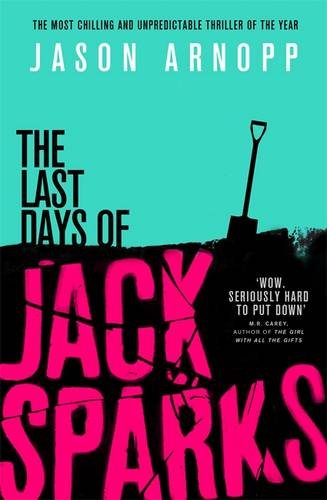
Book Review | The Last Days of Jack Sparks by Jason Arnopp


Jack Sparks died while writing this book.

It was no secret that journalist Jack Sparks had been researching the occult for his new book. No stranger to controversy, he'd already triggered a furious Twitter storm by mocking an exorcism he witnessed. Then there was that video: forty seconds of chilling footage that Jack repeatedly claimed was not of his making, yet was posted from his own YouTube account. 

Nobody knew what happened to Jack in the days that followed—until now.

***

If Hunter S. Thompson had written a Blair Witch tie-in, it might have looked a little something like this. A gonzo ghost story that trades in unreliable narration and drug-fuelled devastation, The Last Days of Jack Sparks marks the original fiction debut of music journalist and now novelist Jason Arnopp, and has as its central character a man who made his name writing for the NME before properly letting loose in a few bestselling books.

That's where the similarities between the author and the authored end, however. I have reason to believe that Jason Arnopp is a genuinely decent human being, whereas Jack Sparks is an egotistical twit who, for his first trick, travelled the length and breadth of Great Britain on a pogo stick, offending everyone he encountered equally. Since then, he's gobbled up gang culture and gotten close to a couple of Class A chemical concoctions, with similarly repugnant results.

Now, for his new novel, he's set his sights on a Halloween theme. Could ghosts really be real? Our intrepid reporter wants to know. So much so that Jack Sparks on the Supernatural will be his last book, because he died, quite violently, while writing it.

We learn this thanks to Jack Sparks' estranged brother Alastair, who footnotes and provides a foreword for the first draft of the found fiction that follows:
The decision to publish Jack Sparks on the Supernatural in its entirely uncensored form was in no way taken lightly, and I know how very difficult it is for the bereaved to read accounts of such horrendous events. Yet I also hope this book may yield some form of closure and put an end to unhelpful internet speculation—not least concerning the nature of my brother's death. (p.8)
Be warned, though, that Alastair's intentions might not be so wholly noble. "Believe me," he begs—but why should we? There's something defensive, dare I say desperate, about his abrupt introduction. And not long later, we learn that he and his brother weren't even on speaking terms towards the end of Jack's tenure. Might Alastair have an axe of his own to grind?

Jack indubitably does. He's a man on a mission at the outset of his ultimate effort: not to find evidence of things that go bump in the night, but to disprove every indication that they may. To wit, he sits in on an exorcism in Italy; laughs out loud as he live-tweets it, even. What he sees that day is hard to explain away, but Jack is determined to do so, or die trying.

Tuesday, 17 May 2016

Book Review | Central Station by Lavie Tidhar


A worldwide diaspora has left a quarter of a million people at the foot of a space station. Cultures collide in real life and virtual reality. The city is literally a weed, its growth left unchecked. Life is cheap, and data is cheaper.

When Boris Chong returns to Tel Aviv from Mars, much has changed. Boris’s ex-lover is raising a strangely familiar child who can tap into the datastream of a mind with the touch of a finger. His cousin is infatuated with a robotnik—a damaged cyborg soldier who might as well be begging for parts. His father is terminally-ill with a multigenerational mind-plague. And a hunted data-vampire has followed Boris to where she is forbidden to return.

Rising above them is Central Station, the interplanetary hub between all things: the constantly shifting Tel Aviv; a powerful virtual arena, and the space colonies where humanity has gone to escape the ravages of poverty and war. Everything is connected by the Others, powerful alien entities who, through the Conversation—a shifting, flowing stream of consciousness—are just the beginning of irrevocable change.

At Central Station, humans and machines continue to adapt, thrive... and even evolve.

***

World Fantasy Award winner Lavie Tidhar rewrites the rules of the short story collection in Central Station, an ambitious assemblage of thirteen tales tall but indubitably true that are all the more remarkable when read together.

"Substantially different versions" (p.251) of eleven of the efforts it collects were previously published, in various venues, between November 2011 and September 2014, and the handful of them that I read then impressed me immensely. 'The Smell of Orange Groves' and 'The Lord of Discarded Things,' for instance, represented intimate glimpses into the lives of a few of the disaffected folks who call the "bordertown" (p.34) at the base of the Central Station spaceport home.

In one, after decades in the Belt, birthing doctor Boris Chong returns to his roots to tend to his ailing parent, only to end up hooking up with his childhood sweetheart Miriam Jones, who's grown older in the intervening years—as has he—and adopted a boy. In the other, Ibrahim, an alte-zachen man, or "junk gypsy," (p.48) finds a genetically modified messiah in a small shoebox, and resolves to raise him himself—free of his fate as far as is possible in a place like Central Station, which is so rife with religion that it boasts a "faith bazaar." (p.23)

They were little things, those stories; lovely, and lively, and large of heart, but little, admittedly. Not so in Central Station, which generously extends the two tales I've touched on at the same time as seamlessly stitching together their characters and narratives with those of the other eleven featured here.

Thursday, 25 February 2016

Book Review | The Guns of Ivrea by Clifford Beal


Acquel Galenus, former thief and now monk of no particular skill, indifferent scribe and even worse chorister, uncovers a terrible secret under the Great Temple at Livorna that could shiver the one faith to its core. A secret that could get him killed. A secret that could enable an older, more sinister form of worship to be reborn...

Pirate princeling Nicolo Danamis, mercenary to the King and captain of the largest fleet in the island kingdom of Valdur, has made one deal too many, and enemies are now closing in to destroy him.

And Citala, fair-haired and grey-skinned, the daughter of the chieftain of the Merfolk who inhabit the waters of Valdur, finds herself implacably drawn to the affairs of men. She puts events in motion that will end her people's years of isolation but that could imperil their very existence...

All their fates will intertwine as they journey through duchies and free cities riven by political intrigue, religious fervour, and ancient hatreds. Alliances are being forged anew and after decades of wary peace, war is on the wind once again...

***

With Gideon's Angel and The Raven's Banquet, Clifford Beal handily established himself as an author of fast-paced historical fiction with a generous splash of the supernatural, but in the first of his Tales of Valdur, he goes full-on fantasy with a book best described as Black Sails meets Peter V. Brett's Demon Cycle series.

Instead of the seventeenth-century England of the cracking Cromwell novels, The Guns of Ivrea takes place in a secondary world reminiscent of the Mediterranean where piracy is rife and unrest is on the rise:
To be sure, Valdur was not a happy kingdom. Five fractious duchies, three free cities, and a royal enclave not much bigger than a market town made the prospects for prosperity and concordia rather slim. Nor did it help that the king of Valdur was a distracted, vain, and rather stupid man, content to let the dukes and high stewards of the land conspire and scheme. 
But at least he has me, thought Captain Danamis. (p.19)
Captain Danamis—Nico to you and me—is the commander of "a sizeable fleet which had come into his hands as a result of inheritance, brashness bordering on insolence, and a smidgen of blind luck. And this fleet, a collection of great carracks, caravels, and cogs, was now the largest in Valdur." (p.19) This is due to Nico's negotiations with the merfolk, who've taken to trading the treasure they find on the ocean floor for a packages of a plant with intoxicating qualities that can only be had on land. 

Self-interested idiot that he is, Nico could care less what the merfolk do with the myrra, so long as the money keeps coming... but our fool has forgotten something obvious: that the bigger you are, the farther you have to fall. He's about to be reminded. See, some of the pirates under Nico's leadership have been feeling increasingly uneasy about their dependence on the people of the sea, not least because they follow the One Faith, which insists that the mer are the enemies of men.

Monday, 21 December 2015

Book Review | The Thing Itself by Adam Roberts


"I saw the John Carpenter film The Thing for the first time recently. That wasn't one of the VHS tapes they gave us, back then, to watch on the base. For obvious reasons. That's not what it was like for me at all. That doesn't capture it at all. They, or it, or whatever, were not thing-y. They are inhuman. But this is only my dream of them, I think."

Two men, alone together on an Antarctic research base. A killer. A sceptic. Alone for months on end. Separated by what they believe. Joined together by Fermi's Paradox.

Are we, indeed, alone in the Universe? Could it be that we are not alone but that we cannot know it? Could we deal with the horror of either answer?

Crossing the boundaries of time and space, the many threads of The Thing Itself weave both a terrifying adventure and a mind-blowing philosophical conundrum, reaffirming Adam Roberts' unique place in the SF canon.

***

At an Antarctic research station in the 1980s, two men at their end of their respective tethers, alone in this lovely if unlovable land but for one another and a copy of Emmanuel Kant's Critique of Pure Reason, see something that cannot conceivably be:
There was a hint of—I'm going to say, claws, jaws, a clamping something. A maw. Not a tentacle, nothing so defined. Nor was it a darkness. It made a low, thrumming, chiming noise, like a muffled bell sounding underground, ding-ding, ding-ding. But this was not a sound-wave sort of sound. This was not a propagating expanding sphere of agitated air particles. It was a pulse in the mind. It was a shudder of the soul. (pp.25-26)
Sound familiar? Well, it is—for a fraction of a chapter.

Would you be surprised if I were to tell you that The Thing Itself is not—not even nearly—what it appears to be? If you answered yes to that question, I'd be given to guess you've never read an Adam Roberts novel. If you had, you'd know that this is not an author who likes to linger on any one thing for long, so though the first chapter has a handful of callbacks to John Carpenter's tentacular classic, the second is a short travelogue of sorts set in Germany almost a century earlier.

"Let me pick the threads of this story up again, rearrange the letters into a new form," (p.48) the next bit begins—which sentence, I'll confess, had me panicking preemptively at the prospect of a new narrative in every chapter. But although Roberts does repeatedly rewrite the rules of the tale he's telling, The Thing Itself is an easier and more coherent read than it appears.

Which isn't to say it's simple.

Thursday, 19 November 2015

Book Review | The Light That Gets Lost by Natasha Carthew


A small boy hiding in a cupboard witnesses something no child should ever see. He tries not to look but he still hears it. And when he comes out, there's no mistaking. His mum and dad have been killed. And though he's only small, he swears that he'll get revenge one day.


Years later, Trey goes to a strange camp that is meant to save troubled teenagers. It's packed with crazies, god-botherers, devoted felons and broken kids. Trey's been in and out of trouble ever since the day the bad thing happened, but he's not here for saving: this is where he'll find the man who did it. Revenge and healing, salvation and hell are a boiling, dangerous mix, and Trey finds himself drawn to a girl, a dream and the offer of friendship in the dark .

***

When you think about it, the business of living boils down to a string of decisions; seemingly insignificant decisions about little things, largely, like whether to take the left road or the right. Maybe one direction gets you to your destination without delay on this postulated day, and perhaps that matters, but taking the long way could lead, equally, to a chance meeting that leads to laughter that leads, at the last, to love.

What I mean to say is that, in a very real way, we're changed by our choices—made or broken or both. Take Tremain Pearce, the deeply damaged protagonist of Natasha Carthew's languid but ultimately uplifting latest. When a man murders his mother and father, and hurts his big brother Billy so seriously that he'll require round-the-clock care for the remainder of his days, Trey chooses to make the guy who got away with it pay: a decision that determines the lot of his lamentable life from that sickening instant on.
His short life, sketched and drawn wrong since memory began, had been rubbed down to this one moment in time; he was sitting at the brink of a place where there was no turning back and he was ready to jump. For Mum and Dad and Billy he was ready to leap into the unknown and all he knew of that unknown was it had one single solitary name and the name was revenge. (p.5)
In the name of revenge, then, Trey contrives a transfer from his foster family into the care of Camp Kernow, a faith-based prison facility which purports to teach difficult children a trade, where he has reason to believe the man who took his family from him has sought safety "in the cloth of God." (p.6)

Tuesday, 20 January 2015

Book Review | The Providence of Fire by Brian Staveley


The Annurian Empire's ruling family must be vigilant, as the conspiracy against them deepens. Having discovered her father's assassin, Adare flees the Dawn Palace in search of allies. But few trust her, until she seems marked by the people's goddess in an ordeal of flame.

As Adare struggles to unite Annur, unrest breeds rival armies—then barbarian hordes threaten to invade. And unknown to Adare, her brother Valyn has fallen in with forces mustering at the empire's borders. The terrible choices they face could make war between them inevitable.

Fighting his own battles is their brother Kaden, the rightful heir to the Unhewn Throne, who has infiltrated the Annurian capital with two strange companions. While imperial forces prepare to defend a far-distant front, Kaden's actions could save the empire, or destroy it.

***

Attracting complaint and acclamation in almost equal measure, Brian Staveley's debut proved precisely as divisive as I imagined it might: there were those readers ready to invest in its incredible potential, and there were those bored by its borderline by-the-numbers nature.

The Emperor's Blades undoubtedly did suffer from some significant issues—its manifest mistreatment of women in particular irked this critic—but at the same time, I found in the fantasy saga's first volume quite a lot to like. What little there was of its world was wonderful; the cosmic horror of its monsters was a welcome exception to certain unwritten traditions; meanwhile most, if not all of the narrative's central characters were well developed by the conclusion of what was an engrossing chronicle overall.

At the end of the day, I dare say I enjoyed The Emperor's Blades. My reservations, however, came back to me in a flash when the time came to see about the sequel. By taking the better part of a hundred pages to begin, it doesn't put its best foot forward, I'm afraid... but beyond that? Boy oh boy. The Providence of Fire stands as a lesson in a sense: that great things can spring from small beginnings.

The Providence of Fire picks up—when it picks up—right where The Emperor's Blades left off: with Kaden, heir to the entire Annurian empire since the assassination of his father, and Valyn, captain of a Wing of rebel Kettral riders—and his elder sibling's saviour—as brothers in both blood and arms at last.

Monday, 17 November 2014

Book Review | Revival by Stephen King


In a small New England town, in the early 60s, a shadow falls over a small boy playing with his toy soldiers. Jamie Morton looks up to see a striking man, the new minister, Charles Jacobs. Soon they forge a deep bond, based on their fascination with simple experiments in electricity.

Decades later, Jamie is living a nomadic lifestyle of bar-band rock and roll. Now an addict, he sees Jacobs again—a showman on stage, creating dazzling 'portraits in lightning'—and their meeting has profound consequences for both men. Their bond becomes a pact beyond even the Devil's devising, and Jamie discovers that revival has many meanings.

A masterpiece in the great American tradition of Nathaniel Hawthorne and Edgar Allan Poe, this rich and disturbing novel spans five decades on its way to the most terrifying conclusion Stephen King has ever written.

***

Whether you love his work or loathe it—and there are those who do, difficult as that is for those who don't to discern—you've got to give Stephen King credit, in the first for working so damned hard. Over the forty years of his career, he's written fifty-odd novels, and financially, you have to imagine he'd have been sitting pretty after the first five.

This, then, isn't a man who does what he does for the money. Demonstrably, I dare say, he does it for the fun, and that's a fine thing, I think; after all, to paraphrase Dreamcatcher's central character, doing the same shit day after day does get dull, and dull is the last thing a writer writing recreationally can afford to be. To escape that fate, King has reinvented himself repeatedly in recent years. He's come up with a couple of very credible crime thrillers, commingled conspiracy with the stuff of science fiction and composed love letters to the old days and ways.

In that respect, Revival is a real throwback. A supernatural horror novel of the sort not seen since Duma Key, it's classic King, complete with fantastic characters, a suggestive premise and an ending I'm going to politely describe as divisive.

Revival begins reflectively:
In one way, at least, our lives really are like movies. The main cast consists of your family and friends. The supporting cast is made up of neighbours, co-workers, teachers, and daily acquaintances. There are also bit players: the supermarket checkout girl with the pretty smile, the friendly bartender at the local watering hole, the guys you work out with at the gym three days a week. And there are thousands of extras—those people who flow through every life like water through a sieve, seen once and never again. [...] But sometimes a person who fits none of these categories comes into your life. This is the joker who pops out of the deck at odd intervals over the years, often during a moment of crisis. In the movies this sort of character is known as the fifth business, or the change agent. When he turns up in a film, you know he's there because the screenwriter put him there. But who is screenwriting our lives? (p.1)
There's a lot in this paragraph to unpack: the idea of the illusion of life; the allusion, not unrelatedly, to God as the author of all; and an introduction to the narrative's eventual antagonist, Reverend Charles Jacobs. Let's focus on that last.

Monday, 3 November 2014

Book Review | The Book of Strange New Things by Michel Faber


It begins with Peter, a devoted man of faith, as he is called to the mission of a lifetime, one that takes him galaxies away from his wife, Bea. Peter becomes immersed in the mysteries of an astonishing new environment, overseen by an enigmatic corporation known only as USIC. His work introduces him to a seemingly friendly native population struggling with a dangerous illness and hungry for Peter’s teachings—his Bible is their “book of strange new things.” But Peter is rattled when Bea’s letters from home become increasingly desperate: typhoons and earthquakes are devastating whole countries, and governments are crumbling. Bea’s faith, once the guiding light of their lives, begins to falter. 

Suddenly, a separation measured by an otherworldly distance, and defined both by one newly discovered world and another in a state of collapse, is threatened by an ever-widening gulf that is much less quantifiable. While Peter is reconciling the needs of his congregation with the desires of his strange employer, Bea is struggling for survival. Their trials lay bare a profound meditation on faith, love tested beyond endurance, and our responsibility to those closest to us.

***

Michel Faber's first novel since The Fire Gospel—a sterling send-up of The Da Vinci Code and its ilk—is a characteristically compelling exploration of faith which takes place "in a foreign solar system, trillions of miles from home," (p.47) on a wasteland planet populated by hooded beings with foetuses for faces.

So far, so science fiction. Factor in first contact, a spot of space travel, and an awful lot of apocalypse, and The Book of Strange New Things seems damn near destined to be speculative. Unfortunately for fans of the form, as the author warns early on, "there was nothing here to do justice to [that] fact." (p.47) Or, if not nothing, then very little aside the superficial.

Even in addition to the aforementioned trappings, honeydewed drinking water and a dizzying day/night cycle do not add up to much more than an unlikely lens through which to look at love: in the first between mere mortals, but above and beyond that, the love—and the love lost—between man and maker.

The Book of Strange New Things is beautiful, albeit brutal. Despairing to a degree, but also bullish about the future. Hope, however, is a fragile thing, as Faber's protagonist preaches at a point:
As fragile as a flower. Its fragility makes it easy to sneer at, by people who see life as a dark and difficult ordeal, people who get angry when something they can't believe in themselves gives comfort to others. They prefer to crush the flower underfoot, as if to say: See how weak this thing is, see how easily it can be destroyed. But, in truth, hope is one of the strongest things in the universe. Empires fall, civilisations vanish into dust, but hope always comes back, pushing up through the ashes, growing from seeds that are invisible and invincible. (p.315)
Indeed, Peter Leigh means to be one of these seeds; to share his hope—the faith that saved him from a life of drug abuse and destitution—with the natives of Oasis. He still struggles to believe the Powers That Be at USIC picked him of all people—him but not his wonderful wife Bea, who did deliver Peter from his dark past—to be an apostle upon another planet; to spread the Good News about God to the "indigenous inhabitants" (p.71) of this unknowable new world.

Monday, 29 September 2014

Book Review | Afterworlds by Scott Westerfeld


Darcy Patel has put college on hold to publish her teen novel, Afterworlds. With a contract in hand, she arrives in New York City with no apartment, no friends, and all the wrong clothes. But lucky for Darcy, she’s taken under the wings of other seasoned and fledgling writers who help her navigate the city and the world of writing and publishing. Over the course of a year, Darcy finishes her book, faces critique, and falls in love.

Woven into Darcy’s personal story is her novel, Afterworlds, a suspenseful thriller about a teen who slips into the “Afterworld” to survive a terrorist attack. The Afterworld is a place between the living and the dead, and where many unsolved—and terrifying—stories need to be reconciled. Like Darcy, Lizzie too falls in love... until a new threat resurfaces, and her special gifts may not be enough to protect those she cares about most.

***

As someone somewhen almost certainly said, the story is the thing... and it is, isn't it? Most readers read in order to know what happens next—to these characters or that narrative—rather than out of interest in much of anything outwith a given fiction; assuredly not the particular process of authors, though after Afterworlds, I've begun to wonder whether we mightn't be missing a trick.

A twofold story about storytelling, Scott Westerfeld's insightful new novel alternates between a pair of coming of age tales. In one, we meet Lizzie: a typical teenager, to begin with, who's too busy texting to notice the start of a terrorist attack:
I'd never heard an automatic weapon in real life before. It was somehow too loud for my ears to register, not so much a sound as the air ripping around me, a shudder I could feel in my bones and in the liquid of my eyes. I looked up from my phone and stared. 
The gunmen didn't look human. They wore horror movie masks, and smoke flowed around them as they swung their aim across the crowd. [...] I didn't hear the screams until the terrorists paused to reload. (pp.5-6)
Luckily, Lizzie comes to her senses eventually. As quietly as she can, she calls 911 as the bullets fly by. The operator on the other end of the telephone tells Lizzie her best bet is to play dead, and in lieu of a safer location, she does exactly that.

A touch too well, in truth, because she faints, and awakens in another world. There, in the land of the no longer living—a grayscale place where "the air [tastes] flat and metallic" (p.20)—she promptly falls for a foxy psychopomp:
These terrorists had tried to kill me but I'd gone to the land of the dead and now could see ghosts and apparently had acquired dangerous new powers and this boy, this boy had touched my fingertips—and they still tingled. (p.76)
In the aftermath of the attack, it beggars belief, a bit, that this boy is Lizzie's priority. Not the loss of so much life. Not her own nearness to nothing. Not even the realisation that she can move between worlds at will. Rather, Yamaraj, "a hot Vedic death god" (p.77) "modeled [...] on a Bollywood star" (p.121) by his faithless creator, debutant Darcy Patel.

Friday, 5 September 2014

Book Review | J by Howard Jacobson


Two people fall in love, not yet knowing where they have come from or where they are going. Kevern doesn't know why his father always drew two fingers across his lips when he said a world starting with a J. It wasn't then, and isn't now, the time or place to be asking questions.

Ailinn too has grown up in the dark about who she was or where she came from. On their first date Kevern kisses the bruises under her eyes. He doesn't ask who hurt her. Brutality has grown commonplace. They aren't sure if they have fallen in love of their own accord, or whether they've been pushed into each other's arms. But who would have pushed them, and why?

Hanging over the lives of all the characters in this novel is a momentous catastrophe—a past event shrouded in suspicion, denial and apology, now referred to as What Happened, If It Happened.

J is a novel to be talked about in the same breath as Nineteen Eighty-Four and Brave New World, thought-provoking and life-changing. It is like no other novel that Howard Jacobson has written.

***

Alongside Us, The Bone Clocks, and How To Be Both, J by Howard Jacobson was one of a number of novels longlisted for the Man Booker Prize in advance of its publication date. A source of frustration for some, I'm sure—though this has ever been the panel's habit—but for others it represents a reason to update reading radars.

This year, I found myself amongst the others above, because if not for the nod, I doubt I'd have looked twice at this book. When I did, additionally, it was with some scepticism; after all, Jacobson has won the Booker before, for The Finkler Question in 2010—the first comic novel to take the trophy home in 25 years—and pointedly acknowledging former nominees is another of the panel's practices.

Not today. J, I'm pleased to say, is in every sense deserving of its spot on the longlist. It's a literary revelation wrapped in understated dystopian clothing; a wonder of wit and whimsy that takes in the chilling and the ridiculous—the hilarious and the horrific. That said, it's a novel that requires rereading to appreciate completely.

Friday, 30 May 2014

Book Review | The Three by Sarah Lotz


The world is stunned when four commuter planes crash within hours of each other on different continents. Facing global panic, officials are under pressure to find the causes. With terrorist attacks and environmental factors ruled out, there doesn't appear to be a correlation between the crashes, except that in three of the four air disasters a child survivor is found in the wreckage.

Dubbed The Three by the international press, the children all exhibit disturbing behavioural problems, presumably caused by the horror they lived through and the unrelenting press attention. This attention becomes more than just intrusive when a rapture cult led by a charismatic evangelical minister insists that the survivors are three of the four harbingers of the apocalypse. The Three are forced to go into hiding, but as the children's behaviour becomes increasingly disturbing, even their guardians begin to question their miraculous survival...

***

Before the Frankfurt Book Fair a few years ago, a partial manuscript of The Three was sent to a selection of editors. A perfect storm of offers followed, and less than a day later, a substantial six figure sum from the Hodder & Stoughton coffers proved sufficient to secure the company Sarah Lotz's phenomenal novel. On the strength of an excerpt alone, this was practically unprecedented, especially for an author absent a track record to trade on.

But that, as a matter of fact, isn't entirely accurate: though The Three is the first book to bear her name in such a prominent place outside of South Africa, Lotz has been around the block and back—in the publishing business, that is. In the past, she's worked with her daughter Savannah on the Deadlands saga; she's one of three writers behind Helena S. Paige's pseudonymous Choose Your Own Erotica novels; The Three, however, has most in common with the scathing urban horror Lotz and Louis Greenberg collaborated on as S. L. Grey: not enjoyable novels, no—the events the Downside descents document being altogether too terrible to take pleasure from—but blerrie good books, to be sure. As, in its way, is Lotz's latest.

A horror novel with a hell of a high-concept, The Three is a nightmarish indictment of contemporary culture in much the same way The Mall and The Ward were. Instead of demonstrating the darker side of capitalism or the health system, however, here, Lotz sets her sights on the religious right—in particular the way some folks use faith to advance their own agendas.

Friday, 4 April 2014

Book Review | Descent by Ken MacLeod


How far would you go for the truth? 

Ball lightning. Weather balloons. Secret military aircraft. Ryan knows all the justifications for UFO sightings. But when something falls out of the sky on the hills near his small Scottish town, he finds his cynicism can't identify or explain the phenomenon.

And in a future where nothing is a secret, where everything is recorded on CCTV or reported online, why can he find no evidence of the UFO, nor anything to shed light on what occurred? Is it the political revolutionaries, is it the government or is it aliens themselves who are creating the cover-up?

Or does the very idea of a cover-up hide the biggest secret of all?

***

The truth is out there, somewhere. But pinning it down can be pretty tricky.

In "an iffy skiffy future like none I would or could have imagined in my teens," (p.7) Scotland is independent, airships ride high in the sky, everyone wears capture glasses, and the poke bonnet has come back into fashion. Ridiculous, right? But that's reality, for Ryan—a teenage boy at the beginning of Ken MacLeod's new book whose coming of age over its conspiratorial course is dictated by the close encounter he has in the company of his neanderthal pal Calum.

It's not as if they set out to see something weird—they're just bored boys who decide one day, mid revision, to hike up a hill—but "that's how it always begins," isn't it? "You wanted a walk. It was a wet afternoon and you fancied a drive. The night was vile and you were minded to check on the cow." (p.14) And then the aliens came!

Actually, scratch that. The aliens come a little later. What happens on the hill, where Calum and Ryan are waiting out weather that's taken a turn for the terrible, is unusual, sure, but the "silvery sphere" (p.20) that appears may be no more than a drone, and the blinding white which knocks both boys unconscious for hours afterwards could be ball lightning... right?

They pair are understandably shaken by their shared experience, but whilst Calum learns to live with it, Ryan takes somewhat longer to move on—not least because of his dreams that evening. He is "terrified, but not surprised," to be visited by something other. "The creature was a cliche, your average working alien, a bog-standard Grey. About four and a half feet tall, with a bit oval head, skinny torso, spindly limbs, a ditto of nostrils and a lipless little em-dash of a mouth." (p.44) It transports him to its mothership, where a handsome pair of alien assistants impart some familiar words of wisdom before making our man-in-the-making masturbate and sending said back to bed.

Monday, 31 March 2014

Book Review | Blood Kin by Steve Rasnic Tem


Michael Gibson has returned to the quiet Appalachian home of his forebears to take care of his grandmother. Sadie is old and sickly but she has an important story to tell about growing up poor and Melungeon (a mixed race group of mysterious origin) while bedeviled by a snake-handling uncle and empathic powers she but barely understands. 

In a field not far from the family home, however, lies an iron-bound crate within a small shack buried four feet deep under Kudzu vine. Michael somehow understands that hidden inside that crate is potentially his own death, his grandmother's death, and perhaps the deaths of everyone in the valley if he does not come to understand Sadie's story well enough.

***

Folks are rarely as forthright in life as they are in literature.

Communicating the truth of the human condition would make for some messy stories, so even the most deftly developed characters are at best partial pictures of the people they’d really be. After all, we wear different faces each day, don’t we? We wear one at work, another at home; one in the company of our mothers, another alongside our lovers.

During your life you play many parts—a daughter, a mother, a grandmother, a hero, a villain. You enter people’s lives and then you exit them. You say your lines—you inspire some people, and maybe some people hate you. And then, well, you leave the stage. (p.233)
Whether you receive a round of applause when you do, or boos, is up to you.

Blood Kin by Steve Rasnic Tem is a book about the conflicting legacies we leave which deals with death and depression and disability whilst trading in tension and frequently intolerable terror to excellent effect.

Our man Michael is almost a monster at the offing. On the back of a bad breakup he’s come back to the house in the South where he was born and raised; ostensibly to look after his ailing grandparent, but in truth he’s considering killing her—or at least letting her die. He decides against it, eventually, before settling in to suffer through some more of old Sadie’s story.

See, for some reason she’s determined to tell him about her hardships in this here hollow. About the preacher whose hellish services she was pressganged into attending as a girl, and the ungodly horrors that followed:

They’d had the most gruesome murder anybody had ever heard of and the murderer in the local jail and the deputy scared to death of angry folks taking his prisoner and her daddy almost shot the most popular moonshiner in the county and there were two big families now that didn’t know how to talk to each other and of course there was the preacher going a little crazier each day. Who walked around with a snake under his shirt curled around his chest and belly. (p.217)

Friday, 3 January 2014

Book Review | The Madonna on the Moon by Rolf Bauerdick


November 1957: As Communism spreads across Eastern Europe, strange events are beginning to upend daily life in Baia Luna, a tiny village nestled at the foot of the Carpathian Mountains. As the Soviets race to reach the moon and Sputnik soars overhead, fifteen-year-old Pavel Botev attends the small village school with the other children. Their sole teacher, the mysterious and once beautiful Angela Barbulescu, was sent by the Ministry of Education, and while it is suspected that she has lived a highly cultured life, much of her past remains hidden. But one day, after asking Pavel to help hang a photo of the new party secretary, she whispers a startling directive in his ear: “Send this man straight to hell! Exterminate him!” By the next morning, she has disappeared.

With little more to go on than the gossip and rumors swirling through his grandfather Ilja’s tavern, Pavel finds curiosity overcoming his fear when suddenly the village’s sacred Madonna statue is stolen and the priest Johannes Baptiste is found brutally murdered in the rectory. Aided by the Gypsy girl Buba and her eccentric uncle, Dimitru Gabor, Pavel’s search for answers leads him far from the innocent concerns of childhood and into the frontiers of a new world, changing his life forever.

***

In Baia Luna, a small village of some 250 self-sufficient souls hidden away at the base of the Carpathian Mountains, "today was like what yesterday was and tomorrow would be." (p.50)

But not for long. On the contrary, a time of great change awaits. It's November 1957, and the fictitious nation of Transmontania is about to be sucked whole-hog into the socialist bloc. Communism is of course on the cards, and whomsoever stands in the way of the Conjucator shall surely be squashed.

"About to turn sixteen [and] stuck in a swamp halfway between a boy and a man," (p.78) Pavel Botev has more immediate problems to attend to at the outset of The Madonna on the Moon, the first novel by Rolf Bauerdick, an award-winning German photojournalist. Raised by his aunt and his grandfather, a "formerly commonsensical" (p.325) sort convinced that the body of the Virgin Mary is on the moon, Pavel becomes caught up in a bizarre conspiracy which will dog him to the end of an era that has hardly started.

Wednesday, 16 October 2013

Book Review | The Devil's Apprentice by Jan Siegel


The Devil is retiring... but who’s taking over?

When teenage Pen inherits the job of caretaker for a London building with no doors and only a secret entrance from the caretaker’s lodge — which she must never use — little does she know it will lead her into unbelievable danger. For Azmordis, also known as Satan, a spirit as old as Time and as powerful as the Dark, Immortality is running out.

In the house with no front door, a group of teenagers are trapped in assorted dimensions of myth and history, undergoing the trials that will shape them to step into his cloven footwear — or destroy them. Assisted by only by an aspiring teenage chef called Gavin and Jinx, a young witch with more face-piercing than fae-power, Pen must try to stop the Devil’s deadly game plan — before it’s too late.

***

A dead man lives in Temporal Crescent. A Mr. Andrew Pyewackett, to be precise. He passed away seven years before the events of The Devil's Apprentice, but he's stuck around since to be sure that the unholy house he spent his lifetime looking after is left to someone sensible, someone undaunted by its particular... idiosyncrasies.

He has the ideal man in mind — Bartlemy Goodman, of no fixed above — alas, no one has been able to find the fellow, and in the period his lax lawyers have been looking, Pyewackett has gone to pieces. Quite literally. As he admits, "I simply can't go on like this. [...] Flesh and blood won't stand it. Let's face it, they aren't meant to. Look at me, I'm already falling to bits — every time I remove my socks several toes fall off. I need to get out of this body and move on. Arrangements will have to be made." (p.14)

These arrangements are as strange as the circumstances which made them a must. Pyewackett instructs the family firm to appoint Penelope Anne Tudor — Pen to you and me — as interim executor of his remaining estate. She's to move into the adjoining property, which comes complete with a brilliant butler and its very own pair of haunted falsers, the better to continue the search for the lost legatee.

Thing of it is, Pen's only thirteen, and her grandmother will never go along with this madness... will she?
She would never be allowed to stay in Temporal Crescent and do her job. And she wanted to. She wanted it more than anything in her life. It was maturity, responsibility, freedom. She had decided she wasn't worried about the danger element — a house surely couldn't be dangerous, with or without a front door. Whatever might happen, she would handle it. 
If she got the chance. (p.40)
She gets the chance.

Let us pause before we talk about the plot proper to consider this: one of my only problems with what is otherwise a magnificent new novel. Pen's gran is an absolute pushover. She takes precious little convincing in the first instance, is largely absent after the fact, and when there's a murder outside 7A several weeks later, dear old Eve expresses her regrets and then simply goes about her business. Which seems, in short, to be shopping.

This is one of the genre's peculiar problems. Reminiscent of modern horror's struggle to strand its characters in isolated environments in a world where such places are truly few and far between, the YA narrative must arrange, often implausibly, for its pubescent protagonists to be let loose by the adults in charge of their care; adults who would in all probability spoil the fun for everyone. In The Devil's Apprentice, Jan Siegel simply dismisses the need for a decent rationale as to why Pen and her pals can run riot, and that did bother me a bit.

Besides this, though, The Devil's Apprentice is fantastic fun, especially once we find out what the house is all about. No. 7 Temporal Crescent isn't haunted, as it happens. Instead:
"It's something called a space/time prison," Pen said. "I don't know what that is, but all the doors open on different bits of the past, or magical dimensions, and if you go through you'll get lost, sort of absorbed into history. Like if you're in the eighteenth century, that's where you think you belong. It stops people going around changing the course of events." (p.92)
As soon as Pyewackett passes on, Pen sets about investigating No. 7 in earnest. By the time Gavin Lester let himself into the adjoining quarters she's already been attacked by a velociraptor, so Pen is happy for him to help. He's looking for Bartlemy Goodman too — Gavin believes Bartlemy may be the man to teach him how to be Great Britain's best chef — as is Jinx, a little witch who comes a-calling because she's intercepted whispers from double-dealing demons about a unique job opportunity.
No one believes in the Devil any more. He went out of fashion with wimples and witch-trials, made a brief comeback with the powdered wig, the bal masque and the Marquis de Sade, popped up in the London smog somewhere between the crinoline and the bustle, and vanished for good into a world of kitsch horror films in the mid/late twentieth century. Evil went on, of course, but Evil is made by humans; we need no supernatural help for that. But there is someone who feeds off our evil — who feeds it and feeds off it — the Rider of Nightmares, the Eater of Souls, the God of Small Print, and if he no longer wears horns and a tail that is merely a matter of style. Modern thinking belittles him, superstition touches wood for him, children dance around his maypole — but never widdershins, always with the sun. He hides in folktale and fear, in legends and lies — don't speak his name, or he may hear you, don't whistle, or he may come to you. If you believe in fairies, don't clap, for there are darker things than the sidhe in the World Beyond Midnight. Call him a myth, call him a fantasy, for myth and fantasy do no exist. 
He exists. (pp.49)
He indubitably does in The Devil's Apprentice, and indeed, he's looking to train his eventual successor, who he's decided must come from the mortal realm.

To be completely clear, Jinx doesn't want the job: she wants to stop whoever does. Because better the devil you know, you know?

She and Gavin and Pen are in any event a terrific trio of troublemakers who work wonderfully as one. Pen is our resident sceptic. Pyewackett hiring her "was the most magical thing that had ever happened to her, except she didn't believe in magic. Unlike her friends, she didn't read fantasy books — in fact, she read very little fiction at all since she couldn't see the point of it, though her grandmother had ensured she had a basic knowledge of all the classics. But Pen preferred facts. [...] In her view, imagination just got you into trouble." (p.24) Jinx the witch is by definition Pen's polar opposite, though they get on pretty well for all that, whilst she and Martin are at odds with one another from the first, which needless to say leads to some smartly barbed banter.

In Jan Siegel's capable hands the entirety of The Devil's Apprentice is rather smart, in fact. The novel's long chapters are punctuated by ominous interludes set elsewhere and elsewhen which do a great job of enlivening the story's more mundane moments... though there are few of these, in truth. Accordingly, the plot is a joy: the premise all potential — above and beyond what goes on in this novel — and in execution even better, equal parts chilling and thrilling.

Take, say, The Graveyard Book by Neil Gaiman as a base. Fold in a little K. J. Parker, perhaps, and fill with Jasper Fforde a la The Last Dragonslayer. Season to taste with finely ground J. K. Rowling and serve with a generous helping of Diana Wynne Jones' wonderful whimsy. It may be that I've been mainlining The Great British Bake Off in recent weeks, but Gavin — the would-be cook of this delectable new book — would approve, I'm sure.

Jan Siegel has been silent, sadly, since the unceremonious sinking of her Sangreal trilogy in 2006. A young adult fantasy for all the family certainly wasn't what I expected from her new novel, but with a hint of the sinister and a smidgen of silliness, it's such bloody good fun that it's a pleasure most piquant to welcome her back to the business of witty literature.

Don't go anywhere, eh? Pretty please with a temporal cherry on top!

***

The Devil's Apprentice
by Jan Siegel

UK & US Publication: October 2013, Ravenstone

Buy this book from
Amazon.co.uk / Amazon.com
IndieBound / The Book Depository

Or get the Kindle edition

Recommended and Related Reading


Tuesday, 10 September 2013

Book Review | More Than This by Patrick Ness


A boy drowns, desperate and alone in his final moments. He dies.

Then he wakes, naked, bruised and thirsty, but alive.

How can this be? And what is this strange, deserted place?

As he struggles to understand what is happening, the boy dares to hope. Might this not be the end? Might there be more to this life, or perhaps this afterlife?

***

A decade on from The Crash of Hennington, this April saw the publication of Patrick Ness's first novel ostensibly for adults since his little-seen 2003 debut... and what a novel The Crane Wife was! At the time, I concluded that it was "simply sublime: a story as strange, ultimately, as it is true," and to be sure, it's still sitting pretty in my list of the year's best books. Now the two-time Carnegie Medal award-winner is back doing... well, I wouldn't say what he does best, not after the enchanting affair aforementioned, but doing, again, the thing with which he's found the most success: genre fiction by way of YA.

But this isn't the YA of your young adulthood. Not by any stretch of the imagination — and there's imagination aplenty in More Than This. It's searching, but soaring. Inconceivably bleak and indisputably brilliant. It's as speculative as anything Ness has written in the years since he appeared on the scene, yet the weird has rarely felt so real; the surreal so sweetly sincere.

Incredibly, it begins with the death — with the drowning — of our poor protagonist Seth, culminating in an "impact just behind his left ear [which] fractures his skull, splintering it into his brain, the force of it also crushing his third and fourth vertebrae, severing both his cerebral artery and his spinal cord, an injury from which there is no return, no recovery. No chance." (p.11)

Be that as it may, this end is a beginning as well, because Seth doesn't simply cease to exist. He's dead, yes, but his life, in some form, goes on...

"The first moments after the boy's death pass for him in a confused and weighty blur," (p.15) and they're apt to affect readers reeling from the mercilessness of Seth's postmortem-esque end equally. But time ticks ever on. "An impossible amount of time passes," in fact; be it "a day, a year, maybe even an eternity, there is no way he can know. Finally, in the distance, the light begins to slowly, almost imperceptibly change." (p.16)

Little by little, things become clearer. Somehow, Seth has awoken in his old house in England, where he and his little brother Owen were brought up before they moved to America. It seems uncannily alike the selfsame summer, he realises, that something indescribably horrible happened in his past; the very unfortunate event that led them to emigrate in the first place. Seth knows it's important, but he can't quite put his finger on what it was.

The village, in any event, is different. That is to say it's much the same as Seth remembers it in many ways, except unnaturally empty — there's no-one to be seen, certainly; there's no traffic, no noise, no nothing — plus it's covered in thick layers of what our protagonist assumes is undisturbed dirt and dust. And that's hardly the half of it. As Seth senses, "this place is more wrong than even all that's obvious. There's an unreality under all the dust, all the weeds. Ground that seems solid but that might give way any moment." (p.51) An indeterminate number of days later — days punctuated by dreams of experiences so vivid that he's practically reliving them — he reflects as follows:

It feels real enough. Certainly to the touch, and definitely to the nose. But it's also a world that only seems to have him in it, so how real can it be? If this is just a dusty old memory that he's trapped in, maybe it isn't really even a place at all, maybe it's just what happens when your final dying seconds turn into an eternity. The place of the worst season of your life, frozen forever, decaying without ever really dying. (p.79)
There are others, then, but Seth's first serious theory is that he's in hell, or some other aspect of the afterlife. Purgatory, perhaps. Speaking of which, please: leave your Lost baggage in the basement, where in all honesty it belongs. More Than This isn't that. What it is, exactly, is difficult to describe without spoiling the surprise. I'll only imply — as Ness does, very neatly indeed — that it has something to do with a pivotal point in our protagonist's past, a memory that Seth refuses to face... of an accident... a prolonged trauma, suffered by another, and perpetuated by his parents.

He stops. The memory is a dangerous one. He can feel himself teetering again, an abyss of confusion and despair looking right back up at him, threatening to swallow him if he so much as glances at it. [...] That can be for later, he tells himself. You're hungry. Everything else can wait. (p.47)
Only in this way, by focussing wholly on his immediate needs — by existing in physical and psychological isolation both figuratively and literally — can Seth keep on keeping on. He knows of no other option.

Besides Seth's death, so little happens in the opening chapters of More Than This that you'd think it'd be boring. But no. If you’ve come across Ness’s narratives in the past, this shall not shock. If you haven’t, your first order of business is to buy up his entire back catalogue — and be assured that the author’s newest novel is riveting, edge-of-your-reading-seat stuff from beginning to end.

The early sections are reminiscent of The Silent Land by Graham Joyce; something of a prose stylist himself, though Ness, I’d stress, has the edge. He effects in the reader a feeling of wonder and discovery paired with an impalpable sense of threat, very much mirroring Seth’s own outlook. Whilst we experience More Than This from the third-person perspective, its painstaking narration perfectly reflects our protagonist’s inexorable descent into despair. And as his awareness of the nature of this place escalates, ours does too.

There is more to More Than This than this... much more, yet many of the novel's successes depend on Seth's struggle to work out what in hell (ahem) has happened to him, where he is, and above all else, why. As such, there’s a whole lot I can't talk about. What I will say is that Ness is winningly aware of the expectations he's inviting here. After parsing one rather far-fetched rationalisation of his situation, Seth even echoes said sentiment:

“Crap sci-fi,” Seth mutters to himself. “Life is never actually that interesting. It’s the kind of story—“He stops again.
It's the kind of story where everything's explained by one big secret, like [...] what's real and what's not being reversed. The kind of story you watched for two hours, were satisfied with the twist, and then got on with your life.
The kind of story his own mind would provide to make sense of this place. (pp.247-248)
Well, you know... yes and no. Truth be told, the denouement is likely to prove divisive. Some, I’m sure, will call it a cop-out. I think it knows exactly what it’s about.

At times, More Than This is like a literary experiment that only by the grace of its creator resulted in a proper novel, but in the hands of a poised, perfectionist prose-smith like Patrick Ness, it's rarely less than life-affirming.

***

More Than This
by Patrick Ness

UK Publication: September 2013, Walker Books
US Publication: September 2013, Candlewick Press

Buy this book from
Amazon.co.uk / Amazon.com
IndieBound / The Book Depository

Recommended and Related Reading

Monday, 9 September 2013

Guest Post | "Faith in Fiction" by David Towsey

Today it's my pleasure to host a guest post from David Towsey, whose "bloody biblical" debut I reviewed late last week. I spoke quite openly about my faith, or lack thereof, in that article, and indeed, I came away keen to know more about the author's approach to the touchy subject above.

I knew it'd be a big ask, but belief is as powerful a pivot-point as it is provocative, so I cast caution to the wind and touched base with David to see if he'd be interested in discussing his particular perspective. He took the subject seriously from word one, and came back to me with the guest post below.

What follows, then, are the thoughts of "an enthusiastic novice" on faith, and how it factors into fiction.

***

When Niall asked me to write a guest post about my faith and how it informed Your Brother's Blood, I was at first reluctant. To be honest, I was terrified. I imagined my blundering sentences being examined and then torn apart in great detail, counter-posts exclaiming what a terrible person I must be, and worse. Religion is a difficult subject; it's a lot of things to a lot of different people and that can make it very hard to talk and write about. It's part of the trifecta of topics that in my house were not suitable for discussion at the dinner table. 

As a writer, I'm acutely aware that when I involve religion in my work I'm going to be creating problems for some readers. But as Your Brother's Blood isn't on sale in the UK as I'm writing this post, it is obviously hard to gauge reader-response. Perhaps readers will be more inclined to focus on the zombie-esque characters than the treatment of Christianity, but I understand both may raise questions. Questions like: how did my faith inform my debut novel Your Brother's Blood?

The short answer is: it didn't. And that's because I don't have a faith. I am a kind of lethargic atheist. I grew up in a non-religious household. I did attend a Church of England primary school. For assemblies we would file into the church that was next to the school. I can remember very little except the songs. 'Dance, dance, wherever you may be...' That was a favourite. As was the one that said the word 'naked'. [I find myself singing 'He's Got the Whole World in His Hands' with alarming regularity - Niall] Some of the teachings must have sunk into my subconscious. But that's my subconscious, and I prefer to leave that alone.

Lethargic and tolerant atheism. I don't begrudge anyone their faith. In fact, I'm slightly envious of it. Part of me would very much like to be a strong believer in one of the major world religions. From the outside looking in there seems to be a great degree of security and support in faith. But I just don't feel the faith, and I don't think that's the kind of thing you can fake. There are times when I struggle to understand some of the acts that are done in the name of various religions. My failure to understand can sometimes lead to angry words or feelings, but this is not unique to religion. People do things I don't comprehend all the time.

So if I'm an atheist, why write a book that involves a future vision of Christianity? Firstly, the Bible fascinates me. I tried to read it once, cover-to-cover. I found it impossible and am in awe of anyone who has. But I approach the Bible as a writer. That is worth emphasising. I am not looking for spiritual guidance. My fascination comes from the amazing stories and characters in the text. More so, there are some fantastic turns-of-phrase. For me, it's a great resource. And I am a child of the digital age. Instead of having a paper copy of the Bible on my desk, I have www.biblegateway.com bookmarked. Completely searchable, with many different versions of the Bible available, I spend hours on this site. Search the word 'flower' and there are thirty-four results. Brilliant. You can view the passages in context, or see the whole chapter, in just a single click.

Secondly, I believe that, in a challenging world like that of Your Brother's Blood, there would be many people who turned to religion for answers. This is something people have done for millennia – some might even argue it is the whole reason for organised religion. Answers for all the big questions, but also answers on how to live day-to-day. Over the course of the Walkin' Trilogy, I show how different people and communities handle the issue of the Walkin' – a kind of undead population. Your Brother's Blood focuses heavily on the town of Barkley that is fairly hard-line in its belief systems. I don't condemn Barkley for its beliefs. Despite the fact that if there is a villain in the novel then they are from Barkley, the same is true of the hero of the book. The difference is in the individual – something I think is true of all world religions and their believers.

Lastly, there is what I like to think of as the 'writers in space' argument. I write in the SF/F genre – I'll let you decide which Your Brother's Blood is – and that means approaching subjects that are unknown to me as an author. If friends of mine can write about space travel without being an astronaut, it seems odd to shy away from writing about religion as an atheist. Both demand a level of research. Both expose a writer to criticism from greater or more learned minds. It's no doubt obvious at this stage that I'm no Bible scholar. At best I'm an enthusiastic novice. At worst... 

[SPOILER] The Bible features heavily in all three of the Walkin' Trilogy books. It is an important part of the McDermott family. Some characters are happier about that than others. I like to think I treat the subject even-handedly. But I probably don't. If the books contribute to a debate on how writers approach or utilise religion then I don't think that's a bad thing. I'd like to be part of that conversation.

***

Thank you, David, for addressing my question so seriously and sincerely. Despite your doubts, I'm sure everyone here will agree that it's been a real pleasure having you on The Speculative Scotsman.