Showing posts with label comic book review. Show all posts

Monday, 21 January 2013

Comic Book Review | The Crow: Death and Rebirth by John Shirley


I couldn't believe my eyes when I saw a copy of the first issue of The Crow: Death and Rebirth in the comic book store the other month. It had been long enough that I'd almost forgotten the franchise entirely, and I confess that felt a blessing after the last film to bear the brand: 2005's Wicked Prayer, starring Edward Furlong before the fall, is one of the few movies in Rotten Tomatoes' vast back-catalogue to have and to hold the booby prize of 0% approval.

Now I adored The Crow in its first and most fertile forms - which is to say a few of the comic books too - and did not entirely despise its subsequent spin-offs, but having suffered through Wicked Prayer once upon its direct-to-DVD release, I would agree with that collective assessment entirely.

Wicked Prayer was the final nail in The Crow's coffin for me, and in the seven years since, the franchise has had naught to offer. In the end, someone must have had the good sense to say enough was enough, and by God, it was. But now? Now, damn my eyes - now, or else then, which is to say whilst collecting my stack of singles sometime last summer - the idea of a revival no longer seemed so egregious.


In a sense, then, IDW's relaunch of the gothic fiction phenomenon is well timed: they let the damned thing lie for just long enough that I couldn't put my finger on exactly why I was so tired of it.

Death and Rebirth reminded me.

Not too far in the future, in Japan's capital city, exchange student Jamie Osterberg and Haruko Tatsumi - receptionist for a cybernetic biology corporation - are very much in love. Alas, their affair is fated to end terribly, because BioTrope's boss hog Hendra also wants Haruko... if only for her body. She may appear to be on the way out, but Hendra has no plans to go quietly into to great goodnight; instead, she intends to make use of the technology her firm have been developing to install her soul in another shell, and the young woman she's seen at the entrance desk looks like a perfect candidate.

Initially, everything goes according to plan. Hendra possesses Haruko, and when Jamie is caught snooping in the BioTrope building, looking for some explanation for his fiancĂ©e's sudden change of heart, she promptly dispatches a pair of assassins to tie up the loose end he represents. With the Kenjutso Haruko's father has helped him hone, Jamie faces his attackers bravely, but two guns trump one sword, however righteous. He's unceremoniously shot dead.


But this is The Crow - this is a story all about how love conquers all, even death; a story first told by James O'Barr after a drunk driver killed his girlfriend - so of course Jamie's death isn't the end. Far from it, in fact, for all this occurs in the first issue of Death and Rebirth, which concludes with the awakening of our tragic anti-hero, imbued now with the superhuman strength and agility that comes courtesy of the crow spirit.

And Jamie will stop at nothing to see Haruko's killers brought to justice.

It's a strong start, actually — compared to the remainder of the miniseries, at least. Overburdened by the necessary evil of exposition, assuredly, and rushed in a number of other ways - most notably, it would have been nice to spend a little longer with our lovers before their inevitable ends - but I enjoyed the first issue of Death of Rebirth more than any of the subsequent singles, which systematically subtract from the appeal of this near-future narrative. By the end, the setting has been rendered incidental at best, the aforementioned characters have practically vanished, excepting perhaps Hendra, whilst the story has become an embarrassing chronicle of The Crow cracking wise like Spider-man, or rather trying to.


I expected so much more from Bram Stoker Award-winning author John Shirley than this silliness. For one thing, he co-wrote the original film, so he's certainly no stranger to The Crow. One can only wonder if he too had forgotten what made the franchise so powerful in the first place... if indeed it ever was, and Death and Rebirth is such a waste of space that I can't help but second-guess myself.

In short, let this one rot, readers. But maybe don't give up on IDW's revival of The Crow quite so summarily. The next miniseries to bear the brand, subtitled Skinning the Wolves, is by James O'Barr himself, which sounds to me like an excellent litmus test as to the question of whether or not there's any life left in this old sow of a story.

If however Skinning the Wolves doesn't improve on Death and Rebirth, then I'm out, and I most definitely won't be giving The Crow another go.

Thursday, 18 October 2012

Comic Book Review | Echo: The Complete Edition by Terry Moore


After 13 years and in excess of 100 issues of his hit comic book sitcom come conspiracy thriller Strangers in Paradise, you'd think the work of Terry Moore would be a known quantity. But no.

Echo has elements of the essentially self-published series with which its cult creator made his name, including realistic female leads, an unpredictable romantic triangle and some corporate corruption, but beyond these superficial similarities, it's a distinct thing both narratively and thematically, as delightful in its own right as it is demonstrative of Moore's myriad talents.

Like all the best things in life, it begins with a bang: an almighty explosion high in the sky, the fallout of a live munitions exercise gone awry. The Heitzer Nuclear Institute (hereafter HeNRI) has fashioned a battle suit from a revolutionary new alloy, but when project lead and pilot Annie Trotter dies during the final phase of its testing, all is thought lost.

That would be that... were it not for Julie Martin, an unfortunate photographer who happens to be in the desert when everything goes to hell in the heavens above her head. Instead, shrapnel from the battle suit adheres to her like a second skin.


As if Julie's life weren't complicated enough! In the midst of a long-delayed divorce, she's an emotional mess; meanwhile her sister needs round-the-clock care, her dog isn't eating, and now, to make matters worse, she's covered in shiny metal. At the hospital, immediately after her near-death experience in the desert, doctors dismiss Julie as a prankster, but when HeNRI is made aware of her involvement in the accident, its top dogs take her very seriously indeed. They dispatch NSB agent and mother of one Ivy Raven to bring their target in... at any cost.

State Park Ranger Dillon Murphy may be Julie's only hope when the company finally catches up with her, but he's Annie's man, and who knows what he'll do when he finds out about his new friend's ties to his partner's tragic passing?

There's so much more to Echo than the above, but I'm going to leave it at that for fear of spoilers. Half the fun of this wild ride is in seeing where it's headed next, anyway. One senses that was the case for Terry More, too, because the series changes gears repeatedly, sometimes suddenly, altering everything from the division between former friends and enemies to the very genre Echo operates in. At the outset, it seems to be a fairly straightforward superhero origin story, but the second arc is all horror and high-octane action, the third revolves around a biblical clash, and in subsequent volumes, far-fetched science fiction segues into oddly topical science fact.

Admittedly, all this gives Echo a bit of a schizophrenic feel. What it is at any given moment is no guarantee for what it was, or will be, and some sections are more successful than others: the subplot revolving around Hong the jawless is nonsense, and the middle act is painfully prolonged, but the beginning is brilliant, and though a fair few loose ends are left to dangle - such that you can easily see a sequel series - the climax still satisfies.


So the narrative is neat, but don't buy this book for the story: buy it for the fantastic characters. As in Strangers in Paradise before it, Echo's main attraction is its core cast members, whose incremental development carries through the complete series. Never mind what everyone's up to — where Moore excels, on the writing side, is in showing how events affect them and their perspective. The Julie of the last chapter is a far cry from the Julie we meet in Echo's opening issue... and I've hardly said word one about Ivy Raven, my favourite character by a massive margin.

Art-wise, Moore is as impressive as ever, and his work here is particularly consistent. His set-pieces especially are extraordinary - sweeping and detailed yet clearly rendered - but even amidst a five-part arc that would be better entitled Talking Heads, his pencils demonstrate a mastery of the minute: facial tics, posture and body language communicate as much about Julie as her dialogue ever does.

That said, I could have done with a little less fan-service, sir.

But let's not end on a bum note. Like Jeff Smith's Bone bible, The Complete Edition of Echo represents tremendous value for money, collecting all 30 issues of the mostly monthly — and unlike the series on either side of it (though seemingly complete, Strangers in Paradise is due to return in 2013, meanwhile Moore views his gorgeous horror comic Rachel Rising as an ongoing endeavour) Echo is over, and there's a lot to be said for such singularly satisfying, self-contained stories in a landscape so prone to the bloated or overblown.

Friday, 21 September 2012

Comic Book Review | The Shade by James Robinson


By all accounts, the New 52 has been a huge success for DC Comics. The relaunch has reinvigorated sales across the board. It's brought forgotten franchises and characters to the fore like never before, yet creatively, I can't help but consider that ancient saying: the more things change, the more they stay the same.

Take the Shade — not to be confused with Shade, The Changing Man: he was an outright villain initially, then an anti-hero, and in the mid-90s - when last we heard of him, excepting cameo appearances in Brightest Day and Blackest Night - a mentor to James Robinson's renowned reinvention of Starman. But whether the Shade was using his unearthly powers for good or evil, or some nefarious purpose betwixt the two, he's always seemed a self-important leftover of another era.

I wasn't always so cynical. Well, I was, but when I heard DC were planning to bring the Shade back as the star of his own series, with none other than James Robinson at the helm... for a while there, I had hope.

But folks? Don't fall for it. The Shade, I'm afraid, is the same as he's ever been, which is to say old, cold, and so full of himself one wonders why he hasn't ascended into the heavens already.


Of course, great stories can still be told about terrible people, and I was ready for this series to take its place amongst them. In my view, Robinson is a woefully underrated writer, and some of the artists involved in the New 52 take on The Shade were worth getting excited about independently. Count amongst the creatives: Darwyn Cooke, of Richard Stark's Parker fame and Before Watchmen infamy; Scary Godmother creator Jill Thompson; Top 10's Gene Ha; not to mention Cully Hamner; Javier Pullido; and Frazer Irving.

Unsurprisingly, then, The Shade looks fantastic. But here's the thing: in comic books - a storytelling medium wherein narratives are complemented by aesthetics, and vice versa - incredible art doesn't immediately equal a must-read series. Must-see, maybe - thus The Shade is absolutely that - but the experience of reading it is... testing.

It starts pretty poorly. With the Shade lamenting the month of October. With the so-called Master of Darkness' girlfriend threatening to leave him unless he has another bloody adventure already. I can only imagine Hope O'Dare wants some time away from her miserable man - soon enough we will sympathise - but as of the offing, their relationship feels false. Small mercy, then, that the author abandons it whole-hog once the actual story gets going, but given its essential irrelevance, why begin with it? Why not in medias res?


The whole of the opening arc, in fact, feels like a poor man's prologue. But don't stop believing, because from here on out, The Shade gets incrementally better. Beginning with the first installment of the three-part Times Past - which occurs in reverse throughout the series, until it begins again in the final issue - the Shade becomes embroiled in a plot involving his blood, both figuratively and literally. It transpires that this is a story about family; about the ties that bind us and how we strive to escape our origins, eclipsing ancient legacies with our own; and about how much easier it is to be evil than do good.

This last sets the scene for a legitimately interesting reflection of our man's murky origins: recombined insight into the circumstances surrounding his dark powers, and his life before he became the Shade. If the series started here, I'd recommend it to you almost wholeheartedly, but whilst it ends very well, I fear it puts its worst foot forward.

Overall, Robinson simply takes too long to find his stride, and even when he has, The Shade comes across somewhat overwrought. Push through the iffy offing and patient readers might find a lot to like, but given the limited scope of this limited series - a trade paperback edition of which will be available in early 2013 - The Shade misses the target as often as it hits it, squandering at least as much of its promise as it spends well. Bear that in mind before you buy in.

Wednesday, 5 September 2012

Comic Book Review | The Underwater Welder by Jeff Lemire


Fancy having your heart broken, folks? Look no further than The Underwater Welder!

If there's a contemporary comic book creator in greater demand than Jeff Lemire is these days, then I pity the poor person. The Canadian writer and artist has been busier than ever since DC reinvented itself with the New 52 late last year: in addition to his dual duties on Sweet Tooth, he committed to scripting several other monthlies, and as much as I've enjoyed his take on Animal Man, and to a lesser extent Frankenstein: Agent of SHADE - the jury's still out on Justice League Dark - this original graphic novel is emblematic of Lemire's inimitable talents in a way nothing has been since The Nobody in 2009.

In point of fact, Lemire was hard at work on The Underwater Welder as early as ought eight, even before his meeting of minds with the editors at Vertigo. This, then, is a labour of love, and how apt it is that this sublimely soulful story about the love lost and won between fathers and sons has heart from the start.

Jack Joseph works as an underwater welder on an oilrig off the coast of Nova Scotia, repairing pipes and the like on the ocean floor, the only place he knows he can go to be at peace. At peace with his tortured past, his high-pressure present, and all the responsibilities of tomorrow... because Jack has a baby on the way, and a partner who needs him - now more than ever - at home.


But home is not where Jack's heart is, so before the baby is born, he slips off for one last dalliance in the sea's deep darkness. So ensconced, and starved of oxygen, he spots - or not - the strangest thing: a rusted old pocket watch that reminds him of the only real gift given him by his drunken dad, who died while diving for forgotten objects on Halloween twenty years ago.

I don't want to say much more about the plot of Lemire's latest, and in any event, The Underwater Welder's core focus is on character. On a man out of his depth, and floundering; a man coming to terms with the loss of his father on the eve of becoming a father himself. Come to that, calling him a character simply doesn't cut the mustard: Jack Joseph rings so absolutely true that he feels less like a creation than a memory - a feeling, even - given form and voice. He has haunted me ever since I began this incredible graphic novel.

As has Lemire's harrowing art. His pencils and inks are not now, nor have they ever been, for everyone. You could say they're an acquired taste: some panels look like raw roughs rather than finished images, and rendered in stark black and white, as they are in The Underwater Welder, I'm afraid there's no getting away from this issue. Everything is on display in this 200+ page paperback — for better or for worse, depending upon your preference.


For me? For better, for sure. I wouldn't trade Lemire's art for all the Alex Ross in the whole wide world. His mastery of atmosphere is unparallelled; his sense of composition truly beautiful to behold. There are astonishing spreads at the beginning and end of each the four sections. There is imagery - of ripples in water, the lost pocket watch, and our man examining himself in the rear view mirror - imagery that becomes exponentially more powerful with every recurrence. And in the interim, a quiet riot of unassuming panels that wordlessly tell The Underwater Welder's tale as adeptly as any amount of text.

I was not prepared to be as affected as I was by The Underwater Welder, nor will you be, no matter how many times I tell you that it's as seminal as comic books come: a subtle thing, all suggestion and implication, yet markedly more moving than it would otherwise be because of the magnificent way Lemire leaves the most meaningful things about it unsaid.

Make no mistake, The Underwater Welder is the greatest work to date of one of the greatest talents in the industry today. It's all I can do to urge you: read it - and if you're anything like me, weep - immediately.

Monday, 13 August 2012

Comic Book Review | Memorial by Chris Roberson and Rich Ellis


So what if I were to tell you that there's a world where the folks from our favourite childhood storybooks live and breathe like real people? Would you be blown away?

No?

Well, nor was I. Though I had high hopes for Memorial: a six-issue miniseries - now a single gorgeous graphic novel - written by iZombie's Chris Roberson, complete with cartoonish art courtesy of comic book newcomer Rich Ellis, and lush covers by M. W. Kaluta. But it's basically another take on Fables.

That said, the great game that made Bill Willingham's name was for its part far from original, so I certainly didn't come to Memorial desperate to dismiss the thing as a pointless carbon copy based on a couple of conceptual coincidences. Sadly, however, this short series never really rises above its clear and present predecessors — and please, pay particular attention to that there plural, because other obvious influences are waiting in the wings. The Sandman, for example. At times, Memorial reads like a deleted scene from said, set in The Dreaming.


Roberson sets the bar hella high, then, and perhaps that's part of the reason why Memorial misses the mark. But make no mistake: several other factors contribute to its at best graceful failure, including lazy storytelling devices like the amnesia our heroine Em - named after the letter on her necklace - suffers from at the outset.

Another thing that annoyed me was how absolutely passive Em is as a protagonist. Throughout the series she stumbles from fantastical place to place, meets a overwhelming cast of characters, becomes drawn into a potentially crucial conflict... all the while without asserting her agency. Come the last act, even, Em's a pawn in someone else's play for power, and unsurprisingly, the path of least resistance she follows - and we with her - makes for a lackluster narrative.


In the final summation, Rich Ellis' art fares better than Roberson's writing, but I didn't find it particularly inspiring either. He deserves some applause for his attention to detail, but well developed backgrounds can only carry one so far, and I'm afraid Ellis' characters looked too much like cartoons for my liking. As ever, your mileage may vary — after all, beauty lies in the beholder's eyes.

So: the storytelling is twee, the cast never quite comes alive, and the setting - to put it politely - could be better differentiated. But putting aside my problems with Memorial in terms of narrative and character, as well as its telling resemblance, I don't actually doubt that there are interesting stories to be told in this world. Better Roberson had started with one of them than the six issues of insipid set-up this collection consists of, certainly, but even then, this book bears a small portion of potential.

Which is to say, Memorial is far from the home run I had hoped for, but it isn't entirely terrible either. It's muddled, derivative, and difficult to get into, but now that the worldbuilding's well and truly begun - if not done - and we've met the major players, it's got to get better. Or else... what was the point?

Monday, 16 July 2012

Comic Book Review | Dollhouse Vol. I: Epitaphs


"Did I fall asleep?"

"For a little while."

A familiar refrain, the recent repetition of which - much to my surprise - made my goddamn day.

Let's begin with a quantity of that rarest commodity: honesty. For a brief period, I thought Dollhouse was awesome. Right through to the provocative first season finale, I was all for Joss Whedon's most recent TV series — even the sad fact that it was over was alright, considering how magnificently it had ended.

Except, as it happened, it hadn't ended. It wasn't over, after all. Because at the very last second, after the showrunners had closed the door on any suggestion of a sensible second season with was essentially an epilogue, optimistic execs brought Dollhouse back from the precipice. Its unlikely renewal meant that the overarching narrative, so smartly concluded in the episode "Epitaph One," had to find some way forward, or else test the patience of even its most dedicated viewers - of which I was one - by backtracking.

Instead, the second season of Dollhouse did both things... badly. This batch of episodes went so far, so fast, and so suddenly beyond the bounds of the first season's remit that it seemed like a completely different series. You couldn't help but suspect the writers were playing fast and loose with a mythology they no longer had a handle on. If I could unwatch it, mark my words: I would. 


Long story short, I was sweet on Dollhouse for a year, but its mishandled second season left me with a sour taste in my mouth. So it came as something of a shock to realise how happy I would be to hear the exchange with which we began again. I wasn't even aware there was a way for me to do so, short of rewatching the first season, until, quite by chance, I came across Epitaphs: the first - and thus far I fear the only - volume of a comic book continuation of the cancelled TV series, along the selfsame lines as Buffy the Vampire Slayer Season 8, and involving some of the selfsame talent, including Andrew Chambliss and Joss Whedon's little brother Jed.

Epitaphs collects the complete five issue miniseries of the same name, as well as the one-shot prelude from the season two Blu-ray box-set. The action occurs after the events of the series, in an LA decimated by Dollhouse technology. The signal pioneered by the Rossum Corporation has gone viral, turning anyone who hears it into an automaton, open to instructions, up to and including orders to spread the signal ever further.

In amidst this apocalyptic chaos, we find what you might call a chaotic mind: the schizophrenic Alpha has been imprinted with so many personalities that the constant struggle to keep them in check - especially the wicked ones that want nothing so much as to stab folks in the faces - has left him as weak as any mere mortal. But when Alpha meets Trevor, a young boy reeling from the loss of his family, he sees that he can do good, too. Together, Alpha, Trevor, and the Ivys - a single rebel who has imprinted her personality upon multiple minds (and bodies, obviously) - together, they resolve to root out Eliza Dushku's Echo, who may be able to help them turn the tide against the Rossum Corporation.


Meanwhile, Felicia Day. That's really all I want to say.

These concurrent narrative arcs do come together eventually, but for the longest time I couldn't be bothered with the scenes starring her character. Perhaps Mag will play an important role in future Dollhouse comics, however in Epitaphs her pages are basically wasted space. Fan service, of a sort.

But that's the only complaint I want to make about Epitaphs, and it's really no big deal. On the whole, this is a great graphic novel. It's better paced and markedly more interesting than the second season of the ill-fated TV series, and its closing moments suggest a return to the fantastic form of the first. Returning characters, too, ring true, and those newbies introduced in Epitaphs - like Trevor - sit neatly alongside the likes of Echo and Alpha. I particularly enjoyed the interplay between the aforementioned Ivys.

Joss Whedon's actual involvement in this comic book may be minimal, especially compared to Buffy the Vampire Slayer Season 8, but in its appealing cast, their smart, snappy banter, and the self-aware sense of humour that elevates even the most minor events above and beyond the banal, his geek-lord legacy is nonetheless felt.

I'm actually shocked at how much I enjoyed Epitaphs. I had not known that I missed this world, yet these characters and the "thoughtpocalypse" they find themselves embroiled in are as compelling to me as ever they were. Now that I've finished with this first volume of the TV series' continuation in comic book form, I can only hope that its creators come together again — and the sooner, the better!

Friday, 1 June 2012

Comic Book Review | PunisherMAX Vol. III: Castle and Vol. IV: Homeless


This is the end, my friends.

In the first half of PunisherMAX - collected in the trade paperbacks Kingpin and Bullseye, which I reviewed together here - Scalped's Jason Aaron impressed the hell out of me with his willingness to develop, on a fundamental level, a classic Marvel character that had been treading water for decades. All of a sudden there were stakes again. Heroes and villains alike, re-envisioned as if they existed in the real world rather than some impenetrable, comic-book bubble. And in the real world, narrative logic often fails to prevail. Good people suffer for nothing. Bad people get away with it, whatever it is, all the goddamned time. Shit happens, we say.

Well, shit happens on almost every page of PunisherMAX, and let me tell you this thing: very little of it is good. But bloody as it is, and unremittingly grim, it's also, equally, absolutely fucking fantastic. If I had thought - for a single, solitary second - that this lamentably limited series couldn't get any better, I'd be eating my words as we speak. Because it can. Because it does. But after Kingpin and Bullseye, I had good reason to expect the best.

Castle, for its part, picks up some time after Bullseye's shocking conclusion, with our bloody, broken and seemingly beaten anti-hero behind bars at last. After "punishing" a corrupt cop and being caught assaulting the Kingpin's impenetrable skyscraper, Frank finds himself locked up in a maximum security prison, surrounded by criminals on all sides... but with no way to make them pay! Instead, he turns inwards, remembering his family, and the sadistic circumstances by which he came to lose them.


Oddly, then, this third volume - of a total of four - is essentially a retelling of The Punisher's origin story, yet ye need not fear: it is not, not by any stretch, the tragic but by now over-familiar origin story fans of the franchise know to the last letter. Superficially, I suppose, the exact same things happen: after a career of killing remarkable even amidst the terrible violence in Vietnam, Frank returns home to New York City, only to find his family caught in the crossfire of a mob shoot-out in Central Park. As they bleed out in his arms one after the other after the other, to add insult to injury, The Punisher takes shape in Frank's fast-hardening heart.

However, where before Frank Castle was a victim of all this, fundamentally a family man driven to a dark place by the wickedness visited upon his nearest and dearest, PunisherMAX isn't so sure of his innocence. The continuity of Aaron's retcon is infinitely more perverse than the clear-cut conflict between the forces of good and the legions of evil that birthed The Punisher in the first. I won't give the game away, but let's say that in a very real sense, Castle implicates Frank in the deaths that have made him the murderer he is.

And Castle is just the calm before the storm, because of course Aaron isn't content to simply lock up The Punisher to rot, and throw away the keys. In Homeless, the fourth and final trade paperback collecting this stunning story arc - indeed the complete series - he breaks out of jail (with some surprising assistance, as it transpires) to wage one last on his arch-enemy: the so-called Kingpin of crime. But this time, they'll fight to the death. By the end, only one man will be left standing... and even then, no-one's truly safe in this series.


And I really do mean no-one.

If Kingpin and Bullseye were surgical strikes of a sort, these two concluding trades represent shock and awe on an epic yet still intimate scale. One senses Aaron is holding nothing back, and the rewards wrought by this no-holds-barred attitude are truly awesome, meanwhile Steve Dillion has never in recent memory been better, or ballsier. With amazing layouts and marvelous clarity, he captures the ugliness of Aaron's bastard cast of characters and the city they lay waste to like no other artist could. 

This, thus, is definitive. Never mind Garth Ennis' hallowed run on The Punisher under the Marvel Knights umbrella: PunisherMAX by Jason Aaron and Steve Dillon takes the cake, the pastry... the very dough, damn it. It's so incredibly good that I'm actually sort of bowled over that it exists to being with. After all, it ends; a real rarity in comic books — as discussed in my review of the first two trades. And though The Punisher will live on in other forms - there's already a separate ongoing series, penned by Queen and Country's Greg Rucka... which I'll probably check out eventually - it's hella hard to imagine how anything else bearing the brand at hand could live up to PunisherMAX's unforgettable finale.

I don't care if you've never given a crap about this character. PunisherMAX will make you care. Like so many of Frank Castle's unwitting targets, in fact, you'll have no choice in the matter. Unlikely as it sounds, PunisherMAX is as groundbreaking in its way as any of the medium's other high watermarks. And let's face it: Watchmen isn't half as much fun.

Friday, 11 May 2012

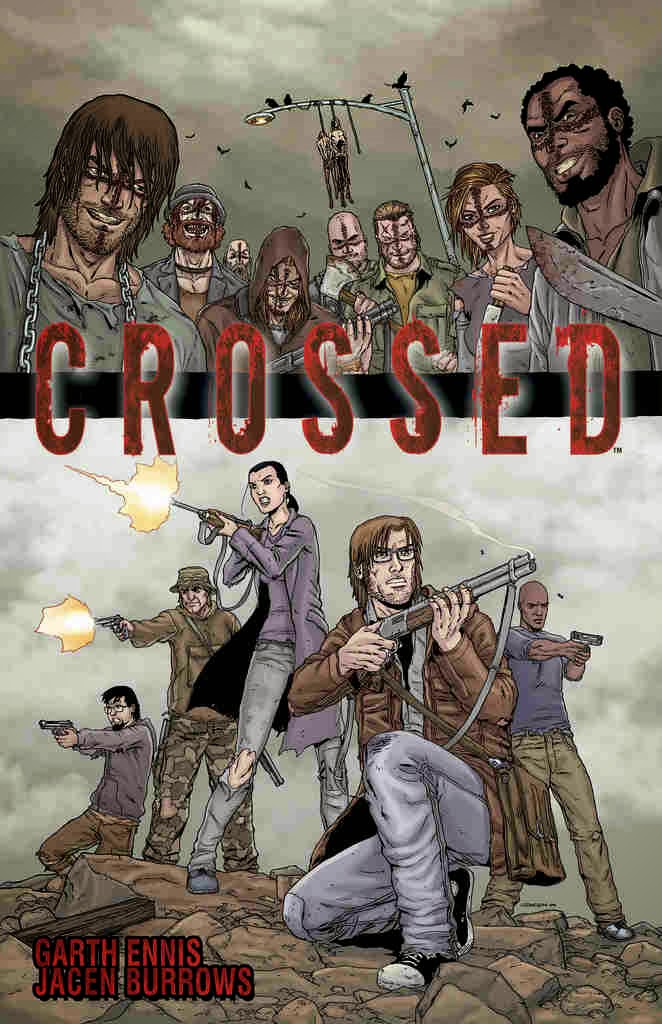
Comic Book Review | Crossed Vol. 1

Preacher was great, wasn't it?
And Preacher co-creator Garth Ennis has written some other stuff that I've enjoyed... though "enjoyed" might be a poor way to put it. Let's say "been gripped by." Or better yet, "been unable to look away from," like the scene of some horrific crime you just can't help but gawp at. I refer to his initial run on Punisher, of course, and nominally to Hitman too, which was published concurrently with Preacher, in the best years of Garth Ennis' career.

But it's been a decade since these three series ended, and most everything of Ennis' I've read in the intervening period has either soured me or simply sickened me. Here's looking at you, Chronicles of Wormwood... and War Story... oh, and The Boys. Particularly that latter; a more disgusting book than The Boys I do not know, nor would I want to. Then again I could only stand to read the first six issues. Maybe it gets better?

In any case, if there was even a miniscule part of me that still believed Garth Ennis was a halfway decent writer, then Crossed has killed it dead. Killed it dead and fucked it in the eye-socket with the severed horse's organ this first volume's antagonist - Horsecock, none other - carries around in lieu of a more socially acceptable weapon. Because Garth Ennis is at the helm. And that's what Garth Ennis does, these days.


Amongst the other highlights: the murder of a man because he's being a bit annoying; panel after panel of excruciatingly graphic depictions of randy zombies raping men, women and children alike; and most appalling of all, the calculated execution of an entire class of primary school kids, supposedly to save them from the horrors of surviving a Crossed apocalypse. I mean, fair enough: it's not pretty. But maybe it's prettier than a bullet in the brain, fired at close-range by someone who's supposed to be taking care of you.

But then, the alternative's not nearly as shocking, is it? And that's what Garth Ennis has made his name trading in: disgust and discomfort. The repugnant and the perverse. Indeed, there's really not a lot else to the first collection of Crossed. It's The Walking Dead with stumpfucking and - in stark contrast with the ensemble Robert Kirkman has gathered together with such tender loving care for his transmedia success story - a cast of characters even the most affectionate individual would have a hard time giving a crap about. I mean, Ennis clearly doesn't, and I've forgotten all their names already. Even the Wikipedia page could care less what this motley lot are called.

Meanwhile the world of Crossed is as ugly as the survivors who run willy-nilly around it, though it bears saying that it's rendered exceptionally well. Indeed, Jacen Burrows, whose pencils I've come across before - paired with the words and the worlds of far better writers than Ennis, including Alan Moore and Warren Ellis - is easily the best thing about this book. Ably supported by Juanmar, whose muted colour palette is only interrupted when blood follows, as invariably it does, Burrows' clinically clean lines leave little to the imagination, which is perfectly in step with Ennis' very direct script. You could describe them as dispassionate, perhaps, but then they'd have to be in service of scenes such as these.


To think a four time Eisner Award-winning author has fallen to this. It's enough to make one wonder whether Hitman and Punisher and Preacher were just happy accidents.

I don't doubt Crossed will have its fans, including people who sincerely believe Survival of the Dead represents the peak of George A. Romero's career of achievements, and those folks who love SAW VI above all other SAWs, say. The easily pleased, in other words, and that's putting it politely: a measure of restraint that may never again appear in the same sentence as the words Garth and Ennis.

In any event, if they want Crossed, then by the dead, they can have it. It's mean and it's nasty and it has no heart. It's cruel and unusual, and singularly spiteful to boot. Crossed is practically cancerous, so it might come as something of a surprise to you that I have every intention of reading the next volume. Maybe it's morbid curiosity, but I should say there's nothing inherently wrong with the premise behind this series in and of itself, and given Garth Ennis' absence, Family Values - written by Stray Bullets creator David Lapham - might just be alright. It certainly couldn't be any worse than this nauseating drivel.

Tuesday, 13 March 2012

Comic Book Review | PunisherMAX Vol. I: Kingpin and Vol. II: Bullseye


The Punisher is Frank Castle, a Vietnam vet who witnessed the brutal slaying of his wife and children in Central Park... collateral damage in the mob's war on law. Haunted by his horrific history, and reeling from this latest, greatest loss, Frank Castle grieved as only a born killer could: he got himself a long leather trenchcoat, a shirt with a sweet skull on, some guns, and murdered his family's murderers.

Since then, I suppose he's mostly been keeping up appearances. Killing, kidnapping, torturing and extorting his way to the top of the food chain, such as it is in the hive of scum and villainy that is New York City... as per The Punisher, at least.

Now it's not a bad origin story, that - there are certainly many, many worse ones - but it's hardly tailor-made for a medium in which codes of conduct and content have historically restricted creativity. No surprise, then, that The Punisher has been badly mishandled in the years since its inception in the 70s. 

Which isn't to say I've steered clear of it, as perhaps I should have. Oh no. In my younger years, during my first fling with comic books, I read rather a lot of The Punisher. What can I say? In those halcyon days, bargain bins everywhere overflowed with coffee-stained copies of War Journal -- perfectly price to match my dinner money, it seemed to me. And I didn't want dinner. I wanted comics! And by god, I got comics.

Obviously not the ones I should have, because I lost my a lot of my love for the medium thereafter, and perhaps that was in part because of The Punisher. Now that I've been pulled back in, it made a certain amount of sense to see whether it had changed, or simply stayed the same. And I can hardly say how glad I am to have given this character another chance.


Not coincidentally, PunisherMAX concluded just last month, after a 22-issue run -- a fact that makes my heart abstractly glad. I like to be sure the things I begin will end eventually, and in comics that's rarely the case. To know that this story has been told on its own terms from one end to the other, to great critical acclaim to boot, thus without any obvious intrusions either... I'll admit it: starting in on the first collected volume of the series, I had - of all things - hope.

Well I've no hope now, but not because PunisherMAX disappointed me in any sense. I've no hope because this is a truly hopeless story: bleak as the inner city and black as long knives at night. But for all that... brilliant. PunisherMAX is a whiplash-fast, smartly characterised comic book, finely toned and heroically honed: Jason Aaron's scripts are tight but not terse, explicit without seeming attention-seeking, and paced perfectly.

Each of PunisherMAX's four story arcs runs for five or six issues, and chronicles, in effect, an origin. In the first, collected in Kingpin, we learn of the rise and rise of the fabled boss of mob bosses. Wilson Fisk means to make the mantle his own, and as he goes from convict to henchman to criminal mastermind, he leaves a bloody trail in his whale's wake that The Punisher cannot bring himself to believe. Fisk's rapid ascension is not without its own cost, of course, and initially Aaron is as interested in this - in the tragedy of the Kingpin - as he is in his creaky old anti-hero, which gives the narrative an excellent sense of balance.


This impression persists in PunisherMAX Vol. II: Bullseye, which brings the master assassin into the fold, under the Kingpin's wing. But Bullseye, being a bit of a lunatic - and that's putting it politely - doesn't just want to kill Frank Castle: first, he has to understand him. Before putting finger to trigger, Bullseye intends to get inside his head, the better to see what makes this vigilante tick. Meantime, The Punisher has a whole lot of catching up to do. His skepticism about the existence of a kingpin of crime has meant he's late late late to a very important date, and now that there's no doubting it, it's practically impossible to get near Fisk.

Among the most admirable aspects of this eminently accessible series is its structure. Kingpin is a tale unto itself - as is Bullseye - but one lays the foundations for the other, and the other builds atop the last chapter's narrative in readiness for the next. The only sensible place to jump on board is with the first  collected volume, but from there on out PunisherMAX doesn't stop, and to my point: you won't want it to.

All these letters later, it occurs to me that I haven't even mentioned the art of PunisherMAX. That's my bad entirely, because it's anything but. Assisting Jason Aaron through these two trades - and indeed the two concluding volumes to come - is Garth Ennis co-conspirator Steve Dillon, whose clear and present pencils took me back to the good old days. Of Preacher, I mean. More meaningfully, Dillon has a preexisting history with The Punisher, and it's evidenced in every panel he and the other iconic characters that figure into this series appear in. Dillon's layouts are plain yet perfectly poised, whilst his Frank Castle is grizzled and relentlessly grim. Exactly what you'd want, in short.

The shocking conclusion of Bullseye falls exactly halfway through the whole run of Jason Aaron's PunisherMAX, and much as I can get behind a good ending at the right time rather than a sudden conclusion well after the fact, at the moment I don't want this series to be over ever. But there's no going back now, and that's probably for the best, because without the worry that this series will have to sustain itself indefinitely, the creators can truly let loose. Thus, the first half of PunisherMAX is incredible - powerful, exhilarating and ambitious from the offing - and I can't imagine it going out with anything less than an almighty bang.

Wednesday, 22 February 2012

Comic Book Review | Northlanders Vol. 2: The Cross + The Hammer


Late last year I reviewed the first volume of Northlanders, Brian Wood's Viking comic book. You can read all about it here.

In short, I found Sven the Returned to be brash, ugly and unduly brutal, but at the same time, kinda compelling. Deadwood with Norsemen instead of outlaws, and axes over six-shooters... though that's giving it more credit than I expect it deserves. In his first unnecessarily protracted arc, about a lone wolf's war on the evil uncle who'd hijacked his inheritance, Wood attempted nothing so ambitious as David Milch did. 

On the surface, Northlanders is all change as of The Cross + The Hammer, which is to say the second trade paperback collection of the series: there's a new artist - great at landscapes but lacking, I'm afraid, in the action department - a whole new story and a new central character. All appear to be huge upheavals, but however ostensibly different The Cross + The Hammer seems from Sven The Returned, I found the two books to be of a very similar spirit.


In Clontarf, in Viking-occupied Ireland, a spate of vicious killings has finally attracted the attention of the country's impromptu monarch. Someone - some gang of organised Irish rebels, by all appearances - is murdering the king's men, and only the king's men. Needless to say, this does not please the king, but he has kingly business to attend to - a war, amongst other things - so in his stead he sends Ragnar, a specialist hunter and killer of men, to put a stop to this insidious tyranny.

Curious and curiouser: when Ragnar arrives in Clontarf, in the first of the six single issues The Cross + The Hammer collects, he finds evidence that suggests they need trap only one man. But what kind of man must their mark be, to have slayed so many, and lived to keep killing?

Well he is a father, first and foremost: Magnus Rodain's life's work, as he sees it, has been about making Ireland a safer place for his little girl, Brigid, who travels with him, and indeed supports his every decision. This - Brigid's unquestioning willingness to hop along happily to the tune her father hums, despite all the awful things Magnus does supposedly in service of her future - this was the first of a few niggling issues I had with The Cross + The Hammer, and not the last.


In fact the last, if not the least or the most egregious, was the way Wood addresses the very problem I've just named and shamed. It beggars belief that Brigid comes to her father's aid after he's butchered an entirely innocent family because he was in a bad mood, certainly, but compared to the Shyamalanish reveal in the penultimate part, it makes perfect sense.

Between the first problem and that last, those reservations I have about The Cross + The Hammer will be familiar to anyone who read my early review of Sven the Returned. Most notably, there's an awful lot of wasted space on the page - in every issue an overabundance of wide or tall panels, and far too many splashes and spreads - such that reading this series on a monthly basis must have been particularly trying. With an entire arc gathered together like this the experience is markedly more tolerable, but you'll still make short work of it. There's perhaps than an hour's worth of reading in The Cross + The Hammer, give or take, so buy in with that in mind, if you're inclined to buy in at all.

And you know, I still think you should. Assuredly Northlanders would be a better book if it were a little less barren, especially if it stopped trying so damned hard to be provocative and "adult" - seriously - but it's a pretty decent one even given its predilections towards the empty and the explicit. Spare, in its way. And absolutely harrowing. With the aforementioned caveats, then, I'd certainly recommend The Cross + The Hammer, as I did Sven the Returned before it.

Friday, 20 January 2012

Comic Book Review | Stephen King's N.


Even before it was published in its original nested text format, Marvel had bought the rights to adapt Stephen King's 'N.' and put the project to a dream-team of comic book and television talent, including Marc Guggenheim - co-creator of the sadly short-lived series Eli Stone - on script duties, with art by the notorious Brian Michael Bendis collaborator Alex Maleev, whose greatest claim to fame has to be his long run on Daredevil.

What resulted - a half-hour motion comic released in 25 miniscule installments to mobile phone owners and certain internet users - was one of the very first instances of a format that's come to some prominence in the years since. I do not say regrettably; I've never been able to see the appeal myself - to me, the motion comic feels like a halfway house between one medium and another, consistently cheap if only intermittently cheerful - but this form of faux-animation has its fans, and that's fine.

In any case, I lost interest in the webisodes quickly. Not because they weren't winningly written, or brilliantly illustrated - to the best of my recollection they were indeed all that - but because I have a moth's memory, and these things were so brief and broken-up I kept forgetting what in God's name was going on. I never revisited the aforementioned motion comic thereafter, but I did see this deliciously twisted tale through eventually -- by way of the originating short story, which was one of the highlights of Stephen King's terrific 2008 collection Just After Sunset.


Whether rendered in words or pictures, or some eldrich accumulation of the pair, 'N.' concerns a journalist, Charlie, who hears from a long-lost friend about the strange suicide of her husband, the psychoanalyst John Bonsaint. Bonsaint, we soon learn, was driven to despair and inevitably death in the selfsame way as his last patient: a man with debilitating OCD, known only as N. as per the doctor's notes. For his part, N. had become obsessed with a circle of standing stones in Ackerman's Field, in rural Motton, Maine, which he was convinced acted as a doorway to another world, from where something wicked - namely the helmet-headed Lovecraftian creature Cthun - will this way come.

Unless someone takes it upon themselves to stop it, that is.

N. does, and dies, and I need not add that his terrible obsession does not end with him. Far from it. Like a virus, it spreads to Bonsaint. Then the doctor's wife catches the bug from her husband, and she, in turn, passes it on to a reporter who becomes fixated on investigating these curious claims. That'd be Charlie, in whose company 'N.' both begins and ends.

Several years later, however, I'd forgotten almost all of the story beats above - a blessing and a curse if ever there was one - so when I heard Marvel had pulled the team behind the webisodes together again, to adapt their own adaptation into a proper comic book, at long last, well... I got my wallet out.


Now I've made some terrible decisions in my time. Once, I voted for Tony Blair, and on another occasion, I bet against Apple, because I couldn't begin to imagine a world without the Walkman. More fool me.

On the other hand, buying into N. again may be one of the best decisions I've made in recent memory, because readers... it's incredible. Without a doubt, Stephen King's N. is the most discomfiting graphic narrative I've encountered since coming back to comic books; it's a real creepshow, chilling and sinister in equal measure.

In the first, that's thanks to Marc Guggenheim: a very fine writer indeed. There's little room in this story for the light touch he's become known for - Stephen King's N. is not sweet but sour - yet herein Guggenheim demonstrates himself equally adept at the darker half of the author's art. Admittedly, some of his script is lifted verbatim from King's short story, but the larger part of it is original, and I would go so far as to say the changes Guggenheim makes add far more to the narrative than they subtract. The pacing is certainly better; the plot, so literal before, comes across more naturally; and the characters - more than names on pages in the originating fiction, but not much more - seem alive at long last.


Nested texts often come across as exercises in look-at-me literary trickery - more about the performance than the performed - and though 'N.' in its first form is an excellent example of said mode of storytelling, I think the beats of its harrowing narrative are rather better served herein than anywhere else. By expanding on the strictly epistolary short with naturalistic flashbacks and a focus on showing instead of telling, Guggenheim fleshes out the bare bones of the original story more to my satisfaction than Stephen King could.

Meanwhile, Alex Maleev. I've never been the biggest fan of his sketchy pencils, but they serve the story so incredibly well in Stephen King's N. that it'd be mean-spirited of me to do anything less than champion Maleev's contribution to this collection's manifest success. Specifically I should applaud his impeccable sense of composition, and his striking use of colour, as illustrated in the images above: of rich reds and warm oranges receding before a palette of clinical blues and greens and greys. It's exemplary stuff.

Though the narrative of 'N.' has gone from nested text to motion comic to graphic novel, Stephen King's N. as adapted by Marc Guggenheim and Alex Maleev is not some admission of defeat. Rather, it is a pitch perfect sequential rendering of a story which remains every bit as thrilling, gripping and magnificently sinister as it was four years ago. In short, I'd still recommend the original short... but I'd recommend this comic book more.

Sunday, 1 January 2012

The Scotsman Abroad | Holmes for the Holidays

As much to my surprise as anyone else's, I enjoyed the new Sherlock Holmes novel by Alex Rider writer Anthony Horowitz... well, immensely. You can read my review of The House of Silk in full here, but suffice it to say Horowitz's novel so endeared the great detective to me that I immediately laid waste to my little library, the better to see what other contemporary pastiches I could read to tide me over till the imminent second season of the exemplary BBC series.

Fast-forward to the present - though 2012 still sounds like the far-flung future to me - and I may have read more Sherlock Holmes stories in the last month than ever before -- not just to satisfy my own appetites, either, because a while ago I heard how the overlords in charge of Tor.com were intending to keep the site ticking on over through Christmas and New Year.


The result - Holmes for the Holidays - has been running since a bit before the big day, and it's been brilliant. Lots of fun, and indubitably interesting. If you aren't following along already, I'd wholeheartedly recommend you pop on over to the index and catch up if you can.

For my part, I contributed two short articles, both of which have now had their official unveiling. In the first, I looked at an old one-shot Caliber Comics put out in the mid-90s: namely The Sussex Vampire, a short graphic adaptation of the original Conan Doyle story masterminded by none other than Warren effing Ellis.

'The Sussex Vampire' is an excellent adaptation of a sterling Sherlock Holmes story, fittingly illustrated and ably scripted by an author since risen to renown, whose early work – up to and including this superb single issue – deserves a great deal more attention than it gets. Warren Ellis and Craig Gilmour make for fine co-conspirators, and while 'The Sussex Vampire' isn’t as easy to find these days as it was for me, way back when – at least, not by legal means – if you can: do.


And I couldn't very well let a celebration of all things Sherlock Holmes pass by without a tip of the trilby - ahem - to Neil Gaiman, whose stunning 'A Study In Emerald' entangled the mythos of everyone's favourite consulting detective together with that - of all things - of H. P. Lovecraft.


Then, in the process of researching 'A Study In Emerald,' I realised Gaiman had recently written a second Sherlock Holmes story, so I got myself a copy of the new anthology out of Titan Books - that is to say A Study in Sherlock - and endeavoured to write about these two weird tales together.

'The Case of Death and Honey' occurs in the mysterious twilight years of the great detective's career, but is also alludes to what might have happened to our man after his retirement. Given that 'A Study In Emerald' so evoked 'A Study in Scarlet' - which is to say the very first Sherlock Holmes story - this, I think, is particularly fitting. A sort of closing of the circle; though it isn't giving the game away to stress, a second time, that appearances can be... deceiving.


Never mind the various other stories it contains, A Study in Sherlock is worth the price of admission for 'The Case of Death and Honey' alone. It's the sort of short story that reminds you what short stories are for. 

Anyway, I will of course be glued to the telly tonight, when the first feature-length episode of the second season of the BBC's Sherlock series premieres. If there's a better way to ring in 2012, no-one's mentioned it to me!

I'm almost afraid to ask, but you guys are as psyched as I am, right?

As to A Game of Shadows, in case you were wondering: no, I haven't seen it yet... but I am hoping to make it to the movies in the imminent. For this, do you think? Or should I wait to rent it on Blu-ray, and see something better?

Tuesday, 20 December 2011

Comic Book Review | Shenzhen and Pyongyang by Guy Delisle


This will be old news to many of you, I expect, but in my other life, I'm a teacher.

Actually, no. That's not exactly true... and thank the lord for that! Strictly speaking I'm an English tutor - I chair courses on reading and writing at a private education centre here in central Scotland - and one of the things I'm often heard to say to the high-school students in my care is that there are stories everywhere. Wherever you look, and you needn't look far, or wide, there are narratives unfolding, complete with characters, conflicts, climaxes -- really the whole kit and caboodle.

They might not be good stories by any meaningful measure, but they are true stories, and often, I find, that's enough. If in a piece of writing one of my students can capture some fleeting fragmentary truth - some glimmer of insight into how we work, or the way the world works around us - then never mind all the elementary spelling mistakes and so on and so forth; no amount of misplaced punctuation marks can take away from an honest, relatable portrayal of some feeling, or facet of our lives.

Now whether I have my teaching hat on or not, that's a sentiment I stand by whole-heartedly, so it's an odd thing - but no less a true thing - that I don't, in my spare time, consume a great deal of non-fiction. Not in any form that I can think of: not in film, not in literature, and - excepting Persepolis - certainly not in comic books. At least, not till now.


I picked up Pyongyang: A Journey in North Korea almost on a whim while out looking for a couple of last-minute Christmas gifts. I read the first few pages right there in the store, and immediately found myself hungry - like one of those hippos - for more. Home again, home again, jiggety jig, I polished off Pyongyang and its successor, Shenzhen: A Travelogue from China, in a wonderful, whimsical week of evenings. I'd urge anyone with an interest in comics books, or culture, to do likewise.

Guy Delisle is - or was, when he put together these "graphic memoirs" (as the blurb would have it) - a jobbing French-Candian animator. His trips to Pyongyang and then Shenzhen were for business rather than pleasure, to oversee the work of various outsourcing studios, and it's just as well, because as he illustrates, there's precious little pleasure to be taken from either of these depressing places.

Saying that, there's not a dull moment in these travelogues, and that's no mean feat, because at around 150 pages each, they're certainly not short, and Delisle spends almost his entire time abroad in complete and utter isolation. He can't speak the required languages, he's restricted to certain areas, and he's made to stay in the most appalling, anonymous hotels. Weeks go by without him talking to anyone at all, or doing anything particularly interesting, so he has to amuse himself somehow -- and us.

To that end, Delisle doesn't spend too long documenting any one thing. Both Pyongyang and Shenzhen are broken up into easily-digestible episodes, about the length of a single issue each, and though he spends the vast majority of them pontificating about what it is to exist in these cities, under their respective regimes, whether as a citizen or a visitor - riffing on this thing he heard or that incident he saw - there are also several sequences wherein he talks about his job, offering insight into and anecdotal evidence of the increasingly bleak business of animation.


These recollections are perfectly fascinating in their own right, but they also work to punctuate the more troubling aspects of life in China and the so-called axis of evil, and there are, shall we say, some very troubling aspects. In any event, Delisle has a real knack for teasing out stories wherever he goes.

Admittedly I've never read anything remotely resembling either Pyongyang: A Journey in North Korea or Shenzhen: A Travelogue from China, but I adored both of these books. Guy Delisle is a disarmingly frank author, and an astute cartoonist, too; these graphic novels are replete with such wit and insight, such good humour and clear-eyed observational engagement - even from afar - that I can't recommend them highly enough, whether to fans of the comic form or simply people with a passing interest in what life is (or was) like in these little-seen cities, particularly in light of the recent reports of Kim Jong-Il's death.

I've holidayed in some strange and dangerous places in my time, and though I know better than to ever say never, realistically I'm not likely to spend several months in China or North Korea myself. Guy Delisle's marvelous, Hergé-esque graphic memoirs are thus as close as I expect to get, and that's quite close enough, thank you very much.

Now, to lay hands on a copy of The Burma Chronicles as soon as humanly possible...

Thursday, 15 December 2011

Comic Book Review | Planet of the Apes Vol. 1: The Long War


When he's not writing tragicomic novels about the second coming of an undead messiah, or having his short story collection Unpossible described as one the year's best books, Daryl Gregory writes comic books. Damn fine comic books.

Among them, this one: the Planet of the Apes ongoing series from BOOM! Studies, which launched a little in advance of the latest film in the franchise, starring go-to dude in a suit Andy Serkis.

To be perfectly frank, I could give a monkey's uncle about the Planet of the Apes. I've seen a few of the original films, and both of the attempts in the last decade to reboot the feature series, but none of the above - excepting Andy Serkis' bravura performance as Caesar in this year's Rise of the Planet of the Apes - have managed to make me care about the mythos, such as they are. My interest in this future world, where apes either have or will one day overthrow humanity, is nominal at best.

Enter Daryl Gregory. The man's such a talent, and so unspeakably overlooked, that I've resolved to read whatever he writes from here on out, or until such a time as he releases something rubbish. On the basis of Planet of the Apes Vol. 1: The Long War, I don't see that happening anytime soon. Because where so many creators have tried and failed to convince me of the value of this to-my-mind one-note franchise, Daryl Gregory has gone and done it, be damned my disinclination.


The Long War collects the first four issues of the ongoing: a complete single story set, or so I gather, ten years after Battle for the Planet of the Apes, but before the events of the first film, which I see now was based on a book. I didn't realise! In any case, Gregory introduces us to a society somewhere between two more familiar extremes, of man versus animal in the last days or man, finally, as animal. In The Long War, the lunatics are already running the asylum, yet humans still have a place - albeit a small one - in Skintown, which is essentially a ghetto in the great ape city-state of Mak.

But when a masked assassin kills Lawgiver, one of the few remaining supporters of our lately endangered species, man and monkey stand poised on the brink of a conflict that could take away even that last refuge. Some people, like Sully - a pregnant women who the people of Skintown look to for leadership - think that everything that can be done to avoid a war and so safeguard the remains of our race should be done.

Others want the exact opposite: namely an end to the apes, or else an end to all the indignities of life not on top of the food chain, via certain death. Among this latter camp, the most vigilant are those who attend ceremonies at the Church of the Bomb - from the movies, remember? - where the investigation which Sully leads into Lawgiver's guerrilla killer begins.


The Long War is a short trade by all but the most generous of measures, yet it contains such a wealth of wonderful world-building and narrative know-how that you'd be forgiven for thinking it twice the length it stands at, which is to say a scant 112 pages. Gregory pulls no punches, either; the mysterious monkey-murderer is unmasked in the approach to the last act, and the plot moves on substantially thereafter. Dense, descriptive language gives the text a real sense of momentum, and a clarity that is altogether too rare in comics. Last but not least, a second (somewhat shocking) death quite suffices to get one's blood pumping for volume two, due from BOOM! Studios in May of 2012.

And there's can be no understating the part artist Carlos Magno plays in the success of this this initial collection. His pencils are perhaps a touch too grainy for my tastes, all fine lines and minute detail, leaving little for the imagination to play with, but they set the scene sumptuously - building the world as much as any amount of words would work to - and many of Magno's spreads are quite simply magnificent.

Somewhat to my surprise, then, The Long War gets this latest take on the Planet of the Apes off to an excellent start. For the first time in my life, thanks in equal part to Daryl Gregory and former Transformers artist Carlos Magno, I can't wait to see what's next from this franchise.

That is to say, this comic book franchise. The movies... meh.